A 34-vehicle landscaping fleet in Georgia spent $47,000 on ABS-related repairs in 2024. Sixty percent of that cost came from emergency replacements after roadside failures. The maintenance director later discovered that every failed unit had produced detectable ABS pump failure symptoms at least four weeks before the breakdown. The problem was not a lack of warning signs. It was a lack of a decision framework that turned symptoms into action.
This guide is written for fleet maintenance managers, procurement engineers, and repair-shop owners who already know what an ABS pump does and need to know what to do when symptoms appear. You will learn how to read ABS pump failure symptoms as maintenance-scheduling signals, how to match each symptom pattern to a repair-or-replace decision, how to estimate the true cost of delaying action, and how to source the right replacement unit the first time. The result is fewer emergency orders, less downtime, and lower total cost of ownership for ABS hydraulic control units.
If you need the technical testing procedure behind these decisions, our ABS pump replacement cost and procedure guide covers removal, installation, and calibration.
Why ABS Pump Failure Symptoms Are a Maintenance Planning Tool

The Hidden Cost of Reactive ABS Repairs
Most maintenance departments treat ABS pump failure symptoms as a safety issue first and a cost issue second. That is correct, but incomplete. Every day a vehicle operates with a degrading ABS hydraulic unit, three cost categories grow:
- Direct repair cost: Emergency parts and expedited shipping add 20 to 40 percent to the baseline price of an HCU.
- Downtime cost: A delivery truck sidelined for an unscheduled repair loses revenue and may breach service-level agreements.
- Liability cost: Commercial operators with documented, unaddressed ABS pump failure symptoms face higher exposure if an incident occurs.
A structured symptom response turns these reactive costs into planned maintenance spend.
How Symptom Timing Affects Parts Sourcing
The same ABS pump failure symptom can trigger different procurement actions depending on when it is detected. An intermittent ABS light in Week 1 allows time to compare remanufactured, OEM, and aftermarket suppliers. A continuously illuminated light in Week 8 may force same-day purchase from the nearest vendor. A locked wheel in Week 12 removes choice entirely. Symptom recognition is therefore the first step in strategic sourcing.
For detailed information, see our guide on ABS pump running continuously after key-off.
The Symptom-to-Decision Matrix
Use the table below to translate ABS pump failure symptoms into maintenance and procurement decisions. The matrix separates symptoms by what they imply for vehicle safety, repair urgency, and parts strategy.
| Symptom | Safety Implication | Repair Window | Sourcing Action |
|---|---|---|---|
| Intermittent ABS light, no pedal change | Low | 7-14 days | Request quotes from 2-3 HCU suppliers; order if symptom recurs |
| Persistent ABS light with stored DTC | Moderate | 3-5 days | Confirm DTC, source replacement module or HCU |
| Loss of pedal pulsation during hard braking | High | 1-2 days | Source complete HCU; inspect brake fluid condition |
| Wheel lock-up during emergency braking | Critical | Same day | Park vehicle; emergency source HCU or arrange reman exchange |
| Continuous pump motor after key-off | High | Same day | Source pump motor relay or HCU; verify electrical system |
| Hard or spongy pedal after ABS event | High | 1-2 days | Source HCU with valve block; flush brake system |
| Grinding or whining noise from HCU | Moderate | 3-5 days | Source HCU; inspect for contamination |
| ABS, ESC, and traction control lights together | High | 1-2 days | Source shared HCU; avoid separate module orders |
This matrix is the operational core of the guide. Each row connects a symptom pattern to a procurement decision, which is what maintenance managers actually need once the technician has confirmed the fault. For more information, please read our article on commercial truck ABS pump failure symptoms.
Reading Early ABS Pump Failure Symptoms as Procurement Signals
Intermittent ABS Light: The Planning Window
An intermittent ABS warning light is the earliest actionable ABS pump failure symptom. It often indicates connector corrosion, relay resistance drift, or a solenoid coil beginning to fail. For procurement, this symptom is valuable because it creates a 1- to 2-week window to evaluate suppliers without pressure.
Action items at this stage:
- Pull and document all current, pending, and historical DTCs.
- Inspect the HCU connector for corrosion or moisture intrusion.
- Request cross-reference data from suppliers to confirm compatibility with the vehicle’s ABS module software version.
- Compare warranty terms: remanufactured HCUs typically carry 1-year to 3-year warranties, while some aftermarket options offer lifetime limited coverage.
To learn more information, please read our article on “How to Tell If ABS Pump or Wheel Speed Sensor Is Bad“.
Slightly Elevated Pump Current Draw: The Predictive Signal
Pump motor current draw during the key-on self-test is one of the most predictive ABS pump failure symptoms, even when no warning light is present. A current reading 10 to 20 percent above specification indicates increased mechanical resistance, usually from worn brushes or bearing contamination. A reading 30 percent or more above specification indicates imminent failure.
Fleet maintenance managers should add current-draw measurement to scheduled brake inspections. The tool cost is low: a clamp meter with ABS capability costs less than one emergency HCU replacement. The return comes from avoiding roadside failures and expedited shipping.
Extended Self-Test Noise: The Overlooked Indicator
A healthy ABS pump self-test lasts 2 to 3 seconds. A self-test that extends beyond 5 seconds, or a faint hum that continues for 30 to 90 seconds after key-off, signals relay sticking or pressure sensor drift. These ABS pump failure symptoms are easy to miss because they do not affect normal braking. They are also among the most reliable predictors of pump motor burnout within the next 500 miles. For ABS pump abnormal noise issues, please read our article on ABS pump noise symptoms.
For the operational decision, our guide to whether you can drive with a bad ABS pump separates safety-critical faults from schedule-it repairs.
Matching Symptoms to the Right Replacement Part
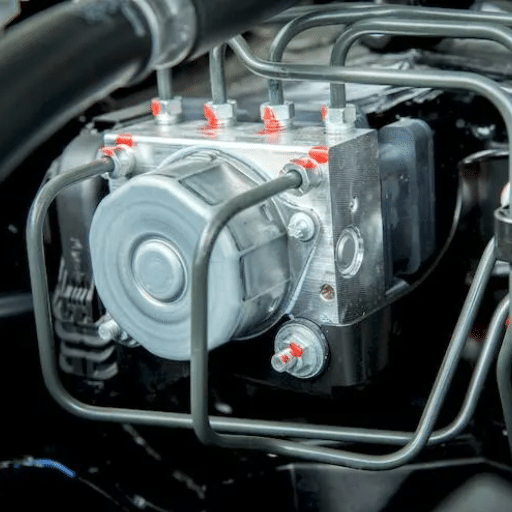
When to Replace the Pump Motor Only
Pump motor-only replacement is rare but cost-effective when the symptom set is narrow:
- The motor runs continuously or makes grinding noise.
- Solenoid valves respond normally to bidirectional commands.
- DTCs are limited to C0265 or C0267.
- The valve block has no leakage or contamination history.
In most modern HCUs, the pump motor is not separately serviceable from the manufacturer. However, some remanufacturers offer pump motor rebuild services for common commercial-vehicle units. Procurement should verify that the rebuild includes brush replacement, bearing inspection, and post-assembly flow testing.
When to Replace the Complete HCU
Replace the complete hydraulic control unit when ABS pump failure symptoms involve the valve block or multiple subsystems:
- Pedal hardness or sponginess indicates stuck or leaking solenoid valves.
- Loss of stability control and traction control indicates shared hydraulic failure.
- Contaminated brake fluid has damaged internal valves.
- DTCs span C0265 through C0279, suggesting multiple circuit faults.
Sourcing a complete HCU rather than individual components reduces comeback risk. A valve block with one failing solenoid often has others near end of life.
When the ABS Module Is the Real Fault
ABS control module failure symptoms overlap with pump-level symptoms because the module commands the pump. Module faults typically produce U-series communication codes, such as U0121, and symptoms that appear and disappear without the gradual mechanical progression of pump wear. If the scan tool loses communication with the ABS module or the fault pattern is purely electrical, source a replacement or remanufactured module before ordering an HCU.
When a Wheel Speed Sensor Is the Real Fault
A failed wheel speed sensor turns on the ABS light but does not produce pump noise, pedal feel changes, or continuous pump operation. DTCs will point to a specific wheel circuit, such as C0035, C0040, or C0044. The correct procurement action is a sensor and connector repair, not an HCU. Misdiagnosing a sensor fault as an HCU fault is one of the most common and expensive errors in ABS maintenance. If you have a problem with this, please read our article on wheel lock-up during braking.
For a detailed procedure, see our guide on brake pedal hard after ABS failure.
Building a Fleet Inspection Protocol Around ABS Pump Failure Symptoms
Inspection Frequency by Vehicle Risk Class
Not every vehicle needs the same inspection intensity. Use risk class to set inspection frequency:
| Vehicle Class | Examples | ABS Inspection Frequency |
|---|---|---|
| High-mileage urban | Delivery vans, shuttles | Every scheduled brake service or 10,000 miles |
| Heavy commercial | Class 6-8 trucks, buses | Every 30 days or pre-trip as required |
| Light-duty fleet | Service trucks, pool vehicles | Every 15,000 miles or semi-annually |
| Severe-duty | Snow removal, refuse | Every 5,000 miles or monthly |
The Five-Minute Pre-Trip ABS Check
Drivers and technicians can complete a basic ABS pump failure symptoms check in under five minutes:
- Key on, engine off. Confirm the ABS light illuminates during bulb check and then extinguishes.
- Listen for the pump self-test. It should last 2 to 3 seconds and stop cleanly.
- With the engine running, press the brake pedal firmly. It should feel consistent, not sinking or unusually hard.
- If equipped, confirm the traction control and stability control lights extinguish after startup.
- Document any warning light that remains on, any abnormal pump noise, or any pedal feel change.
Shop Testing During Scheduled Maintenance
During scheduled service, technicians should go deeper:
- Read ABS DTCs and record freeze-frame data.
- Command pump motor activation and measure current draw.
- Command each solenoid and listen for response.
- Inspect brake fluid color and moisture content.
- Check HCU connector and harness for corrosion or chafing.
Results should be logged in the maintenance management system with date, mileage, and readings. Trending data is more valuable than single-point data for predicting failure.
If you need a technical explanation, please read our article on ABS pump failure DTC codes.
Economic Model: Repair, Remanufacture, or Replace?

Cost Components of Each Option
When ABS pump failure symptoms confirm a fault, maintenance managers face three options:
| Option | Typical Cost Range | Advantages | Disadvantages |
|---|---|---|---|
| Repair existing unit | $200−$600 | Lowest parts cost, keeps original unit | Limited to relay or harness faults; no warranty on internal components |
| Remanufactured HCU | $400−$1,200 | Cost-effective, tested, often warrantied | Lead time varies; core return required |
| New OEM HCU | $800−$2,500 | Longest service life, full warranty | Highest upfront cost; availability can be limited for older vehicles |
The right choice depends on vehicle age, planned retention period, and fleet operating conditions. A vehicle scheduled for replacement within 12 months may justify a remanufactured unit. A vehicle retained for five or more years may justify a new OEM unit.
Calculating the True Cost of Delay
Delaying action on ABS pump failure symptoms rarely saves money. Use this framework to estimate the cost of waiting:
- Planned repair: Parts + labor at shop rate during scheduled downtime.
- Reactive repair: Parts + expedited shipping + overtime labor + towing + lost revenue.
- Incident cost: Deductible, downtime, potential regulatory citation, and liability exposure.
For a Class 6 delivery truck, the difference between planned and reactive repair often exceeds $2,000 per event. For a fleet with 50 vehicles, preventing just three emergency failures per year can fund a predictive current-draw monitoring program.
Supplier Evaluation Criteria for Replacement HCUs
Specification Verification
Not every HCU advertised as compatible is functionally identical. Before purchasing, confirm:
- Part number and software calibration match the vehicle build.
- Solenoid coil resistance specifications match the electrical system, especially for 24-volt commercial vehicles.
- The unit includes the correct mounting bracket and fluid line fittings.
- Post-assembly testing includes pressure cycling and leak verification.
Warranty and Core Return Terms
Compare warranty terms carefully. A longer warranty is not always better if it excludes labor or requires shipping the failed unit at the buyer’s expense. Key questions to ask suppliers:
- Does the warranty cover parts and labor, or parts only?
- Is the warranty prorated or full replacement?
- What is the core return window and freight policy?
- Are there exclusions for contaminated brake fluid or accident damage?
Supplier Technical Support
A supplier that provides wiring diagrams, DTC interpretation support, and calibration guidance reduces diagnostic time and comeback risk. For fleets managing multiple vehicle platforms, technical support is often more valuable than a small price difference.
For a deeper look, see our article on ABS pump failure symptoms by vehicle make.
Regulatory and Liability Considerations for Commercial Fleets

FMCSA and DOT Requirements
For commercial vehicles operating under FMCSA jurisdiction, an illuminated ABS warning light is a maintenance defect. Operating a Class 6-8 vehicle with documented ABS pump failure symptoms beyond a reasonable repair window can result in roadside inspection violations and out-of-service orders. Maintenance records should show the date the symptom was reported, the diagnostic result, and the repair completion date.
Liability Exposure
If an accident occurs and maintenance records show that ABS pump failure symptoms were reported but not repaired, the fleet’s liability exposure increases. Plaintiff attorneys and insurance investigators commonly review maintenance logs. A clear protocol that moves symptoms from detection to repair within defined timeframes is a defensible practice.
Frequently Asked Questions
What are the first ABS pump failure symptoms maintenance managers should track?
The first symptoms are usually an intermittent ABS warning light, history DTCs in the C0276-C0279 range, pump current draw 5 to 10 percent above specification, and a pump self-test that lasts longer than 5 seconds. These early signs create a 1- to 2-week procurement window.
How do ABS pump failure symptoms affect replacement part choice?
Symptoms limited to pump motor noise or continuous operation may allow pump motor repair or relay replacement. Symptoms involving pedal feel changes, multiple DTCs, or loss of stability control usually require a complete HCU. Communication-related symptoms may indicate a module replacement instead.
What is the most cost-effective way to monitor ABS pump health?
Adding pump motor current-draw measurement to scheduled brake service is the most cost-effective predictive practice. The tool investment is low, and the data often identifies degrading pumps weeks before warning lights appear.
How long can a vehicle stay in service after ABS pump failure symptoms appear?
It depends on severity. Intermittent lights with no pedal change may allow 7 to 14 days of monitored operation. Wheel lock-up, continuous pump operation, or total loss of ABS function require immediate removal from service. Commercial vehicles should follow FMCSA repair timelines.
What causes the most expensive misdiagnosis of ABS pump failure symptoms?
Replacing the HCU when a wheel speed sensor or connector is at fault is the most common expensive misdiagnosis. Wheel speed sensor faults produce wheel-specific DTCs without pump noise or pedal feel changes. Always verify DTCs before sourcing an HCU.
Should fleets use remanufactured or new OEM HCUs?
Remanufactured HCUs are cost-effective for vehicles near the end of retention or lower-duty cycles. New OEM units are preferred for vehicles kept long-term or operated in severe conditions. The decision should include warranty terms, supplier support, and core return logistics.
Can brake fluid contamination cause ABS pump failure symptoms?
Yes. Moisture or contamination in brake fluid accelerates valve seat erosion and pump bearing wear. Contaminated fluid can cause erratic ABS behavior that mimics pump failure. Always test fluid condition when diagnosing ABS pump failure symptoms.
What documentation should fleets keep for ABS-related repairs?
Keep the symptom report, DTC readings, current-draw measurements, repair order, parts source, warranty terms, and completion date. Complete records support warranty claims and provide liability defense if an incident occurs.
Conclusion
ABS pump failure symptoms are not only safety warnings. They are procurement and maintenance planning signals. The maintenance managers who act on early symptoms gain control over parts sourcing, labor scheduling, and vehicle uptime. Those who wait for total failure lose that control and pay a premium for emergency repairs.
The decision framework in this guide connects each symptom pattern to a specific action: when to monitor, when to source, when to repair, and when to remove a vehicle from service. It also shows how to select the right replacement part, evaluate suppliers, and document repairs for regulatory and liability protection.
If your diagnosis confirms that the HCU or pump motor needs replacement, review our ABS pump replacement cost and procedure guide for the technical workflow. For help sourcing replacement ABS hydraulic units, remanufactured HCUs, or OEM-compatible components, contact our engineering team for a technical consultation and quotation.