In 2024, a workshop in Ohio replaced the ABS hydraulic control unit (HCU) on a BMW 3 Series after the dash lit up with ABS and DSC warnings. The owner paid for the new module, but the real fault was a corroded ground cable. A make-specific diagnostic check would have saved the part cost and the labor.
This story repeats across brands every day because generic symptom lists miss the manufacturer-specific patterns that separate a pump failure from a wiring or sensor issue. If you maintain, repair, or source ABS hydraulic components, you already know that warning lights look similar in every car. The codes, pedal behavior, and common root causes are not the same.
This guide breaks down ABS pump failure symptoms by vehicle so you can read the signs faster, avoid misdiagnosis, and choose the right replacement path. You will learn why symptoms vary across manufacturers, which diagnostic trouble codes (DTCs) appear most often on each major brand, and the first checks that prevent unnecessary parts spend. We also show when a failed ABS pump becomes a replacement decision and how to source the correct hydraulic unit.
Want the full symptom framework first? Read our complete guide to ABS pump failure symptoms before diving into make-specific patterns.
What Are ABS Pump Failure Symptoms by Vehicle Make?

ABS pump failure symptoms by vehicle make are the manufacturer-specific warning signs, diagnostic trouble codes, and pedal behaviors that point to a failed ABS hydraulic control unit or pump motor. While the ABS light is common across brands, the exact DTCs, affected model years, and root causes differ by make.
Why ABS Pump Failure Symptoms Vary by Vehicle Make
ABS System Suppliers and Generations
Every automaker sources ABS hardware from a small group of suppliers: Bosch, ATE/Continental, Advics, and Continental/MK-series families. The same physical symptom, a lit ABS light, can point to a failed pump motor on one system and a brake pressure sensor on another.
BMW and Mini often use ATE MK60 or MK61 modules where the pump-motor circuit fails internally. Volkswagen Group vehicles share the 1K0907379 module family across Golf, Jetta, Beetle, and SEAT platforms. Honda and Acura integrate ABS and VSA electronics in one module, so a fault can disable stability assist, traction control, and sometimes electric power steering messages.
Supplier architecture also determines how the module reports failure. Some systems store manufacturer-specific codes such as BMW 5DF0/5DF1. Others use standardized OBD-II chassis codes such as Ford C1095 or Toyota C1251. Knowing the supplier behind the vehicle helps you interpret the symptom correctly.
Module Coding and Integration Differences
Modern ABS modules are coded to the vehicle. A pump failure on a Mercedes W204 may also disable speed-signal output, causing the speedometer to drop. On a Ford truck, the same module fault can interrupt the speedometer feed because the ABS module supplies vehicle speed data to the cluster.
Honda modules communicate over the F-CAN bus, so a lost-communication code can cascade into instrument-cluster warnings. This integration means the symptom list must be read in context. A hard brake pedal on a Toyota Land Cruiser often means a locked ABS pump motor. A hard pedal on a GM truck may trace to an internal Electronic Brake Control Module (EBCM) relay fault.
When a Make-Specific Reference Saves Diagnostic Time
Generic guides tell you to “check the ABS light and scan for codes.” That is true but incomplete. A make-specific reference tells you which codes, which model years, and which power or ground points fail most often.
It also tells you whether the module can be repaired, whether it needs coding after replacement, and whether a remanufactured unit is a reliable option. For fleet managers and independent shops that service mixed makes, this knowledge cuts diagnostic time and reduces the risk of replacing a good pump.
Common ABS Pump Failure Symptoms Across All Makes
Before comparing brands, it helps to list the symptoms that appear on nearly every ABS hydraulic system. These are the baseline signs that point to the HCU or pump circuit, regardless of manufacturer.
- Persistent ABS warning light on the instrument cluster.
- Traction control, stability control, or brake system warning light illuminated alongside the ABS light.
- Loss of brake pedal pulsation during hard braking on slippery surfaces.
- Wheel lock-up during emergency braking because anti-lock modulation is disabled.
- Abnormal pump noise such as grinding, whining, humming, or continuous running after key-off.
- Hard or spongy brake pedal caused by a failed pump motor or stuck solenoid valve.
- Stored DTCs in the ABS module that do not clear after cycling the ignition.
- No communication with the ABS module during scan-tool diagnosis.
These symptoms are covered in depth in our ABS pump failure symptoms guide. The sections below explain how each major manufacturer tends to express them.
ABS Pump Failure Symptoms by Vehicle Make

BMW ABS Pump Failure Symptoms
The most common BMW ABS pump failure symptoms are the ABS, DSC, and brake warning lights plus the 5DF0/5DF1 codes. BMW ABS pump failures are most common on vehicles equipped with the ATE MK60, MK60E, or MK61 modules. Affected chassis include the E90/E91/E92 3 Series, E60/E61 5 Series, F10 5 Series, F30 3 Series, and several X3/X4/X5 variants.
The signature codes are 5DF0, Hydraulic Unit Pump Motor, and 5DF1, Hydraulic Unit Pump Motor Connector Faulty. These two codes often appear together. They indicate that the ABS/DSC module has detected a problem in the pump-motor circuit.
The root cause is usually worn motor brushes, an internal relay failure, or a poor ground on E90 models. Dashboard warnings include the ABS, DSC, and brake warning lights. Drivers may notice that ABS and traction control no longer intervene during hard braking. The pump may run continuously or not at all during the key-on self-test. On some cars, the module loses scan-tool communication.
A 2024 case at a German-specialist shop shows why the ground check matters. A 2008 328i set 5DF1, and the owner was quoted $1,400 for a rebuilt module. The technician cleaned the ABS ground cable at the strut tower and the code cleared. The lesson: verify pump-motor power and ground before condemning the HCU on BMW models.
Mercedes-Benz ABS Pump Failure Symptoms
Mercedes ABS pump failure symptoms on the W204 C-Class usually appear 10–15 seconds after the car starts moving. Mercedes-Benz, especially the W204 C-Class (2007–2014), is well known for ABS/ESP module faults tied to the N30/4 control unit. The symptoms often appear 10 to 15 seconds after starting to drive, usually once the vehicle reaches 15–20 km/h.
Common codes include 5001, Control unit internal fault, 5944, Internal fault in control unit N30/4, C2200, Internal anti-lock brake module fault, and C2116, ABS pump motor supply voltage. Drivers see the ABS, ESP, and traction-control warning lights, sometimes with a “See Owner’s Manual” message.
A hard brake pedal, heavy steering, and speedometer drop-out are also common. In some cases, the pump motor runs continuously after key-off, draining the battery.
The N30/4 connector on the W204 is a known corrosion point. Before replacing the module, inspect the main electrical connector at the ABS/ESP unit for poor contact or corrosion. If the connector and voltage supply are good, the HCU typically needs repair or replacement.
Ford ABS Pump Failure Symptoms
Ford ABS pump failure symptoms cover a wide model range and are often flagged by code C1095. Ford ABS pump faults are broad across model lines, from the 2000–2004 Ranger and 2002–2005 Explorer to the 2018–2020 EcoSport. The defining code is C1095, ABS Hydraulic Pump Motor Circuit Failure.
This code is often accompanied by C1096, C1097, C1098, C1100, or C111x relay circuit codes. Symptoms include a constant ABS warning light, possible traction-control light, and a pump motor that runs continuously or buzzes after the key is off. Some Ford trucks also experience speedometer dropout because the ABS module provides the vehicle-speed signal to the cluster.
Brake pedal feel may become inconsistent during hard stops, and wheels can lock on wet surfaces. First checks should include the ABS fuses, pump relay, and harness connectors. Road salt and humidity can corrode the ABS harness, especially on trucks and SUVs. If power, ground, and wiring are good, the fault is internal to the pump/module assembly and requires replacement or rebuild.
Toyota / Lexus ABS Pump Failure Symptoms
Toyota ABS pump failure symptoms most often begin with a hard brake pedal and code C1251. Toyota and Lexus use the chassis code C1251, ABS Pump Motor Failure or ABS Pump Motor Locked/Open. This fault is commonly reported on the Toyota 4Runner, Land Cruiser 100/Prado, FJ Cruiser, Prius, and Camry Hybrid, plus Lexus LX, LS, GS, and SC models.
The most noticeable symptom is a very hard or solid brake pedal with reduced power assist. The ABS, VSC, TRAC OFF, and brake-system warning lights may all illuminate. Some drivers hear a buzzing, grinding, or vibration from the ABS pump area, sometimes when opening the door or at low speed.
ABS and stability control are disabled, so wheels can lock during emergency braking. Common causes include a seized pump motor, worn carbon brushes, a faulty pump-motor relay, a blown ABS No. 1 fuse, or damaged wiring. On higher-mileage Toyota SUVs, worn motor brushes are a known repairable failure. If the brake actuator itself has failed, the typical fix is replacement or rebuild of the ABS brake actuator/pump assembly.
A 2023 repair record from an independent Toyota shop illustrates the value of checking basics first. A 2007 4Runner with C1251, a hard pedal, and a $2,800 dealer quote for a new actuator was fixed after the shop replaced worn pump-motor brushes and verified the relay. The total repair was a fraction of the replacement cost.
Honda / Acura ABS Pump Failure Symptoms
Because Honda integrates VSA into the module, Honda ABS pump failure symptoms can include communication and stability-control warnings. Honda and Acura integrate ABS and Vehicle Stability Assist (VSA) into one module. Common affected models include the Accord (2008–2017) and Civic (2012–2021). Failures are often electronic rather than purely hydraulic.
Typical warning lights include ABS, VSA, traction control, brake system, and sometimes TPMS or EPS. Drivers may also see Forward Collision Warning or Lane Departure Warning failure messages on newer models.
Common codes include 38-11, ABS solenoid valve malfunction; 53-11, Motor relay stuck on; 85-01, Problem in VSA system; 86-14, F-CAN communication fault; and U0121, Lost communication with ABS control module. Symptoms often start intermittently. The lights may come on after driving, go off after parking, or appear after the car hits a bump. Over time, the fault becomes permanent.
Board-level repair of the ABS/VSA module is often a cost-effective alternative to full replacement, provided the hydraulic block and pump motor are healthy.
Volkswagen / Audi / SEAT / Skoda ABS Pump Failure Symptoms
Volkswagen ABS pump failure symptoms on ATE MK60/MK61/MK100 modules frequently include codes 01276 and 01435. Volkswagen Group vehicles share common ABS module families, especially the ATE MK60, MK61, and MK100 units. The 1K0907379 part-number family appears on Golf Mk5/Mk6, Jetta, Beetle, EOS, Caddy, and related Audi/SEAT/Skoda platforms.
Common codes include 01276, ABS hydraulic pump (V64) signal outside specification, 01435, Brake pressure sensor 1 (G201), 01130, ABS operation implausible signal, and 16352, Control module electrical error. Dashboard warnings include the ABS, ESP, and traction-control lights.
Some MK100 systems cause brake binding because the hydraulic pressure regulator cannot release pressure correctly. A constant pump noise or no communication with the module are also common. Because the pump motor is driven directly by the ABS module, a worn motor can damage the module’s internal driver circuit. Many rebuild services therefore recommend rebuilding or replacing the hydraulic block and module together rather than only one component.
Chevrolet / GMC / GM ABS Pump Failure Symptoms
Chevy ABS pump failure symptoms on GMT-800 trucks usually include the ABS light and code C0265. GM trucks and SUVs, especially the GMT-800 platform (Silverado, Sierra, Tahoe, Suburban, Yukon, Escalade), are known for C0265, EBCM Relay Circuit Failure. The EBCM (Electronic Brake Control Module) contains the relay that powers the ABS pump motor.
That relay is not separately replaceable. Symptoms include the ABS light, traction-control light, and sometimes the brake warning light. ABS does not function during hard braking, and wheels may lock on slippery surfaces. In some cases, the brake pedal feels hard or unresponsive. The C0265 code sets because the internal relay fails to close or opens unexpectedly.
Repair starts with fuse, wiring, and ground inspection. Because the relay is internal, the usual fix is EBCM replacement or remanufacture. Module remanufacturing is popular because it often retains the original programming and costs less than a new unit.
ABS Pump Failure DTC Comparison by Vehicle Make
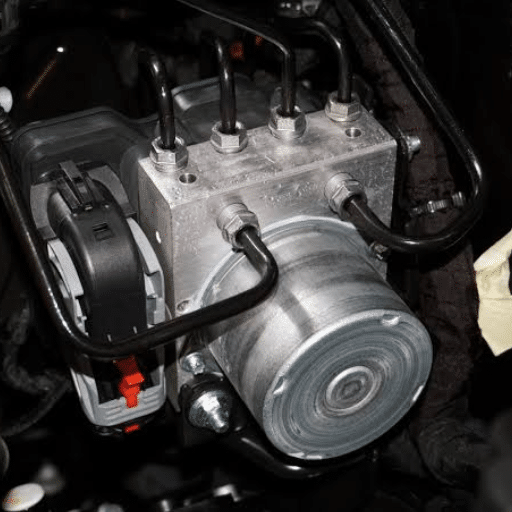
The table below summarizes the most common codes, symptom patterns, and first checks for each major make.
| Make | Common DTCs | Typical Symptom Pattern | First Checks |
|---|---|---|---|
| BMW | 5DF0, 5DF1 | ABS/DSC lights, possible no communication | Pump-motor fuse, ABS ground cable, power/ground at module |
| Mercedes-Benz | 5001, 5944, C2200, C2116 | ABS/ESP lights, hard pedal, heavy steering | N30/4 connector corrosion, battery voltage, module power |
| Ford | C1095, C1096–C1098, C111x | ABS light, speedometer dropout, pump noise | ABS fuse, pump relay, harness corrosion |
| Toyota / Lexus | C1251 | Hard pedal, VSC/TRAC lights, pump noise | ABS No. 1 fuse, wiring, pump-motor brushes |
| Honda / Acura | 38-11, 53-11, 85-01, 86-14, U0121 | ABS/VSA lights, intermittent onset, no comm | Module power/ground, F-CAN bus integrity |
| VW / Audi / SEAT / Skoda | 01276, 01435, 01130, 16352 | ABS/ESP lights, brake binding | ABS fuse, pressure sensor, pump-motor circuit |
| Chevrolet / GMC / GM | C0265, C0274 | ABS/traction lights, hard pedal, lock-up risk | EBCM power/ground, internal relay fault |
Use this table as a quick reference, but always confirm the exact code definition for the model year and engine variant you are diagnosing. If you need a technical explanation, please read our article on ABS pump failure DTC codes.
Diagnostic Steps After Noticing Make-Specific Symptoms
Step 1: Record the Exact Warning-Light Pattern
Note which lights illuminate, whether they are steady or flashing, and whether they appear at startup or after driving. Mercedes W204 faults often appear only after the car reaches low speed. Honda faults may be intermittent for weeks before becoming permanent.
Step 2: Read Chassis-Specific DTCs
A generic OBD-II reader may not communicate with the ABS module. Use a scan tool that can access the chassis/ABS controller. Write down the exact codes and any freeze-frame data.
Step 3: Verify Power, Ground, and Fuse Before Replacing the Pump
Many “ABS pump” faults are actually power-supply faults. Check the pump-motor fuse, relay, and module ground. On BMW E90 models, the ground cable at the strut tower is a known failure point. On Toyota/Lexus, the ABS No. 1 fuse and pump-motor brushes are common causes. On Ford trucks, harness corrosion is frequent.
Step 4: Compare Symptoms to the Manufacturer’s Common Failure Pattern
Match the codes and symptoms to the make-specific patterns in this guide. If the pattern fits a known pump-motor or relay failure, plan for HCU repair or replacement. If the pattern points to a sensor, harness, or ground issue, repair that first.
Step 5: Decide Between Repair, Rebuild, or Replacement
Module repair services can often fix solder joints, relay faults, or pump-motor issues while retaining original coding. Rebuilt or remanufactured units are widely available and can reduce cost. New OEM or aftermarket units are an option when the hydraulic block is damaged, or coding replacement is not practical.
For detailed testing procedures, see our guide on how to test an ABS hydraulic unit.
When Symptoms Require Replacement

Some symptoms mean the vehicle should stop operating until repairs are made. Others allow limited use while the repair is scheduled.
Stop driving immediately if the brake pedal becomes hard or unresponsive, if the wheels lock during normal braking, or if the brake warning light indicates a hydraulic fault beyond the ABS. These conditions affect base braking safety.
Schedule repair soon if only the ABS and traction-control lights are on, base braking feels normal, and no hydraulic leaks are present. The vehicle is still drivable, but emergency braking performance is reduced on wet or icy roads.
Track and re-inspect if the warning light is intermittent and no DTCs are currently stored. Log when the light appears, driving conditions, and any associated codes. Intermittent faults often worsen over time. When replacement is the right path, match the new or remanufactured unit to the vehicle by VIN or part number. Some modules require coding or initialization after installation. For cost guidance by vehicle class, see our article on ABS pump replacement cost by vehicle type. Need help selecting the correct ABS hydraulic unit? Request a technical specification sheet or contact us through the form below.
Frequently Asked Questions
What is the most common ABS pump failure code by make?
There is no single universal code. BMW commonly shows 5DF0/5DF1. Mercedes W204 models often store N30/4 internal faults such as 5001 or 5944. Ford trucks commonly set C1095. Toyota and Lexus use C1251.
Honda/Acura report 38-11, 53-11, or U0121. VW/Audi/SEAT/Skoda often show 01276 or 01435. GM trucks frequently set C0265.
Can a bad ABS pump cause brakes to lock up?
Yes. When the ABS pump or hydraulic control unit fails, the system cannot modulate brake pressure during hard stops. Wheels may lock on slippery surfaces, increasing stopping distance and reducing steering control. Base hydraulic braking usually remains, but anti-lock assist is disabled.
Is it safe to drive with the ABS light on?
Driving with the ABS light on is possible if base braking is normal, but it is not ideal. Emergency braking performance is reduced on wet, icy, or gravel surfaces. If the brake warning light is also on, or the pedal feels abnormal, stop driving until the fault is diagnosed.
Why does my ABS pump run constantly?
Continuous pump operation after key-off usually means the pump relay is stuck or the ABS module is commanding the pump due to an internal fault. Ford, Mercedes, and some Toyota systems are known for this issue. Continuous operation can drain the battery and damage the pump motor.
How do I know if it is the ABS pump or a wheel speed sensor?
Wheel speed sensor faults usually set codes specific to one wheel, such as C0035 or C0040, and may cause the ABS light without affecting pedal feel. ABS pump faults often set pump-motor or relay codes and may change pedal feel or produce noise. Our article on ABS wheel speed sensors explains the distinction in detail.
Do ABS pumps need coding after replacement?
Many modern ABS modules must be coded or initialized to the vehicle after installation. This is especially common on BMW, Mercedes, VW/Audi, and newer Honda/Acura systems. Some remanufactured units retain original coding, reducing the need for dealer-level programming.
What is the typical service life of an ABS pump?
Under normal driving conditions, an ABS pump can last 150,000 to 200,000 miles. Life is shortened by contaminated brake fluid, frequent ABS activation, poor electrical connections, or corrosion in the module.
Are commercial trucks affected by the same ABS pump failures?
Light and medium-duty commercial trucks often use ABS architectures similar to passenger vehicles, but heavy-duty Class 6–8 trucks use 24-volt systems with higher pump-motor current draws. Fleet operators should follow separate diagnostic thresholds for commercial vehicles.
Conclusion
ABS pump failure symptoms look similar at first glance, but the underlying pattern changes by manufacturer. BMW tends toward ATE MK6x pump-motor faults. Mercedes W204 models often suffer N30/4 internal faults. Ford trucks commonly set C1095. Toyota and Lexus flag C1251.
Honda and Acura integrate VSA electronics and can show communication faults. Volkswagen Group vehicles share MK60/MK61/MK100 issues. GM trucks frequently report C0265 EBCM relay faults. Reading ABS pump failure symptoms by vehicle, code, model year, warning-light behavior, and pedal feel reduces misdiagnosis and unnecessary parts spend. It also helps you choose between repair, remanufacture, and replacement.
For a broader diagnostic framework, review our ABS pump failure symptoms guide. If you are ready to source a replacement unit or need application support, contact LOYAL INDUSTRIAL PTE. LTD. for a customized ABS hydraulic system recommendation or technical specification.