Dan manages a fleet of forty delivery vans. On a Monday morning in February, three of them pulled into the yard with the ABS warning light stuck on, and two more had it flickering after heavy rain the night before. He had to decide quickly whether those vehicles could go back out on their routes or sit until a technician looked at them. It’s a decision every driver, fleet manager, and repair shop faces at some point: can you drive with a bad ABS pump, and how much risk are you actually taking?
The short answer is not a simple yes or no. It depends on which fault is present, what the brake pedal feels like, and which warning lights are showing. This guide walks through the scenarios in clear terms, explains what a failing ABS pump does to the brake system, and covers the legal and inspection rules you need before you decide to keep driving.
For a full list of pump-related warning signs, see our article on common ABS pump failure symptoms.
The Short Answer: Can You Drive With a Bad ABS Pump?

So, is it safe to drive with a bad ABS pump? In most cases, yes, you can physically drive with a bad ABS pump, but only for a short, cautious trip directly to a repair shop. Your conventional hydraulic brakes still work without ABS. What you lose is the anti-lock safety layer that prevents wheels from locking up during a hard stop.
There are conditions where you should not drive at all. If the red brake warning light is also on, if the brake pedal feels spongy or hard, or if the ABS pump motor is stuck running, stop and arrange a tow. Driving in those situations risks losing braking function entirely.
The practical rule is this: a bad ABS pump usually disables anti-lock braking, but the base brakes keep working. The danger is not normal driving. It’s the emergency stop or the wet road where you suddenly need ABS, and it isn’t there.
What a Bad ABS Pump Actually Does to Your Brakes
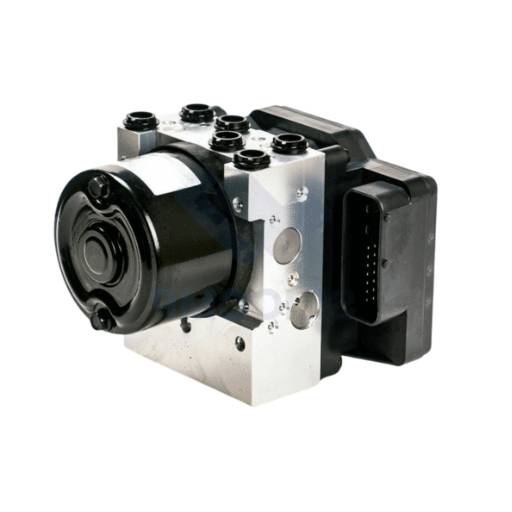
The ABS pump is a precision hydraulic pump. It sits inside the hydraulic control unit (HCU) and is driven by an electric motor. When you brake hard and a wheel begins to lock, the ABS controller pulses the brake pressure using the pump to hold, reduce, and reapply pressure rapidly. That pulsing is what lets you steer while braking hard instead of skidding.
When the pump fails, the ABS controller can no longer modulate pressure. The system usually falls back to a fail-safe mode: the ABS and related warning lights come on, and the brakes behave like a conventional non-ABS system. That is why your brakes still stop the vehicle. But you have lost anti-lock function, traction control, and stability control, because all of those depend on the same hydraulic unit.
It also helps to separate three conditions that people often confuse:
- A bad ABS pump. Anti-lock is disabled, but base hydraulic braking remains fully functional.
- Disabled ABS from a sensor or module fault. Same result: anti-lock is off, brakes still work, but the ABS light is on. This is where the question of whether you can drive with a bad ABS module gets asked, and the answer is the same as for the pump.
- Complete brake failure. Fluid loss, a failed booster, or a major HCU leak. This is the only category where the vehicle is unsafe to move.
That distinction matters, because most drivers assume any ABS fault means the brakes will fail. They rarely do. The engineering reality is that a failing ABS pump is a safety-system fault, not a total brake failure, unless one of the severe conditions is present.
Maya learned this the hard way last spring. Her sedan’s ABS light came on during a highway drive, but the pedal felt completely normal, so she kept driving for three weeks. Then came a sudden downpour and a car that stopped short in front of her. She stood on the brakes, the wheels locked, and the car slid forward while she wrestled with the wheel. She stopped with inches to spare. The fix, it turned out, was a corroded rear wheel-speed sensor connector, a repair that took under an hour. The scare cost her nothing but a lesson: a bad sensor had quietly disabled her ABS, and she had driven for weeks without the safety net she thought she had.
Can I Drive? A Scenario-Based Decision Table

Instead of a vague recommendation, use this decision table. It is based on the fault condition, what the pedal does, and which warning lights are illuminated.
| Fault condition | Safe to drive? | Recommended action |
|---|---|---|
| ABS light on, brake pedal feels normal | Yes, short trip only | Drive cautiously to a repair shop. Avoid wet or slippery roads. |
| ABS light on, traction/stability light also on | Limited | Short trip to a shop only. No emergency braking, no poor weather. |
| ABS + red brake warning light together | No | Stop immediately. Tow the vehicle and have it inspected. |
| Spongy, hard, or low brake pedal | No | Do not drive. This can indicate fluid loss or booster failure. |
| ABS pump motor stuck running | No | Park it. Excessive pressure can build in the brake system. |
| Visible brake fluid leak | No | Do not drive. Fluid loss means lost braking power. |
| ABS light + no other symptoms, dry road, normal pedal | Yes | Short, careful drive to the nearest qualified shop. |
The amber ABS warning light alone is rarely a reason to stop on the roadside. It is a reason to change your plans, shorten your route, and get the system checked. Our guide to ABS pump failure symptoms explains which warning signs point to the pump versus a sensor or wiring fault, so you know how urgent the trip really is.
If you have a brake pedal that feels wrong or a red warning light, the calculus changes completely. When in doubt, tow it. A tow bill is always cheaper than a crash.
For hybrid and electric vehicles, add extra caution. Regen braking and one-pedal driving depend on the brake-by-wire module, so a depowered brake system can behave unexpectedly. One Ford Fusion Hybrid owner who pulled the ABS fuse reported a complete loss of braking. That’s a specific case, but it’s a reminder that the “base brakes still work” rule doesn’t always hold on electrified platforms.
How Long Can You Drive With a Bad ABS Pump?
There is no fixed mileage or time limit. It depends entirely on the fault, the road conditions, and how the vehicle is driven. Some owners report driving for months or even years with ABS disabled and never having an issue. Others need ABS within the first mile on a wet highway.
The defensible recommendation is short, direct, dry-road trips to the repair shop only. Avoid highway speeds, heavy rain, snow, gravel, and anything that could force an emergency stop. Give yourself more following distance, brake progressively, and anticipate stops earlier than usual. On a slippery surface, if you feel wheels lock, release and reapply the brakes in a cadence instead of standing on the pedal.
The bigger risk of driving for a long time with a bad ABS pump is not a sudden crash. It is secondary damage. A faulty wheel speed sensor can trigger the ABS pump and module so often that the control unit burns out over time. What started as a sensor replacement turns into a full module or HCU replacement. That’s why a bad ABS pump or a bad sensor should be diagnosed early, and our guide to telling the difference between ABS pump and wheel speed sensor faults can save you from paying for parts you don’t need.
The Real Risks of Driving Without Working ABS
The statistics explain why ABS matters more than daily driving might suggest. In wet and snowy conditions, NHTSA data shows ABS reduces crashes with other vehicles by 37% for cars and 36% for trucks. A separate study from Valunas and Vestartas found ABS cut multi-vehicle crashes on wet pavement by roughly 24% and fatal crashes by about 14%.
Stopping distance tells a similar story. Fambro and colleagues measured braking distances up to 30 meters shorter with ABS at 90 km/h, with the biggest gap on wet pavement. In controlled testing at 100 km/h, wet-road stopping distance was about 66 meters without ABS versus 55 meters with it. On a wet road, that extra 11 meters can be the difference between stopping behind the car ahead and rear-ending it.
The mechanism is straightforward, and it is also why the answer to can you drive without ABS is never a comfortable yes. Without ABS, a hard brake application locks the wheels. Locked wheels slide, and a sliding tire has no steering grip. You keep going straight regardless of where you point the wheel.
ABS holds the tire at the limit of grip, so you can brake and steer at the same time. That’s what you give up when you drive with a bad ABS pump.
None of this means the vehicle is undriveable. It means the margin for error is smaller, especially in conditions where you need an emergency stop. If you must drive, drive like the safety net is gone, because it is.
Is It Legal to Drive With a Bad ABS Pump?
Legality varies by region, and it is separate from safety. In most places, a bad ABS pump is not illegal to drive with in normal conditions, because the base brakes still work. But a persistent ABS fault can fail you at inspection time, and commercial vehicles face stricter rules.
- UK MOT: An illuminated ABS warning light is classified as a major defect and fails the MOT, even if the braking system feels fine. Testers check whether essential safety systems work, not just whether the car stops. Blackcircles covers the MOT rules for warning lights in detail.
- US state inspections: Several states, including New York, fail vehicles with an illuminated ABS light. Check your local rules before you assume it is a minor issue.
- EU periodic inspection (ITV): In Spain, driving with an ABS fault light can bring fines of €200 to €500 and, in some cases, vehicle immobilisation.
- Commercial vehicles (FMCSA): In the US, FMCSA regulations require ABS to be operational on commercial vehicles. A persistent ABS fault is a roadside inspection violation and a liability for any fleet.
For fleet operators, the compliance angle is the one that hurts. An ABS fault that a private driver could shrug off for a week becomes a fine, an out-of-service risk, and a maintenance headache when the vehicle is pulled over. Our guide to commercial truck ABS failure symptoms is written for fleets that have to manage exactly this risk across a whole vehicle roster.
What to Do Next: Diagnose, Repair, and Source Reliable Parts

Before you assume the ABS pump itself is the problem, know this: most ABS faults are not the pump. Wheel speed sensors, corroded connectors, damaged wiring, blown fuses, and failed relays account for the majority of cases, and most of those are inexpensive fixes. The pump and module only get blamed when those cheaper causes are ruled out.
Start with a scan tool that can read ABS codes. A code like C0131 points to the pump motor circuit, while sensor codes point elsewhere. If the pump motor is stuck running, you’re looking at a relay or module fault, not necessarily a bad pump. These are the codes most likely to show up when you pull them:
| DTC | What it usually points to | Most likely cause |
|---|---|---|
| C0035-C0045 | Wheel speed sensor circuit (LF, RF, LR, RR) | Faulty sensor, corroded connector, damaged wiring |
| C0121 | Valve relay circuit malfunction | Failed relay or HCU driver stage |
| C0131 | ABS pump motor circuit malfunction | Pump motor, wiring, or relay fault |
| C0265 | ABS pump motor relay circuit | Bad relay or module driver |
| C0550 | ECU internal fault | Failed ABS control module |
Our guide to ABS pump failure DTC codes walks through the common codes and what each one means.
Check the cheap things first. Inspect the wheel speed sensors and their wiring. Check the brake fluid level and condition. Verify the ABS fuse and relay. In a large share of cases, one of those is the culprit, and the fix is measured in tens of dollars rather than hundreds.
If the pump is the cause, our explainer on a pump that keeps running after key-off can point you to the likely relay or module fault before you order a single part. For detailed information, see our guide on ABS pump running continuously after key-off.
If the diagnosis does land on the hydraulic unit, weigh repair against replacement. A module rebuild is often a fraction of the cost of a new unit, and some pump faults can be repaired rather than replaced. Compare OEM, remanufactured, and aftermarket options carefully, because warranty and core-return terms vary widely. For a complete cost and procedure breakdown, see our ABS pump replacement guide. RepairPal’s ABS hydraulic pump cost estimator is a useful independent cross-check for your vehicle.
For fleets and repair shops, sourcing matters as much as diagnosis. A reliable replacement ABS hydraulic pump keeps vehicles on the road and inspection-compliant, and a supplier with engineering support can confirm the right unit for the specific HCU. That is where a technical supplier adds value beyond a parts listing.
Final Word
A bad ABS pump does not usually mean the brakes will fail, but it does mean the safety net is gone. The honest answer to can you drive with a bad ABS pump is this: only if the pedal feels normal, only the amber ABS light is on, and only for a short trip to a shop. Stop and tow when the red brake light is on, the pedal feels wrong, or the pump motor is stuck running. And remember that most ABS faults start with a cheap sensor or wiring issue, so diagnose before you replace.
If you are responsible for a fleet or a repair shop, do not leave ABS faults open-ended. A documented, consistent triage process keeps vehicles compliant, safe, and available. When you need to source reliable ABS hydraulic pumps or confirm the right replacement for your equipment, contact our engineering team and request a technical specification sheet.
This guide was published by LOYAL INDUSTRIAL PTE. LTD., a global supplier of hydraulic pumps, motors, valves, and hydraulic system components for industrial and automotive applications.