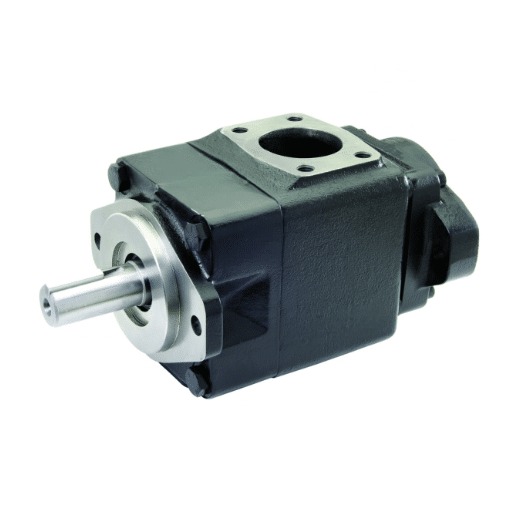
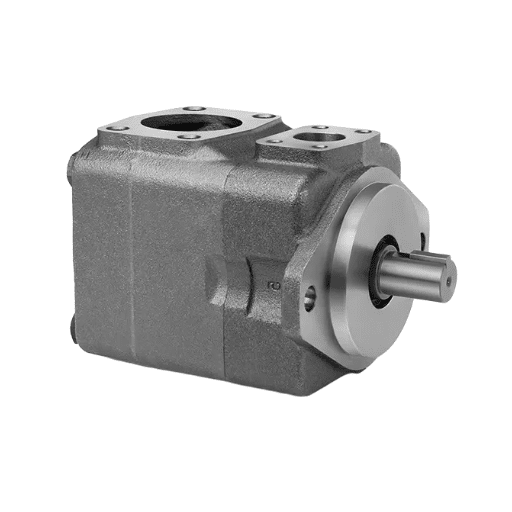
A vane pump that has lost 20% of its rated flow usually gets scrapped. That decision often costs far more than it needs to, because the part that actually wore out is a field-replaceable cartridge that typically sells for a fraction of a new pump.
You have probably already worked out that a repair costs less than a replacement. What you cannot yet verify is whether the repair will hold.
Does the vane pump cartridge kit include the cam ring, or is that a separate order? Will new vanes bounce on a worn housing and fail inside a year? Which kit fits your pump, and how do you confirm the cross-reference before the money leaves your account?
This guide covers industrial hydraulic vane pump cartridges (Vickers, Denison, Tokimec, Yuken). It doesn’t cover rotary-vane vacuum pumps or fluid-transfer kits, which share the name but not the engineering. It answers those questions with the specifics the OEM manuals publish and the sales pages omit: what is actually in the box, a housing inspection that decides whether a kit is viable at all, the interchange and torque references for the major families, the installation steps that cause most post-rebuild failures, and an honest cost comparison against a rebuild and a new pump. For the full family context, our complete guide to hydraulic vane pumps covers design, sizing, and selection.
What Is a Vane Pump Cartridge Kit?
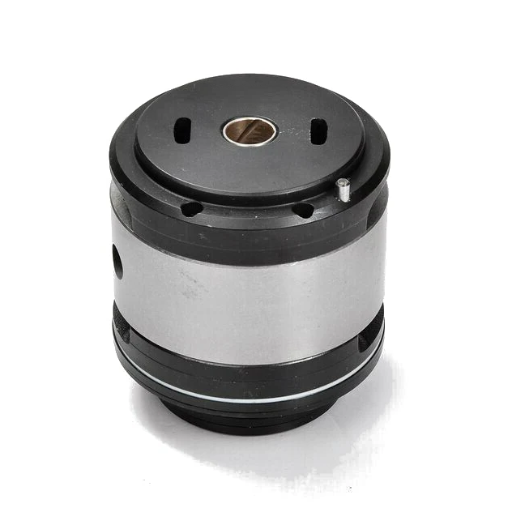
A vane pump cartridge kit is a preassembled pumping group dropped into an existing pump body to restore factory performance. It isn’t a bag of spare parts. It is a matched, factory-tested assembly, usually delivered with the seals already fitted to the pressure plate.
That is the commercial case for vane pumps. Because the pumping elements sit in a cartridge independent of the shaft and housing, it can usually be swapped in place: no uncoupling the drive, no re-piping. No other positive-displacement family is built this way.
What arrives in the box depends on the kit, and buyers constantly confuse four different products. A cartridge kit and a seal kit are not substitutes. A seal kit doesn’t include a rotor.
| Component | Cartridge kit | Seal kit | Shaft kit | Cam ring |
|---|---|---|---|---|
| Rotor | Yes | No | No | No |
| Vanes and intra-vanes (vane kit) | Yes | No | No | No |
| Cam ring (stator ring) | Yes | No | No | This part only |
| Inlet and outlet support plates | Yes | No | No | No |
| Flex or pressure side plates | Yes | No | No | No |
| Seals, O-rings, shaft seal | Usually, though some designs need a separate seal kit | Yes | No | No |
| Bearings | Some designs | No | Yes | No |
| Shaft | No | No | Yes | No |
Two conventions are worth memorising, because they let you read a parts list without a manual. Metaris catalogues mark components with an asterisk for seal-kit inclusion and a double asterisk for cartridge-kit inclusion. Denison and Parker kits use a numeric suffix, so the same vane pump rebuild kit is ordered differently depending on the seals it carries: a 4 indicates EPR and a 5 indicates Viton in both conventions, while the Denison vane handbook adds an 8 for nitrile with a shaft seal and a 1 for no shaft seal. Confirm the extended suffixes against your own parts list before ordering.
Vane count matters too, and it is not a rounding error. Vickers VQ cartridges come in a 12-vane industrial version that runs quieter, and a 10-vane mobile version that tolerates higher pressure and a wider speed range. Ordering the wrong one will fit but won’t meet the duty.
Not sure which kit matches your pump? Send us the nameplate details, and we will confirm the cross-reference before you order. Request a cartridge kit recommendation.
When a Cartridge Kit Restores a Vane Pump (and When It Cannot)
A vane pump cartridge kit is the right answer only if the housing is sound. Three checks decide it.
The positioning hole must be true and unworn, because it locates the whole cartridge. The shaft seal and bearings must be serviceable. The shaft and housing must show no wear or deformation.
The most common misdiagnosis in vane pump repair is overlooking the bore. Once the bore is rippled, a condition called washboarding, the surface the vanes ride on is no longer flat.
New vanes follow the same ripples, lose contact, and get hammered back onto the ring. The pump makes flow again for a while, then fails. Fitting a cartridge into a washboarded bore is not a repair; it is a deferred replacement with extra labour.
Scoring depth then separates the salvageable from the terminal. Light scoring can be resurfaced within the manufacturer’s removal limit. Deep gouges cut by hard-particle contamination can’t be fixed by replacing internals, because the damage sits in a surface the internals do not include.
| Pump condition | Correct remedy | Why |
|---|---|---|
| Positioning hole true, bore in spec, shaft and bearings serviceable, vanes or cam ring worn | Cartridge kit | Restores rated performance in place |
| Seal-only leakage, pump still meets flow demand | Seal kit | Cheapest fix; the internals are still sound |
| Shaft bent, bearing collapsed, or seal surface worn | Shaft kit plus cartridge, or full pump | A cartridge does not restore the rotating input |
| Cam ring rippled, but the bore is still in spec | Cartridge kit | The kit includes a new ring; the bore is the limit |
| Bore oversize, deformed, or deeply scored | Full pump replacement | New vanes bounce on a worn bore and fail fast |
| Positioning hole deformed | Full pump replacement | The cartridge cannot be located correctly |
| Seized rotor, twisted or ruptured shaft | Full pump replacement | Housing and input are both likely damaged |
Still working out why the pump failed? Start with our vane pump troubleshooting guide. Diagnosis and repair are separate jobs, and the sequence matters.
Fix the Circuit Before You Fit the Kit
Roughly 80% of vane pump failures trace to fluid condition and loss of lubrication. If the root cause was contaminated or starved fluid, a new cartridge fitted into the same unchanged circuit fails the same way. The first 500 hours of service is the classic premature-failure window, and it is almost always a repeated cause rather than a bad kit.
Before the kit goes in, flush the circuit, restore filtration, and fix the inlet. Our vane pump maintenance and filtration programme gives you the cleanliness targets and oil specification to work to.
Choosing the Right Cartridge Kit: Interchange, Rotation & Seals
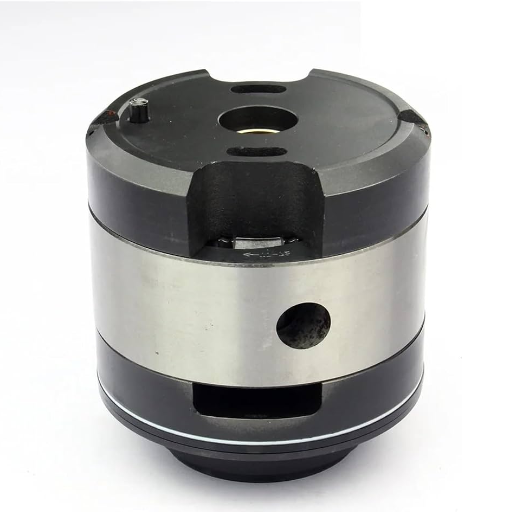
Kits are widely available across four major families plus machine-specific equivalents. Knowing which family you have is the first half of the job; confirming the configuration is the second.
This table is a verification aid, not a compatibility guarantee. Always confirm fit against the OEM drawing and part number.
| Family | Series | Notes |
|---|---|---|
| Vickers / Eaton | V, VQ, VQH, V10/V20, 20V/25V/35V/45V, 2520V/3520V | 210 bar class; VQH for higher pressure; 12-vane industrial and 10-vane mobile versions |
| Denison / Parker | T6 (T6C/T6D/T6E), T67, T7; T6CC/T6DC/T6EC/T6ED | T6 rated to 320 bar, T7 to 275 bar; most cartridges bi-rotational |
| Tokimec / Tokyo Keiki | SQP1, SQP2, SQP3, SQP4, SQP21/31/41 | |
| Yuken | PV2R1 to PV2R4 | 210 bar class |
| Machine-specific | CAT 4J-8490, 1U3953, 35VQ38 | Ordered by machine model rather than family |
If you are sourcing a Vickers vane pump cartridge kit, anchor part numbers are the fastest way to confirm the cross-reference. The Metaris VQ cut sheet lists 20VQ05 as the equivalent of Vickers 417053, and 25VQ12 as the equivalent of Vickers 416439. For Denison, Parker’s T6/T67/T7 service information sets out the interchange rules, where 7B, 6C and 6CM share external dimensions within the same housing position. Ask any supplier for the cross-reference number in that format before accepting a quotation, because a series name alone doesn’t identify a kit.
Then verify three configuration details. Each one, ordered wrong, guarantees an early failure.
Rotation. Confirm clockwise or counter-clockwise. Vickers designates left-hand kits with an L suffix, so 416439-L is the left-hand version of 416439. Most Denison T6 and T7 cartridges are bi-rotational and convert by reversing the port plates and cam ring.
Vane count and design. The 12-vane industrial and 10-vane mobile split described above. A kit built for the wrong duty fits but won’t deliver the expected pressure tolerance or noise level.
Seal material. Buna-N is standard. Viton handles high temperature. EPR suits phosphate-ester and fire-resistant fluids. The wrong compound is a guaranteed leak.
Verifying a “100% Interchangeable” Claim
Every aftermarket listing claims full interchangeability. Almost none show you how to check it.
Verification is mechanical, not verbal. Demand dimensional verification against the OEM drawing, covering mounting, shaft form, pilot, bolt pattern, rotation, and port position. Our SAE mounting and port standards reference covers the flange and port conventions.
One more ordering trap, and it is expensive. Double and triple vane pumps don’t use a single kit. They use a cover-end and a shaft-end kit, ordered separately, which means two lead times with the machine down. Our double and triple vane pump guide covers how those cartridges stack.
How to Replace a Vane Pump Cartridge Kit
What follows is the field guide to the steps that decide whether the rebuild holds, drawn from the Parker T6/T67/T7 instructions, the Eaton/Vickers vane pump service document, and the Denison service literature. It isn’t a substitute for the manual for your specific pump.
Before you start. Lock out the drive and relieve all stored pressure, including accumulator energy, before loosening anything. Confirm the kit matches the old model code. Inspect the positioning hole; if it is deformed, stop and replace the pump.
Inspect the shaft seal and bearings. Mark the body and cover for orientation, remove the four cover screws, and slide the old cartridge out as one unit. Discard every used seal, and never reuse an O-ring, oil seal, or retaining ring.
Installation. Seven things that go wrong.
- Concentricity. The stator and the port and side plates must be aligned. If they are not, the cartridge won’t seat. Never force it; adjust alignment and refit.
- The dowel pin. The positioning pin must sit in the housing locating hole. Verify by attempting to rotate the cartridge. If it turns, the pin is out. Pull it and start again.
- The shaft seal lip. Use a protective cone over the shaft as the assembly slides through the seal. This prevents more post-rebuild leaks than any other step. Lubricate the seals, and use petroleum jelly to hold O-rings in place.
- Flex side plate orientation. In Vickers VQ designs, the bronze face must go toward the rotor.
- Tightening sequence. Bring the four screws down in stages, evenly. Squeezing one side fully before the others cuts the seal, which is the mechanism behind most post-rebuild weeping.
- Port orientation. Change direction by rotating the upper housing. Do not lift the cartridge to do it; lifting misaligns the pin and the seals between the housings.
- Free rotation. Turn the shaft by hand. The correct feel is free rotation with a slight spring-loaded resistance. If it binds, open the assembly, clean and stone the binding areas, and refit.
Torque reference. Values differ by frame and fastener, and they are not interchangeable between families. Confirm against the manual for your exact pump.
| Fastener | Torque |
|---|---|
| Vickers 20V/VQ and 25V/VQ cover bolts | 48 to 55 N·m |
| Vickers 35V/VQ cover bolts | 102 to 118 N·m |
| Vickers 45V/VQ cover bolts | 188 to 203 N·m |
| Vickers VQ cartridge retaining screws | 50 lb·in |
| Parker/Denison T6CC and MP-T67CB mounting cap | 159 N·m |
| Parker/Denison T7DB/S, T6DC and MP mounting cap | 187 N·m |
| Parker/Denison T7BB/S end cap | 61 N·m |
Commissioning. Fill the pump body with filtered oil, open the outlet to purge air, and start in jog mode rather than running straight up to speed. Once the pump runs normally, retighten the outlet joint. Monitor oil temperature, which should sit below 60 °C, and listen for the sound level to return to normal.
Post-Rebuild Verification and the First 500 Hours
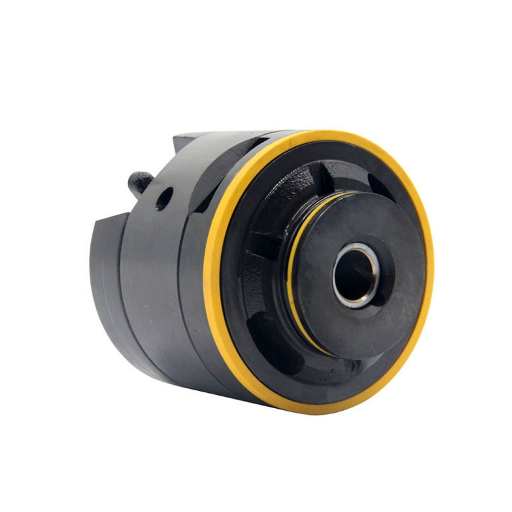
Fitting a vane pump cartridge kit isn’t the end of the job. You need evidence the repair worked, and you need to watch the window when a bad repair reveals itself.
Run an acceptance test. Confirm free hand rotation with the correct feel, start at low pressure and bring the system up gradually, and compare flow against the rated curve for the displacement, using the method in our vane pump sizing guide. Confirm the pump holds pressure at the compensator or relief setting, and watch the shaft seal for weeping.
Then watch the first 500 hours deliberately. Check oil condition, filter differential pressure, oil temperature, and sound at the end of the first shift, the first week, and the first month. A kit that survives those checkpoints is very likely to run a full service life.
If the pump fails again inside that window, treat it as information rather than bad luck. A second failure means the root cause was never addressed, so return to the diagnostic sequence rather than ordering a third kit.
Rebuild vs Replace vs New: What It Actually Costs
A vane pump cartridge kit is cheap next to a new pump, and this is where you find the widest gap between what suppliers claim and what they can show you.
Published savings figures in this market are marketing. One supplier states a repair kit costs 10 to 30% of a new unit. A kit manufacturer claims up to 70% off an MRO budget. A reseller advertises 85% below original equipment pricing.
None publish the arithmetic. Treat each as a claim, not a benchmark.
What is verifiable is the order of magnitude. Listings for Tokimec SQP and Vickers VQ cartridges sit around $120 per piece, Denison T6CC to T6ED kits around $220, and Yuken PC-PV2R kits in the $38 to $42 range at volume tiers. Those are point-in-time listings, not quotations. They are useful for judging whether a quotation is in the right postcode.
The comparison that decides the question has four columns, and most buyers only look at two.
| Cost element | Cartridge kit in place | Full rebuild (external shop) | New pump |
|---|---|---|---|
| Parts | The kit | The kit plus consumables | Complete pump |
| Labour | 2 to 4 hours typical | 4 to 8 hours plus handling | 2 to 4 hours, plus re-piping |
| Downtime | Often one shift | Days to weeks with shipping and queue | Days to weeks with lead time |
| Realignment | Not required | Not required | Required after refit |
| Lead-time risk | Stocked kit, short | Shop queue | Manufacturing lead time |
| Housing risk | Fails if the bore is worn | Fails if the bore is worn | Eliminated |
Labour and downtime usually dominate the parts cost, and a vane pump cartridge replacement avoids the bottom two rows entirely. A kit on the shelf that goes in without uncoupling the drive is a different operational event from a pump that arrives in three weeks and needs re-piping and realignment.
Where the cheap option becomes false economy is predictable: a kit fitted into a washboarded bore, a kit ordered in the wrong rotation or seal compound, a budget kit with no dimensional verification, or any repair that skips the circuit flush. In each case, the kit price saved is smaller than the cost of doing it again. And if the model is phased out and no kit exists, replacement is the only route regardless of price.
Sourcing Cartridge Kits and Vane Pump Spares
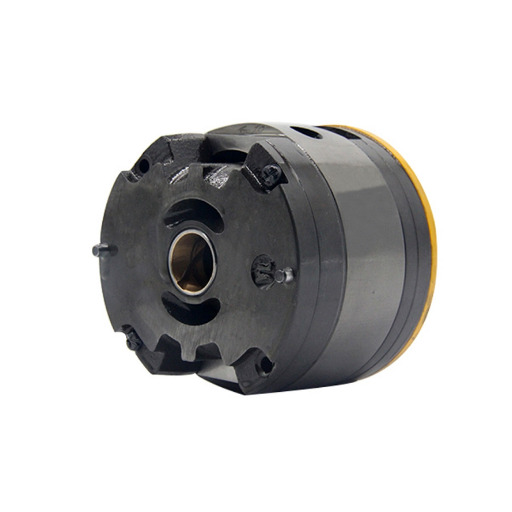
The practical question no ranking page answers is where to get the correct vane pump cartridge kit, and how to know it is right before it ships.
Send a complete data set, and you get a correct quotation the first time: pump nameplate and model code, per-section displacement codes, rotation direction, vane count if you know it, seal material, OEM cross-reference number, and a photograph of the nameplate and port faces.
What should come back is equally specific: the cross-reference number, the seal compound stated explicitly, a dimensional verification statement against the original drawing, a performance test record, the lead time, and the warranty terms. If a supplier can’t produce those six items, the quotation is incomplete regardless of the price on it.
On genuine versus aftermarket, evidence decides it, not the badge. Genuine kits carry the original manufacturer’s warranty and an assured fit. A verified aftermarket kit that can demonstrate dimensional verification and per-unit test records delivers most of the performance at a fraction of the price.
Spare-parts availability is the real long-term risk in vane pump ownership, because a vane pump is only as serviceable as its parts pipeline. Ask whether kits for your model will be available for the life of the machine, not just for this order.
FAQ
What is included in a vane pump cartridge kit?
The matched pumping group: rotor, vane kit with intra-vanes, cam ring or stator ring, inlet and outlet support plates, flex or pressure side plates, and in most designs a seal pack. Bearings are included in some designs. The shaft isn’t included.
What is the difference between a cartridge kit and a seal kit?
A seal kit contains seals only: gaskets, O-rings, and the shaft seal. It doesn’t include the rotor, vanes, cam ring, or support plates. If the pump has lost flow through internal wear, a seal kit won’t restore it. If the pump still meets demand and only weeps, it is the cheaper correct answer.
Can a vane pump be rebuilt rather than replaced?
Often, yes. The cartridge is a field-replaceable assembly and can frequently be replaced without removing the pump from its mounting. A kit restores performance only if the positioning hole is true, the bore is within specification, and the shaft isn’t worn or bent.
How do I know if my vane pump cartridge is bad?
The classic signature is noise that increases as system pressure rises combined with reduced flow. Confirm it with the diagnostic sequence before ordering parts.
How much does a vane pump cartridge kit cost?
Listings put Tokimec SQP and Vickers VQ cartridges around $120, Denison T6CC to T6ED kits around $220, and Yuken PC-PV2R kits at $38 to $42 at volume. Pricing moves with brand, seal material, and quantity, so treat these as order-of-magnitude anchors, not a quotation.
Why did my new cartridge kit fail in the first year?
Almost always because the original cause was not fixed. Around 80% of vane pump failures trace to fluid condition and lubrication, so a kit fitted into an unchanged contaminated or starved circuit fails the same way. The first 500 hours is the classic window. Flush the circuit and restore filtration first.
Are aftermarket cartridge kits as good as OEM?
That depends on the supplier’s evidence, not the price. Ask for dimensional verification against the OEM drawing, a cross-reference number, and a performance test record for the specific kit. A supplier who can produce all three is offering a credible alternative.
How do I confirm which kit fits my Vickers or Denison pump?
Match the series, then verify rotation direction, vane count or design, and seal material. For Vickers, left-hand kits carry an L suffix. For Denison, the kit number suffix indicates the seal compound. Confirm the cross-reference number against a source such as the Metaris interchange listing before ordering.
Conclusion
A vane pump cartridge kit is the strongest argument for choosing a vane pump, and it is also where the most money gets wasted. Four things decide which it is.
- Inspect the housing first. If the bore is washboarded, oversized, or the positioning hole is deformed, no kit will save the pump. Replace it.
- Know what is in the box. A cartridge kit and a seal kit are different products. Ordering one when you need the other is the most avoidable mistake in this category.
- Verify the configuration. Rotation, vane count, and seal material. Each one ordered wrong guarantees an early failure, and each takes thirty seconds to confirm.
- Fix the circuit before you fit the kit. Around 80% of failures come from fluid condition. A kit fitted into an unchanged dirty circuit fails identically inside the first 500 hours.
Get those four right and a cartridge kit turns a scrapped pump into a one-shift repair. Get them wrong, and you will pay for the kit and the replacement.
Tell us your pump model, rotation, and displacement codes, and our engineers will confirm the correct cross-reference and kit specification for your application. Request a cartridge kit recommendation, or ask for the technical specification sheet for the series you run.