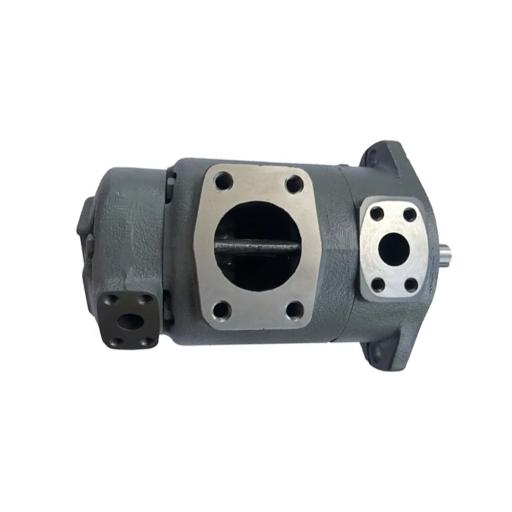
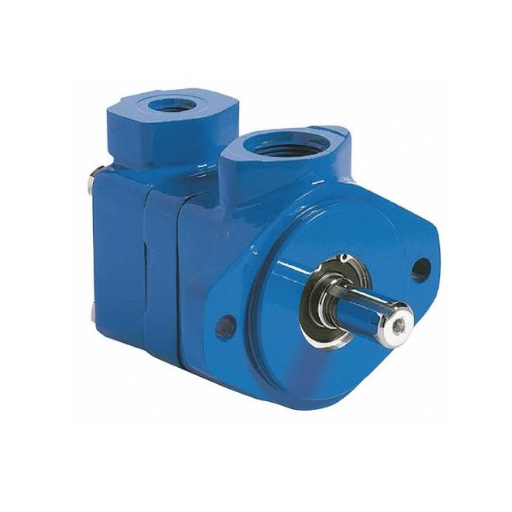
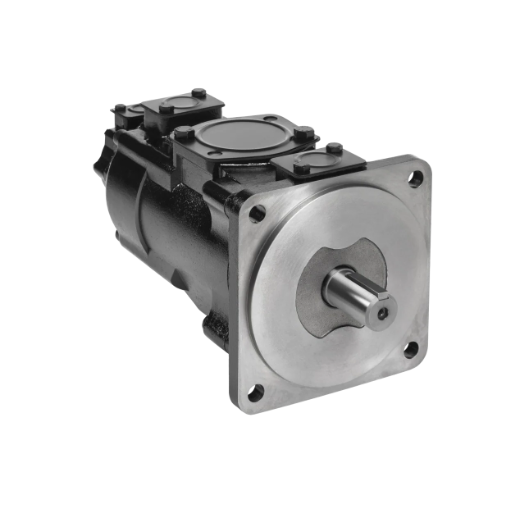
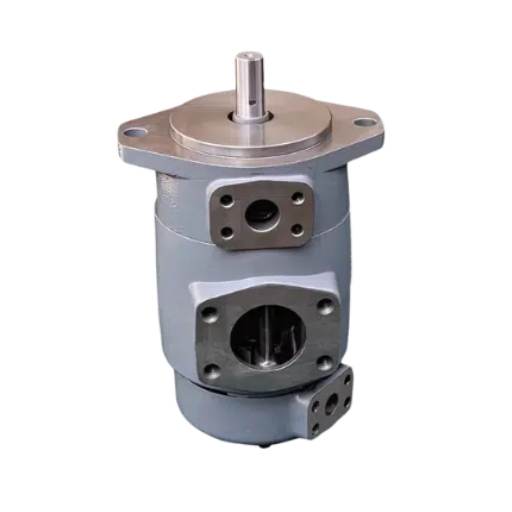
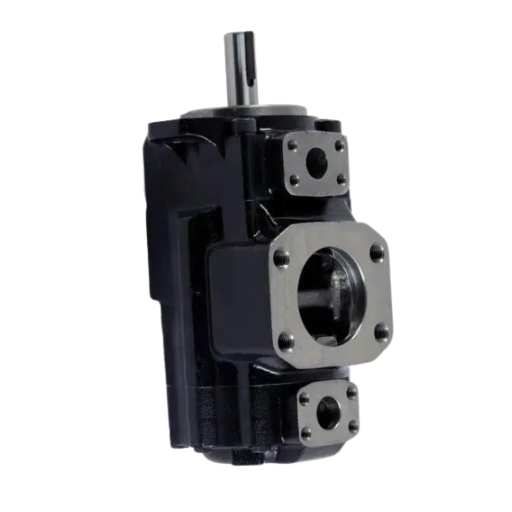
A triple vane pump takes three cartridge kits, labelled A, B, and C by section. The letter is only half of the part number. The other half is a frame digit read out of the pump’s model code, and that digit decides which of four separate tables the number comes from.
That is the part buyers get wrong. Plenty of sources say a triple needs three kits. Almost none explain that one displacement code can carry five different triple vane pump cartridge numbers. Fewer still mention that a shaft-end kit for one frame size shares nothing with the shaft-end kit for the next size up.
This article works from the Tokyo Keiki SQP triple catalogue and the Denison T6 service-parts sheets. Every part number below is transcribed from a page we can point you to. Every claim that a number is or isn’t shared with a single or double pump is given as a count, so you can check it yourself. If you are still deciding whether to rebuild at all, that question comes first.
Key Takeaways
- A Tokyo Keiki triple kit table has four blocks, and the block number is the frame digit in the model code: block 1 serves frame 1, block 4 serves frame 4. An SQP421 draws its three kits from blocks 4, 2 and 1.
- Code 21 exists as five different triple vane pump cartridge kits across the table (VA12092A, VA12118A, VA12105A, VA12317A, 40078070). Codes 42, 50 and 60 exist as exactly one each.
- The shaft-end kit is identical on a single, a double and a triple in 20 of 20 (frame, code) pairs. The middle and cover-end kits are shared with nothing: 0 of 16 and 0 of 21.
- Only the SQP211 can carry one displacement code in all three sections. On the other five SQP triples the three codes are necessarily different.
- Denison numbers every kit by position: 0 of 36 single-versus-multi kit comparisons match, while the cam ring is unchanged in 35 of 36.
Triple vane pump cartridge kits: three letters and a number that depends on the frame
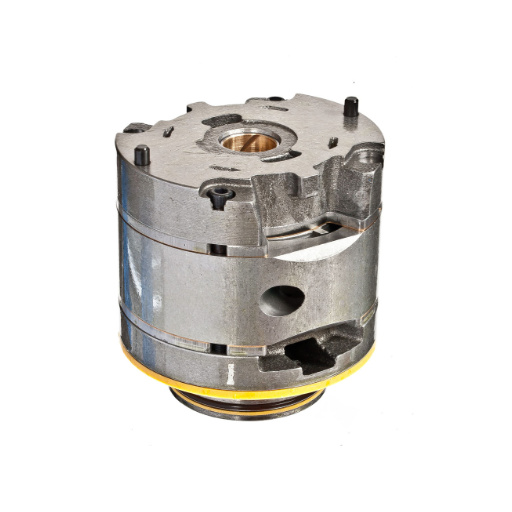
A “triple vane pump” here means three pumping cartridges stacked on one shaft, sharing one drive. It is not a triplex plunger pump and not a triple automotive fuel pump, both of which turn up in search results for the phrase.
The kit letters are positional. Kit A is the shaft end, Kit B the middle section, Kit C the cover end. Tokyo Keiki prints the reason plainly on the page: “Care should be taken as construction of shaft end, middle, and cover end pump differ.” A kit from the middle bay will not do a shaft-end job.
What the letter does not do is identify a part number. On page B3-8 of Tokyo Keiki’s triple vane pump catalogue, there are four separate blocks, each with its own column headers, and each header names the models its column applies to.
| Block | Columns present | Displacement codes | Models each column serves |
|---|---|---|---|
| 1 | Kit B, Kit C (no Kit A) | 2, 3, 4, 5, 6, 7, 8, 9, 11, 12, 14 | B: SQP211, SQP311 · C: SQP211, SQP311, SQP321, SQP421, SQP431 |
| 2 | Kit A, Kit B, Kit C | 10, 12, 14, 15, 17, 19, 21 | A: SQP211 · B: SQP321, SQP421 · C: SQP432 |
| 3 | Kit A, Kit B (no Kit C) | 17, 21, 25, 30, 32, 35, 38 | A: SQP311, SQP321 · B: SQP431, SQP432 |
| 4 | Kit A only | 30, 35, 38, 42, 50, 60 | A: SQP421, SQP431, SQP432 |
Read the model names against the model code, and the pattern resolves. In SQP421, the third, fourth, and fifth digits are 4, 2, and 1. Those are the shaft-end, middle, and cover-end frame numbers. Block 4 serves frame 4, block 2 serves frame 2, and block 1 serves frame 1.
So an SQP421 takes its shaft-end kit from block 4, its middle kit from block 2, and its cover-end kit from block 1. Three sections, three tables.
That single rule explains every dash in the table. The cover-end legend on page B3-1 offers only two frames, printed as SQP**1 and SQP**2, with the asterisks standing in for the frame digits.
Frames 3 and 4 have no cover-end options, so blocks 3 and 4 have no Kit C column to print. The middle legend runs to frame 3, so block 4 has no Kit B column either. The gaps are structural, not omissions.
What the four blocks cost a buyer
Code 21 shows the damage. It appears five times across the table:
| Kit | Frame | Block | Part number |
|---|---|---|---|
| A (shaft end) | 2 | 2 | VA12092A |
| A (shaft end) | 3 | 3 | VA12118A |
| B (middle) | 2 | 2 | VA12105A |
| B (middle) | 3 | 3 | VA12317A |
| C (cover end) | 2 | 2 | 40078070 |
Five numbers, one displacement code. Note what is missing: there is no frame-1 cover-end entry for code 21. The frame-1 list stops at 14. So code 21 can never be the cover end of an SQP321, because an SQP321’s cover end is always frame 1.
If you are ordering against a full model string and want the nameplate fields decoded beyond these three digits, our triple vane pump model code guide covers the rest.
Worked example: the three kits for an SQP421
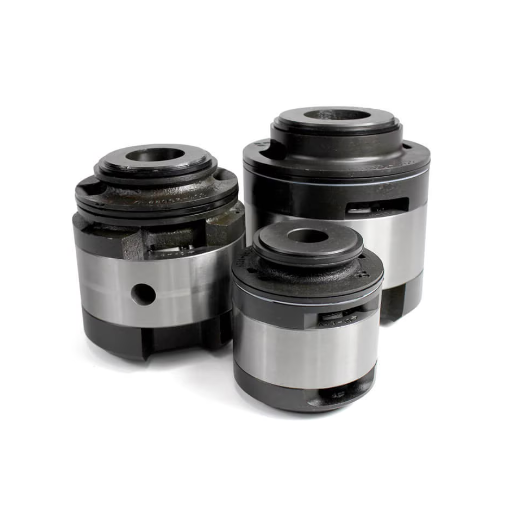
Take an SQP421 with a 30 cc/rev shaft end, a 12 cc/rev middle, and a 4 cc/rev cover end. The full string would read something like SQP421-30-12-04 with the port and rotation fields appended.
| Position | Frame | Block | Code | Kit to order |
|---|---|---|---|---|
| Kit A, shaft end | 4 | 4 | 30 | VA11211A |
| Kit B, middle | 2 | 2 | 12 | VA12101A |
| Kit C, cover end | 1 | 1 | 04 | VA10245A |
Three different tables, three different number series. That is the normal case, not an unusual one.
Here is the harder point. On an SQP421, there is no displacement code that works in all three sections. The frame-4 shaft-end list starts at 30. The frame-1 cover-end list stops at 14.
The two lists do not overlap at all.
Checking the overlap for all six triples gives one surprising result, and it is the reason a triple vane pump cartridge order goes wrong so often:
| Model | Frames (A/B/C) | Codes legal at all three positions |
|---|---|---|
| SQP211 | 2 / 1 / 1 | 12, 14 |
| SQP311 | 3 / 1 / 1 | none |
| SQP321 | 3 / 2 / 1 | none |
| SQP421 | 4 / 2 / 1 | none |
| SQP431 | 4 / 3 / 1 | none |
| SQP432 | 4 / 3 / 2 | none |
Only the smallest triple, the SQP211, can carry a single displacement code through all three sections. Everywhere else, the three codes differ, and the three kit numbers differ with them. The six models themselves, their frame assignments, and their displacement ranges are mapped in Tokyo Keiki SQP triple vane pumps.
Field note: Idris, a maintenance fitter at a Midlands die-caster, ordered a cover-end kit for a Tokimec triple by quoting the displacement code he read off the housing. The kit arrived, fitted the bore, and would not build pressure. The code was a middle-section code, matched against the cover-end column of the wrong block. The kit was right for a section his pump didn’t have; the part number was never the problem, the frame was.
Which triple vane pump cartridge kits are shared with single and double pumps
This is where the triple vane pump cartridge question stops being an accounting exercise and starts being useful.
The shaft-end cartridge sits in the same bore whether one section, two, or three are bolted behind it. So the shaft-end kit number is the same at every level. Tokyo Keiki’s single-pump table (page B1-11), double-pump table (page B2-12) and triple vane pump cartridge table all agree:
| Comparison | Result |
|---|---|
| Single-pump kit vs double-pump Kit A vs triple-pump Kit A, per frame and code | 20 of 20 identical |
| Double-pump cover-end kit vs triple middle kit | 0 of 21 identical |
| Double-pump cover-end kit vs triple cover-end kit | 0 of 16 identical |
Read that carefully, because the wording matters. The sharing holds per frame, not per code. Code 30 is VA12059A as a frame-3 shaft end and VA11211A as a frame-4 shaft end.
Both are shared across all three pump types. So “the shaft-end kit is the same at every level” is true, and “a code has one shaft-end kit” is false.
The middle and cover-end numbers share nothing with the single or double tables. The double sheet calls its cover-end kit “Kit B”, which makes the letters more confusing than helpful: the same letters mean different positions in different Tokyo Keiki documents. Treat the letter as local to the page in front of you, and treat the triple vane pump cartridge list as four separate lists that happen to share a page.
Two more limits worth knowing before you order:
- Codes 42, 50 and 60 exist only as a shaft-end kit. There is no middle or cover-end version at any frame.
- Codes 2 through 9 and 11 can never be a shaft-end. The shaft-end lists begin at 10.
Denison T6 triples: every number changes, and the cam ring does not
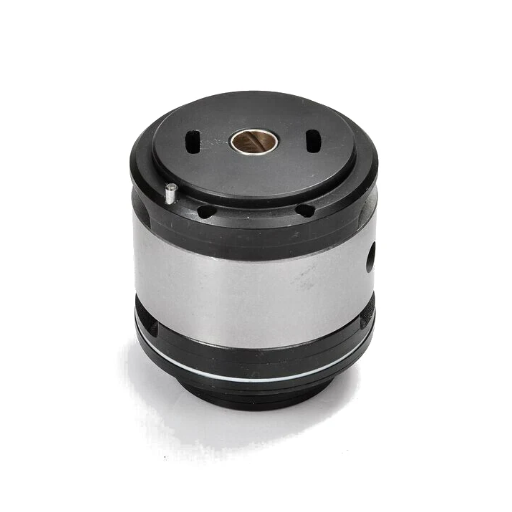
Denison handles the same problem the opposite way, and the difference is instructive. Where Tokyo Keiki reuses a triple vane pump cartridge number across blocks, Denison changes it at every level.
The T6 service-parts sheets print the kit number per position. For one displacement code, T6C-003:
| Level | Kit | Cam ring |
|---|---|---|
| Single pump | S24-10692N | 034-59050N |
| Double pump, front section | S24-10732N | 034-59050N |
| Double pump, back section | S24-10749N | 034-59050N |
Three different kit numbers. One cam ring. Across all 36 single-versus-multi comparisons we could make on the T6C, T6D, and T6E sheets, the kit number matches 0 of 36 times, while the cam ring matches 35 of 36. The one exception is T6D-028, where the cam is 034-59133N on the single sheet and 034-59113N on the double-pump front.
The cam ring is the same part because it defines the displacement, and displacement does not care which housing it sits in. The kit is different because every plate, pin, and seal around that cam ring is matched to the housing it bolts into.
The back kit depends on the machine, not on the section code:
| Comparison | Result |
|---|---|
| T6CC back column vs T6EC back column, same code | 11 of 11 identical |
| T6CC back column vs T6DC back column, same code | 0 of 11 identical |
So a T6C section used as the back half of a T6CC and the same section used as the back half of a T6EC take the same kit. Drop it into a T6DC and the number changes.
One limitation you should know about. The manufacturer’s own T6 catalogue, Parker’s HY29-0001/UK, publishes no kit part numbers at all. A search of the full 78-page document returns zero results for the S24- prefix.
The numbers above come from T6 service-parts sheets as reproduced by a US rebuilder. They’re a practical working reference, not an OEM-published list, and should be confirmed against the sheet that ships with your unit.
A second limitation, specific to triples. Those service-parts sheets cover two-section pumps. Across 56 pages, the word “middle” does not appear once.
The only triple material is a model-number list on page 6, giving complete OEM part numbers for triple model strings such as T6DCC 038 017 014 3R. There is no per-section kit chart for a Denison triple. The front kit can be looked up the way a double’s can. The middle and back kits cannot.
Field note: Bram, a plant engineer at a Dutch extrusion line, had a Denison triple with a tired back section. The front kit was charted and easy. The back kit shared no number with the single-pump list and no triple chart existed. The first number he quoted came back as a front kit for a different frame, which is exactly the error the missing chart invites.
For the model families and displacement codes of the Denison triples themselves, see Denison triple vane pumps. The Vickers equivalent works differently again: it is a parts-document lookup rather than a kit chart, mapped in Vickers triple vane pumps.
What’s inside a triple vane pump cartridge kit, and the two seals that aren’t in it
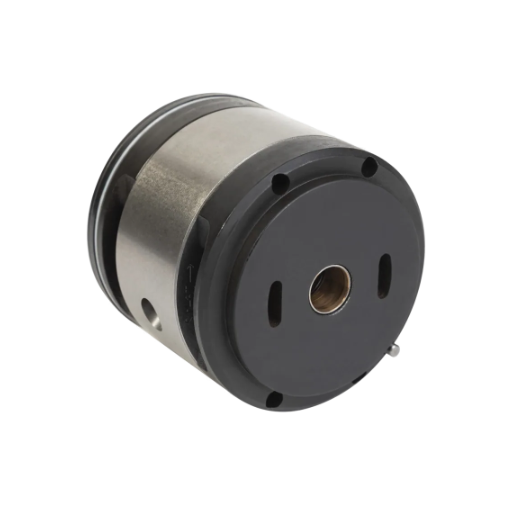
A cartridge kit is the rotating group. Parker’s catalogue defines it as “replaceable assemblies. Each includes cam ring, rotor, vanes, pins, and sideplates.” Those are the wear parts that set displacement and generate flow, and they are what you are paying for in a triple vane pump cartridge kit.
Tokyo Keiki adds the boundary condition: “Cartridge kit includes seals excluding shaft seal.” So O-rings and backup rings come with the kit. The shaft seal does not.
That distinction decides which job you have. Each SQP triple has a seal kit and a shaft seal listed separately, and neither is a triple vane pump cartridge kit:
| Model | Seal kit | Shaft seal |
|---|---|---|
| SQP211 | VA10885A | VP191668 |
| SQP311 | VA10757A | VP193428 |
| SQP321 | VA10756A | VP193428 |
| SQP421 | VA11703A | VP195287 |
| SQP431 | VA11133A | VP195287 |
| SQP432 | VA11450A | VP195287 |
The page note is explicit: “Shaft seal included in seal kit.” A leak at the drive end is a seal-kit job, not a cartridge job.
Field note: Lakshmi, a workshop supervisor at a pump repair shop in Chennai, quoted a triple leaking at the drive end as a cartridge rebuild. The shaft seal sits in the seal kit and the cartridge kits were fine. Three kits were priced and none were needed.
Denison separates the same two items on its own sheet, printing standard and Viton seal kits and standard and Viton shaft seals as four distinct columns. For the full contents, interchange notes, and replacement procedure, see vane pump cartridge kits.
Rebuild or replace, section by section
On a single pump, the rebuild question is one decision. On a triple, it is three, and the order matters. Each answer decides whether you are buying one triple vane pump cartridge kit, three, or none.
First, is the kit available for this code at this position? Codes 42, 50, and 60 are shaft-end only. A worn cover end at code 50 has no cover-end kit to buy, at any frame. That is a replace-the-unit finding, not a rebuild one.
Second, did the other two sections pass their own flow test? A triple with one weak section and two healthy ones is a one-kit job. All three weak is a different conversation, because three kits plus labour approaches the cost of a replacement unit. If you aren’t sure which section is the weak one yet, finding which section failed is its own procedure.
Third, is the housing sound? Check the cam-ring seat, the shaft journal, and the plate faces on the failed section. A scored seat will destroy a new triple vane pump cartridge kit in short order, and no supplier will cover it.
| Finding | Action |
|---|---|
| One section low, kit available at that position, housing sound | Order that one kit |
| Two sections low, both kits available | Order both, or compare against unit cost |
| All three sections low | Compare three kits plus labour against a replacement |
| Failed section’s code is not available at that position | Replace the unit |
| Cam-ring seat or shaft journal damaged | Replace the unit or the housing |
Fluid class changes the number rather than adding a suffix. The water-glycol column on page B3-8 carries different part numbers throughout: block 4 runs VA12567A through VA12572A against a mineral-oil column of VA11211A, VA12122A, VA11212A, VA11213A, VA11214A and VA11215A. All six pairs differ. There is no suffix that converts one into the other.
Rotation is the one field that does work as a suffix. Tokyo Keiki notes that “L” is added to the kit number for left-hand rotation, so a left-hand cover-end kit carries an L on the end of the base number.
Ordering checklist
Send or quote eight things, and the second is the one most people skip when they order a triple vane pump cartridge:
- The full model string, not just the displacement codes.
- The three displacement codes, in shaft-end, middle, cover-end order.
- Which section failed, and how it was tested.
- Rotation, since the L suffix changes the number.
- Fluid class: mineral oil, F3 phosphate ester, or F11 water glycol.
- The kit number you believe is correct.
- The block that number came from.
- Whether the pump is a single, double, or triple, because the same code carries different numbers at each level.
The eighth item is the one that catches people. Quote the model string and the block, not the code alone.
FAQ
How many cartridge kits does a triple vane pump need?
Three triple vane pump cartridge kits, one per section: Kit A at the shaft end, Kit B in the middle, Kit C at the cover end. Each is a separate part number, and each comes from a different table on a Tokyo Keiki triple.
Can I reuse the same kit number for all three sections?
Only on an SQP211, and only at code 12 or 14. On the other five SQP triples, the shaft-end and cover-end displacement lists do not overlap, so the three codes are necessarily different.
Are triple vane pump cartridge kits interchangeable with single-pump kits?
The shaft-end kit is, in 20 of 20 frame-and-code comparisons. The middle and cover-end kits are not, in 0 of 16 and 0 of 21. If you need the middle or cover-end kit, do not substitute a single-pump number.
Does the fluid type change the part number?
Yes, completely. Tokyo Keiki prints a separate water-glycol column with different numbers for every cell. The bracketed numbers on the mineral-oil side are the F11 water-glycol equivalents.
Is a Denison triple back kit listed anywhere?
No. The T6 service-parts sheets cover two-section pumps and contain no triple per-section chart. The front kit is charted; the middle and back kits have to be confirmed against the sheet supplied with the unit.
Conclusion
Three triple vane pump cartridge kits, three tables, and a number that depends on a digit most buyers never read.
- The block a Tokyo Keiki triple kit comes from is the frame digit in the model code, not the kit letter.
- One displacement code can carry five different triple vane pump cartridge numbers; codes 42, 50, and 60 carry one each.
- Shaft-end kits are shared with single and double pumps per frame. Middle and cover-end kits are shared with nothing.
- Denison changes every kit number with position while the cam ring stays the same.
- A drive-end leak is a seal-kit job, and a code with no kit at that position is a replacement finding.
If you are holding a nameplate and three displacement codes, send us the full model string and the section that failed. We will come back with the triple vane pump cartridge kit numbers and the block each one came from, and tell you honestly if the pump is past rebuilding. The SQP series page lists the models we cover, and the triple vane pump guide covers how the three sections stack.