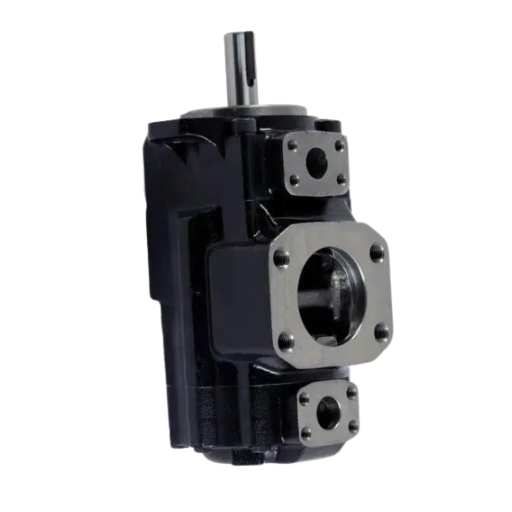
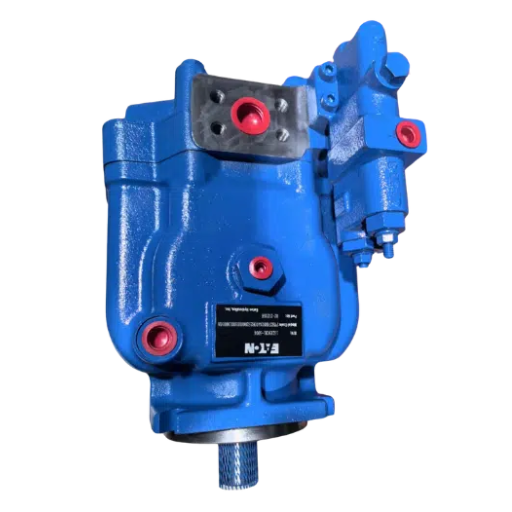
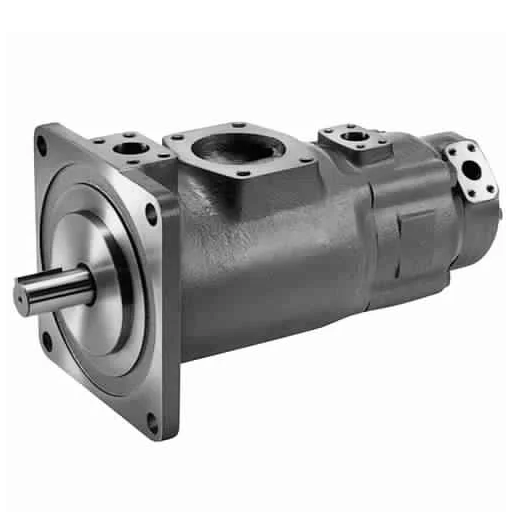
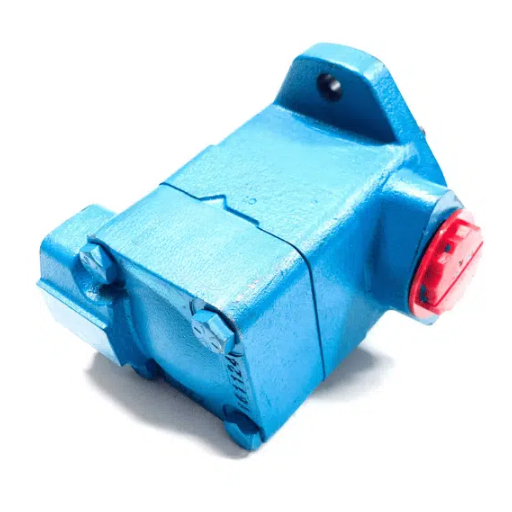
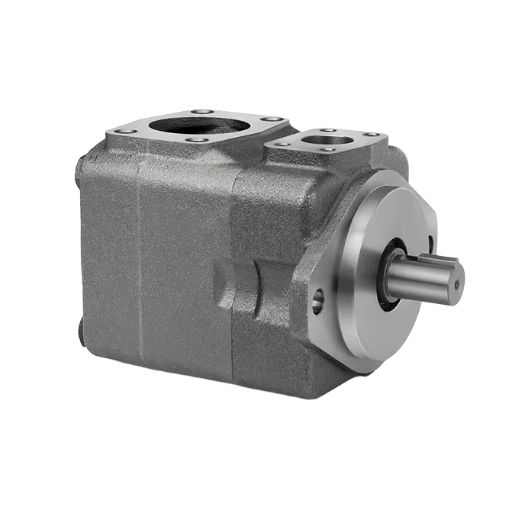
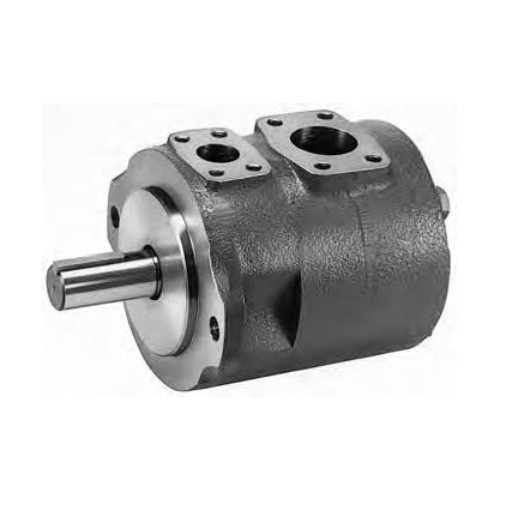
A Tokimec SQP triple vane pump is a Tokyo Keiki fixed-displacement pump with three cartridges on one shaft. Six models exist: SQP211, SQP311, SQP321, SQP421, SQP431 and SQP432. The four digits are the frame sizes, read shaft end first. Each position accepts its own list of displacement codes, and the cover-end section sets both its own pressure ceiling and the top speed for the whole pump.
Tokimec is the name most buyers still use. It was the company’s corporate name from 1990 to 2008; the manufacturer is Tokyo Keiki again, and the SQP range is still listed in its current catalogue. The brand name survived the rename, which is why the same pump appears as Tokimec, Tokyo Keiki, or both.
This guide covers the six triples and the three rules that decide whether a configuration will work: the code list for each section, the pressure and speed limits for each cover code, and the shaft-torque check. It is not a substitute for the nameplate. For the wider family, the triple vane pump guide covers section ratings and fault isolation.
Key Takeaways
- Six SQP triples exist, and the model number is the frame stack: SQP432 is frame 4 at the shaft end, frame 3 in the middle and frame 2 at the cover end.
- Each position draws its displacement code from a different list. An SQP421 accepts only cover codes 7, 8, 9 and 11; an SQP432 accepts only 10 to 21.
- The cover-end code sets the maximum speed. An SQP311 runs 1,800 min⁻¹ with cover code 2 and 1,000 min⁻¹ with cover code 8, both on mineral oil.
- Pressure is not one figure for the pump. Most sections are rated 17.5 MPa, small cover codes are limited to 14 MPa, and phosphate-ester fluid caps the unit at 14 MPa.
- The shaft-torque limit is a sum across three sections. Tokyo Keiki’s example: 111.7 kW at 1,200 min⁻¹ gives 889.3 N·m against a 950 N·m limit.
What a Tokimec SQP triple vane pump is
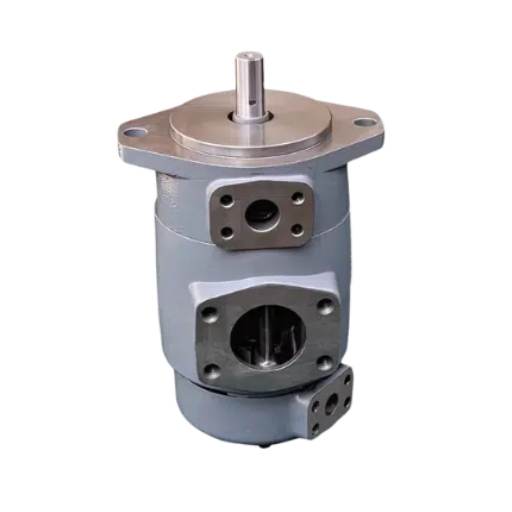
An SQP triple is one housing, one drive shaft, and three vane cartridges. Fluid enters through a common suction passage, and each cartridge discharges through its own delivery port. In practice, each outlet feeds a separate circuit with its own relief valve, which is how a triple replaces three pumps, three couplings, and three mounting pads.
The cartridges are the same rotating groups used in the single pumps of the matching frame. That is why maintenance is cartridge-level work: the shaft stays in place, and a section can be reworked without splitting the unit.
Two design details matter in comparisons. The vanes are pressure-loaded from below through an intra-vane passage, which keeps the tips against the cam ring as pressure rises. The SQPS variant adds pulsation damping chambers to the delivery side; Tokyo Keiki describes these as reducing pressure pulsation and overall noise. For a noise-sensitive machine, ask for the SQPS build rather than a standard SQP.
The six models and what the four digits mean
The digits after SQP are frames, not a grade and not a displacement. SQP432 means a frame-4 section at the shaft end, a frame-3 section in the middle, and a frame-2 section at the cover end.
| Model | Shaft end | Middle | Cover end | Shaft torque limit | Weight, flange / foot | Total displacement |
|---|---|---|---|---|---|---|
| SQP211 | SQP2, codes 10 to 21 | SQP1, codes 2 to 14 | SQP1, codes 2 to 8 | 360 N·m | 40.0 / 49.5 kg | 47.5 to 135.4 cm³/rev |
| SQP311 | SQP3, codes 17 to 38 | SQP1, codes 7 to 14 | SQP1, codes 2 to 8 | 610 N·m | 60.0 / 69.5 kg | 83.7 to 188.4 cm³/rev |
| SQP321 | SQP3, codes 17 to 38 | SQP2, codes 10 to 15 | SQP1, codes 2 to 7 | 610 N·m | 62.0 / 71.5 kg | 93.3 to 187.6 cm³/rev |
| SQP421 | SQP4, codes 30 to 60 | SQP2, codes 17 to 21 | SQP1, codes 7 to 11 | 950 N·m | 88.0 / 113.0 kg | 171.4 to 289.0 cm³/rev |
| SQP431 | SQP4, codes 30 to 60 | SQP3, codes 17 to 38 | SQP1, codes 2 to 14 | 950 N·m | 97.0 / 122.0 kg | 156.8 to 351.2 cm³/rev |
| SQP432 | SQP4, codes 30 to 60 | SQP3, codes 17 to 38 | SQP2, codes 10 to 21 | 950 N·m | 104.0 / 129.0 kg | 181.8 to 372.0 cm³/rev |
The total displacement column is arithmetic, not a catalogue figure: add the three sections at 1,000 min⁻¹. It shows the real spread. An SQP211 starts around 47.5 cm³/rev and an SQP432 reaches 372 cm³/rev, which is why “SQP triple” alone says very little about flow.
Two constraints sit inside the table. The cover-end list shrinks as the stack grows: SQP211 and SQP311 accept cover codes 2 to 8, SQP321 stops at 7, SQP421 starts at 7, SQP431 goes to 14, and SQP432 moves to the SQP2 list. The lists also skip numbers. The SQP1 frame has no codes 10 or 13, so “2 to 14” means the eleven codes that exist.
These figures, and the pressure and speed tables later in this guide, come from Tokyo Keiki’s SQP triple catalogue. It is published as a PDF, which is why the numbers rarely appear in article form elsewhere.
If you are reading a nameplate for the first time, the field-by-field model code method covers fluid prefix, shaft code, port letters, rotation, and design number.
Three sections, three displacement lists
Each frame has one displacement table. The same code means the same displacement wherever it appears, but the code ranges differ by frame, and that is where ordering mistakes start.
| Frame | Codes and delivery at 1,000 min⁻¹ (L/min, numerically the displacement in cm³/rev) |
|---|---|
| SQP1 | 2 = 7.5, 3 = 10.2, 4 = 12.8, 5 = 16.7, 6 = 19.2, 7 = 22.9, 8 = 26.2, 9 = 28.3, 11 = 35.0, 12 = 37.9, 14 = 44.2 |
| SQP2 | 10 = 32.5, 12 = 38.3, 14 = 43.3, 15 = 46.7, 17 = 52.5, 19 = 59.2, 21 = 65.0 |
| SQP3 | 17 = 53.3, 21 = 66.7, 25 = 79.2, 30 = 95.0, 32 = 100.0, 35 = 109.0, 38 = 118.0 |
| SQP4 | 30 = 96.0, 35 = 109.0, 38 = 128.0, 42 = 134.0, 50 = 156.0, 60 = 189.0 |
Tokyo Keiki lists delivery at 1,000 min⁻¹ and 0.7 MPa. Because the speed is exactly 1,000 rpm, the litres-per-minute figure equals the geometric displacement in cm³/rev. That equivalence is convenient, and it stops being true the moment you change speed: flow scales with rpm, displacement does not.
Take the catalogue’s own example, SQP432-60-38-14. Code 60 is an SQP4 section at 189.0 cm³/rev, code 38 is an SQP3 section at 118.0, and code 14 is an SQP2 section at 43.3. Total displacement is 350.3 cm³/rev, and at 1,200 min⁻¹ the theoretical delivery is about 420 L/min before volumetric efficiency is considered.
Now check those three numbers against the lists in the model table. SQP432 accepts shaft 30 to 60, middle 17 to 38, and cover 10 to 21, so 60-38-14 is valid. Put the same 14 in the middle position, and it is not: the middle list is the SQP3 list, 17 to 38. A build sheet reading SQP432-60-14-38 is either mistyped or a special, and it should be confirmed before anyone quotes it.
Pressure and speed are set by the cover-end section
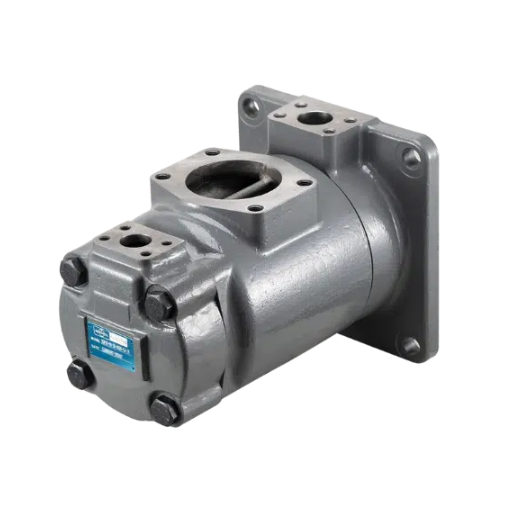
This is the part of the catalogue that gets copied least and matters most. The cover-end code sets the pressure ceiling for that section and the maximum speed for the entire pump.
| Model | Cover codes | Cover max working pressure | Max speed, mineral oil, by cover code |
|---|---|---|---|
| SQP211 | 2 to 8 | 14 MPa on codes 2 and 3, 17.5 MPa on 4 to 8 | 1,800 (2 to 4), 1,500 (5 to 6), 1,200 (7), 1,000 (8) |
| SQP311 | 2 to 8 | 14 MPa on 2 and 3, 17.5 MPa on 4 to 8 | 1,800 (2 to 5), 1,500 (6), 1,200 (7), 1,000 (8) |
| SQP321 | 2 to 7 | 14 MPa on 2 and 3, 17.5 MPa on 4 to 7 | 1,800 (2 to 5), 1,500 (6), 1,200 (7) |
| SQP421 | 7 to 11 | 17.5 MPa on all listed codes | 1,500 (7), 1,200 (8), 1,000 (9 and 11) |
| SQP431 | 2 to 14 | 14 MPa on 2 to 6, 17.5 MPa on 7 to 11, 16 MPa on 12, 14 MPa on 14 | 1,800 (2 to 9), 1,500 (11 to 14) |
| SQP432 | 10 to 21 | 17.5 MPa on all listed codes | 1,800 (10), 1,500 (12 and 14), 1,200 (15 to 21) |
Water-glycol and phosphate-ester builds run slower. Depending on the cover code, maximum speed falls from 1,200 to 1,000 min⁻¹, and the minimum for all models is 600 min⁻¹. Phosphate-ester fluid also caps maximum working pressure at 14 MPa across the pump, which overrides the 17.5 MPa figures above.
The practical consequence is simple. An SQP311 with cover code 2 is a 1,800 rpm pump. The same model with cover code 8 is a 1,000 rpm pump. Nothing else on the nameplate changes. If a maintenance team replaces a failed unit with the same model but a larger cover section, the machine may no longer reach its cycle speed, and the fault will look like a drive or valve problem.
Pressure follows the same logic. Small cover codes on SQP211, SQP311, and SQP321 are limited to 14 MPa, and SQP431 codes 12 and 14 step down to 16 and 14 MPa. A buyer who reads “17.5 MPa” on a supplier page and specifies cover code 2 on an SQP321 has ordered a section that will relieve at 14 MPa.
The middle section has its own exceptions. On the SQP211, middle codes 2 to 6 are limited to 14 MPa. On the SQP311, middle code 12 is 16 MPa and code 14 is 14 MPa. Check the section, not the model.
Safety note: isolate the pump from its drive, release pressure at all three outlets and lock out the machine before you open any cartridge. A triple can hold pressure in a section you are not working on.
The shaft-torque check that stops a valid-looking build
Three sections share one shaft, so the torque limit applies to the sum, not to each section.
| Model | Shaft torque limit |
|---|---|
| SQP211 | 360 N·m |
| SQP311 | 610 N·m |
| SQP321 | 610 N·m |
| SQP421 | 950 N·m |
| SQP431 | 950 N·m |
| SQP432 | 950 N·m |
The formula is T = (9554 / N) × L, where N is the operating speed in min⁻¹, and L is the sum of shaft input power in kW. The catalogue’s example uses SQP432-60-38-14 1,200 min⁻¹ with each section at maximum working pressure. The shaft inputs are 57.1 kW, 36.2 kW, and 18.4 kW, a total of 111.7 kW. Torque is 9554 × 111.7 / 1200 = 889.3 N·m, below the 950 N·m limit.
Run the same build at a higher pressure on the large section, or fit a larger cover section, and the sum can cross the limit without any single component looking wrong. A configuration can be dimensionally correct, use valid codes, and still overload the shaft.
When the sum exceeds the limit, the options are to reduce pressure duty on the largest section, reduce speed, or change the frame stack. Adding a bigger cover section to gain flow often makes the problem worse, because it adds torque at the cover end and can lower the speed ceiling at the same time.
Port letters do not mean the same thing on every model
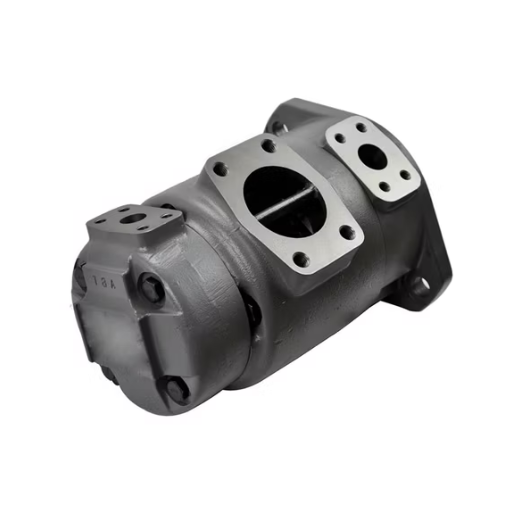
The ordering code uses letters for delivery port positions, viewed from the cover end. The letters are not a universal compass. The same letter means different angles on different model groups, and the cover-end group is not the same as the middle group.
| Position | Models | A | B | C | D |
|---|---|---|---|---|---|
| Shaft end | All six | Opposite suction port | 90° CCW | Inline with suction | 90° CW |
| Middle | SQP211, SQP311, SQP321, SQP421 | 135° CCW | 45° CCW | 45° CW | 135° CW |
| Middle | SQP431, SQP432 | Opposite suction port | 90° CCW | Inline with suction | 90° CW |
| Cover end | SQP211, SQP311, SQP431, SQP432 | 135° CCW | 45° CCW | 45° CW | 135° CW |
| Cover end | SQP321, SQP421 | Opposite suction port | 90° CCW | Inline with suction | 90° CW |
A string copied from an SQP421 to an SQP431 can describe a different port layout even though the letters match. On the SQP421, the cover letter C means inline with the suction port. On the SQP431, it means 45° clockwise, and the hoses were built around the old answer.
The mounting field has a similar trap. Flange mounting is blank; foot mounting uses a two-digit code, and the second digit gives the shaft-end delivery port position relative to the foot: 2 is up, 23 is right, 26 is down, and 29 is left. A foot-mounted pump ordered by the wrong code will bolt down and then point its main delivery the wrong way.
Our SQP series page lists the configurations we supply, and the catalogue’s field-by-field table is the final check. Photograph the nameplate before you order; a string typed from memory is how most of these errors start.
Cartridge kits: three per pump, and the number depends on position
Every triple carries three cartridge kits, labelled A, B and C. Kit A is the shaft-end section, B is the middle, and C is the cover end. The same displacement code can appear in more than one position, but the kit part number changes with the position because the cartridge construction differs.
Three details from the OEM kit table are worth writing down before a rebuild:
- Kits include seals but not the shaft seal. The shaft seal is ordered separately.
- Left-hand rotation kits carry an L suffix. A clockwise kit is not interchangeable with the counter-clockwise version.
- Water-glycol builds use F11-prefixed kits. Phosphate-ester builds use F3-prefixed pumps and compatible seals, and the pump is derated to 14 MPa.
Part numbers sit in the VA series and are listed against each displacement code and position. Because the table marks some kits as not applicable to every series, quote the full model string when you ask for a kit rather than the displacement code alone.
Rebuild economics are straightforward. One failed section is usually worth a kit; three tired sections, a worn shaft or an overheated housing point to a replacement pump. The cartridge kit procedure covers removal and refitting, and the pillar guide explains how to work out which section has failed before you buy.
Installation and fluid limits that decide pump life
Most SQP failures that are not wear-related come from installation and fluid, not from the pump. Tokyo Keiki’s operating notes give hard numbers.
| Parameter | Limit |
|---|---|
| Viscosity, running | 13 to 54 mm²/s |
| Viscosity, start-up | Up to 860 mm²/s permitted, with warm-up |
| Fluid temperature | Below 65 °C |
| Suction pressure, mineral oil | +35 to −16.7 kPa |
| Suction pressure, water glycol and phosphate ester | +35 to −10.1 kPa |
| Suction strainer | 150 µm or equivalent tank filter |
| Return filtration | Below 25 µm, or a bypass filter below 10 µm |
| Shaft alignment | Within 0.05 mm total indicator reading |
The warm-up rule is specific and often skipped. If viscosity at start-up is above 54 mm²/s, run the pump at no more than half its maximum working pressure until the fluid thins below that figure. Cold starts at full pressure are a common cause of early vane and cam-ring wear.
These limits come from Tokyo Keiki’s notes on using vane pumps, which apply to the SQP family, including the triples.
Piping and alignment matter as much as the numbers. Keep the suction line short and large, with few bends and a flow velocity of 0.5 to 1.5 m/s. Use a flexible coupling, but not a tire-type coupling, and do not hang a belt, chain, or gear load on the shaft. The catalogue states that there should be no external radial or thrust load on the shaft end. A triple already carries three rotors, and a side load from a misaligned drive adds to it.
Buying or replacing an SQP triple: what to send
The fastest way to get the right Tokimec SQP triple vane pump is to send the field data, not the model name. Five items cover almost every inquiry:
- A photograph of the nameplate, with the full string legible.
- All three displacement codes, in shaft-end, middle, and cover-end order.
- The three port letters and the mounting code, including foot orientation if fitted.
- The rotation letter, LH or blank, and the fluid prefix, F3 or F11 if present.
- The design number at the end of the string, plus the duty for each circuit: pressure, flow, and whether it is continuous or intermittent.
One field needs a question rather than an assumption. Supplier listings show a -T suffix on some SQP432 builds and describe it as a variant that unloads the two larger sections during a pressure hold, leaving the small section to maintain pressure. Tokyo Keiki’s triple catalogue does not document that suffix. Treat it as a build option to confirm with the supplier or the OEM, not as a standard code you can infer.
The same caution applies to the word “compatible”. A replacement SQP triple can be dimensionally and hydraulically equivalent without being original equipment. Ask which it is, and ask for the kit numbers, the pressure setting of each section, and the speed limit for the cover code you are buying. If a listing gives one pressure for all three sections, it has not read the table.
For the other common triple architecture, please read our article on Denison triple vane pumps.
FAQ
What does SQP432 mean?
SQP432 is a triple with a frame-4 shaft-end section, a frame-3 middle section, and a frame-2 cover-end section. InSQP432-60-38-14, the codes are 60 on the SQP4 list (189.0 cm³/rev), 38 on the SQP3 list (118.0) and 14 on the SQP2 list (43.3), for 350.3 cm³/rev total.
Is Tokimec still in business?
Tokimec was the corporate name of Tokyo Keiki from 1990 to 2008. The company restored the Tokyo Keiki name in 2008, and the SQP range is still listed in its current vane pump catalogue. Pumps and parts are sold under both names.
Which section of my SQP triple sets the pressure limit?
The lowest-rated section in that build. Most sections are 17.5 MPa, but small cover codes on the SQP211, SQP311, and SQP321 are 14 MPa; SQP431 cover codes 12 and 14 are 16 and 14 MPa, and phosphate-ester fluid caps the pump at 14 MPa. Check the cover code first, then the middle code.
What does the -T suffix mean on an SQP triple?
Supplier listings describe -T as an unloading variant in which the two larger sections are unloaded during a pressure hold while the small section maintains pressure. Tokyo Keiki’s triple catalogue does not document the suffix, so confirm it on the build sheet before treating it as standard.
Can I replace one cartridge instead of the whole pump?
Yes, if the housing and shaft are serviceable. Kits are position-specific: A for the shaft end, B for the middle, C for the cover end, and the shaft seal is separate. If two or three sections are worn, or the shaft is damaged, a complete replacement is usually the better decision.
What is the difference between SQP and SQPS?
SQPS is the low-pulsation build of the same Tokimec triple vane pump. It adds pulsation damping chambers to the delivery side, which Tokyo Keiki describes as reducing pressure pulsation and overall noise. Displacement codes follow the SQP family.
Conclusion
A Tokimec SQP triple vane pump is not a bigger single pump. It is three cartridges with three code lists, three pressure ceilings, and one shared torque limit. The model number gives the frame stack, the cover code sets the speed, and the torque sum decides whether a valid-looking build will survive its duty.
The next step is physical, not theoretical. Photograph the nameplate, write down the full string and the three codes, and note the pressure and flow each circuit actually needs. With those five items, a configuration can be checked against the OEM tables in minutes instead of after a failed start-up.
LOYAL INDUSTRIAL PTE. LTD. supplies the Tokimec SQP triple vane pump range and its replacement cartridges, and can review a configuration against the nameplate string before you commit to a rebuild or a replacement. Send the string, the three codes, and the duty for each circuit, and ask for the configuration review.