The cheapest vane pump on the quote sheet is rarely the cheapest one you’ll buy.
Consider a replacement ordered against a drawing that matched on the flange. The mounting bolt pattern lined up, the quote came in 40% below the incumbent brand, and the pump arrived on schedule. Then it failed inspection. The shaft form was wrong: the original used a keyed shaft, and the replacement used a splined one.
The mismatch surfaced during a scheduled shutdown, not at goods-in. The line sat idle for four days while a correct unit was airfreighted in. On paper, that pump cost less. In reality, it cost a production week.
That story repeats across industrial procurement. The market for hydraulic vane pumps is crowded with listings and short on verification. Hundreds of companies present themselves as manufacturers. Almost none of them can prove it from a search result.
If you’re an OEM machine builder, a distributor, or a maintenance buyer, this guide gives you a working method. It shows how to tell a real hydraulic vane pump manufacturer from a trading company, verify an interchange claim before you commit, and assemble a request that gets a correct quotation the first time.
Request a technical specification sheet from our engineering team and compare it against your drawing before you shortlist anyone.
What Does a Hydraulic Vane Pump Manufacturer Actually Do?
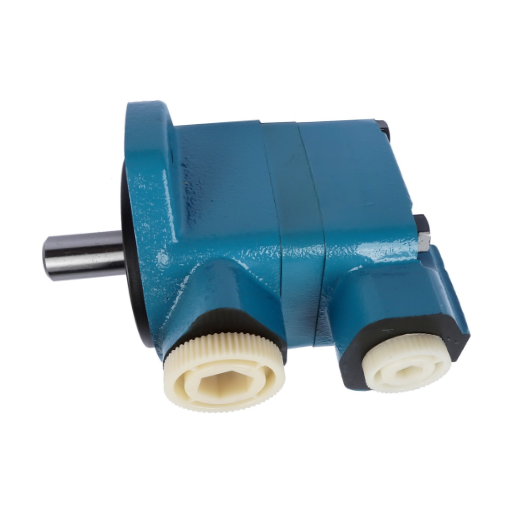
A genuine vane pump manufacturer machines, assembles, and tests the pump in-house. That last word is the one that matters.
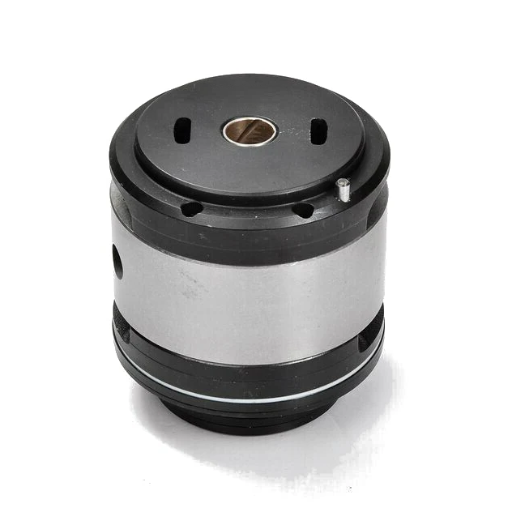
The core work is the rotating group and its housing. A vane pump manufacturer produces the rotor, the vanes and intra-vanes that slide in it, the cam ring the vanes ride against, and the inlet and outlet support plates that close the pumping chamber. Each of those parts carries a tolerance measured in microns, and the pump only performs if they are held together.
The distinction between a manufacturer and a trading company is not marketing language. It’s a question of capability. A trading company buys a finished pump and resells it. It can’t change a displacement, can’t hold a tolerance across batches, and often can’t decode the model code it’s quoting.
Machining Scope: Rotor, Cam Ring, Vanes, and Support Plates
Ask what the supplier machines itself. A full manufacturer runs CNC grinding and honing on the cam ring bore, grinds the rotor slots, and finishes the support plates to a flatness tolerance. An assembly-only operation buys those parts from someone else and bolts them together.
Neither model is automatically worse. But you should know which one you’re buying from, because it determines who is accountable when a batch drifts.
The Red Flags of a Trading Company
A trading company can be a legitimate partner, but it should be priced and treated as one. Warning signs appear quickly once you ask direct questions.
- No in-house test bench, or a bench that has never produced a per-unit report
- Refusal to name the actual manufacturing entity on the Certificate of Origin
- Price 30% or more below every other quote for identical specifications
- Inability to supply cartridges or spare parts for the pump it just sold you
For a deeper technical baseline on how these pumps are built and where they are used, the complete guide to hydraulic vane pumps covers types, working principle, and selection in full.
Types of Hydraulic Vane Pump Manufacturers and Suppliers
Not every sourcing problem needs a factory. Match the supplier type to the job.
| Supplier Type | Capability | Typical MOQ | Lead Time | Best For | Main Risk |
|---|---|---|---|---|---|
| Factory-direct OEM manufacturer | In-house machining, per-unit testing, custom displacement and shafting | 1 to 50 pcs (varies) | 15 to 30 days standard; 8 to 12 weeks custom | OEM programs, volume, private label, drop-in replacements | Longer sample approval cycle |
| Trading company / export agent | Sourcing and logistics only | 1 pc | 1 to 3 weeks | One-off units, hard-to-find models | No dimensional accountability |
| Brand distributor (authorized) | Genuine OEM brand units and warranty | 1 pc | 4 to 16 weeks | Critical-duty machines, warranty-sensitive spec | Highest unit price |
| Aftermarket / interchange supplier | Interchange units and spare parts | 1 pc | 1 to 4 weeks | Cost-driven replacement of compatible models | Interchange claims need verification |
Factory-Direct OEM Manufacturers
This is the type most buyers want and the hardest to confirm. A factory-direct hydraulic vane pump supplier owns the machining, the assembly, and the test process. The reward is dimensional control and a price without distribution layers.
The trade-off is diligence. You must verify the factory, and the verification takes a visit or a documented audit rather than a promise.
Trading Companies and Export Agents
Trading companies add value in logistics and in reaching models a factory doesn’t stock. Use them deliberately. Ask which factory produces the unit, and get that name on the documentation.
Brand Distributors and Authorized Channels
When a pump sits on a machine where failure stops a plant, the price premium of a brand distributor can be justified by warranty and traceability. Judge it as insurance, not as waste.
Aftermarket and Interchange Suppliers
These suppliers sell units built to interchange with Vickers, Denison, Parker, and Tokimec designs. The savings are real, and so is the variability. Interchange is where the flange-versus-shaft failure above originates, so treat every claim as a hypothesis to test.
Certifications and Quality Standards to Verify
Certification is a baseline, not a guarantee. Understand what each document actually proves before you weigh it.
ISO 9001:2015 as the Baseline
ISO 9001:2015 shows that a supplier runs a documented quality management system. It says nothing about whether a specific pump you receive will hit its rated pressure. Treat it as the entry ticket, not the score.
Per-Unit Performance Testing vs a Generic Datasheet
This is the single most useful evidence you can request. A real manufacturer can supply a performance record for the unit in the crate: flow against rated displacement, pressure hold, and internal leakage. A generic catalogue sheet tells you what the design can do. A test record tells you what this pump did.
Ask for the record on a specific serial number, then ask whether you can receive the same record for the next order.
Material and Heat-Treatment Verification
Vane pump life depends on the cam ring and vane surfaces. Genuine manufacturers can supply material certificates for the cam ring alloy and the heat-treatment specification that sets its surface hardness. If a supplier describes the material only as “high-grade alloy steel” with no grade and no hardness value, that vagueness is the answer.
Certificate of Origin, Test Records, and Traceability
Three documents separate a documented supplier from a sales page.
- Certificate of Origin naming the actual manufacturing entity
- Per-unit test records tied to serial numbers
- Nameplate and model code that reconcile with your original drawing
A supplier who can’t produce all three is asking you to carry the risk they won’t.
Specifications to Confirm Before You Order
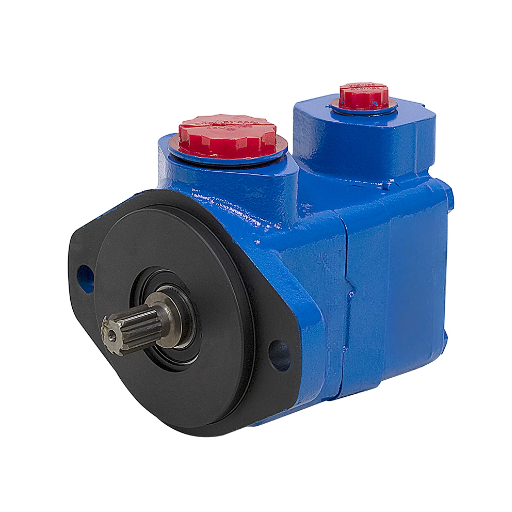
Most failed orders trace to a specification left vague in the request. Confirm these fields before a purchase order is issued.
Displacement, Pressure Rating, and Speed Range
Vane pumps are commonly grouped by displacement. Small units run around 7 to 20 cm³/rev for compact circuits. Mid-range pumps cover 20 to 45 cm³/rev for injection molding and die-casting. Large units sit above 45 cm³/rev for heavy machinery. Match displacement, continuous pressure, and operating speed together, because each constrains the others. For sizing ring travel around those duty points, work through our vane pump sizing procedure rather than estimating from a nameplate.
Continuous vs Intermittent vs Peak Pressure
Insist that any quotation separates continuous, intermittent, and peak pressure. A supplier who quotes a single maximum number without qualification is telling you how they specify everything.
For reference, Parker rates the Denison T6 series to 320 bar and the T7 series to 275 bar, and those figures depend on displacement and speed. Confirm them against the specific manual for your model, not against a summary table.
Shaft Form, Mounting Pattern, Pilot, and Port Position
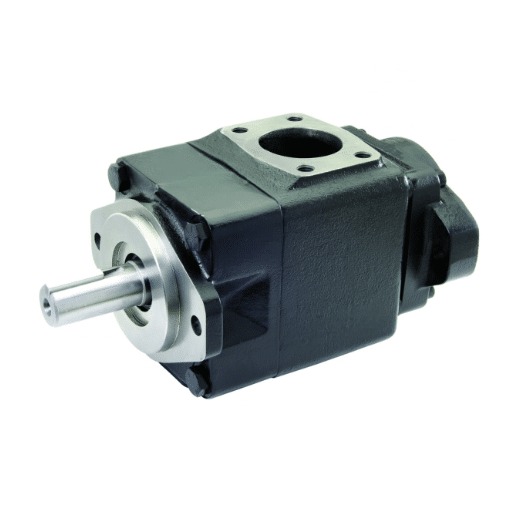
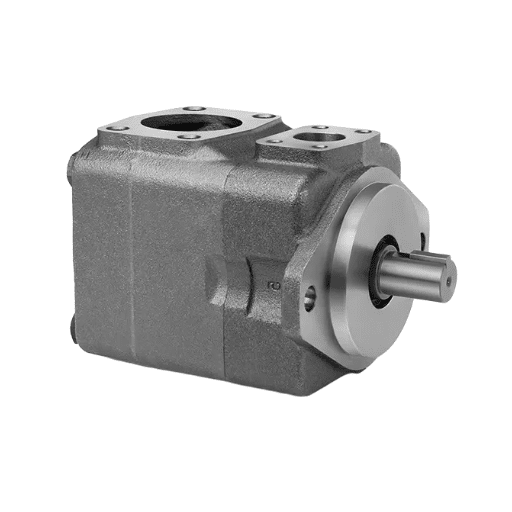
These four interface points decide whether the pump physically fits. Flange compatibility alone proves almost nothing. A pump can match the mounting pattern and still fail on shaft form, pilot diameter, or port orientation.
Rotation Direction
Rotation is either biorotational or unirotational, and the difference isn’t cosmetic. Some designs convert by reversing port plates and the cam ring. Others are built for one direction only and carry a suffix in the model code to mark it. Order the wrong one and the pump won’t build pressure.
Housing Material
Cast iron and aluminum housings behave differently under pressure and in weight-sensitive mobile applications. If the original used cast iron, confirm that the replacement is not a lighter aluminum unit unless the application allows it. The comparison of aluminum versus steel hydraulic pumps is worth a look when material choice is open.
The Interchange Claim Trap: How to Verify Drop-In Fit
Almost every aftermarket supplier advertises hydraulic vane pumps as interchangeable with Vickers, Denison, or Parker. Those claims hold only when verified against the full interface. A matching flange is not a match.
Picture a distributor who received a batch of “fully interchangeable” pumps for a mining customer. The flanges fit, the pumps ran, and three of the twelve leaked at the pilot within the first month. The supplier had matched the mounting pattern and ignored the pilot diameter. The distributor absorbed the replacements and the customer’s goodwill.
The Full-Interface Check
Verify six points against the original drawing before you accept an interchange claim.
| Interface Point | What to Confirm | Why It Fails |
|---|---|---|
| Mounting pattern | SAE or ISO flange standard and bolt spacing | Adapter made to fit the wrong standard |
| Shaft form | Keyed, splined, or tang, with dimensions | Coupling will not engage |
| Pilot diameter | Bore diameter and concentricity | Leakage or misalignment |
| Bolt pattern | Thread size and count | Fasteners do not seat |
| Rotation direction | CW or CCW with the correct suffix | Pump does not build pressure |
| Port position | Inlet and outlet locations and orientation | Piping cannot be routed |
Cross-Reference Families
Interchange claims usually travel along a known family line rather than across the whole market. Common vane pump families include the Vickers and Eaton V, VQ, V10, and V20 series; the Denison and Parker T6, T67, and T7 series; the Tokimec SQP series; and the Yuken PV2R series. Aftermarket manufacturers frequently build to these families directly.
Use a cross-reference as a starting hypothesis. Then confirm it against the OEM drawing and part number for your exact model.
What “100% Interchangeable” Really Means
In practice, the phrase means the supplier believes the pump will fit and perform. It’s a claim, not a certification. The protection is the cross-reference number on the documentation and a fit check before the unit goes into service.
When your need is a repair rather than a whole pump, the vane pump cartridge kits guide covers kit-level interchange, installation, and cost, which is a separate sourcing decision from buying a complete unit.
The RFQ Data Set That Gets a Correct Quote First Time
An incomplete request produces a quote that has to be re-issued, and a re-issued quote costs you a full lead time. Send the complete data set once.
Send these fields for every vane pump enquiry:
- Nameplate details and the full model code from the original pump
- Photographs of both port faces and of the shaft
- Pump type and configuration (single, double, or triple)
- Displacement of each section in cm³/rev
- Combined shaft power required
- Required flow and the drive speed
- Inlet capacity and suction line size
- Continuous pressure rating and duty cycle (continuous, intermittent, or peak)
- Cold-start viscosity and the hydraulic fluid grade in use
- Rotation direction and coupling details
A supplier who reviews a request this complete is being asked a technical question, not a price question. That shift is where accurate quotations come from.
OEM, Private Label, and Custom Vane Pump Manufacturing
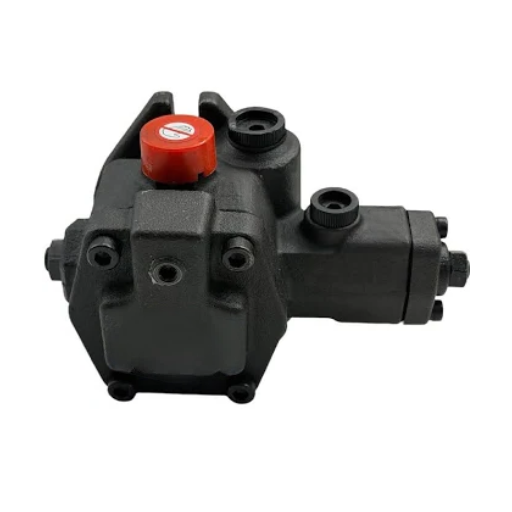
For machine builders and distributors, a vane pump manufacturer becomes a design partner rather than a parts counter.
What Custom Manufacturing Can Change
A capable manufacturer can adjust displacement, shaft form, port positions, rotation, and housing to suit a specific machine. It can also produce a unit designed for variable displacement operation when the application calls for flow control rather than fixed output.
Tooling, NRE, and the Sample Approval Workflow
Custom work follows a sequence: requirement analysis, design engineering, prototype testing, and then production. Expect non-recurring engineering costs where new tooling is required, and expect a sample approval step before volume release. Treat first-article approval as a gate, not a formality.
Private Label and Distributor Programs
Private label arrangements let a distributor carry its own branding on a manufacturer’s platform. Two terms decide whether the program works: the supplier’s ability to hold tolerances across production batches, and its commitment to supply cartridges long after the first order.
Talk to an engineer about an OEM or private-label program and get a sample and specification package for your application.
China Factory-Direct vs OEM-Brand: What the “Brand Tax” Actually Buys
One aftermarket manufacturer has made a marketing argument out of the price gap, claiming that factory-direct vane pumps run at roughly a third of OEM cost and that the difference reflects brand overhead rather than engineering. The claim is worth examining, because it contains both a real point and an unproven one.
What Factory-Direct Saves
Factory-direct sourcing removes distribution layers, and those layers carry real cost. A direct manufacturer can also adapt a design faster than a large corporate purchasing cycle allows, which matters when a machine needs a non-standard port configuration.
What the Brand Premium Buys
The premium is not purely marketing. It buys a documented warranty, traceability to a global part network, and often a tested consistency that a new supplier has to prove rather than assert. On a pump whose failure halts production, that insurance has a value.
Reading Cost Claims Critically
A claimed 33% cost ratio is a supplier claim, not a benchmark. It typically rests on an illustrative example rather than a controlled test, and it usually omits load time, warranty terms, and spares pipeline. Treat any dramatic cost figure as the opening of a conversation, not its conclusion.
For sourcing across all pump families rather than vane pumps alone, the hydraulic vane pump guide is the reference point for this cluster and covers types, working principle, and selection in full.
MOQ, Lead Times, and Pricing Benchmarks
Commercial terms vary by supplier type, but the ranges below are typical market benchmarks to calibrate your expectations.
| Order Type | Typical MOQ | Typical Lead Time | Notes |
|---|---|---|---|
| Aftermarket unit, in stock | 1 pc | 24 to 48 hours | Fastest; verify interchange claim |
| Standard production unit | 1 to 10 pcs | 15 to 30 days | Confirm test record availability |
| Custom OEM build | 10 to 50 pcs | 8 to 12 weeks | Includes sample approval stage |
| Brand-name factory order | 1 pc | 12 to 26 weeks | Longest; highest unit price |
Price Tiers and Volume Breaks
Published listings for Denison and Parker T6 and T7 class vane pumps have appeared around USD 185 to USD 211 with a minimum order of one piece, and cartridge kits for common families range from roughly USD 38 to USD 220 depending on brand and seal material. Treat all of these as order-of-magnitude anchors with a date, not quotations. Pricing shifts with brand, seal elastomer, and quantity.
The Terms That Outweigh Unit Price
Three commercial terms deserve more attention than the price line.
- Warranty duration and what it actually covers
- Spare-parts availability and lead time after the sale
- The supplier’s historical on-time delivery record
Ask for reference customers and check them. A supplier unwilling to provide references is answering the question.
How to Vet a Hydraulic Vane Pump Manufacturer
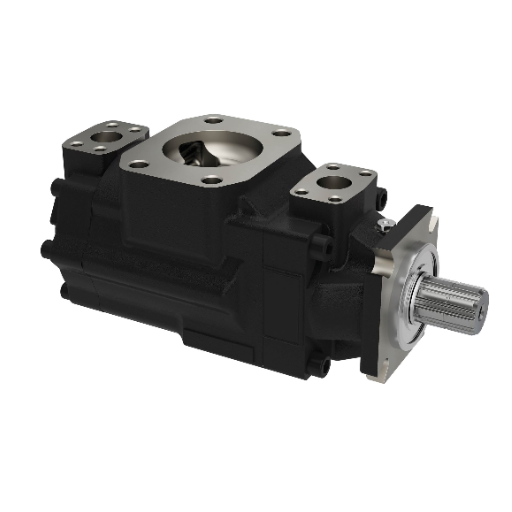
Use this scorecard to compare candidates on one page. Weight the criteria to your application and score each supplier from 1 to 5.
| # | Criterion | What to Verify | Weight |
|---|---|---|---|
| 1 | Manufacturing capability | In-house machining of rotor, cam ring, vanes, plates | High |
| 2 | Quality certification | ISO 9001:2015 and the scope it covers | High |
| 3 | Per-unit test evidence | Pressure and flow records tied to serial numbers | High |
| 4 | Material traceability | Certificates for cam ring alloy and heat treatment | High |
| 5 | Dimensional accuracy | Drop-in verification against your drawing | High |
| 6 | Customization capability | Displacement, shaft, port, and rotation changes | Medium |
| 7 | Spares availability | Cartridge and seal kit supply with stated lead times | Medium |
| 8 | Warranty terms | Duration and coverage in writing | Medium |
| 9 | Commercial terms | MOQ, lead time, and pricing structure | Medium |
| 10 | References | Verifiable customers in comparable applications | Medium |
Operational KPIs to Benchmark
Beyond the factory audit, measure the relationship with numbers. Reasonable targets are on-time delivery of 95% or better, a reorder rate above 25% (which signals that customers come back), and a quotation response time under three hours during business days.
Sample Orders Before Volume
Never commit to volume on a specification sheet alone. Order one unit, run it on a bench or in a monitored application, and confirm flow at rated conditions and pressure hold before scaling. A sample that passes tells you more than a catalogue that promises.
Consider how that card works in practice. A procurement team scored three suppliers. The lowest-priced candidate failed criteria three and four; it couldn’t produce a per-unit test record or a material certificate. The team awarded the order to the second supplier, whose unit price was 12% higher.
Over the next two years, that pump ran without a warranty claim. The rejected supplier’s trial unit had already come back twice. The scorecard didn’t choose the cheapest quote. It chose the cheaper outcome.
Frequently Asked Questions
What is the difference between a vane pump manufacturer and a supplier?
A manufacturer machines, assembles, and tests the pump in-house. A supplier may only resell a finished unit without controlling dimensional quality or holding tolerances across batches. The distinction matters most for custom work and for spare-parts support after the sale.
How do I verify that a vane pump is interchangeable with a Vickers or Denison model?
Confirm the full interface, not just the flange. Check the mounting pattern, shaft form, pilot diameter, bolt pattern, rotation direction, and port position against the original drawing. Then match the cross-reference part number on the documentation.
What certifications should a hydraulic vane pump manufacturer have?
ISO 9001:2015 is the baseline. Beyond that, ask for per-unit performance test records, material certificates for the cam ring and vanes, and a Certificate of Origin naming the manufacturing entity. Certification sets a floor; test evidence proves the specific unit.
What is the typical MOQ for hydraulic vane pumps?
Chinese aftermarket suppliers frequently quote a minimum order of one piece for standard units, while custom OEM builds often start at 10 to 50 pieces. Volume pricing generally begins once the order supports a single production run.
How long is the lead time for a hydraulic vane pump?
In-stock aftermarket units ship in 24 to 48 hours. Standard production runs take roughly 15 to 30 days, custom OEM builds run 8 to 12 weeks including sample approval, and brand-name factory orders can run 12 to 26 weeks.
Can a manufacturer produce private-label or custom vane pumps?
Yes. A capable manufacturer can adjust displacement, shaft form, port positions, rotation, and housing to a specification, and can apply a distributor’s branding. Confirm tolerance control across batches and long-term cartridge supply before committing.
What specifications should I send for a vane pump quotation?
Send the nameplate and model code, port-face and shaft photographs, pump type, per-section displacement, combined shaft power, required flow and speed, inlet capacity, continuous pressure and duty cycle, fluid viscosity, and rotation direction.
Are Chinese hydraulic vane pump manufacturers reliable?
Many are, and the country of manufacture says less than the individual supplier’s evidence does. Judge on in-house machining capability, per-unit test records, material certificates, and verifiable references rather than on origin alone.
Conclusion
Choosing a hydraulic vane pump manufacturer is a verification exercise before it is a purchasing decision.
- Distinguish the factory from the broker. Ask who machines the rotor and cam ring, and get that name on the Certificate of Origin.
- Ask for evidence, not assurances. Per-unit test records and material certificates separate a documented manufacturer from a sales page.
- Verify interchange by the full interface. Mounting pattern, shaft form, pilot, bolt pattern, rotation, and port position. A matching flange proves almost nothing.
- Send the complete RFQ data set. A thorough request is the difference between one quotation and three.
- Judge total cost, not unit price. Warranty, lead time, and the spare-parts pipeline decide what the pump really costs.
LOYAL INDUSTRIAL PTE. LTD. supplies tested hydraulic vane pumps and cartridge kits with OEM customization, per-unit performance documentation, and global export. Our engineering team reviews your nameplate details and confirms drop-in dimensions and ratings before you commit.
Request OEM pump specifications and a quotation with your model details, and we will return a technical response rather than a price list alone.