Most people who search for a “double vane pump” are looking for the wrong machine, and the catalogue won’t tell them.
The name hides three different designs. A double vane pump is two cartridges on one shaft. A double-acting vane pump is one cartridge with a two-lobe ring. A “double intravane” is a vane profile, not a second pump at all. Search any two of those terms, and you get the same product listings, with no page explaining which one you actually need.
Consider a machine builder designing a die-casting cell. The machine needs three hydraulic functions: a fast low-pressure approach, a slow high-pressure intensification, and an ejection stroke. The obvious route is three separate pumps, three couplings, three mountings. One multi-cartridge vane pump with three cartridges on a single shaft does the same work in one housing, one drive, one alignment.
The catch is that the catalogue names the sections and never explains how to combine them. It lists model codes, displacement ranges, and pressure ratings. It does not show you how the cartridges stack, how to split displacement between them, or how to size the motor that drives them.
This guide closes that gap. It shows how double and triple vane pumps are built, how to read their model codes, how to choose the ratio between sections, how to compute combined shaft power, and when one multi-cartridge pump genuinely beats two separate units. It also separates “double vane” from “double-acting,” so you land on the right page before you order.
Request a configuration recommendation from our engineering team and describe the circuits your machine needs. We will propose a section ratio rather than a price.
What Is a Double Vane Pump or Triple Vane Pump?
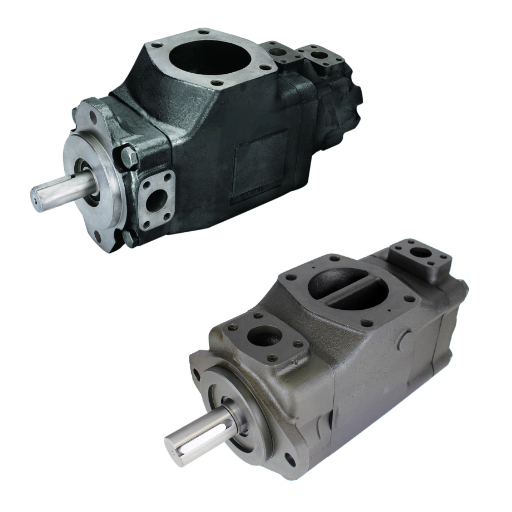
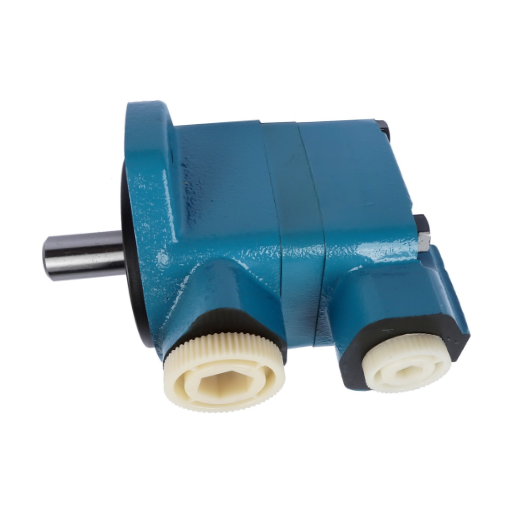
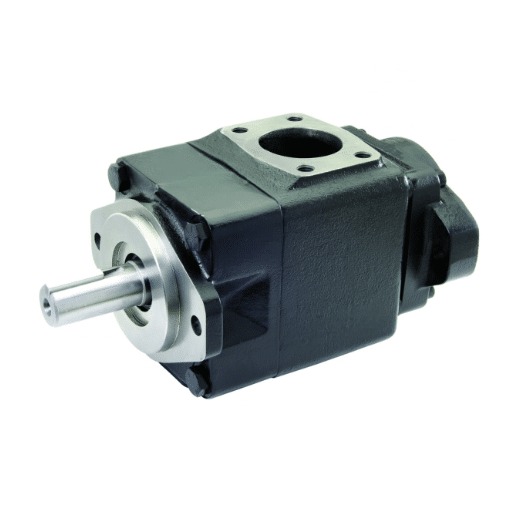
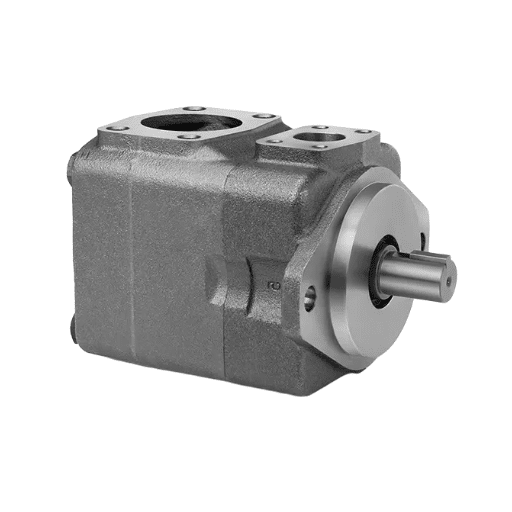
A double or triple vane pump is a hydraulic vane pump with two or three independent cartridge kits mounted on one common drive shaft inside a single housing. The sections share an inlet but deliver fluid through separate outlets, so one drive feeds two or three hydraulic circuits at different flows and pressures.
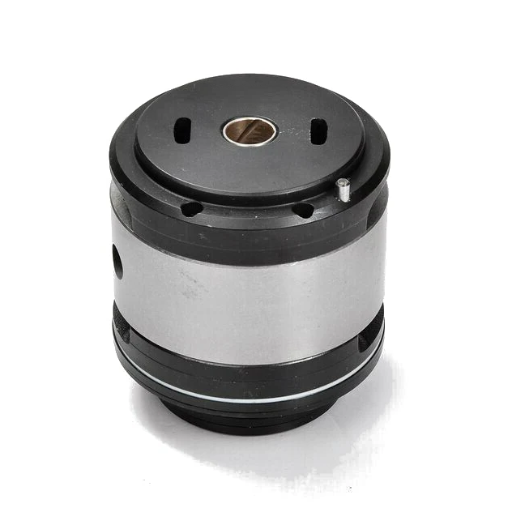
Each cartridge is a complete pumping unit: rotor, vanes, cam ring, port plates, and seals. Because the sections are independent, the flow and pressure of one circuit do not change the duty of another. The common shaft carries torque, not fluid.
| Configuration | Cartridges | Outlets | Circuits | Mounting positions | Typical use |
|---|---|---|---|---|---|
| Single | 1 | 1 | 1 | 4 | One function |
| Double | 2 | 2 | 2 | 32 | High/low circuit, two functions |
| Triple | 3 | 3 | 3 | 128 | Clamp, injection, and ejection from one drive |
The mounting-position figures come from the Denison family, and they underline a real layout advantage. Each section’s port plate can be clocked independently, so a triple pump offers 128 combinations of inlet and outlet orientation against four for a single pump. On a crowded machine base, that flexibility is often the reason the design is chosen at all.
One scope note before going further. This article covers industrial hydraulic vane pumps only: Vickers and Eaton, Denison and Parker, Tokimec, Yuken, and Bosch Rexroth families and their interchangeable equivalents. Rotary-vane vacuum pumps and fluid-transfer double pumps share the name but nothing else. For the full family picture, the complete guide to hydraulic vane pumps covers types, working principle, and selection in depth.
Double Vane vs Double-Acting: Clearing Up the Terminology
Three designs borrow the same word, and buyers confuse them constantly. Getting them straight saves a wrong purchase.
Double vane pump. Two cartridges on one shaft. This is a multi-section pump, and it is the subject of this article. The word “double” refers to the number of pumping sections.
Double-acting vane pump. One cartridge with a two-lobe (elliptical) stator. Each chamber draws in and discharges twice per revolution, and the two opposed pressure zones cancel the radial load on the shaft. The word “double” refers to the number of pumping actions per revolution, not to a second cartridge. This is a different machine on a different page: our guide to the double-acting, balanced vane pump covers the geometry and pressure limits.
“Double intravane.” Parker and Denison use this term for the double-lip, or bilabial, vane profile inside a single cartridge. It describes how a vane is built, not how many cartridges a pump contains.
Here is the short version. If you want higher pressure and quieter running from a single fixed-displacement pump, you want a double-acting design. If you want two or three circuits driven from one shaft and one motor, you want a double or triple vane pump.
That distinction matters because the two designs are sold through the same channels and appear in the same search results. A buyer who wanted the balance and pressure of a double-acting unit and received a two-cartridge pump will find the mistake expensive to unwind.
How Cartridges Stack on a Common Shaft
A multi-cartridge pump is described by its sections in physical order. The industry labels them P1, P2, and P3.
- P1, the front or shaft-end section, carries the drive coupling and takes the input torque directly.
- P2, the middle section, appears only on triple pumps.
- P3, the rear or cover-end section, closes the unit.
Each section has its own port plate and distribution windows, which is what keeps the circuits hydraulically independent even though one shaft drives them all. The shaft transmits torque; it does not carry fluid between sections. That separation is the entire point of the design.
The inlet can be common because suction pressure is low and the sections do not compete for fluid in any meaningful way. The outlets stay separate because each circuit runs at its own pressure. Bosch Rexroth builds its PVV double pumps on exactly this principle: two pump kits on one shaft, one common suction port, and separate outlets. Yuken defines the same arrangement as two single pumps combined in tandem within one housing and driven by a common shaft, with ports that can feed separate or common circuits.
Two design rules follow from the stacking order. First, the larger section conventionally sits on the shaft or flange end, with the smaller section on the cover end. Denison’s T6DC, for example, is a D shaft-end section paired with a C cover-end section. Second, the sections cannot be paired at will. Rexroth specifies that two identically sized kits cannot be combined as a double pump, because the larger-plus-smaller arrangement is what the housing and shafting are built to carry.
When a section eventually wears, it is served individually. A double pump takes a cover-end kit and a shaft-end kit, ordered separately; a triple pump takes three. That split is a genuine ordering trap, and our guide to vane pump cartridge kits covers how to specify each one correctly.
Reading a Double Vane Pump Model Code
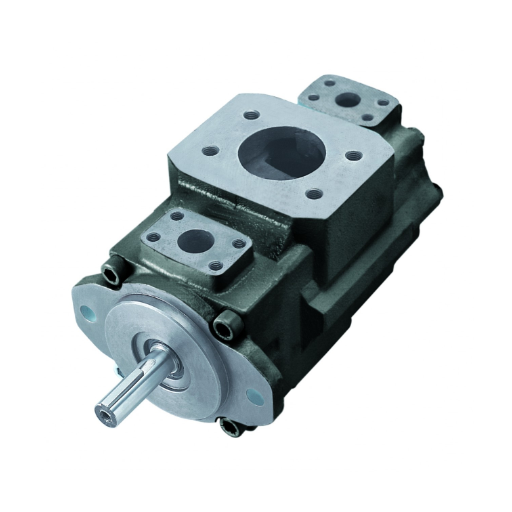
The model code is the specification. Send an incomplete code, and you will receive the wrong pump.
Most families encode the sections in sequence. Denison and Parker use a letter per section: T6CC is a C shaft-end section with a C cover-end section, T6DC is D plus C, T6EC is E plus C, and T6ED is E plus D. A triple adds a third letter, which is why models such as T67DCB, T6DCC, T6EDC, and T7EEC exist. Vickers and Eaton work numerically: 2520V is a 25V front section with a 20V rear section, and 3520V is 35V plus 20V.
| Family | Pattern | Meaning |
|---|---|---|
| Denison / Parker T6 | T6CC, T6DC, T6EC, T6ED | C+C, D+C, E+C, E+D: shaft-end letter first |
| Denison T6/T7 | T67DCB, T6DCC, T6EDC, T7EEC | Triple: three section letters in order |
| Vickers / Eaton | 2520V, 3520V | 25V+20V, 35V+20V: front code plus rear code |
| Yuken | PV2R12, PV2R13, PV2R23 | Two displacements in one housing |
| Bosch Rexroth | PVV series | Two pump kits on one shaft |
A full Denison designation carries more than the section letters. A code such as T6CC-25-17-1R2-C110 combines the series, a flow code for the shaft-end pump, a flow code for the cover-end pump, the shaft type, the rotation direction, the port position, the design number, the sealing level, and the port dimensions. Each field is a decision you can get wrong.
The displacement ranges below show what each series covers. Treat them as a starting point and confirm against the manufacturer’s catalogue, because suppliers publish slightly different ceilings.
| Series | Sections | Approx. displacement | Max speed |
|---|---|---|---|
| T6CC | C + C | 22 to 200 cm³/rev | 2,800 rpm |
| T6DC | D + C | 59 to 290 cm³/rev | 2,500 rpm |
| T6EC | E + C | 143 to 370 cm³/rev | 2,200 rpm |
Triple versions extend the range considerably. Models such as T67DCB reach 308 mL/rev, T6DCC reaches 358, T6EDC reaches 527, and T7EEC reaches 638. These are OEM-derived catalogue figures, and they vary with section combination and seal material, so verify the specific model before you design around it.
Choosing the Displacement Ratio Between Sections
The reason multi-cartridge pumps exist is the high/low circuit. One machine needs a large flow for a fast, low-pressure approach stroke and a small flow for a slow, high-pressure working stroke. A double or triple pump delivers both from one drive, without a second motor or a separate power pack.
Splitting the displacement is the design decision that determines whether the pump suits the machine.
| Circuit duty | Section | Displacement | Pressure |
|---|---|---|---|
| Fast approach, main flow | Large (shaft end) | Large | Low to medium |
| Clamp, pressing, holding | Small (cover end) | Small | High |
| Pilot, ejection, control | Smallest | Small | Medium |
Work through a typical injection-molding requirement. The fast clamp approach needs on the order of 90 L/min at around 70 bar. The hold and injection phase needs roughly 15 L/min at around 160 bar. A double pump with a large section near 60 cm³/rev and a small section near 12 cm³/rev covers both, and each section keeps its own pressure rating and service life.
The larger section conventionally sits on the shaft end, which is where the drive torque enters and where the frame is stiffest. Confirm the convention for your specific brand, since the housing and porting are built around it.
One caution that no ranking page states clearly: a multi-cartridge unit derates against the equivalent single pump. A T6 series unit listed at 320 bar as a single pump is rated to about 300 bar in multi-unit form, and the D frame drops from 280 bar to roughly 250 bar. The derating exists because a shared shaft and housing carry the aggregate load and heat of every section at once. Parker’s T6/T67/T7 service literature confirms these multi-unit figures. Account for it before you map circuit pressure, or you will specify a pump that cannot hold its advertised rating. For the single-section flow and power method behind these figures, see our guide to how to size a vane pump.
Combined Shaft Power and Drive Sizing
This is where most double vane pump selections go wrong, and it is the calculation the catalogues bury in a PDF.
The input power of a multi-cartridge pump is the sum of each section’s input power at its own operating pressure, when the sections run together. They do not average, and they do not blend. They add. The Eaton and Vickers literature states the rule directly: for a thru-drive pump, add the kilowatts for the front pump and the rear pump at the selected operating pressures.
A worked example makes it concrete. A shaft-end section displacing 131 cm³/rev needs about 62 kW at 140 bar. A cover-end section displacing 121 cm³/rev needs about 30 kW at 70 bar. Running together, the pump requires approximately 92 kW at the input.
Then check the shaft. Multi-cartridge pumps carry a frame input-power limit, and the Eaton catalogue cites figures around 78 kW for one frame size and about 96 kW for a larger one. Exceed the limit and the shaft or coupling becomes the failure point, no matter how healthy the cartridges are.
The trap is sizing the motor from the largest section alone. A designer who reads only the high-flow section sees a comfortable margin, orders the drive to match, and then browns out the motor whenever both sections run at once. The two sections usually do run together, because the machine reaches for both functions in the same cycle.
Read the section powers from the manufacturer’s performance chart at your actual operating pressures and speeds, sum them, and size the motor with the frame limit in mind. The same 600 to 900 rpm vane-extension minimum that governs a single pump applies to every section here.
Mounting, Ports, and Drive Considerations
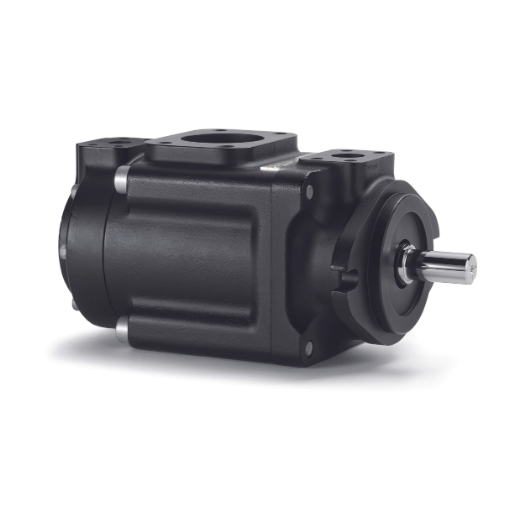
A multi-cartridge pump consolidates hardware, and the savings show up at the interface.
- One drive instead of two or three. One motor, one coupling, one bell housing, one shaft alignment. Each additional pump that would require a separate arrangement is a real cost and a real failure point removed.
- One mounting. A single SAE J744 or ISO 3019-2 flange carries the whole unit. Confirm the flange standard (SAE B, C, or E by frame) against your machine.
- Independent port clocking. With 32 orientations on a double and 128 on a triple, the inlet and outlets can be routed to fit the machine base rather than the other way round.
- Common inlet, separate outlets. Size the suction line for total flow and each outlet line for its own circuit flow and pressure.
Rotation deserves a check before ordering. Vane cartridges are either bi-rotational, which convert by reversing the port plates and cam ring, or uni-rotational, which are built for one direction and carry a suffix in the model code to mark it. Confirm the direction for every section. For the flange and port details that decide a drop-in fit, the SAE mounting and port standards reference is worth keeping open.
One more practical note: the sections share oil. A contamination problem that would degrade one pump degrades all three, and it does so faster because the same fluid passes more pumping elements. The cleanliness discipline that protects a single vane pump matters more here, not less.
Applications: Injection Molding, Die-Casting, and Mobile Machinery
The high/low circuit is the through-line that explains where these pumps are used. Name the machine, and the circuit usually names itself.
| Machine | Circuits | Typical sections | Why a multi-cartridge pump |
|---|---|---|---|
| Injection molding machine | Fast clamp, high-pressure injection and hold, ejection | Large + small (double) or large + small + small (triple) | Three functions, one drive, one footprint |
| Die-casting machine | Fast close, intensification, ejector | Large + small + small (triple) | Sequence needs distinct flows and pressures |
| Hydraulic press | Fast approach, pressing and hold | Large + small (double) | Press cycle is a textbook high/low circuit |
| Machine tool | Clamp, tool, transfer | Large + small (double) | Compact, quiet, cartridge-serviceable |
| Mobile machinery | Steering and working circuits | Large + small (double) or single + working | One shaft feeds two independent duties |
The vane family suits these duties for specific reasons. Pulsation is low, so motion is smooth, and noise is reduced. Multi-cartridge units are cited by manufacturers at roughly 94% mechanical and volumetric efficiency, though that is a supplier figure that should be confirmed against test data. And cartridges are individually serviceable, so a worn section is replaced rather than a whole assembly.
When one cartridge fails, the pump may still need to come off the machine as a unit, but the sections are rebuilt individually. That combination of shared drive and independent service is what makes the design economical over a long operating life. For the wider industrial picture, our vane pump applications guide covers the industry breadth.
One Multi-Cartridge Pump vs Two or Three Separate Pumps
The multi-cartridge design wins on packaging and on serviceability. It is not automatically the right answer, and an honest comparison shows where the line falls.
The advantages are concrete. One drive, one coupling, one mounting, and one alignment replace two or three of each. The total footprint shrinks. Plumbing reduces to one suction run and a separate outlet per circuit. With fewer shafts and fewer mechanical interfaces, there are fewer places for alignment error and wear to begin.
The trade-offs are equally concrete. A multi-cartridge pump cannot combine two different pump types, so a machine that genuinely needs a gear pump on one circuit and a vane pump on another needs two units. Selection is locked at build time; the section ratio is fixed when the pump is ordered. And the multi-unit pressure derating applies to every section.
Two separate pumps are the better answer when the circuits need different pump families, when they run at widely separated pressures, when independent redundancy matters, or when capacity will be added in phases. In those cases, the packaging advantage of a multi-cartridge pump is outweighed by the rigidity it imposes.
Cost follows the same logic. Unit price alone favors whatever the catalogue offers, but system cost includes drives, couplings, mountings, bell housings, and the labour to align them. Weigh the whole picture rather than the invoice line. For how the pump fits into a complete package, our 20 GPM hydraulic power unit guide shows the surrounding components.
Sourcing a Double Vane Pump or Triple Vane Pump
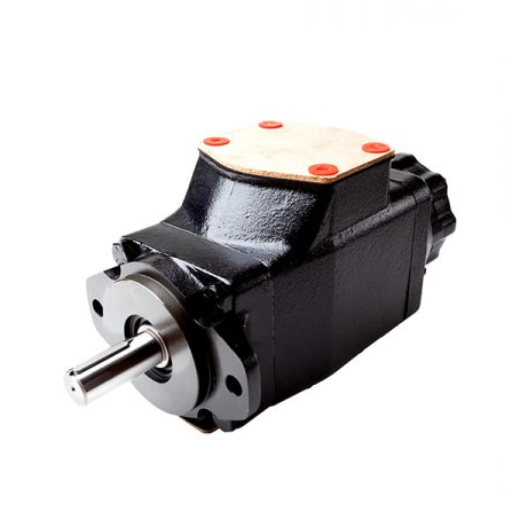
Specifying a multi-cartridge pump is a technical exercise, and a supplier who can read the code is worth more than a low quote.
Send a complete request and the response becomes a technical proposal rather than a price list. Include the nameplate and full multi-section model code, the displacement code for each section, the rotation direction, the mounting and port position, the pressure and flow each circuit needs, the duty cycle, and a photograph of the nameplate and port faces. State the high/low requirement in plain terms: which circuit needs high flow at low pressure, and which needs low flow at high pressure.
A capable supplier returns a proposed section ratio, a combined shaft-power figure, per-section pressure ratings separated into continuous and intermittent values, a lead time, and warranty terms. If a supplier cannot decode the section letters in a Denison or Vickers model code, that tells you what the response is worth.
For non-standard section pairs, OEM and private-label manufacturing can build to a specification rather than to catalogue stock. For the vetting framework that separates a real manufacturer from a trading company, our hydraulic vane pump manufacturers guide covers per-unit test evidence, certification, and the request data set in full.
Request a double or triple vane pump configuration recommendation with your circuit details, and we will return a section ratio and combined shaft-power figure.
Frequently Asked Questions
What is a double vane pump?
A double vane pump is a hydraulic vane pump with two independent cartridges on one common shaft inside a single housing. It shares an inlet and delivers fluid through two separate outlets, so one drive feeds two hydraulic circuits at different flows and pressures.
What is the difference between a double vane pump and a double-acting vane pump?
A double vane pump is two cartridges on one shaft. A double-acting vane pump is one cartridge with a two-lobe stator that discharges twice per revolution and balances the radial load. The first gives two circuits from one drive; the second gives higher pressure and quieter running from a single section.
How does a triple vane pump work?
A triple vane pump adds a third cartridge, labelled P3, on the same shaft between a P1 shaft-end section and a P2 middle section. All three share the inlet and deliver through three separate outlets, which suits machines that need a fast approach, a high-pressure working stroke, and an ejection or pilot function from one drive.
Can a double vane pump supply two circuits at once?
Yes. The sections are hydraulically independent. Each has its own port plate and outlet, so the two circuits run at their own pressures and flows without influencing each other, even though a single shaft drives both.
How do I choose the displacement of each section?
Match the displacement to the circuit duty. Put the largest section on the circuit that needs the most flow at low pressure, and the smallest on the circuit that needs high pressure at low flow. Confirm the pairing against the manufacturer’s allowed section combinations before ordering.
How do I calculate the shaft power of a double vane pump?
Read each section’s input power from the manufacturer’s performance chart at its operating pressure and speed, then add the two figures together. The sections sum rather than average, and the total must stay within the frame’s input-power limit.
What is the difference between a tandem vane pump and a double vane pump?
The terms are used interchangeably for a pump with two cartridges on one shaft. “Tandem” emphasises that the sections follow one another along the shaft; “double” emphasises that there are two of them. Both describe the same multi-section design.
Why use a double vane pump instead of two single pumps?
A double vane pump replaces two drives, two couplings, two mountings, and two alignments with one of each, inside a smaller footprint. Two separate pumps remain the better choice when the circuits need different pump types, widely separated pressures, or independent redundancy.
Can a single vane pump be converted to a double?
No. A multi-cartridge pump needs a housing, shaft, and end cover built for the extra sections. The configuration is decided at manufacture, not added later. Changes to the ratio require a new pump rather than a retrofit.
What is the difference between T6CC and T6DC?
Both are Denison double pumps. T6CC pairs two C sections, and T6DC pairs a larger D shaft-end section with a C cover-end section. The first letter is the shaft-end section and the second is the cover-end section, so the codes define both the size and the order of the two cartridges.
Conclusion
A double vane pump or triple vane pump is the answer when one machine needs several hydraulic circuits from one drive, and the selection hinges on details the catalogues leave out.
- Separate the terminology first. A double vane pump is two cartridges on one shaft; a double-acting vane pump is one balanced cartridge. The names collide, and the machines do not.
- Read the model code as the specification. The section letters and flow codes define size, order, and rotation. An incomplete code produces the wrong pump.
- Split displacement to the circuit. Large section for high flow at low pressure, small section for high pressure at low flow, in the order the housing expects.
- Sum the section powers. The drive is sized on the total input power of every section running together, within the frame limit.
- Account for the multi-unit derating. A multi-cartridge unit holds slightly less pressure than the equivalent single pump, and the margin matters in selection.
LOYAL INDUSTRIAL PTE. LTD. supplies tested vane pumps and cartridge kits, including custom multi-section configurations, with OEM customization and global export. Our engineering team reads your model code and circuit requirements, confirms the section ratio and combined shaft power, and responds with a configuration rather than a bare price.
Request an OEM pump specification and quotation with your nameplate details and circuit pressures, and we will return a technical recommendation for your machine.