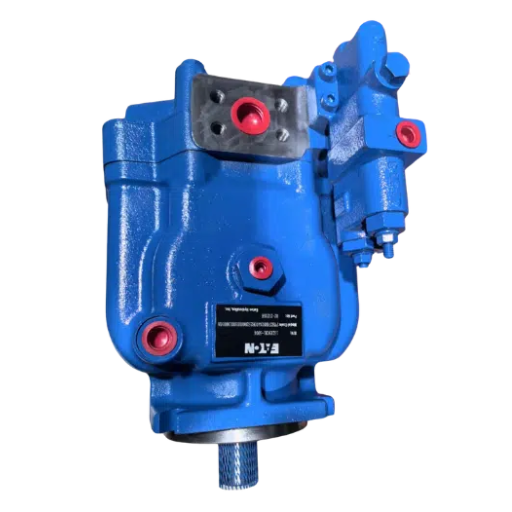
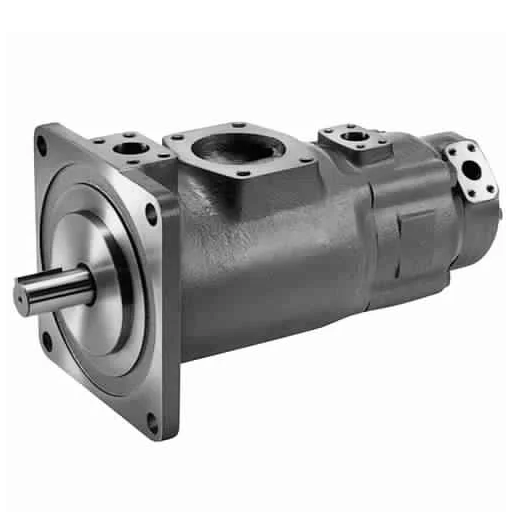
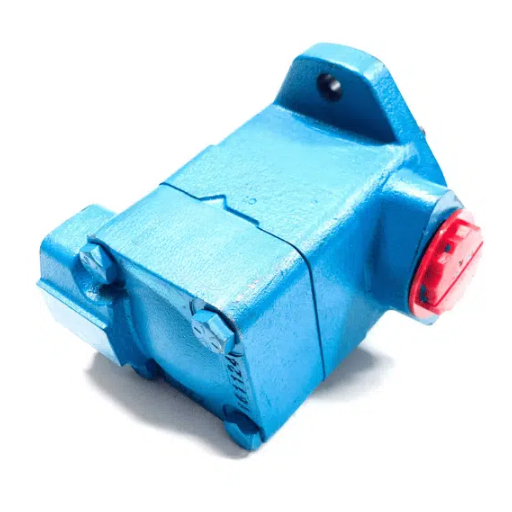
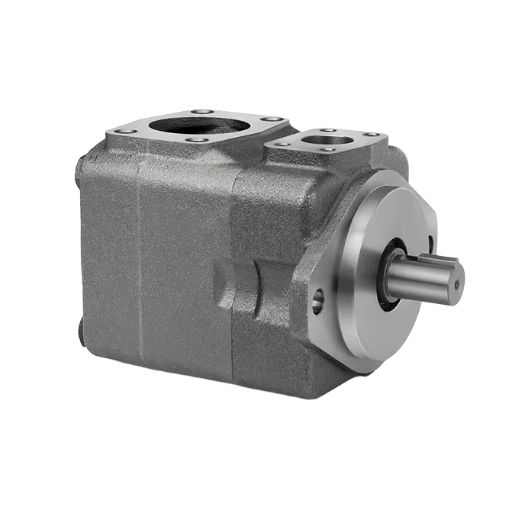
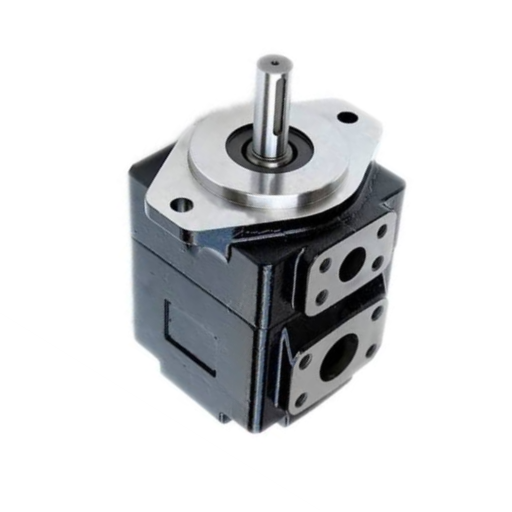
A Denison triple vane pump carries three cartridge sections in one housing, on one shaft, and the model code names them in order from the shaft end. T6DCC is a D section followed by two C sections. T7EEC is two E sections followed by one C section.
That order matters. The letters are different frame sizes with different displacement tables and pressure ceilings, so a Denison triple vane pump isn’t three copies of the same section, and the three numbers after the letters aren’t three readings on one scale. Most listings flatten them into one figure, which is where ordering mistakes start.
This guide reads the stack the way Parker’s catalogue does: letters, codes, pressure, speed, ports, then the shaft check that decides whether a build survives its duty. Scope is industrial fixed-displacement Denison and Parker T6, T67 and T7 pumps, not the mobile T6 thru-drive line, Denison piston pumps or Vickers triples. The triple vane pump guide covers three sections on one shaft in general.
Key Takeaways
- The letters are frame sizes in stack order, shaft end first:
T6EDCis E + D + C,T7EECis E + E + C.- Each code comes from its own displacement table.
T7EEC-062-062-017is 196.7 + 196.7 + 58.3, or 451.7 ml/rev.- Frame caps are A 300, B 320 (300 multi-unit), C 275, D 280 (250 multi-unit) and E 240 bar. Position does not set the cap.
- The cover-end section is not automatically the weakest: in a
T7EECthe C-frame P3 section is rated 275 bar against 240 bar for the two E sections.- The biggest build is the lowest-pressure build. The 085 cartridge is capped at 90 bar and 2,000 rpm.
What is a Denison triple vane pump?
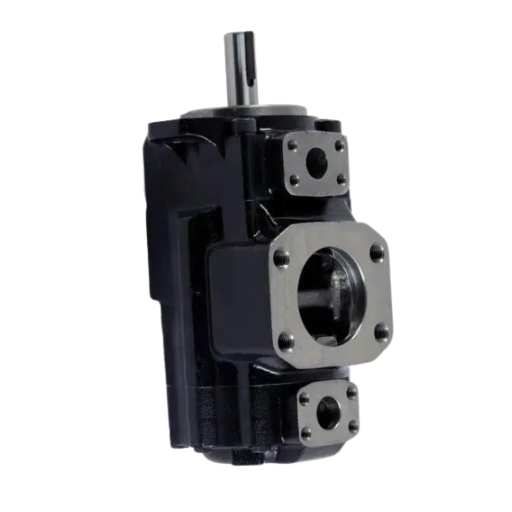
A Denison triple vane pump is one pump body with three cartridge sections on a single shaft. Each letter in the code names the frame size of one section, read from the shaft end. Each section has its own displacement code, outlet port, and pressure ceiling.
The catalogue behind these figures is Parker Hannifin’s T7/T67/T6C industrial vane pump catalogue (a Parker document, hosted here by a distributor), published by the Denison Vane Pump Division in Vierzon, France. Denison is the vane brand inside Parker, so a Parker Denison vane pump and a Denison vane pump are the same hardware under different listing names.
The three sections exist for a high/low circuit: one supplies high flow at moderate pressure, one supplies low flow at high pressure, and one runs a separate function. Parker’s wording is that the combination “allows low flow at high pressure (300 bar max.) and high flow at lower pressure”, with fast pressure-cycle change and repeatable flow.
Each cartridge is a replaceable assembly of cam ring, rotor, vanes, pins, and side plates, so a triple can be rebuilt section by section. The vane pump cartridge kit guide explains how the three are matched.
The section letters: which Denison triples exist
The letters run A to E in ascending size. Parker prints a displacement band for each: A 5.8 to 40.0, B 5.8 to 50.0, C 10.8 to 100.0, D 44.0 to 158.0, and E 132.3 to 268.7 ml/rev.
In a model code, the letters read left to right from shaft end to cover end, and the displacement codes follow the same order.
| Model | Sections | Typical build |
|---|---|---|
| T6DCC | D + C + C | 045 / 025 / 022 |
| T6EDC | E + D + C | 052 / 014 / 010 |
| T7EEC | E + E + C | 062 / 062 / 017 |
| T7DCB | D + C + B | none listed |
| T7DBB | D + B + B | none listed |
Parker’s T7/T67 catalogue lists nine triple families: T7DBB, T7DCB, T7DCC, T7DDB, T7EDB, T7EEC, T67DDCS, T67EDB and T67EDC. The T6 series adds builds such as T6DCC and T6EDC, which appear as complete part strings in Parker’s parts catalogue rather than in that table.
One caution on names. T67DCB circulates widely in supplier listings but is not in the catalogue’s triple list, and at least one supplier page calls it a double in one paragraph and a triple in another. Treat it as hardware that exists in the market and confirm the build against the stamped string. The field-by-field decode, including shaft, rotation, porting, and seal classes, is in the triple vane pump model code guide.
If the string on your pump doesn’t match a listed family, LOYAL INDUSTRIAL can check it against the catalogue before you order parts.
To learn more information, please read our article on Vickers triple vane pumps.
Reading the displacement codes: three tables, three numbers
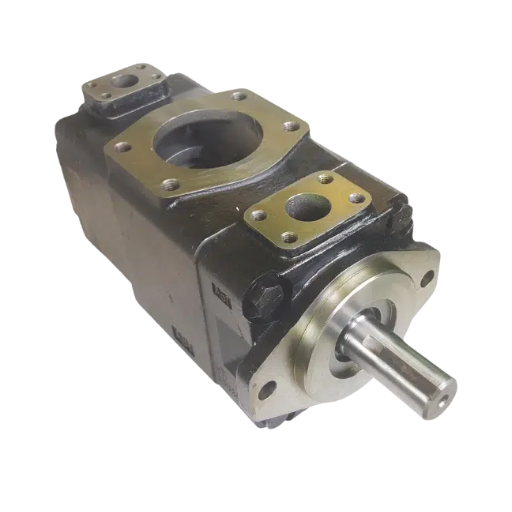
The three numbers are not millilitres per revolution. They are ring sizes in nominal US gallons, and the catalogue converts each one. Parker’s T6 ordering code labels the field “Ring Size (US gallon)”, and the conversion table sits on the same page.
So 052 does not mean 52 ml/rev; it means 164.8 ml/rev. And the same digits can carry different values depending on the frame’s table.
These are the two tables that matter for most triples:
| C code | ml/rev | E code | ml/rev |
|---|---|---|---|
| 003 | 10.8 | 042 | 132.3 |
| 005 | 17.2 | 045 | 142.4 |
| 006 | 21.3 | 050 | 158.5 |
| 008 | 26.4 | 052 | 164.8 |
| 010 | 34.1 | 054 | 171.0 |
| 012 | 37.1 | 057 | 183.3 |
| 014 | 46.0 | 062 | 196.7 |
| 017 | 58.3 | 066 | 213.3 |
| 020 | 63.8 | 072 | 227.1 |
| 022 | 70.3 | 085 | 268.7 |
| 025 | 79.3 | ||
| 028 | 88.8 | ||
| 031 | 100.0 |
The same sheet gives ring sizes in cubic inches, where 052 is exactly 10.00 in³, and 062 is 12.00 in³, which is why the codes read as gallon figures rather than displacement figures.
The D frame is the awkward one. The catalogue prints its middle codes as B14 to B42 and gives numeric values only for 045 (145.7) and 050 (158.0).
That produces the clearest proof of why the letter matters: B14 is 45.0 ml/rev as a B cartridge and 44.0 ml/rev as a D cartridge, printed side by side on the same page. Same digits, two frames, two values. For a D code other than 045 or 050, get the figure from the sheet for that pump.
Now apply it. A T7EEC-062-062-017 has two E sections at 196.7 and one C section at 58.3, so it displaces 451.7 ml/rev. The ordering page shows exactly this build, with P1 and P2 drawn from an E list and P3 from a C list. One model number, two displacement tables.
A supplier listing for T6EDC-052-014-010 gives 246.5 ml/rev at 240 bar and 2,200 rpm. The arithmetic also reveals which table the middle code came from: the total works only if 014 is read as a D cartridge at roughly 47.6, not as the C-table 46.0. Parker’s parts catalogue lists T6DCC-045-025-022 as a complete assembly, which computes to 145.7 + 79.3 + 70.3 = 295.3 ml/rev.
Pressure ratings: frame caps, derating and the “P3 is weaker” myth
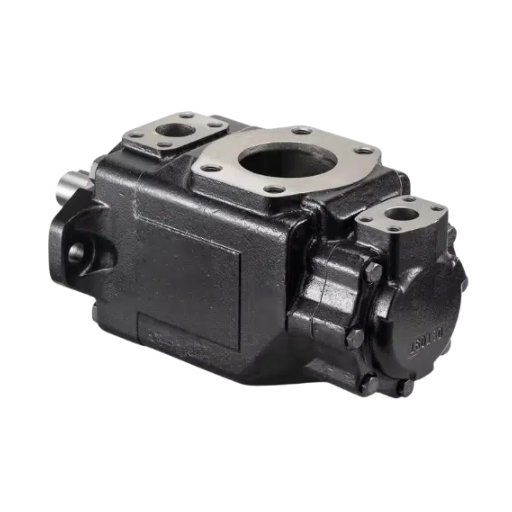
Each frame has a headline cap, stated without reference to position in the stack:
| Frame | Maximum pressure | In a multiple pump |
|---|---|---|
| A | 300 bar | not stated |
| B | 320 bar | 300 bar |
| C | 275 bar | not stated |
| D | 280 bar | 250 bar |
| E | 240 bar | not stated |
Read it as the ceiling for a section of that frame wherever it sits, which is why a Denison triple vane pump cannot be rated from its series name alone. B and D carry an explicit multi-unit derate, in the catalogue’s words “300 bar for multiple pump” and “250 bar for multiple pump”.
Now the part most listings get wrong. A T7EEC is E + E + C, so its caps are 240 bar at P1, 240 at P2 and 275 at P3. The cover-end section is the strongest in that build. Parker’s own performance page confirms it: P1 and P2 are tabulated to 240 bar, P3 to 275 bar.
Where does “port 3 is always lower” come from? Three places:
- Distributor specification tables publish P1, P2, and P3 bands of roughly 90 to 320, 90 to 300, and 210 to 275 bar. Those bands aggregate frame caps rather than describe position.
- Most triples do put a C or B section at the cover end, which makes the pattern look universal.
- The P3 port is smaller, 3/4 inch and 1 inch against 1 1/2 inch for P1 and P2, which reads as a lower rating even when the section behind it is rated higher.
The largest cartridges step down inside their own frame. C 028 and 031 are capped at 210 bar intermittent, stated in a footnote on the ordering page rather than the main table. D 045 is rated 240 bar intermittent and 210 continuous; D 050 at 210 and 160, B15 at 280 and 240. The 085 E cartridge is the extreme case: 90 bar maximum intermittent, limited to 2,000 rpm.
The largest T7EEC combines 085, 085 and 031 for 637.4 ml/rev, but two of its three sections stop at 90 bar.
Parker defines intermittent precisely, and the definition decides real duty. A unit may run above its continuous rating when the time-weighted average pressure stays at or below it, provided speed, fluid, viscosity and contamination are respected.
The catalogue’s example is a T7B B10 at 4 minutes of 320 bar, 1 minute of 35 bar and 5 minutes of 160 bar. The average is 211.5 bar, below the 290 bar continuous rating, so the cycle is acceptable. Cycles longer than 15 minutes go back to Parker.
The pressure columns also differ by fluid. The caps above are mineral-oil figures; water glycols and synthetics carry lower ones, so read the matching column before comparing pumps. Seal class appears in the code as 1 for S1 BUNA N, 4 for S4 EPDM, and 5 for S5 VITON.
Speeds, ports, mounting, and the shaft torque check
Triples run from 600 rpm to 2,200 rpm on mineral oil, and to 1,800 rpm on water-based and synthetic fluids. The low limit matters: Parker rates full pressure down to 600 rpm, which suits presses and injection machines that hold pressure at low speed.
Porting is where a triple gets flexible and where a replacement gets mis-ordered. Single pumps offer four mounting positions, doubles 32, triples 128. The shaft-end outlet rotates in 90-degree steps, the cover-end outlet in 45-degree steps, and a two-character code selects the combination from the catalogue’s diagram pages, where 00 is standard. Two pumps with identical displacement codes and different porting codes won’t pipe up the same way.
Port size follows the section. On a T7EEC, P1 and P2 are 1 1/2 inch, P3 is 3/4 inch and 1 inch, and suction is 4 inch.
Mounting splits into two families that share a stack but not an envelope. T7EEC Uses an ISO 3019-2 four-bolt flange, 250 mm diameter; T7EECS Uses a SAE J744 E four-bolt flange at 165.1 mm, and the S suffix marks the SAE variant. The ISO build weighs 114.8 kg. That flange difference alone can decide whether a replacement drops in or needs an adapter.
Rotation is fixed at build on most triples. A, B, and D cartridges are bidirectional; C and E cartridges are unidirectional. A T6DCC or T7EEC therefore has its rotation set by its cartridges, marked R or L and read from the shaft end, and you cannot flip a cam ring to reverse it.
Then the check almost nobody runs. Each shaft code has a torque limit expressed as the sum of displacement times pressure across all three sections, written Vi × p and printed on the dimensions page. For the T7EEC, shaft code 2 allows 118,340 and shaft code 4 allows 126,800, in millilitres per revolution times bar.
Run it on the build above. At 240 bar on both E sections and 275 bar on the C section: 196.7 × 240 + 196.7 × 240 + 58.3 × 275 = 47,208 + 47,208 + 16,033 = 110,449.
That sits inside the 118,340 limit for shaft 2. Assume all three circuits can run at 275 bar and the sum rises to 124,218, which is over the limit. The frame caps are what keep the shaft within its rating.
Safety note: isolate the power unit, release stored pressure and lock out the drive before opening any circuit or removing a cartridge. A triple holds pressure in more than one section.
Sections add; they don’t average. For input power, calculate each section at its actual duty pressure, add the results, then add the losses. The hydraulic pump horsepower calculator handles one section at a time; run it three times.
Choosing a Denison triple vane pump
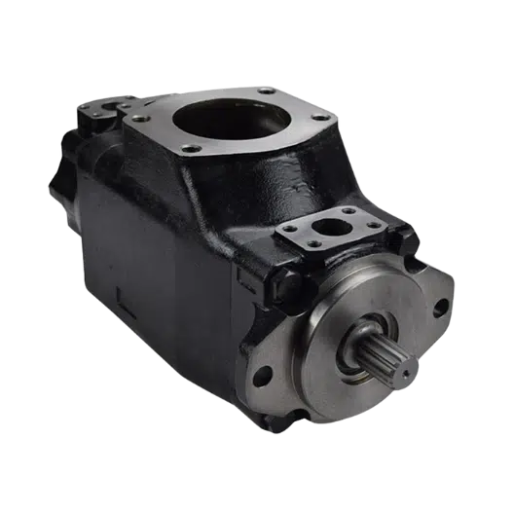
Start from the machine cycle. A Denison triple pump earns its place when one circuit needs large flow at moderate pressure, a second needs small flow at high pressure, and a third has its own function, all from one prime mover. Presses, injection moulding machines, machine tools and lubrication systems are the usual applications.
The largest section conventionally goes at the shaft end, because that end carries the sum of the torque. If a build reverses that order, ask why and run the Vi × p check before accepting it.
A triple isn’t automatically better than a double pump plus a separate small pump. The triple gives one drive, one coupling, and one mounting footprint. The double plus separate pump gives independent pressure settings, easier service access, and room to change one circuit later. For a low-flow third circuit, the separate pump is often cheaper to own.
Cross-brand comparisons need care. Veljan’s VT6DCC uses the same letter pattern, and one distributor lists it at 275 bar and 70 to 390 cm³/rev at 2,500 rpm. Those are the seller’s figures, and the pattern alone doesn’t establish licensing or equal ratings.
What to send for a quote
A useful inquiry carries five things:
- The full stamped string, with all three displacement codes, shaft code, rotation, and porting code.
- Pressure and duty for each section, split into continuous and intermittent.
- Rotation and the reference used to read it.
- Mounting standard, ISO or SAE, plus port positions if the piping is fixed.
- Any section that runs intermittently, with its duty cycle.
With those five, a supplier can confirm section values, apply the right frame caps, run the shaft check, and quote a build that will not be derated on arrival. LOYAL INDUSTRIAL supplies Denison vane pumps and reviews configurations against those details. The Denison vane pump range covers the wider family, including the T6C, T6D and T6E series.
FAQ
What does T6DCC mean on a Denison pump?
A triple with a D-frame section at the shaft end and two C-frame sections behind it. The three numbers follow the same order, so T6DCC 045 025 022 is 145.7 + 79.3 + 70.3 ml/rev.
Are the three displacement codes on the same scale?
No. Each letter selects its own table, and the same digits can differ between them. B14 is 45.0 ml/rev in the B table and 44.0 ml/rev in the D table, printed on the same catalogue page.
Is the cover-end section always the lowest-pressure port?
No. In a T7EEC the C-frame P3 section is rated 275 bar, while the E-frame sections at P1 and P2 are rated 240 bar. Most triples do have a smaller section at the cover end, which is where the general impression comes from.
Can I reverse the rotation of a Denison triple?
Not usually. A, B, and D cartridges are bidirectional, but C and E cartridges are unidirectional, so any build containing one has its rotation fixed at the factory. Rotation is marked R or L and read from the shaft end.
Why is my T7EEC rated lower than the seller advertised?
Two likely reasons. E-frame sections are capped at 240 bar regardless of position, and the largest cartridges step down further: 028 and 031 to 210 bar, 085 to 90 bar with a 2,000 rpm limit. Check the codes, not the series headline.
Conclusion
A Denison triple vane pump is three frames on one shaft, and the code says which three. The letters run shaft end first, so T6EDC is E + D + C and T7EEC is E + E + C, and each letter selects its own displacement table.
Pressure follows the frame, not the position: 240 bar for an E section, 275 for a C section, with B and D derated in multi-unit builds. The cover end is sometimes the strongest section in the unit, and the largest displacement build is the narrowest-pressure one.
The next step is physical. Photograph the nameplate, write down the full stamped string, and note the pressure and duty for each circuit. Send that with your rotation reference and mounting standard, and ask for the section-by-section check.
LOYAL INDUSTRIAL PTE. LTD. supplies Denison and Parker triple vane pump replacements and can review a configuration against the catalogue ratings before you commit to a rebuild or a replacement. Send the string and the duty, and request the configuration review.