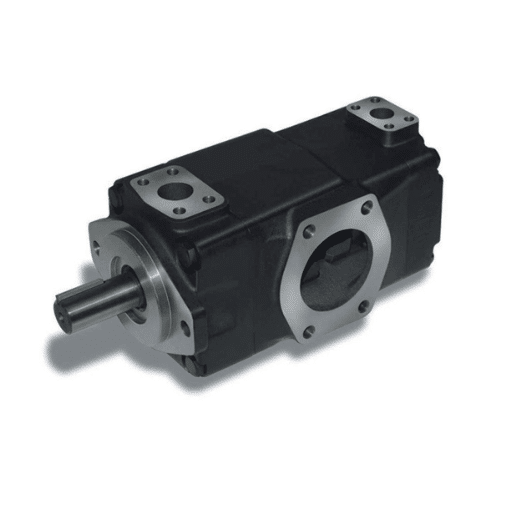
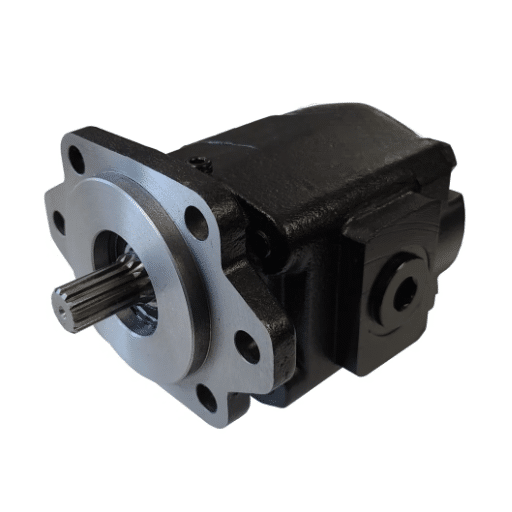
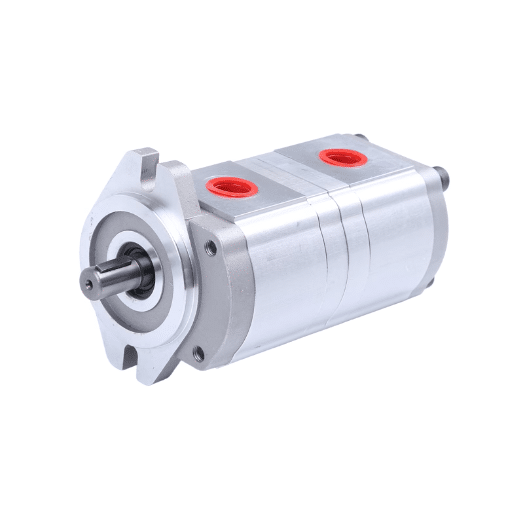
Design engineer Priya had two quotations on her desk for machines that were, on paper, identical. Both pumps displaced roughly 25 cm³ per revolution, ran at the same shaft speed, and fed circuits of the same size.
One was rated at 70 bar. The other carried a 175 bar rating and, when she opened the drawings, sat on smaller bearings than the low-pressure unit. Nothing in the pricing explained it.
The difference was geometry. A double-acting vane pump turns its rotor concentrically inside a two-lobe stator, so two pressure zones form on diametrically opposite sides of the rotor and cancel each other. A single-acting pump has no opposing zone, and its one-sided load must be carried by the shaft and bearings.
Knowing that the stator is elliptical, and the pump therefore balanced, is correct but incomplete. The parts that decide what you can specify are usually left out: which stator profile makes the balance work, why the vane count follows a multiple-of-four rule, why the displacement cannot be varied, and what pressure the design actually reaches. That last number gets published as 69 bar, 175 bar, and 320 bar for what is described as the same pump.
This article works through the design itself, from the eight-part stator contour to the vane-loading problem that balancing does not solve, and the honest case for when a fixed-displacement pump is the wrong purchase.
This is the design deep dive. For the full family picture, start with our complete guide to hydraulic vane pumps.
What Is a Double-Acting (Balanced) Vane Pump?

A double-acting vane pump is a rotary positive-displacement pump in which each chamber between adjacent vanes draws in and discharges fluid twice per rotor revolution, because the rotor turns concentrically inside a two-lobe (elliptical) cam ring. It is also called a balanced vane pump because the two discharge zones sit diametrically opposite each other, so the hydraulic forces on the rotor cancel and the net radial load on the shaft approaches zero.
The component set is small. A slotted rotor carries the vanes, which slide outward against the cam ring. Front and rear side plates close the rotor and ring into a sealed pumping volume, and the distribution plate carries four windows, two suction and two discharge, in opposing pairs.
A naming trap worth clearing up immediately. A double-acting pump is one cartridge with a two-lobe stator. A double vane pump is two or three cartridges stacked on one shaft. The names read almost identically and describe different machines; the double and triple vane pump configurations are covered separately. There is a second trap in OEM literature: Parker/Denison market T6 cartridges as “double intravane”, where “double” refers to the double-lip vane profile, not to the pumping action.
Specifying a pump for a fixed flow at high pressure? Request a technical specification sheet and our engineers will confirm whether a balanced design or an unbalanced one suits your duty.
The Eight-Part Elliptical Cam Ring: Where the Balanced Design Comes From
The stator inner surface of a double-acting vane pump is not a simple ellipse. It is eight joined segments: two long-radius arcs, two short-radius arcs, and four transition curves connecting them. The rotor is concentric with the ring rather than offset, so chamber height is set by the profile itself. That is the sharpest distinction from the single-acting pump, and most explanations compress it into one sentence.
Two Long-Radius Arcs, Two Short-Radius Arcs, Four Transition Curves
The long-radius arcs form the suction regions, where the gap between rotor and ring is largest; the short-radius arcs form the discharge regions, where it is smallest. The four transition curves carry the profile between them. One consequence of that layout is easy to miss: because the rotor never leaves the ring’s centre, this is a concentric vane pump rather than the offset design the single-acting family uses. Chamber volume change is what moves the fluid: the pump generates flow, and circuit resistance converts that flow into pressure.
Why the Transition Curve Sets Sealing, Efficiency and Noise
The transition curve is a genuine design lever in a double-acting vane pump. A suitable profile preserves the seal between the pressure and suction sides and reduces leakage at the rotor-to-stator and vane-tip-to-stator interfaces, raising volumetric efficiency and delivered flow at the same speed.
Continuity at the arc-to-curve junctions matters just as much. A smooth transition keeps the vane sliding without abrupt acceleration changes, suppressing jerk, lateral force, wear, stress, and noise. A discontinuity at a junction point shows up as vane chatter, and no amount of balancing removes it.
Marcus found that out on a commissioning job. A 210 bar balanced pump ran quietly for six weeks, then developed a rising tone that tracked shaft speed. The circuit was clean, the alignment inside tolerance, the relief setting correct.
The tone sat at the vane passing frequency: vane-ring contact at one transition region, worn unevenly after a contamination event. Replacing the cartridge removed the noise.
For the step-by-step mechanics, see how a vane pump works, and for the wider family picture, types of hydraulic pumps explained.
How a Double-Acting Vane Pump Works: Working Principle
The working principle follows from the lobe count. Each pocket between two vanes passes through the same sequence twice per revolution:
- The chamber grows as it approaches a long-radius arc, so pressure falls, and fluid is drawn in through a suction window.
- The chamber crosses a sealing zone where volume stays roughly constant, and the pocket is isolated from both ports.
- The chamber shrinks as it approaches a short-radius arc, so fluid is pushed out through a discharge window.
- The sequence repeats at the diametrically opposite lobe, suction then discharge.
- The result is two complete suction-and-discharge events per rotor revolution, across four port windows.
This matches the standard academic treatment: the rotor turns concentrically in a cam ring shaped so each chamber completes two cycles per revolution, with the two discharge ports 180 degrees apart.
Why the Flow Is Smoother Than a Single-Acting Pump
With two lobes running in opposite phase, there is always a chamber in discharge while another fills, so delivered flow is far more continuous than the pulsed output of a one-cycle-per-revolution design. Flow pulsation typically sits below 2% on a balanced pump, against roughly 5 to 10% on a single-acting one. What ripple remains sits at the vane passing frequency, vane count multiplied by shaft speed, which is why the vane count is chosen the way it is.
Why the Vane Count Is a Multiple of Four
Balanced vane pumps conventionally use 12 or 16 vanes, and the rule behind that is that pulsation is minimised when the vane count is an integer multiple of four. Some designs use 10, and the practical range spans roughly 8 to 18, but the multiple-of-four layout is the one that performs.
The reason is symmetry. With two lobes and a symmetric vane layout, a multiple-of-four count keeps the vanes in each quadrant balanced, so overlapping discharge pulses interleave and largely cancel. That is where the sub-2% figure comes from, and it is why a double-acting vane pump sits at the quiet end of the vane family, which occupies the 55 to 75 dB(A) band as a whole.
The single-acting architecture solves the same problem differently, using an odd count, commonly 13 or 15. Our single-acting vane pump guide covers that parity rule.
Where the Balance Comes From: Net-Zero Radial Load

Discharge pressure acts over the rotor’s projected area in two quadrants. The two resultant forces are equal, opposite, and collinear through the shaft axis, so they cancel. Net radial load on the shaft approaches zero, and the source literature states this directly as the reason a balanced pump can use less robust bearings than an unbalanced design at the same pressure.
That is the answer to Priya’s puzzle. The 175 bar double-acting vane pump in her comparison ran on smaller bearings not because it was built to a lower standard, but because its geometry never asked those bearings to carry a one-sided load.
What Near-Zero Radial Load Buys
The practical consequences are the design’s whole commercial case:
- Smaller, lighter bearings for a given pressure and displacement
- No alternating bearing load, so no fatigue cycling of the rolling elements
- No shaft deflection from hydraulic pressure, and therefore no running-clearance distortion, no vane-tip wear from deflection, and no leakage opened up by a bending shaft
- Lower vibration, since the pressure-induced forcing is largely cancelled
Published service-life ranges reflect this: 15,000 to 22,000 hours for balanced units on continuous production-line duty, against 8,000 to 12,000 hours for single-acting units on intermittent duty, with 5,000 to 10,000 hours in mobile applications. One manufacturer claims over 24,000 hours with no stated pressure, filtration, or duty basis; treat that as a vendor claim, not a specification.
An honest qualification. The cancellation holds while both sides of the rotor see the same pressure. Port timing errors, internal leakage, or a blocked port disturb the symmetry and reintroduce a real side load, so state the advantage as “net radial load approaches zero under symmetric loading”.
Vane Loading: The Problem the Balanced Design Does Not Solve
Balancing the rotor of a double-acting vane pump does not balance the vane. Discharge pressure acting on a vane’s trailing edge tends to push the vane away from the cam ring, which causes chatter and leakage across the tip. Vane tip loading is a separate design problem, and the two-lobe geometry does nothing about it on its own.
The standard answer is to bias the vane outward deliberately. Undervane pressure is held slightly above discharge pressure, with the cavities beneath the vanes fed through side holes, so the net force presses the vane against the ring. A flow-regulating element between the undervane and overvane channels maintains the differential, and a vent through the vane equalises lateral pressure so the vane floats freely in its slot.
Intra-Vane, Pin-Vane, Dual-Vane and Twin-Lip Constructions
Above that baseline, manufacturers use several distinct constructions. Which one sits inside a double-acting vane pump tells you a great deal about its pressure rating.
| Construction | Mechanism | Effect on vane tip load |
|---|---|---|
| Undervane pressure biasing | Cavities under the vane fed at slightly above discharge pressure | Holds the vane on the ring; prevents chatter and tip leakage |
| Dual vane | Two vanes per slot | Each vane almost completely balanced, with a good seal because two vanes are used |
| Intra-vane | A small vane inside a large vane with a bevelled edge; system pressure fed above the small vane | Much lower vane loading; feed passages can assist extension at low speed and cut tip force at high speed |
| Pin-vane | Discharge pressure acts under a pin that drives the vane outward | Vane stays balanced through a central annular groove and radial bores |
| Spring-loaded or angled vane | Spring pressure at the base, or an angled slot | Loads the vane lightly without an extra mechanism |
| Twin-lip (bilabial) | Two lips with balancing bores | Cam-ring load falls by two orders of magnitude against single-lip vanes, leaving centrifugal force as the dominant remaining component |
The twin-lip result is the headline number, and it traces to a published study of balanced twin-lip vane pump fluid supply paths. That is why every high-pressure series in production is an intra-vane or twin-lip design rather than a strengthened plain vane. It is the construction Parker/Denison sells as “double intravane”, and it brings high contamination tolerance and a wide speed range with it.
Double-Acting Vane Pump Pressure: 69 bar, 175 bar, or 320 bar?

This is the number a double-acting vane pump spec sheet contradicts most often, because sources attach different figures to “double acting” without separating the classic design, the mainstream industrial band, and the modern high-pressure vane pump series. Separated properly, all three figures are correct.
| Design | Typical continuous pressure | Why it sits there |
|---|---|---|
| Classic simple single-acting | 60 to 70 bar | Low-cost bearings and shaft absorb a one-sided radial load |
| Modern compensated single-acting | 100 to 250 bar | Compensated side plates, heavy-duty bearings, stiff shaft |
| Balanced double-acting, mainstream band | 69 to 103 bar (6.9 to 10.3 MPa) | The band general-purpose catalogue data quotes; special designs reach 206 to 300 bar |
| Balanced double-acting, classic form | Around 175 bar (17.5 MPa, roughly 2,500 psi) | Two opposed pressure zones cancel the radial load |
| Balanced double-acting, modern series | 210 bar (Eaton/Vickers VQ), 241 bar (VQH), 240 to 320 bar (Parker/Denison T6, T67, T7) | Balanced geometry plus intra-vane or twin-lip vanes and pressure-clamped side plates |
| Piston pumps | 350 bar and above | Different architecture entirely |
The 69 to 103 bar figure and the 175 bar figure are not rivals: they describe the same architecture at different points in its development. The classic textbook rating for a balanced vane pump is 175 bar, roughly two and a half times the classic single-acting ceiling of 60 to 70 bar, purely because the rotor is balanced; 69 to 103 bar is the mainstream range general-purpose balanced units are catalogued at.
The modern series go further. In the Parker T6R range, the front side plate is clamped axially by discharge pressure to reduce internal leakage. Combined with intra-vane or twin-lip vane construction, that is what lets the modern balanced pump hold pressure the classic design could not. Eaton/Vickers documents the VQ range as rated to 210 bar and the VQH to 241 bar.
So ratings of 175 to 320 bar are not a single-acting vane pump pushed harder. They are balanced, two-lobe pumps. The industry answered the unbalanced radial load by changing the geometry, not by strengthening the shaft. Our guide to the single-acting (unbalanced) vane pump makes the same point from the opposite direction, including the compensated single-acting class that reaches 250 bar.
Need pressure and flow data against a real duty cycle? Contact our engineering team for a sizing review before you commit to a pressure class.
Why a Balanced Vane Pump Cannot Be Variable Displacement
Every source states that a balanced vane pump is a fixed displacement vane pump. Almost none explains why, and the reason is geometric.
A single-acting pump has one offset between the rotor and a circular ring, and that offset is the only variable the design needs. Pivot the circle and the displacement changes steplessly while the pump runs.
A balanced pump has two lobes and a fixed radial difference between the long-radius and short-radius arcs. There is no single eccentricity to pivot. Moving the ring to create one would break the diametric symmetry that produces the balance, and with it the net-zero radial load that justifies the design. Balance and variability are mutually exclusive by construction.
So a double-acting vane pump is a fixed-flow machine in service. Where flow must vary, the alternatives are a variable single-acting vane pump, the only vane architecture that offers it, or a variable piston pump such as an axial piston pump, which sits above it on cost. If the duty always needs full flow, a balanced fixed-displacement pump is the right and least expensive answer; if it needs varying flow, a balanced pump is the wrong purchase, and it is better to say so plainly.
The Two-Lobe Displacement Relationship
A single-lobe (single-acting) geometry displaces, per revolution:
V_D = 2 × e × L × (D_C − e) × π
where D_C is the cam-ring bore diameter, e is the radial offset between the rotor and ring centres, and L is the vane width. This is the form published in our hydraulic pump displacement formula reference. In a double-acting vane pump, the same relationship applies to each of the two lobes.
A balanced pump has two such lobes per revolution, so it sweeps two of those volumes instead of one and displaces roughly twice as much as a single-lobe pump of the same ring size and radial difference. The flow advantage and the pressure advantage come from the same second lobe.
Double-Acting Vane Pump vs Single-Acting: A Buyer’s Comparison
| Attribute | Double-Acting (Balanced) | Single-Acting (Unbalanced) |
|---|---|---|
| Cam ring shape | Elliptical two-lobe, rotor concentric | Circular bore, rotor eccentric |
| Port plate windows | 4 | 2 |
| Cycles per revolution | Two suctions, two discharges | One suction, one discharge |
| Vane count | Even; integer multiple of 4, commonly 12 or 16 | Odd, typically 13 or 15 |
| Radial load on shaft | Net zero under symmetric loading | High side load, one direction |
| Displacement | Fixed only | Fixed or variable |
| Pressure, classic form | Around 175 bar, to 320 bar heavy-duty | 60 to 70 bar |
| Pressure, modern compensated form | Not applicable (fixed design) | 100 to 250 bar |
| Volumetric efficiency | Above 94% | About 92% |
| Flow pulsation | Below 2% | About 5 to 10% |
| Noise | Low, comparable to internal gear | Higher, especially variable versions |
| Flow reversal | No | Yes, by reversing eccentricity |
| Contamination tolerance | Lower than a gear pump | Lower |
| Relative cost | Similar to a fixed vane pump | Lower than a variable piston pump |
The naming distinction, repeated because it is the most common error in this category, and the reason to check before specifying a double acting vane pump. “Double-acting” describes the balanced internal geometry of one cartridge. “Double vane” describes two or three cartridges on one shaft. For the gear-pump comparison instead, see gear pump vs vane pump.
Where Double-Acting Vane Pumps Win, and When They Don’t

| Duty | Why the balanced design fits |
|---|---|
| Constant full-flow, higher-pressure industrial circuits | Injection moulding, die-casting, presses, machine tools, rolling mills and continuous-duty test stands, where flow demand is fixed and the noise and pulsation budget is tight |
| High/low circuits | A T6-E/C cartridge delivers low flow at high pressure and high flow at low pressure, solving a two-flow-rate duty with one pump instead of two |
| Mobile and automotive hydraulics | Power steering and transmission circuits, where noise, package size and durability decide the specification |
| Retrofit and replacement | A 210 to 320 bar balanced cartridge drops into an existing VQ or T6 mounting, with the interchange caveats noted below |
The limitations belong in the same list, because they are equally real:
- Fixed displacement only, as the geometry requires
- Higher acquisition cost and more complex construction than a single-acting pump
- Contamination sensitivity requiring finer filtration than a gear pump: 10 to 25 µm absolute, with typical ISO 4406 cleanliness targets of 18/15 up to 140 bar and 17/14 for 140 to 210 bar
- A suction-speed window of roughly 8.3 to 25 r/s (about 500 to 1,500 rpm), below which centrifugal force may not seal the vanes against the ring and above which suction becomes discontinuous
- Poor tolerance of cold start, since thick oil slows vane extension before the pump reaches working speed
- No flow reversal, which rules it out of bidirectional duties that a single-acting pump handles by reversing eccentricity
Deniz ran into the cold-start item. A plant he supported specified balanced pumps on power units that started outdoors in winter. The pumps were correctly sized for pressure and flow, and on paper they were the better choice.
In practice, cold oil at start-up left the vanes unable to reach the ring quickly enough, and the units needed a pre-heat and a fluid change to a lower viscosity grade. The pumps were right; the specification had simply ignored the suction-speed window.
Specifying a Double-Acting Vane Pump
Start with the pressure class, because it narrows everything else. The honest fork is the mainstream 69 to 103 bar band, the 210 bar VQ/VQH class, or the 240 to 320 bar T6/T67/T7 class.
The RFQ data set that gets a correct quotation:
- Required flow, constant or the two rates if it is a high/low circuit
- Continuous pressure, not the relief setting
- Speed at the drive, and whether it stays inside the suction-speed window
- Fluid type and viscosity window, plus ambient and cold-start conditions
- Filtration capability available on the machine, since this design demands finer filtration than a gear pump
- Mounting and shaft form, port position, and rotation direction, per the SAE and ISO mounting and port standards
- The vane count and cartridge family required for drop-in interchangeability
One warning on interchange. Claims of “100% interchangeable with Vickers or Denison” have to be checked against the mounting flange, shaft form, pilot, bolt pattern, rotation, port position, and cartridge model, not against a matching flange alone.
Cost sits between a single-acting vane pump and an equivalent variable piston pump. The decision turns on whether the flow requirement is genuinely fixed, and on what the noise and pulsation margin is worth to the machine.
Request OEM pump specification and quotation → Our engineers will confirm the pressure class, cartridge family, and filtration requirement for your circuit.
Frequently Asked Questions
What is a double acting vane pump?
A balanced vane pump is a rotary positive-displacement pump in which each chamber between adjacent vanes draws in and discharges fluid twice per rotor revolution, because the rotor turns concentrically inside a two-lobe (elliptical) cam ring.
Why is a double-acting vane pump called a balanced vane pump?
Because the two discharge zones sit diametrically opposite each other, so the hydraulic forces on the rotor are equal, opposite, and collinear through the shaft axis. They cancel, and the net radial load on the shaft approaches zero.
How many times does a double-acting vane pump discharge per revolution?
Twice, through four port windows arranged in two opposing pairs.
How many vanes does a double-acting vane pump have, and why a multiple of four?
Conventionally 12 or 16. An integer-multiple-of-four count keeps the vanes in each quadrant balanced so overlapping discharge pulses interleave and cancel, which holds pulsation below 2%.
What is the maximum pressure of a double-acting vane pump?
A general-purpose balanced vane pump is catalogued in the 69 to 103 bar band, and the classic textbook rating is around 175 bar. Modern series reach further: Eaton/Vickers rates the VQ at 210 bar and the VQH at 241 bar, while Parker/Denison rates the T6, T67 and T7 from 240 to 320 bar depending on size.
Can a double-acting vane pump be made variable displacement?
No. Two lobes with a fixed radial difference leave no single eccentricity to pivot, and moving the ring would destroy the symmetry that produces the balance. Variable vane pumps are single-acting designs.
What is an intra-vane vane pump?
A construction in which a small vane sits inside a large vane with a bevelled edge, and system pressure is applied above the small vane, producing much lower vane tip loading than a plain vane.
Why is a double-acting vane pump quieter than a single-acting pump?
Two lobes in opposite phase mean a chamber is always discharging while another fills, holding pulsation below 2% against 5 to 10% for a single-acting design. The multiple-of-four vane count interleaves the remaining pulses so they cancel rather than add.
How long does a double-acting vane pump last?
Published ranges put balanced units at 15,000 to 22,000 hours on continuous production-line duty, against 8,000 to 12,000 hours for single-acting units on intermittent duty and 5,000 to 10,000 hours in mobile applications. Those figures assume a particular pressure, duty cycle, and fluid cleanliness.
Is a double-acting vane pump the same as a double vane pump?
No. A double-acting pump is one cartridge with a two-lobe stator. A double vane pump is two or three cartridges stacked on a single shaft.
Conclusion
A double-acting vane pump turns a concentric rotor inside an eight-segment, two-lobe stator, completing two suction and two discharge events per revolution. The two opposed pressure zones cancel the radial load, which is what “balanced” means in practice, and that cancellation is why the design holds the pressure a vane pump is capable of at all, on bearings smaller than an unbalanced pump of the same displacement would need.
The same symmetry explains the rest: why the displacement cannot be varied, why the vane count follows a multiple-of-four rule, and why pulsation stays below 2%. The costs are equally structural: fixed displacement, a higher purchase price than a single-acting pump, contamination sensitivity, and a suction-speed window that cold starting can fall outside.
Match the design to the duty rather than to the category. If flow is genuinely constant and pressure is high, the balanced pump is usually the most economical and the quietest answer. If flow must vary, or the duty must reverse, specify a different architecture.
Request a technical specification sheet or an OEM quotation → LOYAL INDUSTRIAL PTE. LTD. supplies vane, gear, and piston families from one verified source, with performance testing on every unit, factory-direct pricing, OEM customization, and global export support.