In March 2024, a maintenance engineer at a die-casting plant near Ningbo replaced a failed vane pump with a cheaper unit sold as a “high pressure vane pump.” The listing carried no continuous rating, no speed, and no fluid specification. The machine ran at 190 bar. The replacement failed inside seven months.
The pump it replaced had cost more than twice as much and had run for six years.
That story repeats across every industrial market, and it repeats because “high pressure” has never been defined for a vane pump. A buyer searching for a high-pressure hydraulic vane pump lands on marketplace listings and trading-company storefronts, each asserting the phrase and none stating what it means. There is no agreed ceiling, no published derating method, and no honest account of which series actually reach the top of the range.
This guide fixes that. It sets explicit pressure bands, explains the mechanical reason the family has a ceiling at all, maps the series that reach each band with their current production status, and shows how to turn a catalogue number into a rating you can defend at your speed and your fluid. It closes with the vane-versus-piston crossover and the evidence to demand before you pay.
If you need the family fundamentals first, our complete guide to hydraulic vane pumps covers design, working principle, and type selection. This article assumes you have a machine and a pressure requirement, and takes pressure as its organizing axis.
Specifying a circuit at 200 bar or above? Request a specification-matched quotation with your duty cycle, and we will confirm the rated pressure at your speed and fluid before you commit.
What Counts as a High-Pressure Vane Pump?
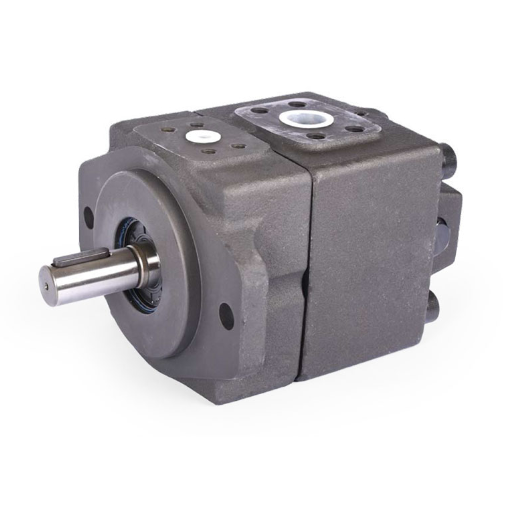
A high-pressure vane pump is a fixed-displacement vane pump engineered to hold 210 bar (about 3,000 psi) or more continuously, using heavier vanes, hardened cam rings, and hydraulically balanced geometry to survive the side loading that limits the standard family.
That definition is deliberately narrow, and it excludes most of what the market sells under the label. Use these bands instead of the marketing phrase:
| Band | Continuous pressure | Typical series | What it means in practice |
|---|---|---|---|
| Standard | to ~140 bar (2,000 psi) | General V series, single-acting designs | The baseline the family was designed for |
| Medium | 140 to 210 bar | VQ, SQP, PV2R | Where most “high pressure” listings actually sit |
| High | 210 to 300 bar | VQH, T7, T67 | Genuine high-pressure vane territory |
| Very high | 300 to 400+ bar | HVQ (400 bar), T7 B-frame intermittent | Narrow, and constrained by availability |
Two facts follow from that table. First, a 175 bar pump is not a high-pressure vane pump; however, the listing describes it. Second, the top band is real but thin. Only a handful of designs have ever crossed 300 bar continuously, and one of the two that did is no longer manufactured.
Fluid Power World’s survey of the category puts the general position plainly: standard vane pumps are “often limited to 2,000 psi or less,” and it is “rare to find a vane pump running more than 3,000 psi.” Anything above that is an engineered exception, not a product category. That is the gap a high-pressure hydraulic vane pump has to close, and only a few designs have closed it.
There is a second problem with the label, and it is worse than imprecision. Most listings quote a single number, and a vane pump pressure rating is never one number. It is three, and they are not interchangeable. We will come to that discipline shortly.
The Pressure Ceiling, and Why It Exists
Vanes have to do two things at once. They slide in and out of their rotor slots to follow the cam ring, and they must stay pressed against that ring to seal. At low pressure, the second job is easy. At high pressure, it becomes the limiting constraint.
The mechanism is side loading. As discharge pressure rises, the fully extended vane is pushed against the cam ring across a small contact area while pressure acts along its exposed length. The vane bends, the tip loads, and the ring wears. Fluid Power World describes the consequence directly: at high pressure, vanes “are subject to excessive side load,” and the pump suffers “high leakage and rapid wear.”
Heat compounds it. Leakage converts pressure energy into heat; hot oil thins, thin oil leaks faster, and the loop tightens. That is why a vane pump near its ceiling does not fail gradually. It fails once the loop gets ahead of the cooler.
Designers accept this ceiling instead of engineering past it, and the reason is commercial. Push a vane pump harder, and it starts to behave and sound like a gear pump, which removes the reason anyone chose it. As Josh Cosford writes in Fluid Power World, the low noise and slightly better efficiency that distinguish a vane pump from a gear pump are “hard to justify over a gear pump, in most cases.” The family’s value is quiet, smooth output in clean, medium-pressure duty. Every step up in pressure trades some of that away.
Three changes did move the ceiling, and they define the high-pressure tier. Hardened steel, tighter tolerances, and pitched vanes, where the vane sits at an angle instead of square to the ring. Cosford notes that combination lets modern fixed-displacement pumps exceed 5,000 psi.
One boundary matters here. Variable-displacement vane designs, for all their efficiency advantages at part load, “never gained traction at high pressure.” High-pressure vane is a fixed-displacement story. Our guide to variable-displacement vane pumps covers the compensated designs where they belong.
The High-Pressure Vane Lineage: V, VQ, VQH, HVQ
The Vickers lineage is the clearest documented record of how far the family has been pushed, and each generation solved a different part of the problem.
| Series | Rated pressure | Era | What changed | Status |
|---|---|---|---|---|
| V series | ~2,000 psi or less (~138 bar) | original | baseline design, widely cloned | still sold |
| VQ | 3,000 psi (~207 bar) | 1980s | better materials, improved balancing, quieter and more compact | in service |
| VQH | 3,500 psi (~241 bar) | later VQ evolution | enhanced rotor, ductile iron | still in production |
| HVQ | 5,800 psi (400 bar) | 1990s | redesigned materials, balancing geometry, optimised vane loading | discontinued by Danfoss, clones available |
The VQ arrived in the 1980s because machine builders wanted piston-pump pressures without piston-pump noise, particularly in metal forming and die casting. The VQH followed as an evolution of the VQ, not a scaled-down HVQ, and it remains in production. It is the industry-standard fixed-displacement vane pump for mobile hydraulics, including garbage trucks and wheeled loaders.
The HVQ is the interesting one. Eaton developed it after acquiring Vickers in 1999, and it reached 400 bar by changing so much of the pump that it “does not directly interchange with the V- or VQ-series pumps.” Danfoss no longer manufactures it. Clone makers still offer it at the same 5,800 psi rating.
That combination is a purchasing fact, not trivia. If you need 380 bar continuously and you want vane instead of piston, the HVQ lineage is the only answer that has ever existed; it is out of production by its owner, and it does not swap into a V or VQ installation. You are buying a clone of a discontinued design, which means provenance and test evidence carry more weight there than anywhere else in this market.
A press builder in Pune ran into exactly that in 2023. Their 400-ton forming press needed 340 bar continuous and a noise limit of 75 dB(A) because the press sat in a shared bay. Piston pumps met the pressure and failed the noise requirement, so the only vane option was an HVQ clone.
They bought two and kept one as a spare. They also made per-unit pressure-hold records at 340 bar, a condition of the order. When the first unit developed internal leakage at 14 months, the records proved it was out of specification, and the supplier replaced it.
Two naming traps catch buyers repeatedly. The VQH is not a small HVQ, and the HVQ is not a large VQH. They are separate developments with no interchange. Confirm mounting, shaft, rotation, and port position against the original drawing, not against a model code.
Need a replacement for a discontinued series? Send us the nameplate details and port-face photographs, and we will confirm what interchanges and what does not.
Pressure Classes by Series: T6, T67, T7, SQP, PV2R
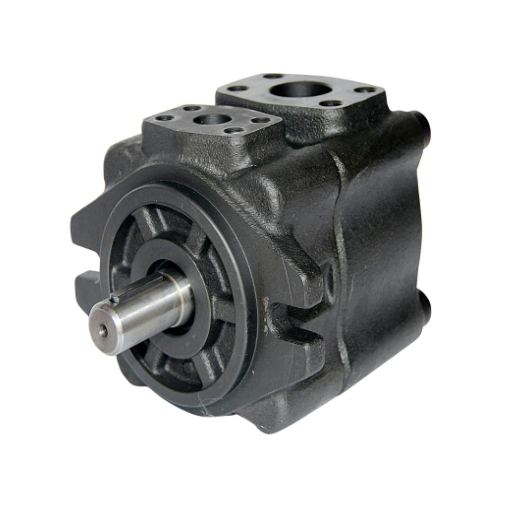
Denison, Tokimec, and Yuken approach the same problem from different directions, and their catalogue structures differ enough that comparing them takes care.
| Family | Typical continuous pressure | Pressure varies by | Notes |
|---|---|---|---|
| Denison/Parker T6 | 240 to 275 bar by frame | frame (C, D, E) and displacement | C frame rated higher than D and E |
| Denison/Parker T67 | ~210 bar and above | frame and section count | mid tier between T6 and T7 |
| Denison/Parker T7 | ~250 bar continuous, higher intermittent | frame (B, D, E), grade, displacement | B frame carries the highest peak rating |
| Tokimec SQP | ~175 bar | displacement | intra-vane, low noise, machine tools and die casting |
| Yuken PV2R | ~210 bar, falling as size rises | displacement | cartridge-serviceable, low-noise intra-vane |
| YB-E series | verify per supplier | displacement and section count | Chinese double-vane series common in this market |
Here is where most buyers get into trouble. Denison pressure ratings are published per frame and per pump core, not per family. The B frame is the smallest and carries the highest peak rating, while the D and E frames carry larger displacements at lower pressure.
When a distributor publishes one number for “T6, T67, T7,” that number belongs to a specific frame at a specific displacement. It will not transfer to the pump in your hand.
The widely quoted 320 bar figure illustrates the problem. Some distributor documentation attributes it to the T7 B frame as a peak or intermittent rating, while other distributor documentation attributes it to the T6C and T6D frames instead. The Parker T6/T67/T7 instructions are the only place to settle it, and any figure you publish or specify should carry its frame and its rating type attached.
Frame is not the only variable. Multi-section pumps derate further. When the high-pressure and low-pressure sections of a T6, T67, or T7 run together, distributor documentation caps the combination at about 2,200 rpm, with higher speeds requiring manufacturer approval.
If you run a two-cartridge pump on a die-casting machine, the single-section rating is not your rating. Our guide to double and triple vane pumps covers how the sections combine and how to size the drive.
The YB-E series deserves a mention because it dominates the search results for this query and almost never appears in Western series guides. It is a Chinese double-vane family widely quoted in this market. Its rating basis and naming convention do not match the Vickers or Denison systems, so confirm the pressure basis against the supplier’s test data. Do not assume a like-for-like comparison with a T6 quote.
Continuous, Intermittent and Peak: Reading a Rating Correctly
A pump rated 300 bar intermittent is not a 300 bar pump. It is a pump that will hold 300 bar for a defined fraction of its cycle, and a lower figure indefinitely.
Intermittent allowance in industrial practice runs around 10% of the duty cycle, measured in time, not in cycles. That sounds generous until you apply it to a press that holds pressure through the pressing stroke, or a die-casting machine clamping through a full shot and dwell. In both cases, the high-pressure phase is the working phase, not an exception, and the pump spends its life in what the catalogue calls intermittent.
The practical rule is simple. Never quote a bare pressure number in a specification conversation. Quote pressure with speed, fluid, and duty attached.
“250 bar at 1,500 rpm on ISO VG 46, 40% of cycle” is a specification. “250 bar” is a wish.
Our parent guide explains the three ratings in general terms. The distinction that matters at the top of the range is that the margin between continuous and intermittent shrinks as pressure rises, because the wear mechanisms are already working hard at the lower figure.
Derating: What Your Catalogue Rating Becomes at Your Conditions
The number in the catalogue is measured under reference conditions. Your machine is not running under reference conditions. Four factors move the permissible pressure down, and they act in sequence.
Speed. Higher rotational speed raises the centrifugal load on each vane and shortens the pressure envelope. The effect runs in both directions: too slow and the vanes will not extend and seal, which is why single-acting designs carry a 600 to 900 rpm floor. Our vane pump sizing method covers the extension minimum in detail.
Displacement. Larger displacements derate within the same frame. Yuken’s PV2R ratings fall as size rises, which is why a series table quoting one pressure for the whole family is misleading.
Fluid. This is the largest single correction and the one buyers miss. Denison distributor documentation specifies that with HF-3 (water-in-oil emulsion) or HF-4 (water glycol) fluids, pressure should be reduced to about 0.8 times the oil-based rating, and further with HF-5 phosphate ester. Yuken’s PV2R catalogue documentation similarly notes that maximum pressure and maximum speed may change with the fluid used.
If your plant runs fire-resistant fluid for insurance reasons, you may already be outside your pump’s envelope.
Temperature. Sustained fluid temperature above roughly 60 °C thins the oil and increases slip. Slip is internal leakage, and internal leakage is heat, so the correction compounds.
Work the arithmetic in this order:
- Start with the nameplate continuous rating.
- Apply the speed correction for your actual rpm.
- Apply the displacement correction for your pump size.
- Apply the fluid multiplier, roughly 0.8 for HF-3 and HF-4.
- Apply the duty-cycle correction for your intermittent fraction.
- The result is your permissible continuous pressure.
That sequence answers the question buyers actually ask. “Can this pump run at 250 bar?” has no answer on its own. “Can it run at 250 bar at 1,800 rpm on water glycol for 60% of the cycle?” has one, and it is probably no.
A foundry in Sheffield learned this the expensive way. They specified a pump rated 250 bar continuous against a system that held 230 bar, which looked like a comfortable 20 bar margin. Nobody applied the fluid correction.
The plant ran HF-4 water glycol for fire safety, which cuts the rating to about 0.8 times the oil figure and puts the real ceiling near 200 bar. The pump ran 30 bar outside its envelope for eleven months before the cam ring scuffed. The replacement was specified at 300 bar and has run since 2022.
High Pressure Vane Pump vs Piston Pump: The Crossover
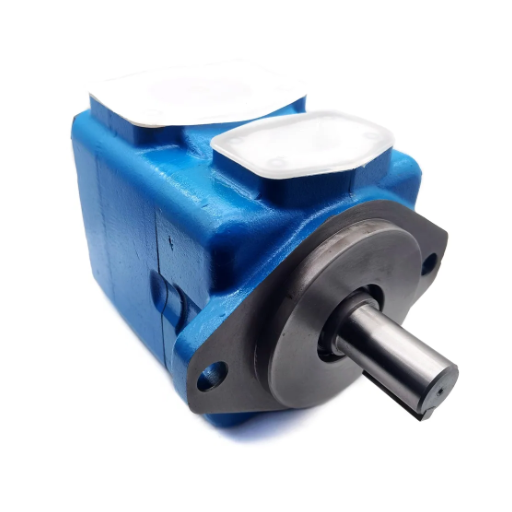
The highest-intent question in this segment is whether to stay with vane at all. It deserves a decision framework, not a feature table.
On pressure, the boundary is reasonably clear. Vane holds roughly 210 to 250 bar continuous in practical service, reaches about 300 bar with the best cartridges, and reaches 400 bar only through the discontinued HVQ lineage. Piston pumps are comfortable from 350 to 450 bar and keep going.
On output quality, vane wins, and the margin is not close. Smooth, quiet output is the entire reason high-pressure vane exists. The HVQ was built for presses and die casting because those applications needed piston-level force without piston-level noise and pulsation. As Fluid Power World notes, a bent-axis piston pump would sacrifice that smooth, quiet output.
On cost, the ladder runs basic vane, then high-pressure vane, then piston, including bent-axis. The HVQ costs more than a basic vane pump but “vastly less” than piston alternatives, which is exactly why it found a niche.
On serviceability, vane cartridges are field-replaceable in a way piston rotating groups are not. Our guide to vane pump cartridge kits covers what that saves in practice.
Here is the decision, stated plainly:
Stay with vane when continuous pressure sits under about 250 bar, noise or flow smoothness matters, fluid is clean and stays clean, and the duty is continuous but not extreme.
Move to piston when continuous pressure exceeds about 310 bar, when precise high-power control is required, or when duty is severe enough that contamination tolerance becomes the deciding factor. Our axial piston pump guide covers that family.
The honest middle case is 300 to 400 bar with a noise requirement. The HVQ lineage is the only vane answer; it is discontinued, and your options are a verified clone with test records or a piston pump with an acoustic enclosure.
Circuit Architectures That Reach High Pressure
Not every high-pressure requirement needs a high-pressure pump. Two architectures reach the same system pressure with less installed power.
A hi-lo circuit pairs a small high-pressure element with a large high-flow low-pressure element. Both deliver during the fast approach stroke. At a set pressure, the high-flow element unloads, and only the small element continues to full pressure.
You get a fast cycle and full final force from a fraction of the drive power, and you generate less heat while doing it. Presses, balers, and die-casting machines all run this pattern.
Multi-cartridge configurations put two or three rotating groups on one shaft inside one housing, sharing an inlet and delivering through separate outlets. One footprint, one drive, independent circuits. Our guide to double and triple vane pumps covers how the sections stack and how to split displacement between them.
Accumulator-assisted circuits handle peak demand without sizing the pump for the peak. The pump fills the accumulator between cycles, and the accumulator supplies the surge.
If you are diagnosing a circuit that already exists, not designing one, the fault pattern is different and worth separating. Our vane pump troubleshooting guide covers the symptom side.
Where High Pressure Vane Pumps Earn Their Place
The application logic is consistent across industries: continuous duty, multiple circuits, and an operator nearby.
| Application | Pressure band | Why vane rather than piston |
|---|---|---|
| Die casting and injection molding | 160 to 210 bar continuous | Multi-circuit, continuous duty, low pulsation for shot repeatability |
| Presses and metal forming | 200 to 315 bar | The HVQ’s original justification; smooth force build |
| Steel and metallurgy | Top of the envelope | Heavy-duty continuous operation |
| Machine tools under load | 70 to 175 bar | Pressure-compensated clamping, quiet enough to work beside |
| Hydrostatic bearings | to ~5,000 psi | Quieter, cheaper, and more contamination-tolerant than piston |
The hydrostatic bearing case is worth flagging because it is underused. Cosford notes that vane pumps suit supporting large-diameter or high-speed bearings, and that they do it more quietly, more cheaply, and with better contamination tolerance than piston pumps.
One newer pattern also deserves attention. Pairing a fixed vane pump with a variable-speed drive and a pressure transducer lets a PLC hold target pressure by changing motor speed instead of reducing displacement. It is quiet, efficient at part load, and it sidesteps the fact that variable-displacement vane designs never worked well at high pressure.
For industry breadth across the whole family, our vane pump applications overview covers each sector in turn. The matrix above is about pressure bands, not industries.
Noise and Pulsation: The Real Reason to Pay for Vane
If noise did not matter, nobody would buy a high-pressure vane pump. They would buy a piston pump and accept the pulsation. The acoustic advantage is the product.
Balanced and intra-vane designs are the quiet ones, sitting in the 55 to 70 dB(A) band depending on size and mounting. Single-acting designs and worn pumps are louder.
Noise climbs as pressure rises, because vane loading and internal leakage both increase. A pump that was quiet at 100 bar is not automatically quiet at 210. This is the trade you make when you move up a band, and it is worth measuring, not assuming.
One diagnostic is worth carrying into the plant. Noise that worsens as system pressure rises points to a restricted inlet, because higher pressure increases internal leakage and inlet starvation gets worse. Noise that appears only at low speed points to lost vane extension. Those two signatures separate most of the cases that get misdiagnosed as “the pump is failing.”
Filtration belongs here too, because it is the cheapest way to keep a high-pressure pump quiet. Our guide to vane pump maintenance and filtration covers the ISO 4406 targets by pressure band.
Specifying a High Pressure Vane Pump
A correct specification gets a correct quote the first time. Send this data set.
- Required continuous pressure and peak pressure, each with its duty fraction
- Displacement in cm³/rev, and speed in rpm
- Fluid type and viscosity window, including cold start
- Mounting flange, pilot diameter, bolt pattern, and shaft form
- Port positions and sizes, and whether the housing can be rotated
- Rotation direction, and whether the port plate is bi-rotational
- Number of sections and the displacement of each
- Filtration and cleanliness target
- Ambient temperature and any noise limit
- Nameplate photographs, including the port face
The last item prevents most ordering errors. A model code alone rarely settles a replacement. Our reference on SAE mounting and port standards covers the interface dimensions that matter.
Then set acceptance criteria before the order, not after. The standard to insist on is per-unit pressure-hold test evidence at rated continuous and rated intermittent pressure, with the hold time and the leakage limit stated. A catalogue screenshot is not test evidence. A datasheet is not test evidence.
Sourcing: Verifying That High Pressure Is Real
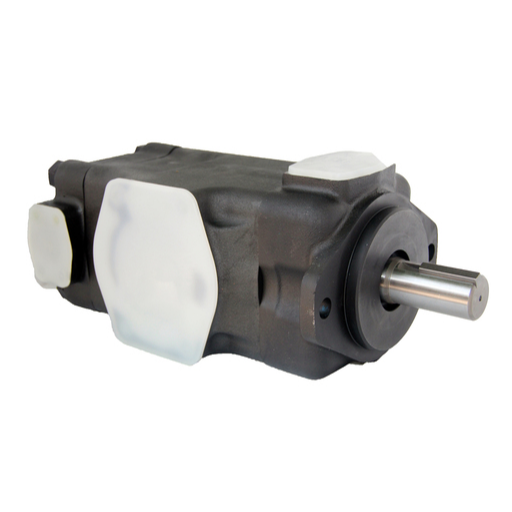
In a market where every listing says high pressure, evidence is the only differentiator.
Ask for five things:
- Per-unit pressure-hold test records.
- ISO 9001:2015 certification, understood for what it proves, which is process control and not product performance.
- A published derating position, meaning the supplier can tell you how pressure falls with speed, displacement, and fluid.
- Cartridge and spare-part availability for the specific series.
- Warranty terms that reference pressure and duty, not just elapsed time.
Then check the interchange claim. “100% equivalent to Vickers or Denison” is a marketing phrase until someone verifies mounting flange, pilot diameter, bolt pattern, shaft form and length, rotation, port positions, and pressure class. Pressure class is where equivalence claims fail most often, because a clone can match dimensionally and rate lower.
The HVQ situation concentrates all of this. It is discontinued by its owner, cloned by several makers, and does not interchange with V or VQ. Provenance, test records, and dimensional verification matter more there than anywhere else.
Our vane pump OEM sourcing guide covers supplier vetting in general, including certification, MOQ, and lead times. This section is narrower: proving that a pump holds the pressure it claims.
Want the evidence before the invoice? Request test records and a specification-matched quotation, and we will supply per-unit pressure-hold data with the offer.
Frequently Asked Questions
What is a high pressure vane pump?
A fixed-displacement vane pump rated to hold 210 bar (about 3,000 psi) or more continuously, built with heavier vanes, hardened cam rings, and balanced geometry to survive the side loading that limits standard vane pumps.
How much pressure can a vane pump produce?
Standard designs are limited to about 2,000 psi (138 bar). The VQ reached 3,000 psi (207 bar), the VQH 3,500 psi (241 bar), and the HVQ 5,800 psi (400 bar). Above roughly 3,000 psi, the options narrow sharply.
Can a vane pump reach 300 bar?
Yes, with the right cartridge. The VQH holds 241 bar continuously, and Denison T7 and T67 frames reach the 300 bar range depending on frame, grade, and whether it is a continuous or intermittent rating. Confirm the figure against the frame-specific catalogue.
What is the highest-pressure vane pump ever made?
The Vickers HVQ at 5,800 psi (400 bar). Eaton developed it after acquiring Vickers in 1999. Danfoss no longer manufactures it, though clone makers still offer it at the same rating.
What is the difference between HVQ and VQH?
They are separate designs, not scaled versions of each other. The VQH is an evolution of the VQ rated 3,500 psi and is still in production. The HVQ was a ground-up redesign for 5,800 psi that does not interchange with V or VQ pumps.
Why are vane pumps limited in pressure?
At high pressure, the fully extended vane takes excessive side load against the cam ring, which produces leakage and rapid wear. Heat compounds the problem by thinning the oil, which increases leakage further.
Is a vane pump better than a piston pump?
Below about 250 bar continuous, with clean fluid and a noise requirement, yes. Above about 310 bar continuous, or where precise high-power control is needed, piston wins.
What oil should I use in a high-pressure vane pump?
ISO VG 32, 46, or 68 depending on ambient and operating temperature, held clean to the target for your pressure band. If you run fire-resistant fluid, derate pressure to roughly 0.8 times the oil-based rating for HF-3 and HF-4.
Conclusion
The phrase “high pressure vane pump” carries no fixed meaning in this market, and that gap costs buyers real money. Four points settle most of it.
- Set the band before you shop. Under 140 bar is standard. 140 to 210 bar is medium, and it is where most listings claiming high pressure actually sit. Above 210 bar, you are in genuine high-pressure vane territory.
- The ceiling is mechanical, not commercial. Vane side loading against the cam ring, plus the leakage and heat loop it creates, is why the family stops where it does. Three redesigns moved it, and one of them is out of production.
- Series status matters as much as series rating. The VQH is still built. The HVQ is not. A clone at 5,800 psi is a different purchasing decision from a current-production pump at 241 bar.
- Derate to your conditions, then verify with evidence. A catalogue number means nothing without speed, fluid, and duty attached, and a claim means nothing without per-unit pressure-hold records.
Get those four right and the pressure question answers itself. Get them wrong, and you buy a 175 bar pump with a label, which is exactly what happened to that die-casting plant in Ningbo.
Ready to specify a high-pressure vane pump against a real duty cycle? Contact us for an industrial solution consultation with your pressure, speed, fluid, and duty fraction, and we will confirm the rating that will hold.