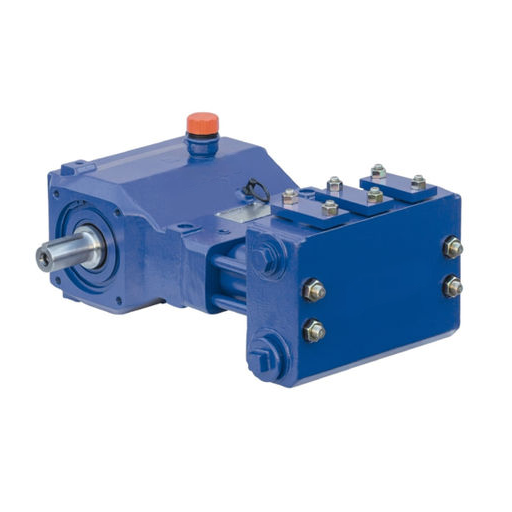
Two high-pressure triplex plunger pumps can sit in the same building and share almost nothing.
One runs a vehicle wash bay at 2,000 psi: brass manifold, lip seals, rebuilt every few years. The other drives water through a sapphire orifice at 60,000 psi: forged stainless fluid end, ceramic plungers, seals replaced on a schedule measured in hundreds of hours.
Both are called a high-pressure plunger pump. The pressure number is all they share, and that’s the problem. Buyers who specify on pressure alone routinely buy the wrong class of machine, and the mistake surfaces in service months later.
This guide covers what the pressure classes mean and the three architectures that produce high pressure. It also covers what changes inside the pump as the class rises, and the inlet and safety requirements that fail before the fluid end does.
One scope note: this covers process and industrial plunger pumps, not hydraulic axial piston pumps. For the broader picture, see our complete guide to plunger pumps.
If you already have a flow, a pressure, and a fluid, request a technical specification sheet, and we’ll confirm the class and architecture against your duty point.
What Counts as a High Pressure Plunger Pump?
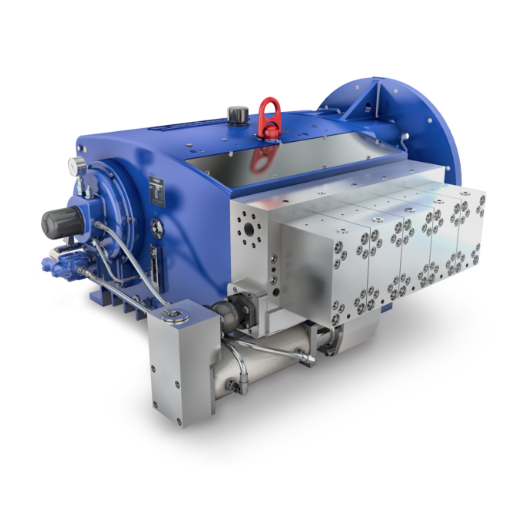
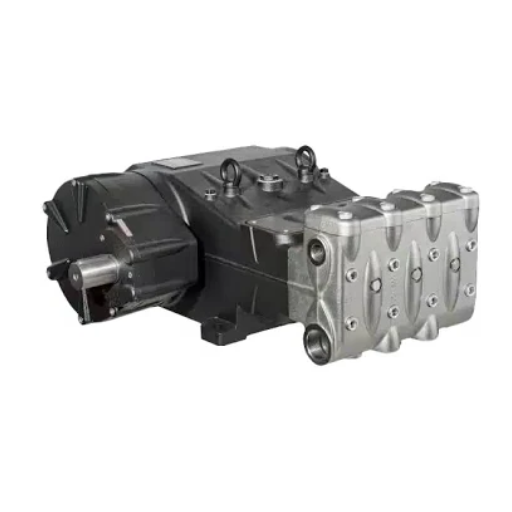
A high-pressure plunger pump is a positive-displacement reciprocating pump. A precision plunger moves through a stationary seal and displaces fluid through check valves, at discharge pressures from roughly 1,000 psi to above 60,000 psi.
The useful definition isn’t a number. It’s the pressure class, because each class changes the materials, sealing system, and frame size.
| Pressure band | Typical duty | What sets the design |
|---|---|---|
| 1,000–3,000 psi | Car washing, light cleaning | Brass or cast-iron manifold, lip seals |
| 3,000–5,000 psi | Commercial pressure washing | Upgraded seals, coated plungers |
| 5,000–20,000 psi | Industrial surface prep, hydro-blasting | Ceramic plungers, carbide seats, stacked packing |
| 10,000–40,000 psi | Hydrodemolition | Heavy fluid end, intensifier or high-ratio drive |
| 40,000–100,000 psi | Waterjet cutting | Intensifier architecture, carbide orifice |
| 5,000–20,000 psi | Oil-well stimulation | API 674 construction, abrasion-resistant trim |
These bands match the figures in our plunger pump sizing guide.
Two distinctions matter before you read a datasheet. Operating, rated, and peak pressure are three different numbers. Operating is where the pump runs day to day, rated is what the manufacturer warrants continuously, and peak is a short-duration limit. A pump sold on peak and run there continuously is a warranty claim waiting to happen.
And “high pressure” is a class, not a compliment. When a supplier quotes a pressure, ask which class it’s in.
Why Plungers Own the Top of the Pressure Range
In a plunger pump, the seal is stationary in the pump head, and the plunger slides through it. In a piston pump, the seal travels with the piston inside the bore. A moving seal must be flexible enough to slide and tight enough to hold. Those requirements pull against each other as pressure rises.
A stationary seal only has to hold.
That single choice is why plunger pumps reach pressures that would extrude a piston cup. The mechanism is covered in how a plunger pump works; the pressure consequence matters here.
The Pressure Ceiling, Stated Honestly
CAT Pumps’ selection guidance quotes 100–10,000 psi for plunger pumps and 100–1,200 psi for piston pumps. That’s accurate about CAT’s product line. It’s widely repeated as though it were the physical ceiling of the plunger family.
It isn’t. KAMAT catalogues direct-drive plunger pumps from 1,000 to 3,500 bar (roughly 14,500 to 50,800 psi), with a stated range to 4,000 bar. Their K18000-3G runs 3,500 bar at 522 L/min and 180 kW. KAMAT states a 4,000 bar maximum, but no model in its published table reaches it, so treat 3,500 bar as the achieved catalogue figure.
Above that, waterjet systems use an intensifier to reach 60,000 psi and beyond.
Three Ways to Reach High Pressure
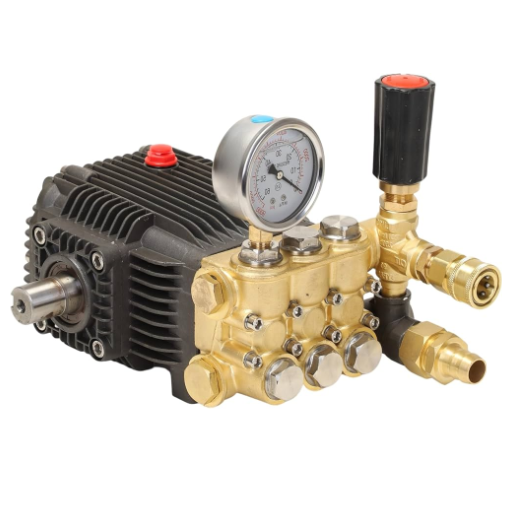
Pressure at the discharge flange can be produced in three ways. The choice changes flow behaviour, maintenance profile, and cost structure, and it’s the decision most buyers skip.
Direct Drive: Motor, Reducer, Crankshaft
A motor drives the crankshaft through a belt, gear reducer, or coupling, converting rotary motion into plunger reciprocation. Pressure comes from the plunger area working against system resistance. It’s the default for cleaning, blasting, descaling, hydrostatic testing, and process injection.
Its ceiling is set by rod load and fluid-end materials, which is why catalogue ranges top out near 3,500 bar. Flow is fixed by crank speed unless you add a variable-speed drive.
Hydraulic Drive: a Hydraulic Motor on the Crankshaft
A hydraulic motor replaces the electric motor; the pump itself is unchanged. It suits mobile equipment, hazardous areas, and sites that already have hydraulic power, at the cost of a second fluid system and lower efficiency.
Intensifier: Area Ratio Instead of a Bigger Motor
An intensifier doesn’t build pressure with a bigger motor. It multiplies pressure with a smaller area. A large hydraulic plunger drives a small water plunger on a shared rod, and that small area concentrates the force into very high water pressure:
P_water = P_oil × (D_large ÷ D_small)²
Our plunger pump guide works that relation through with real numbers. The selection consequence: an intensifier lets a modest hydraulic supply generate 60,000 psi of water pressure.
Production ratios are narrower than commonly assumed. KMT builds its waterjet intensifier pumps at 20:1 for 50 hp and 23:1 for 100 hp and above, not the 40:1 sometimes quoted as typical.
Flow continuity is the catch. A single intensifier pressurises in one stroke direction only, so units are built in opposing pairs that alternate. That pairing is why the architecture costs more and takes more space.
A fourth option, servo direct drive, replaces the crankshaft with independently driven servo plungers. Vendors claim energy savings; verify them against your duty cycle.
Choosing Between Them
| Architecture | How pressure is produced | Flow continuity | Best duty | Watch-outs |
|---|---|---|---|---|
| Direct drive | Crankshaft + plunger area | Good with 3+ plungers | Cleaning, blasting, testing, injection | Catalogue ceiling ~3,500 bar |
| Hydraulic drive | Hydraulic motor on crankshaft | Same as direct drive | Mobile, hazardous area | Second fluid system; lower efficiency |
| Intensifier | Area ratio, 20:1–23:1 typical | Needs paired units | Waterjet, ultra-high-pressure | Higher cost, more space, more parts |
| Servo direct drive | Independently driven plungers | Good | Variable demand, energy-sensitive | Newer; verify vendor claims |
Below roughly 3,500 bar, direct drive is almost always right. Above it, the choice is intensifier or nothing.
What Changes as Pressure Rises: The Design Ladder
A 60,000 psi pump isn’t a 2,000 psi pump built heavier. Almost every internal decision changes.
| Pressure class | Plunger | Packing | Valves | Manifold | Speed |
|---|---|---|---|---|---|
| 1,000–3,000 psi | Coated steel or stainless | Lip seals | Plate or ball | Brass, cast iron | Higher rpm |
| 3,000–5,000 psi | Coated or ceramic | Stacked V-rings | Ball, hardened seat | Brass, nickel-plated | Moderate |
| 5,000–20,000 psi | Solid ceramic | Stacked V-rings + flush | Ball or poppet, carbide seat | Forged stainless, duplex | 300–500 rpm |
| 20,000 psi+ | Solid ceramic, long stroke | Cartridge seal assemblies | Carbide, metal-to-metal seats | Forged duplex, special alloys | Low rpm |
Plunger diameter, stroke, and speed move in opposite directions. Flow comes from plunger area × stroke × count × speed; pressure capability comes from that same area against rod load. A larger plunger gives more flow and less pressure, so at high pressure plungers get small, strokes get long, and speed drops to 300–500 rpm.
Stroke length is a seal-life variable. Stroke is usually treated as a flow input, but it also sets how many stress reversals the seal sees per hour.
KMT attributes reduced maintenance and extended seal life on its intensifiers partly to a longer 8-inch stroke, which it says generates fewer stress reversals. Two pumps with identical flow and pressure can therefore have materially different seal life.
Rod load sets the frame size. Rod load equals plunger area times pressure, so a small diameter increase raises load sharply at high pressure, driving bearing size, connecting-rod design and crankshaft mass. That’s why these pumps are heavy for their flow: a quintuplex unit at 10,529 L/min and 1,000 bar weighs 7,500 kg.
Duty Cycle Decides More Than Pressure Does
The most common high-pressure buying error isn’t a pressure error. It’s a duty-cycle error.
A cleaning pump rated for intermittent use, installed on a line that runs around the clock, will fail early. Nothing’s defective; the pump was never rated for the job.
CAT Pumps defines continuous duty concretely: full load, or cycling, 8 to 24 hours a day, 5 to 7 days a week. Intermittent covers short jobs such as jetting or pressure washer duty. If your duty runs more than a few hours a day, you’re in continuous territory, whatever the application is called.
Two consequences follow. Ask for the continuous rating in writing, not the peak; a datasheet listing one pressure figure without a duty basis is incomplete. And a larger pump run more slowly generally outlasts a smaller pump at full speed, because lower speed means fewer plunger passes.
Cylinder count also sets the pulsation profile, covered in our comparison of triplex vs quintuplex plunger pumps.
Fluid-End Materials and Sealing at Pressure
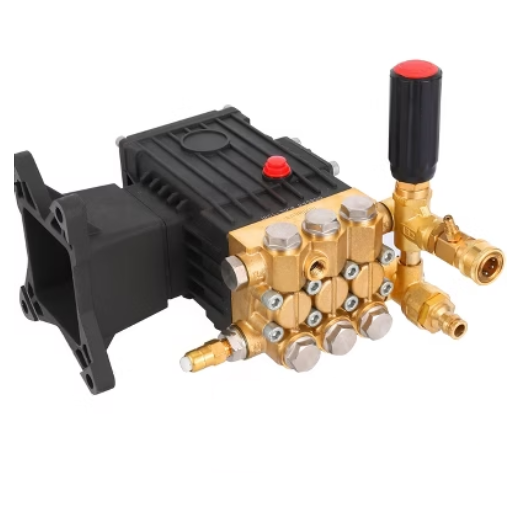
Materials at high pressure are chosen by failure mode: what the fluid attacks, what it carries, and how the seal fails.
Plungers, Packing and the Failure Cascade
Solid ceramic, usually zirconia, is the default above roughly 5,000 psi, and surface finish matters as much as hardness. KMT states that a ceramic plunger’s harder, smoother surface “resists better against wear, eliminates scoring and increases seal lifetimes.”
That mechanism matters. A scored plunger destroys packing quickly, because every score line acts as an abrasive edge running through the seal. Ceramic resists scoring, so packing lasts longer.
It’s brittle, though. It tolerates compression and abrasion but not impact or thermal shock.
A packed plunger has a controlled leak path by design. A small weep is normal and lubricates the packing; the goal is managing it, not eliminating it. Above a few thousand psi, single lip seals give way to stacked V-rings with a lantern ring and flush.
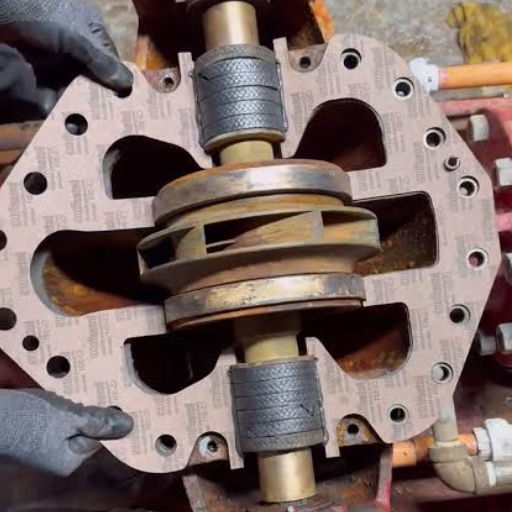
AxFlow’s fault-diagnosis guide is blunt about the most common installation error. The V-groove must face the spring side, or packings must face the liquid and high-pressure side. A backwards seal won’t hold pressure, and the symptom mimics a worn pump.
AxFlow describes the cascade that makes packing service economically important. Worn packings let the male adaptor travel along the plunger and damage it. A neglected seal job becomes a plunger job, then a manifold job.
Some designs add weep holes that reveal seal condition before major damage. It’s a spec worth asking for.
Valves, Seats and Manifold Materials
Valves move from plate to ball or poppet as pressure rises, and seats move to tungsten carbide. The valve must seat cleanly against particles that pass through, or it loses flow before the plunger wears out.
Brass and cast iron serve clean water at moderate pressure. Above roughly 5,000 psi, forged stainless and duplex take over. Seawater needs duplex 2205, 904L or titanium; aggressive chemicals need Hastelloy.
Maintenance intervals are in our plunger pump maintenance guide. For fluids where a packed gland is unacceptable, a diaphragm pump contains the fluid entirely.
Pulsation Control and System Accessories
The pump is one component in a system where the accessories carry much of the cost and most of the safety.
Pulsation dampeners absorb flow ripple. Size them against your pump’s plunger-pass frequency; one sized for a triplex at a given speed will be wrong for a quintuplex at another.
Relief valves protect against overpressure. AxFlow recommends an external relief valve alongside the internal one to prevent manifold overpressure. On ultra-high-pressure systems, a burst disc adds a non-resettable layer.
Tubing and fittings must be rated for the class. A fitting rated for 10,000 psi in a 40,000 psi circuit is a hazard, not a shortcut.
System power follows a standard relation: water horsepower equals GPM × PSI ÷ 1,714, and brake horsepower divides that by overall efficiency. Our guide to how to size a plunger pump sets out the method.
Inlet Conditions: Where High-Pressure Pumps Fail First
High-pressure systems are usually specified from the fluid end backward, and the suction gets whatever space is left. That’s backwards: the inlet is where these pumps fail first.
The Inlet Pressure Requirement
Plunger pumps aren’t self-priming. They need flooded suction or a booster.
Two independent sources agree. CAT Pumps requires a flooded inlet or booster at 60 to 70 psi; AxFlow gives the same figure and contrasts it with 40 psi (2.75 bar) maximum for piston pumps. That agreement matters, because the number gets ignored in practice.
Water Quality and Filtration
CAT publishes a concrete envelope for standard units:
- Particles up to 50 microns
- Total suspended solids up to 50 PPM
- pH 5 to 9; outside this, different seals and manifold material are required
- Water temperature 34°F to 130°F from an overhead tank
- Above 130°F, add 0.5 psi of inlet pressure per degree
- Viscosity up to 500 cP (2,500 SSU)
- Reduce pump rpm for aggressive liquids
Each limit has a mechanism. Particles score plungers and wear packing. High temperature narrows the margin between vapour pressure and inlet pressure, the path to cavitation. High viscosity makes the inlet harder to fill.
AxFlow adds two practical details: fit a flexible hose 3 to 6 inches before the pump inlet to isolate vibration, and put a pulsation dampener on the discharge.
Cavitation and What It Sounds Like
When the inlet can’t keep up, the pump cavitates. The signs are distinctive:
- Suction noise or knocking: NPSH not met
- Pulsation: low NPSH, sticking or worn valves, or discharge pipework
- Low pressure: worn nozzle, air leak, clogged suction strainer, worn valves or seats
AxFlow’s fixes are practical: open all valves, check fluid temperature, reduce bends, enlarge pipework, or add a feed pump.
Safety at High Pressure
Most high-pressure buying guides omit this. At 40,000 psi, a small volume of trapped water holds enough energy to injure someone badly if released uncontrolled.
Stored energy and trapped pressure. Isolate and bleed before any work. A pump that’s been switched off can still be pressurised. Verify with a gauge, not a guess.
Hose and fitting failure. Using a lower-rated component in a higher-rated circuit is the most common cause of sudden failure. Inspect for abrasion, kinks, and age; replace, don’t repair.
Pinhole injection injury. A high-pressure jet can penetrate skin without an obvious wound. It’s a medical emergency requiring immediate professional evaluation, not something to clean up and watch.
Procedural controls. Lockout and tagout, a working relief valve and, where appropriate, a burst disc. Pressure testing follows a written procedure with a defined test pressure, hold period, and exclusion zone. The ASME B31.3 hydrostatic basis Pt = 1.5 × P × (ST/S)works out to about 1.5 times design pressure; put that to a supplier.
Specifying and Sourcing a High Pressure Plunger Pump
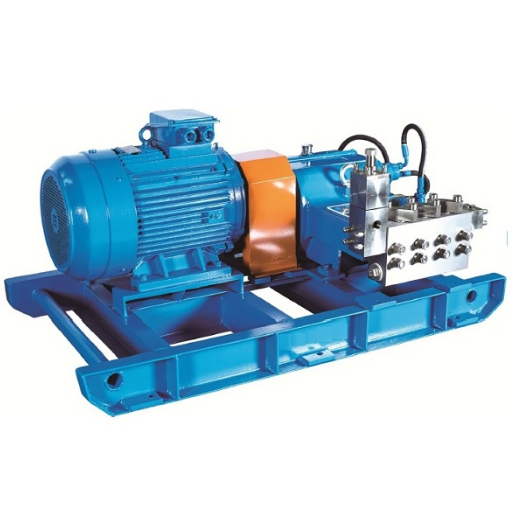
A high-pressure RFQ needs more fields than a standard one, because the class changes so many downstream decisions. Any high-pressure plunger pump supplier will quote against whatever you send, so send the right data.
The RFQ Data Set for High-Pressure Duty
- Fluid: chemistry, pH, solids content and particle size, temperature
- Flow required, with 10–20% headroom
- Discharge pressure: operating, rated, and peak, stated separately
- Duty cycle: hours per day and days per week, continuous or intermittent
- Inlet conditions: flooded suction, booster pressure, or lift
- Pressure class and required standard (API 674, API 675, ISO 13710, PED/CE, ATEX)
- Plunger diameter and stroke, or the flow and pressure that determine them
- Fluid-end materials for manifold, plunger, valves and seats
- Packing type and whether flush is required
- Drive: direct, belt, gear reducer, hydraulic, engine
- Accessories: dampener, relief valve, burst disc, instrumentation
- Mounting, port positions and available footprint
The complete supplier-vetting framework is in our guide to plunger pump manufacturers and OEM sourcing, including how to tell a real manufacturer from a trading company.
Acceptance Testing
“Every unit is tested” is universal, and therefore meaningless. Specify what you want tested and what record you expect:
| Test | What to specify | What you should receive |
|---|---|---|
| Hydrostatic | Multiple of design pressure, hold period, acceptance criterion | Signed record per serial number |
| Performance | Three points against the published curve | Measured flow and pressure at each point |
| Volumetric efficiency | Measured flow against theoretical displacement | Calculated value, with the method stated |
| Material traceability | Fluid-end certificates; PMI on high-value orders | Mill certs matched to the unit |
On ultra-high-pressure units, confirm the seal and valve design allows service without dismantling the entire hydraulic section.
What High-Pressure Duty Costs
Unit price is the smallest part of the picture. The pump is a consumables commitment with a machine attached.
At 800 bar, a standard industrial jetter pump lists around US$4,100–4,500 from Chinese manufacturers, against roughly US$1,095–2,800 for lower-pressure units. A 1,000 bar foot valve alone runs US$500–800. These are live marketplace listings, not quotations, and prices move with class, materials, seal package, drive, and quantity.
At the top of the range, seal life is the cost driver. KMT applies a 500-hour warranty on its high-pressure intensifier seal, a concrete benchmark for what the market treats as reasonable at 6,200 bar. Compare any supplier against that number, and ask what a full consumables kit costs before committing to a platform.
Frequently Asked Questions
What pressure does a high-pressure plunger pump produce?
Direct-drive plunger pumps are catalogued from about 1,000 bar to 3,500 bar (roughly 14,500 to 50,800 psi). Waterjet intensifiers reach 60,000 psi and above, with 90,000 psi units available. The pressure class determines the achievable range.
Can a plunger pump run continuously?
Yes, if it’s rated for it. Continuous duty means full load or cycling 8 to 24 hours a day, 5 to 7 days a week. An intermittent-rated cleaning pump on continuous duty will fail early, and the failure is a rating mismatch, not a defect.
What is the difference between an intensifier and a direct drive pump?
A direct-drive pump builds pressure with a motor turning a crankshaft that drives plungers. An intensifier multiplies pressure through an area ratio, a large hydraulic plunger driving a small water plunger, typically 20:1 to 23:1. Intensifiers reach far higher pressures and are used above roughly 3,500 bar.
Why do high-pressure pumps use ceramic plungers?
Ceramic, usually zirconia, has a harder and smoother surface than metal, which is why a ceramic plunger pump resists scoring from abrasive particles. A scored plunger is what destroys packing. Ceramic plungers therefore extend seal life as well as plunger life, though they’re brittle.
Are high-pressure plunger pumps self-priming?
No. Plunger pumps require flooded suction or a booster. Acceptable inlet pressure is typically 60 to 70 psi, higher for some designs. Running one dry or starved causes cavitation, which damages the fluid end quickly.
What water quality does a high-pressure pump need?
For standard units: particles up to 50 microns, suspended solids up to 50 PPM, pH between 5 and 9, and water temperature between 34°F and 130°F. Above 130°F, add 0.5 psi of inlet pressure per degree.
What is the difference between high-pressure and ultra-high pressure?
There’s no universal boundary, but the market generally treats up to about 3,500 bar as high pressure. Above that, an ultra-high-pressure pump needs intensifier architecture. Ask a supplier to define the terms on their datasheet.
How much does a high-pressure plunger pump cost?
It depends heavily on class. Standard plunger pumps list from roughly US$1,100 to US$2,800, while an 800 bar industrial jetter unit runs US$4,100 to US$4,500. Ultra-high-pressure intensifier systems cost substantially more, and consumables dominate lifetime cost.
Conclusion
A high-pressure plunger pump isn’t defined by a number on a datasheet. It’s a design class, and the class decides almost everything about the machine.
Five checks before you specify:
- Confirm the class, not just the pressure. Ask whether the figure is operating, rated, or peak, and what duty basis it assumes.
- Match the architecture to the duty. Direct drive below roughly 3,500 bar; intensifier above it. Don’t assume a bigger direct-drive pump reaches ultra-high pressure.
- Verify the continuous rating in writing. Most high-pressure failures are duty-cycle mismatches, not material ones.
- Size the inlet properly. A high-pressure plunger pump needs flooded suction or a booster at 60–70 psi. The suction fails before the fluid end does.
- Buy the test record, not the claim. Per-unit hydrostatic and performance data, material certificates, and a defined acceptance criterion.
For the wider picture, see plunger pump applications by industry and the complete guide to plunger pumps.
If you’re specifying a high-pressure plunger pump for cleaning, blasting, waterjet, injection, or testing duty, our engineering team can review your duty point and recommend a class and architecture. Request a technical specification sheet with your flow, pressure, fluid, and duty cycle, and we’ll confirm the configuration before you commit.