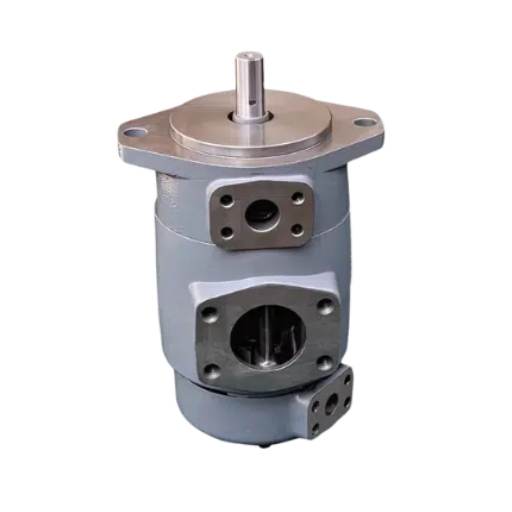
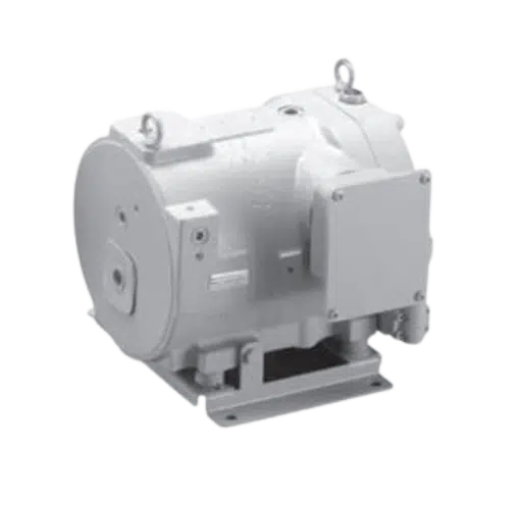
A hydraulic rotor pump is a variable-displacement piston pump built into the same housing as an electric motor. In Daikin’s RP series, the motor and the piston group share one sealed, oil-filled case, so the hydraulic oil that transmits power also cools the motor.
Ask five people what a rotor pump is, and you can get five different machines. The word describes a rotating part, not a displacement principle, and the results for the term are dominated by progressive cavity, screw, gear, gerotor, and vane pumps. That ambiguity matters at the ordering stage, because the wrong reading sends you to the wrong datasheet.
This guide pins down the hydraulic meaning. It separates the five machines that share the name and explains how the RP’s piston group and pressure compensator work. It also lists the four frames with verified specifications and decodes the model string, so you can tell a 7 MPa build from a 21 MPa build before you order.
The reference throughout is the Daikin RP series; the integrated motor pump is the term most often used in machine-tool and industrial power packs. If you already know the RP is the family you need, the Daikin RP series page lists the frames and control options.
Key Takeaways
- A hydraulic rotor pump, in Daikin’s RP series, is a variable-displacement piston pump with an oil-cooled motor in one sealed housing, not a vane, gear, screw or progressive-cavity pump.
- Four frames cover 8.0 to 37.7 cm³/rev and 0.75 to 5.5 kW, with up to 21 MPa on the right pressure code and up to 64 L/min at 60 Hz.
- The pressure digit, not the motor code, sets the ceiling: RP15A1-22-30-T is a 7 MPa build, while RP15A3-22-30 is the 21 MPa version of the same frame and motor.
- The RP uses petroleum-based ISO VG 32 to 68 oil at 15 to 400 mm²/s, 0 to 60 °C, water at 0.1% or less, and NAS class 9 or better; the same oil cools the motor.
- It suits compact machine-tool and general industrial hydraulic power, not process-fluid transfer; above 21 MPa, above 64 L/min at 60 Hz, or with non-petroleum fluid, look at another pump family.
What a hydraulic rotor pump is
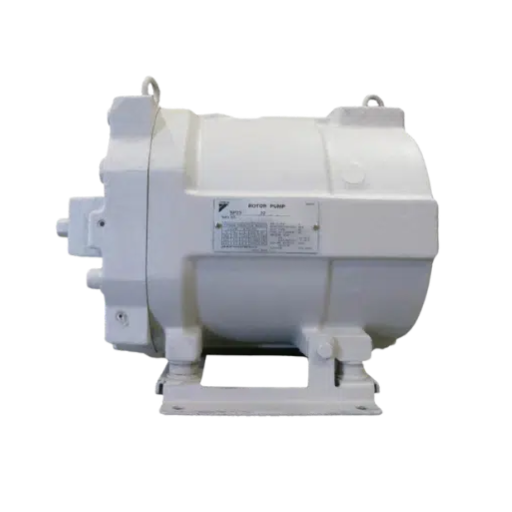
In the hydraulic sense, the Daikin RP is a variable displacement rotor pump: a positive-displacement piston pump whose rotating group sits inside a sealed housing shared with its motor. Its piston and cylinder block run in the same oil-filled case as the motor. There is no separate motor to align and no coupling to guard.
One name, five different machines
The phrase covers at least five machines. Only the first row below is the subject of this article.
| Name | What rotates | Typical duty | Is it the RP? |
|---|---|---|---|
| Hydraulic rotor pump (Daikin RP) | Motor rotor drives a piston group inside an oil-filled housing | Hydraulic oil power for machine tools and general industrial machinery | Yes |
| Rotary vane pump | Rotor with sliding vanes inside an eccentric ring | Vacuum, compression or hydraulic flow | No |
| Progressive cavity pump | Helical rotor inside an elastomer stator | Viscous, abrasive or dosing duty | No |
| Lobe, gear or screw pump | Two or more intermeshing rotors or gears | Process-fluid transfer | No |
| Gerotor pump | Inner rotor inside an outer ring | Lubrication, transfer or hydraulic flow | No |
The other four are real pumps with real duties, and each answers “what rotates?” differently. A rotary vane pump slides vanes in and out of a rotor inside an eccentric ring. A progressive cavity pump turns a helical rotor inside a fixed elastomer stator, which is the family our guide to rotor and stator pumps covers.
The last two are common in transfer duty. A lobe, gear, or screw pump moves fluid between intermeshing rotors. A gerotor pump uses an inner rotor with one fewer tooth than the outer ring.
Why the name causes confusion
Rotor is a component name, not a pump classification. Every one of the five machines has a rotor, and several manufacturers use “rotor pump” for whichever one they sell. In the top results for the term, process-fluid pages outnumber hydraulic pages by a wide margin.
Our own site reflects the split. The stator and rotor guide owns the progressive cavity meaning. This article is the hydraulic counterpart. The two pages should be read as a pair, not as competing answers.
What the RP is not
Not a vane pump. The RP has pistons running against a swash plate, not vanes sliding in slots. The rotary vane pump guide covers that mechanism.
Not a progressive cavity pump. There is no elastomer stator and no helical rotor. The piston group runs in oil inside a metal housing.
Not a gear pump. No gears mesh, and the displacement isn’t fixed per revolution.
Not a process pump. It moves hydraulic oil, not the product. The oil is the working fluid and the motor coolant at the same time.
How the Daikin RP works
How does a rotor pump work in this series? A motor turns a piston group inside a sealed case, and a compensator trims the flow to hold pressure. Daikin describes the series as rotor pumps that “integrate an electric motor with an internal piston mechanism” and are characterized by low noise, a compact design, low pulsation, and high reliability, with consideration for CE compliance.
The motor and pump share one housing
An earlier edition of Daikin’s RP instruction manual describes the sequence inside the case. The motor turns the rotor and cylinder block. The pistons reciprocate against a swash plate, and the displacement changes with the swash angle. Because no shaft leaves the housing, there is no external shaft seal to leak and no coupling to align.
The construction sets the service model. There is no separate motor to replace and no shaft-seal kit. Daikin’s catalogue lists sealing washers, O-rings, needle bearings and gaskets by frame, but not a complete rebuild kit.
The pressure compensator
The A control uses a pressure compensator. As discharge pressure approaches the set cutoff, the compensator reduces the swash angle, so displacement and flow fall. At full cutoff, the swash plate sits close to zero, and the pump holds pressure with almost no flow.
The catalogue calls the full-cutoff pressure and the discharge rate manually adjustable. That is the practical meaning of pressure compensation. The pump supplies only the flow the circuit needs to hold the set pressure, instead of pushing full flow across a relief valve.
A control versus C control
A control has one pressure setting. You set the ceiling, and the pump trims flow to hold it. A-RC adds remote control of that setting.
C control has two. The pump runs at low pressure and high flow, then switches to high pressure and low flow when the cycle demands it. H uses pressure feedback, and J uses a solenoid. Daikin describes the purpose as lower power consumption, lower oil temperature, and feed-rate switching.
Choose C when the machine approaches at low pressure and feeds at high pressure, and you want one pump to cover both. Choose A when the circuit needs a single holding pressure.
The oil is also the coolant
Because the motor sits in the oil, the oil specification is also an electrical specification. Daikin’s catalogue says the oil-cooled motor suppresses coil temperature rise and allows continuous operation at overload. The published figures are 150% of rated current continuous and 200% momentary.
Water ties the two roles together. The catalogue limits water content to 0.1% by volume. In a conventional pump, water is a lubrication and corrosion problem. In the RP, it is also an insulation problem, because the same fluid touches the motor.
A common version of this error is a machine builder who specifies an RP to replace a vane pump on a line that already runs water-glycol fluid, without checking the fluid rule. The catalogue prohibits non-petroleum fluids, and the oil also cools the motor.
The unit can’t be commissioned on that circuit. The line has to be flushed, and the fluid changed before the RP is started.
The four rotor pump sizes at a glance
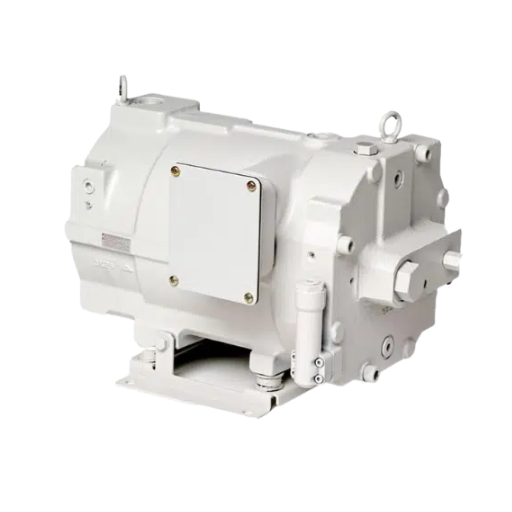
The RP comes in four frame sizes. The table shows what each frame can do with the correct pressure code, not what every build of that frame can do.
| Frame | Displacement (cm³/rev) | Motor (kW) | Max pressure with correct code (MPa) | Flow at 60 Hz (L/min) |
|---|---|---|---|---|
| RP08 | 8.0 | 0.75 | 14 | 4.8 to 14.0 |
| RP15 | 14.8 | 1.5 | 14 | 12.0 to 25.0 |
| RP15 | 14.8 | 2.2 | 21 | 12.0 to 25.0 |
| RP23 | 24.4 | 2.2 | 14 | 20.0 to 42.0 |
| RP23 | 24.4 | 3.7 | 21 | 20.0 to 42.0 |
| RP38 | 37.7 | 3.7 | 14 | 20.0 to 64.0 |
| RP38 | 37.7 | 5.5 | 21 | 20.0 to 64.0 |
Two entries are easy to misread. The pressure column is the maximum available with the right code, not the pressure of a specific build. The flow column is an adjustment range at 60 Hz, and delivery falls as pressure approaches cutoff.
Mass runs from 30 kg for the RP08 to 87 kg for the RP38-55. The same frame gains about 2 kg when C control uses a solenoid instead of pressure feedback.
| Model | High flow (L/min) | Low flow (L/min) | Motor (kW) | Mass H / J (kg) |
|---|---|---|---|---|
| RP15C-15 | 12.0 to 25.0 | 3.5 to 10.0 | 1.5 | 50 / 52 |
| RP15C-22 | 12.0 to 25.0 | 3.5 to 10.0 | 2.2 | 50 / 52 |
| RP23C-22 | 20.0 to 42.0 | 3.7 to 15.0 | 2.2 | 70 / 72 |
| RP23C-37 | 30.0 to 42.0 | 5.8 to 25.0 | 3.7 | 76 / 78 |
| RP38C-37 | 30.0 to 64.0 | 5.8 to 25.0 | 3.7 | 76 / 78 |
| RP38C-55 | 30.0 to 64.0 | 5.8 to 25.0 | 5.5 | 90 / 92 |
C control starts at the RP15 frame; there is no RP08 C model. The high range can also be restricted by the low-range setting, and the catalogue points to graphs on page C-9 for those combinations. The RP08 carries a separate restriction between 7 and 14 MPa.
One ordering detail catches people. Piping flanges aren’t supplied with the pump and are ordered separately.
If you’re matching a frame to an existing power unit, the catalogue GK247D pages C-5 to C-19 (PDF) carries the full specification pages, including the C-control graphs.
How to read an RP model code
The model string carries more information than most buyers read. Take RP15A1-22-30-T.
| Order | Example | Meaning |
|---|---|---|
| 1 | RP | RP series rotor pump |
| 2 | 15 | Pump capacity: 15 = 14.8 cm³/rev; 08 = 8.0, 23 = 24.4, 38 = 37.7 |
| 3 | A | Control method I: A = pressure compensator; C = combination control |
| 4 | 1 | Pressure adjustment range: 1 = 7 MPa max, 2 = 14 MPa max, 3 = 21 MPa max. For C control, this becomes two digits: low range, then high range. |
| 5 | 22 | Motor output: 22 = 2.2 kW; 07 = 0.75, 15 = 1.5, 37 = 3.7, 55 = 5.5 |
| 6 | (blank) | Voltage: blank = 200 V 50/60 Hz and 220 V 60 Hz; X = 230 V 50 Hz; Y = 380 to 460 V |
| 7 | 30 | Design number, subject to change |
| 8 | RC (optional) | Remote control system, when fitted; appears after the design number and before T |
| 9 | T | Installation: blank = foot support mount; T = vertical installation, RP08 and RP15 only |
The most common misreading is the “22”. It is the motor output in kilowatts times ten: 22 means 2.2 kW. It’s not a pressure. The pressure is the digit before the dash, and here it is 1, which caps the pump at 7 MPa.
If the same machine needs 21 MPa, the string becomes RP15A3-22-30. Same frame, same motor, same flow range, different compensator setting. That’s the whole difference, and it’s one character.
The C-control string adds two pressure digits and a control letter before the dash. RP15C23H-15-30 reads as C control, low range code 2, high range code 3, pressure feedback, 1.5 kW, and design 30.
What the string doesn’t tell you matters too. It doesn’t give the flow setting, the oil, the filtration, the port options, or whether a remote relief is fitted. Those come from the specification pages.
The error shows up in real orders. A maintenance engineer reads the “22” as 22 MPa, sets the system relief to 12 MPa, and orders RP15A1-22-30-T as a drop-in replacement. The pump’s pressure code tops out at 7 MPa, so it runs at full cutoff and the cycle stalls. The correct high-pressure string for the same frame and motor is RP15A3-22-30.
Rotor pump vs vane, gear and piston pumps
The short answer
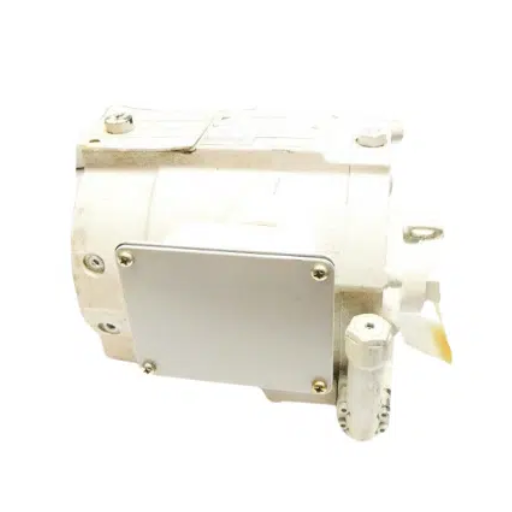
In this series, the rotor pump is a piston pump with an integrated motor. A vane pump, a gear pump, and a separate piston pump are different displacement mechanisms, and they are usually sold as a pump you couple to your own motor.
| Type | Displacement | Control | Service model | Best fit |
|---|---|---|---|---|
| Daikin RP | Variable | Pressure compensator or high/low combination | Sealed integrated unit; seals and bearings listed, no rebuild kit | Compact machine-tool and general industrial power |
| Vane pump | Fixed or variable | Pressure compensator, cartridge | Separate pump on a motor; cartridge kits | General industrial hydraulics |
| Gear pump | Fixed | Simple relief valve | Separate; robust and simple | Transfer, lubrication, mobile |
| Piston pump (separate) | Variable | Pressure and flow controls | Separate; high-pressure service | High-pressure systems |
The pressure and flow figures in this article belong to the RP. Don’t carry them across to the other families; the datasheet for each one decides. Our comparison of hydraulic pump types sets out how the other three mechanisms differ.
Where the RP fits, and where it does not
It fits machine tools, where clamping, feed and tool change need compact hydraulic power. It fits general industrial machines and quiet power packs, and it fits CE-market equipment where Daikin’s compliance statement applies.
It doesn’t fit process-fluid duty, pressures above 21 MPa, or flows above 64 L/min at 60 Hz. It doesn’t fit non-petroleum fluids, suction below -16.7 kPa, ambient above 40 °C, altitude above 4,000 m, or vertical mounting on the RP23 and RP38.
The service-model difference
The RP is a sealed integrated unit. Seals and bearings are listed; a rebuild kit is not. A vane pump typically uses cartridge kits, a gear pump is simple and often replaced whole, and a separate piston pump goes to high-pressure service.
Six checks before you specify an RP
- Pressure code and motor. Choose code 1, 2, or 3, then check that the frame and motor support it. Never read the motor digits as MPa.
- Flow at the duty point. Use the 60 Hz adjustment range and the pressure-flow curve. Do not size at maximum flow if the duty point sits near cutoff.
- Control. A for one pressure, C for two. H or J, and RC if the setting is remote.
- Oil and filtration. Petroleum-based ISO VG 32 to 68; 15 to 400 mm²/s; 0 to 60 °C; water 0.1% maximum; NAS class 9 maximum. Use a 150-mesh suction filter and a 25 µm return filter, or 10 µm at 14 MPa and above.
- Installation. Four-hole foot mount, level, filler at the top, rubber pad at the bottom. Vertical mounting is RP08 and RP15 only, with the T suffix and a rigid base. Keep case pressure at 0.1 MPa or less, the drain line at 1 m or less, and suction at -16.7 kPa or above. Order the flanges separately.
- Electrical. A 4-pole motor from 0.75 to 5.5 kW, the right voltage code, a no-fuse breaker, and a ground fault interrupter. Check phase order if pressure does not build within five minutes. Daikin states IP54 for the terminal box and compliance with EN60034-1.
Safety note: Isolate and lock out the motor before you open the terminal box, change a filter or disconnect a line. The case can reach about 80 °C in service, and stored pressure stays in the circuit after the pump stops. Release pressure before you loosen a fitting.
The guide to choosing a Daikin rotor pump covers the selection sequence in more detail. The list above is the short version you can take to a quote request.
One common slip is to use the T suffix on a light bracket. The catalogue allows vertical installation on the RP15, but it also says the rubber pad has no effect vertically and the base must be rigid. A flexible bracket runs noisy and has to be rebuilt before the pump goes into service.
The catalogue pages C-2 to C-4 (PDF) carry the oil, installation and start-up requirements in full.
What goes wrong, and repair versus replace
Most RP problems show up as one of five symptoms, and most of them trace back to a catalogue limit rather than a failed component.
| Symptom | First check | Likely cause |
|---|---|---|
| No pressure at start-up | Phase order, oil fill, air bleed | Wrong rotation, air lock, low fill |
| Low flow at pressure | Suction strainer, oil viscosity, compensator setting | Restricted inlet, wrong oil, setting below duty |
| Noise or vibration | Suction pressure, mounting, air in oil | Cavitation, flexible base, entrained air |
| Overheating | Oil temperature, water content, case drain | Cooler or drain problem, water contamination |
| Leak at the case | Drain line, case pressure, seals | Blocked or undersized drain, worn seal |
The first checks are quick and low-cost. Confirm the oil level and the fill volume, check the suction strainer, verify phase order, and read case pressure at the drain. A pump that is noisy under load usually has an inlet restriction or entrained air, not a worn piston group.
Repair and replacement split along the parts list. A sealing washer, an O-ring, a needle bearing, or a gasket can be replaced. The catalogue doesn’t publish a complete rebuild kit or a field procedure for the piston group. If the piston group or the motor is damaged, the usual route is replacement.
Water contamination is the case where both decisions meet. Because the oil is also the motor coolant and insulator, a water event can damage the electrical side as well as the hydraulic side. Oil analysis before restart is cheaper than a second failure.
Before you request a replacement, quote the full model string, the duty point in pressure and flow, the voltage, and the mounting. The string alone isn’t enough, because the same frame can be built for 7, 14, or 21 MPa. The hydraulic pump troubleshooting covers the system-side checks that come before a pump change.
FAQ
Is a rotor pump the same as a vane pump?
No. A vane pump moves sliding vanes in an eccentric ring. The Daikin RP uses pistons against a swash plate inside a sealed, oil-filled housing. The name overlaps; the mechanism does not.
What is the difference between a rotor pump and a progressive cavity pump?
A progressive cavity pump turns a helical metal rotor inside an elastomer stator and handles viscous or abrasive process fluid. The RP is a hydraulic piston pump that circulates oil.
What does the “22” in RP15A1-22-30-T mean?
It is 2.2 kW of motor output. The pressure code is the digit before the dash: 1 means 7 MPa maximum.
Can a Daikin RP pump water, food, or chemical products?
No. A Daikin RP pump is a hydraulic power unit. It pumps petroleum-based hydraulic oil, and non-petroleum fluids are prohibited. Process-fluid duty needs a different pump family.
What oil does a Daikin RP use?
A general-purpose rust- and oxidation-inhibited (R&O) or wear-resistant hydraulic oil in ISO VG 32 to 68, with viscosity 15 to 400 mm²/s, fluid temperature 0 to 60 °C, water at 0.1% or less, and contamination at NAS class 9 or better.
Can a Daikin RP be mounted vertically?
Only the RP08 and RP15 with the T suffix. The rubber pad has no effect in a vertical install, so the base must be rigid and must absorb vibration. The RP23 and RP38 are foot-mount only.
Conclusion
A hydraulic rotor pump is not a generic rotary pump. In the Daikin RP series, it is an integrated piston pump, and the name collision with vane, progressive cavity, gear, and screw pumps is the first thing to clear up.
- Four frames cover 8.0 to 37.7 cm³/rev and 0.75 to 5.5 kW, with up to 21 MPa and 64 L/min at 60 Hz.
- The pressure digit sets the ceiling, and the digits after the dash set the motor.
- Petroleum-based oil only, and that oil also cools the motor.
- Above 21 MPa, above 64 L/min, or with process fluid, the RP is the wrong family.
The next step is a nameplate and a duty point. Write down the required pressure, flow, fluid, voltage, and mounting, then match them to a full model string. That string is what makes a quote accurate, because the same frame can be built three different ways.
If the duty fits, start with the Daikin rotor pump range and quote the full model string with your pressure and flow.