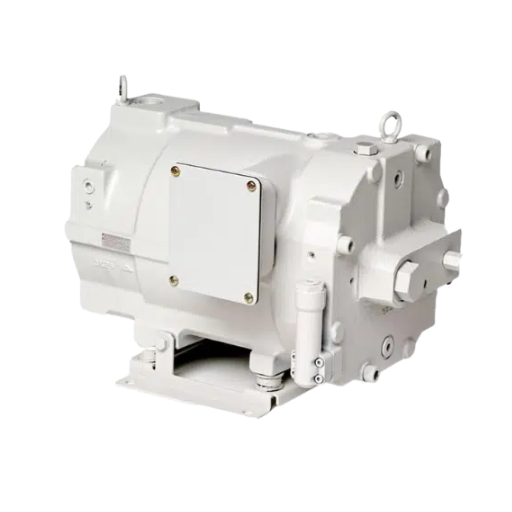
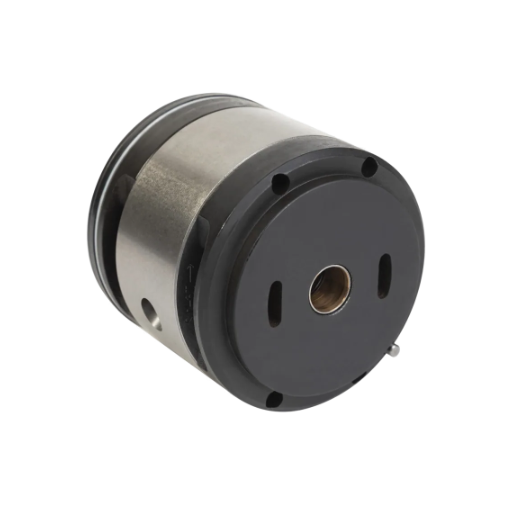
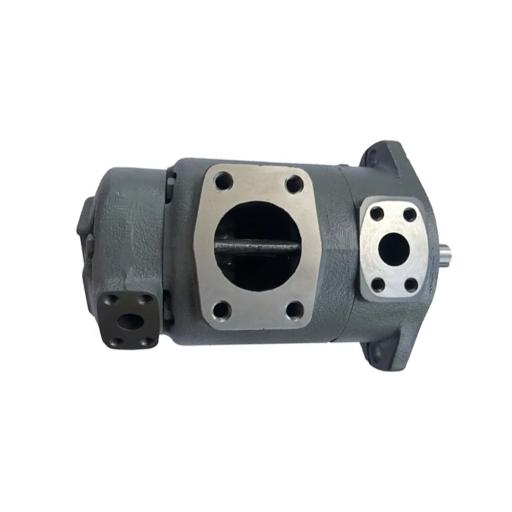
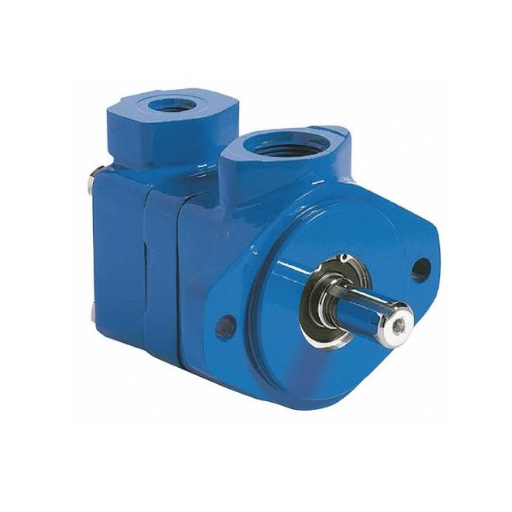
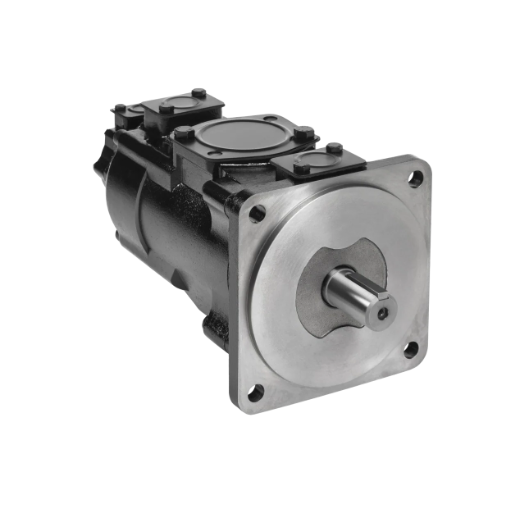
A rotor pump and a vane pump are two different machines, not two names for one pump. In a hydraulic rotor pump such as Daikin’s RP series, pistons on a swash plate sit inside the motor rotor, sealed in one oil-filled housing. In a hydraulic vane pump, flat vanes slide out of a slotted rotor and press against a cam ring, and the pump couples to a separate motor by a shaft.
The confusion is fair. Both are rotary positive-displacement pumps, both can be pressure compensated, and both turn up in machine-tool hydraulics. On a crowded baseplate, they look like the same black cylinder.
This guide separates them. It covers how each displaces oil, why the pressure ceilings differ by mechanism rather than marketing, and how to identify which machine is in front of you without a datasheet. It covers hydraulic duty only.
Scope note. “Vane pump” also names the rotary vane vacuum pump, which runs at very different clearances and pressures. Our rotary vane vacuum pump guide covers that machine.
Key Takeaways
- A hydraulic rotor pump integrates a variable-displacement piston pump and its motor in one sealed housing, with no external shaft and no oil seal.
- A hydraulic vane pump slides vanes inside a cam ring and is a separate unit on a motor; the single-acting layout can be variable, the double-acting layout can’t.
- The RP series tops out at 21 MPa (210 bar) and only with the correct pressure code; a vane pump’s ceiling belongs to a named frame and series.
- A shaft coupling and an oil seal mean vane pump; a terminal box on the pump housing means an integrated rotor pump.
- A vane pump takes cartridge kits, while the RP is a sealed unit with listed seals and bearings and no rebuild kit.
Rotor pump vs vane pump: the short answer
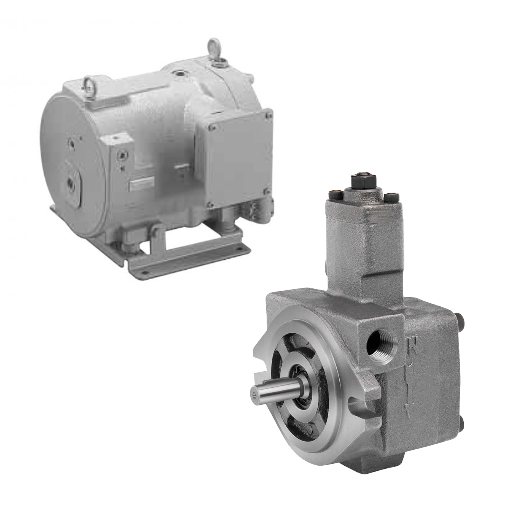
Two architectures, not two names
A rotor pump moves oil with pistons. The motor rotor turns a cylinder block, the pistons reciprocate against an angled swash plate, and their stroke sets displacement. A pressure compensator reduces the swash angle as discharge pressure approaches its setting, so flow falls while pressure holds.
A vane pump moves oil with vanes. The rotor carries slots, each holding a flat blade that rides on the cam ring. As the rotor turns off-centre inside a circular ring, the gap opens on the inlet side and closes on the discharge side.
That difference decides almost everything downstream. The rotor pump has no shaft because the motor sits inside the housing, so it needs no oil seal; the vane pump needs both. And the rotor pump’s oil touches motor windings, so its oil specification is also an electrical one. Our guide to what a hydraulic rotor pump is covers that series in full.
Why the names collide
“Rotor pump” names at least four other machines: the progressive cavity or rotor-stator pump, gerotors, lobe pumps, and screw pumps. The first is a different product with a different duty, and it isn’t covered here.
“Vane pump” splits the same way. In vacuum work, it means a dry-running or oil-sealed vacuum pump; in hydraulics it means the cam-ring machine described here. Search this comparison, and you’ll mostly get gear-versus-vane pages, because engines read the phrase as a vane question.
How each one moves fluid
The rotor pump
Daikin describes the RP series as rotor pumps that “[integrate] an electric motor with an internal piston mechanism,” characterized by low noise, a compact design, low pulsation, and high reliability, with consideration for CE compliance. That sentence is the whole architecture, and it comes from Daikin’s RP product page.
The rotor turns the cylinder block, and the pistons run against a swash plate whose angle sets stroke, so at full angle the pump displaces its rated volume per revolution. Nothing protrudes from that assembly, so there’s no rotating shaft to seal. The catalogue states the structure is fully enclosed, with no shaft and no oil seal, and that the motor is cooled by the hydraulic oil. Four frames span 8.0 to 37.7 cm³/rev and 0.75 to 5.5 kW.
The vane pump
The vane pump has two layouts, and a comparison has to name which one it means.
In the single-acting layout, the cam ring is circular, and the rotor sits off-centre inside it. The pump draws in and discharges once per revolution, and pressure acts on one side of the rotor, so the shaft and bearings carry a steady radial load. Because the ring can pivot, this is the layout that can be made variable displacement.
In the double-acting layout, the ring is slightly elliptical, and the rotor sits at its centre. Two inlet and two discharge ports sit opposite each other, so the pump fires twice per revolution and the pressure forces on opposite sides cancel. Radial load is nearly zero, which allows higher pressure and longer bearing life, but eccentricity can’t change, so these units are fixed displacement only.
NPTEL’s oil hydraulics module states the governing rule plainly: “the fluid flow will not occur when the eccentricity is zero.” Displacement depends on eccentricity, vane expansion, vane width, and rotor speed. The internal layout is drawn step by step in our guide to how a vane pump works.
What construction decides
| Rotor pump (Daikin RP) | Vane pump | |
|---|---|---|
| Displaces oil with | Pistons on a swash plate | Vanes against a cam ring |
| Shaft and seal | None; fully enclosed | External shaft, coupled to a motor, seal fitted |
| Displacement control | Swash angle; compensator (A) or two pressures (C) | Eccentricity; pivoting ring on single-acting only |
| Motor | Inside the housing | Separate, on a coupling |
| Service parts | Seals and bearings listed, no rebuild kit | Cartridge kits available |
Everything after this point follows from one of those five rows.
Where rotor pump vs vane pump differences show up
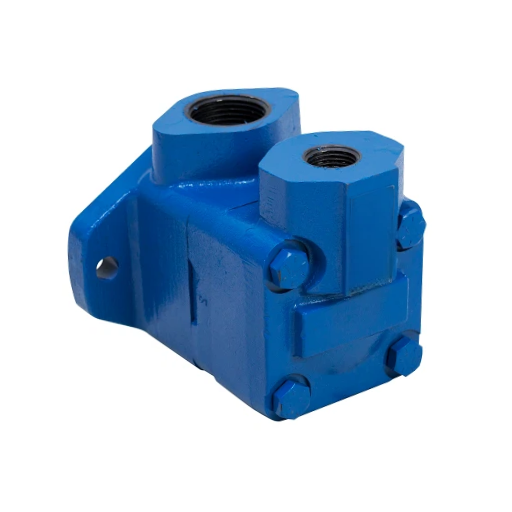
The pressure ceiling, and why it exists
Fluid Power World’s history of the vane pump explains the mechanism. As pressure rises, “the force against those vanes becomes excessive, increasing friction and wear.” The vanes are pushed harder into the ring, so the ring and vane tips wear faster and internal leakage climbs with them.
The same article records how far fixed vane designs have come. Hardened steel, tighter tolerances, and a pitch in vane angle let modern fixed-vane pumps achieve performance over 5,000 psi, about 345 bar. It also records the limit that matters here. Variable displacement technology never caught on for those high-pressure pumps, which is why the pressure-compensated vane pump dominated machine tools, holding jaws and clamps at relatively low pressure.
The rotor pump sits in a narrower, documented band. The RP series reaches 21 MPa (210 bar) on the right build and 14 MPa on others. Pressure isn’t a property of the frame alone. The pressure code in the model string sets it, and that code has to match the motor output.
Field note.
RP15A1-22-30-Tis a 7 MPa build, not a 22 MPa build. The “22” after the dash is the motor code for 2.2 kW. The digit before the dash, 1, is the pressure code, and code 1 tops out at 7 MPa. Code 2 gives 14 MPa, code 3 gives 21 MPa.
Variable displacement, two mechanisms
The vane pump pivots its cam ring. A compensator spool senses discharge pressure and repositions the ring, changing eccentricity. At the setting, output falls; at full deadhead the pump holds pressure while displacing almost nothing. A double-acting pump can’t do this, because its rotor is centred and there’s no eccentricity to vary.
The rotor pump tilts its swash plate. The standard A control gives one adjustable pressure ceiling. The C control gives two operating points from one pump: a low-pressure, high-flow range and a high-pressure, low-flow range, switched by pressure feedback (H) or a solenoid (J). That’s the build for a cycle with a fast approach and a slow, forceful feed.
Speed, noise, and what the oil is doing
Speed
The rotor pump has a four-pole motor built into its own housing, so pump speed is motor speed. There’s no belt ratio or coupling to get wrong, and no minimum speed below which the displacement mechanism stops sealing.
The vane pump is different at the slow end. Vanes are thrown outward mainly by centrifugal force, which rises with the square of shaft speed. That force fades fast. Below roughly 600 to 900 rpm, it is too weak to hold the vanes against the ring, so they bounce and sealing fails intermittently.
The ring surface then ripples. The industry calls that damage washboarding, and once the bore grows past its limit, no cartridge kit can recover it.
That’s why a variable-frequency drive used to slow a power unit for energy savings can quietly destroy a vane pump. The pump isn’t faulty; it’s running outside the range its geometry needs.
Noise and pulsation
Daikin states that the RP cuts noise by 10 to 15 dB compared with Daikin products, reduces overall length by approximately 40% compared with Daikin conventional models, and cuts pulsation by approximately 50%. Read those as comparisons with Daikin’s own machines, not as a claim against every vane pump on the market.
On the vane side, geometry sets pulsation. A double-acting pump fires twice per revolution and cancels most of the radial load, which is why balanced designs are the smooth, quiet option in that family. A single-acting pump fires once and carries a one-sided load, and variable single-acting units are noticeably noisier.
The oil isn’t doing the same job on both
This difference catches people out during a retrofit.
In the RP, the oil is the hydraulic fluid and the motor coolant at the same time. Daikin’s catalogue therefore reads like an electrical specification as much as a hydraulic one. It requires petroleum-based rust- and oxidation-inhibited oil equivalent to ISO VG 32 to 68, viscosity 15 to 400 mm²/s, fluid temperature 0 to 60 °C, water content 0.1% maximum by volume, and contamination to NAS class 9 maximum. Non-petroleum fluids are prohibited.
Read the consequence. Water in an ordinary hydraulic circuit causes corrosion and accelerates wear. Water in an RP circuit reaches motor insulation. A builder who specifies an RP onto an existing water-glycol circuit hasn’t bought a pump with a fluid caveat; they’ve bought a pump that can’t be commissioned until the line is flushed and refilled.
In a vane pump, the oil lubricates the vanes and side plates and carries heat away, so cleanliness and viscosity drive wear rates. The fluid rules still matter, but they stay hydraulic rules.
How to tell them apart on the machine
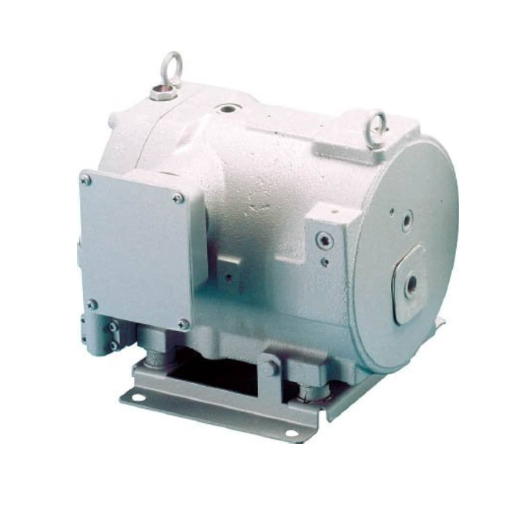
If you’re standing in front of an unlabelled unit, six checks settle it.
| What you see | Rotor pump | Vane pump |
|---|---|---|
| Shaft coupling to a motor | None | Present |
| Oil seal at the shaft exit | None | Present |
| Terminal box location | On the pump housing | On the separate motor |
| Casing shape | One cylinder, motor and pump together | Pump body bolted to a motor |
| Nameplate string | RP15A1-22-30-T style code |
T6C, SQP, VDC, 25V, PV2R Style series code |
| Port layout | Suction and discharge on one body | Ports on the pump section, often with a second section stacked behind |
The nameplate is the fastest test. An RP string decodes as series, frame, control letter, pressure digit, motor code, design number, and installation suffix. A vane pump nameplate gives a series code and a displacement, and the motor carries its own plate.
If the plate is gone, look for the seal. A shaft seal is the clearest physical marker of a pump coupled to its motor rather than built with it.
What fails, and how each is serviced
The RP is a sealed integrated unit, and the catalogue is honest about what that means. It publishes a parts table with sealing washers, O-rings, needle bearings, and gaskets by frame. It doesn’t publish a rebuild kit or a field rebuild procedure. Seal and bearing work is possible; piston group or motor damage usually means replacing the unit.
Two failure paths are worth knowing. The first is fluid, because the oil cools the motor: contamination that would only accelerate wear in a vane pump can become an insulation problem.
The second is installation. The catalogue limits case pressure to 0.1 MPa and the drain line to 1 m, and it requires suction no lower than -16.7 kPa. It also specifies a 150 mesh suction filter with a 25 µm return, tightened to 10 µm at delivery pressures of 14 MPa and above.
The vane pump is the more serviceable of the two. Cartridge kits renew the rotating group in place, which keeps the family economical to run. Its characteristic failures are vane tip and cam ring wear, washboarding from running too slowly, and efficiency loss from contamination. A pump that reaches pressure unloaded and drops under load is usually leaking internally, and the first check is volumetric efficiency against the OEM acceptance value.
Safety note. Before opening any hydraulic circuit, isolate and lock out the drive, release stored pressure, and check fluid temperature. Surfaces on an RP can reach about 80 °C in service, and a drain line under pressure will spray.
For symptom-by-symptom diagnosis on either family, start with the hydraulic pump troubleshooting guide.
Rotor pump vs vane pump: which one to specify
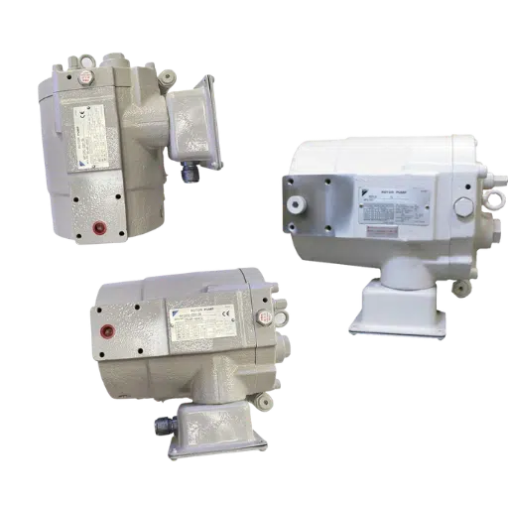
Start from the duty point, not the pump name. The table below is the short version; the paragraphs after it explain each row.
| Duty | Better fit | Why |
|---|---|---|
| Compact, quiet power on a machine tool | Rotor pump (RP) | Motor and pump share one sealed housing, so the package is short and has no shaft seal |
| Smooth flow at moderate pressure | Double-acting vane pump | Two pulses per revolution and radial forces that cancel |
| Two pressure settings from one unit | Rotor pump with C control, or variable single-acting vane | Both switch between a low-pressure and a high-pressure setting |
| Separate pump on an existing motor | Vane pump | The rotor pump has no shaft to couple |
| In-place renewal with a cartridge kit | Vane pump | The RP is a sealed unit with no rebuild kit |
| Process fluid rather than hydraulic oil | Neither | Both are hydraulic components, and the RP prohibits non-petroleum fluid |
Specify an integrated rotor pump when the machine needs compact power with low noise, and you’d rather not design a coupling, bell housing, and shaft seal into the package. It fits when the duty sits inside 21 MPa and 64 L/min at 60 Hz, and when the circuit is a clean, closed, petroleum-oil system. Machine tools, general industrial machines, and quiet power units are a good fit. The Daikin RP series page lists the current frames.
Specify a vane pump when you want a separate pump on an existing motor. It is also the fit when a balanced double-acting unit gives the smooth flow the circuit needs, or when in-place cartridge service matters more than packaging. The hydraulic vane pump guide covers selection and sizing for that family.
Neither fits when the fluid is a process fluid rather than hydraulic oil. The RP pumps oil, and only oil, and a vane pump is a hydraulic component too. Neither answers water treatment, food, or chemical transfer, whatever the listings say.
Not sure which build fits your duty point? Send the model string, the required flow and pressure, the voltage, and the fluid. We’ll confirm the frame and control before anything is ordered.
FAQ
Is a rotor pump the same as a vane pump?
No. A hydraulic rotor pump uses pistons inside the motor rotor and has no external shaft or oil seal. A hydraulic vane pump slides vanes against a cam ring and couples to a separate motor. They share only the broad category of rotary positive-displacement pumps.
Is a rotor pump the same as a rotary vane pump?
No, and the phrase is a trap. “Rotary vane pump” most often means a vacuum pump, a different machine with different clearances. In hydraulics, it means the cam-ring pump described here.
Why does a rotor pump have no shaft seal?
Because the motor sits inside the same oil-filled housing as the pump. No shaft passes through the casing, so there’s nothing for a seal to seal. The trade-off is that the oil also cools the motor, which makes fluid quality an electrical requirement too.
Which is quieter, a rotor pump or a vane pump?
It depends on the vane design and the comparison. Daikin states the RP is 10 to 15 dB quieter than Daikin products. Balanced double-acting vane pumps are the quiet option in their family, while single-acting variable units are noisier. Compare like duty cycles and like measurements.
Can a vane pump replace a rotor pump directly?
Rarely without engineering. The rotor pump has no shaft, so a vane replacement needs a motor, coupling, bell housing, and shaft seal that weren’t there before. Pressure and flow must match at the duty point, and a vane pump has a minimum speed the integrated unit doesn’t.
What pressure can each one reach?
An RP reaches 21 MPa (210 bar) on the correct frame, motor, and pressure code, and 14 MPa on other builds. Vane ceilings are frame- and series-specific; Fluid Power World notes that modern fixed-vane designs with hardened steel and tighter tolerances reach over 5,000 psi (about 345 bar).
Conclusion
The difference is construction, and everything else follows from it. Rotor pump vs vane pump comes down to two geometries, and each carries its own pressure ceiling, noise signature, and service model.
- A hydraulic rotor pump is a variable-displacement piston pump sealed inside an oil-cooled motor: no shaft, no oil seal, oil that’s both fluid and coolant.
- A hydraulic vane pump slides vanes in a cam ring, couples to a separate motor, and splits into single-acting (variable possible) and double-acting (fixed only).
- Pressure, noise, and service model all trace back to those two geometries, so quote the frame, the code, and the duty point rather than a family number.
- On the machine, look for a shaft seal and a coupling for a vane pump, and a terminal box on the pump body for an integrated rotor pump.
The next physical step is the nameplate. Rotor pump vs. vane pump is settled there before it is settled in a specification. Photograph both plates, note the model string and motor ratings, and record the duty point the machine actually needs. If the answer points to an integrated unit, send that to our team through the Daikin rotor pump range, and we’ll confirm the frame, control, and pressure code before you order.