Jake burned through three 12V motors in one season before a hydraulics technician spotted the real problem. His 1.6 kW single-acting dump truck hydraulic power unit was lifting a 14-foot trailer loaded with wet mulch, and each cycle ran three to four minutes straight. The motor was never designed for that. Most DC hydraulic power units carry a 10% duty cycle rating, meaning one minute of run time needs nine minutes of cooling. Jake was running his unit at roughly 40% duty cycle, and the repeated thermal overload destroyed every motor he installed.
If you have faced similar failures or you are trying to select the right dump truck hydraulic power unit for a new build, you are not alone. Most content online either lists product specifications with no context or offers generic hydraulic system overviews that never address the integrated nature of pump-motor-reservoir-valve assemblies. This guide bridges that gap. You will learn how a dump truck hydraulic power unit works as a complete system, how to choose between 12V and 24V configurations, how to size components for your load, and how to avoid the field failures that cost operators thousands in unnecessary downtime.
For a complete breakdown of how hydraulic systems transmit power across industrial machinery, see our Dump Truck Hydraulic Pump guide.
What Is a Dump Truck Hydraulic Power Unit?

A dump truck hydraulic power unit — also called a hydraulic power pack for dump truck applications — is a self-contained electro-hydraulic assembly that combines a DC electric motor, hydraulic gear pump, fluid reservoir, and integrated valve manifold into a single package. It converts 12V or 24V vehicle electrical power into pressurized hydraulic flow, typically generating 2,200 to 3,200 PSI to raise and lower dump beds on trailers, light-duty trucks, and sanitation vehicles.
Unlike engine-driven PTO hydraulic pump systems, which draw mechanical power from the truck transmission, a DC hydraulic power unit operates independently using the vehicle battery. This makes it ideal for dump trailers that lack a PTO provision, small dump trucks with limited engine bay space, and applications where the operator needs remote control flexibility.
The global hydraulic power unit market reached approximately 12.5 billion to 13.4 billion in 2025, with construction equipment representing a major growth segment. Within the truck hydraulic pump market, dump trucks account for roughly 31.4% of total demand, making them the single largest application category ahead of cranes and excavators. Understanding how to select and maintain a dump trailer hydraulic power unit is, therefore, a high-value skill for fleet managers, maintenance engineers, and equipment builders.
For PTO selection guidelines and installation procedures, see our dump truck PTO hydraulic pump guide.
12V vs 24V DC Hydraulic Power Units: How to Choose
Voltage selection is the first engineering decision when specifying a dump truck hydraulic power unit, and it is not simply a matter of what battery is installed. The choice affects motor current draw, wire gauge, duty cycle capability, and long-term reliability.
When 12V Is the Right Choice
A 12V hydraulic power unit suits light-duty to medium-duty applications with intermittent operation. Typical 12V configurations use motors rated from 0.8 kW to 3.0 kW, with 1.6 kW being the most common. Flow rates range from 0.5 to 1.25 GPM, and relief valves are typically set between 2,200 and 3,200 PSI. These units work well for single-axle dump trailers, small landscaping trucks, and liftgate applications where each lift cycle is brief and followed by adequate cooling time.
The challenge with 12V is the current draw. A 1.6 kW motor at 12V draws approximately 133 amps under load. Many installers underestimate this demand and use undersized wiring, which creates voltage drop, heat buildup, and premature motor failure. Battery and alternator capacity must also be verified before installation.
When 24V Is Required
A 24V hydraulic power unit becomes necessary for heavier loads, frequent cycling, and commercial operations. At equivalent power, a 24V motor draws roughly half the current of a 12V unit. A 2.2 kW motor at 24V draws approximately 92 amps instead of the 183 amps it would demand at 12V. This reduction in current decreases wiring heat, extends motor life, and allows for smaller gauge cables.
Typical 24V units run motors from 1.2 kW to 4.0 kW, with 2.2 kW being standard for medium-duty commercial dump trucks. These systems handle larger reservoirs, higher flow rates, and more demanding duty cycles.
| Specification | 12V DC Units | 24V DC Units |
|---|---|---|
| Motor Power | 0.8 – 3.0 kW (typical: 1.6 kW) | 1.2 – 4.0 kW (typical: 2.2 kW) |
| Current Draw at Typical Power | ~130A (at 1.6 kW) | ~92A (at 2.2 kW) |
| Max Pressure | 16 – 25 MPa (2,200 – 3,600 PSI) | 16 – 25 MPa (2,200 – 3,600 PSI) |
| Flow Rate | 0.5 – 1.25 GPM | 0.5 – 1.3+ GPM |
| Typical Application | Dump trailers, light trucks, liftgates | Commercial dump trucks, heavy trailers |
| Duty Cycle | 10% standard | 10% standard, some S2 rated to 10 min |
| Price Range (China OEM) | 50−200 | 80−350+ |
Single-Acting vs Double-Acting Hydraulic Power Units
After voltage, the next critical decision is operating mode. A dump trailer hydraulic power unit can be configured as single-acting or double-acting, and the wrong choice leads to poor control or unnecessary cost.
Single-Acting: Power Up, Gravity Down
In a single-acting hydraulic power unit configuration, the pump pressurizes the cylinder to raise the dump bed. Lowering occurs by gravity, with hydraulic fluid returning to the reservoir through a control valve. This design is simpler, less expensive, and perfectly adequate for dry, free-flowing materials such as gravel or mulch.
Double-Acting: Power Up, Power Down
A double-acting hydraulic power unit pressurizes the cylinder for both lifting and lowering. This provides controlled descent speed, which is essential when handling sticky materials like clay, wet soil, or sand that can bind the bed. It also improves safety on uneven terrain where gravity lowering might create an uncontrolled tilt.
The electrical demand is similar between the two because most power consumption occurs during lifting. The primary trade-offs are cost and complexity. Double-acting units require additional valve ports and more sophisticated control logic.
For a complete breakdown of hose and line configurations, see our guide to complete wet kit configuration for dump trucks.
Core Components of a Dump Truck Hydraulic Power Unit

A dump truck hydraulic power unit is more than a pump attached to a motor. It is an integrated system where each component affects overall performance, thermal behavior, and service life. Understanding these hydraulic system components helps you evaluate specifications and troubleshoot failures.
DC Electric Motor
The motor provides the mechanical input that drives the pump. Most dump truck hydraulic power units use brushed DC motors rated for continuous duty at S1 or intermittent duty at S2. Motor power is measured in kilowatts, with typical ratings of 1.6 kW for 12V and 2.2 kW for 24V. Cooling fans are standard on higher-wattage motors to extend duty cycle tolerance.
Hydraulic Gear Pump
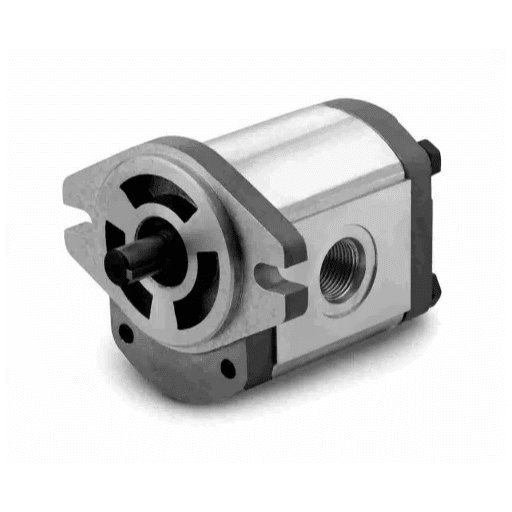
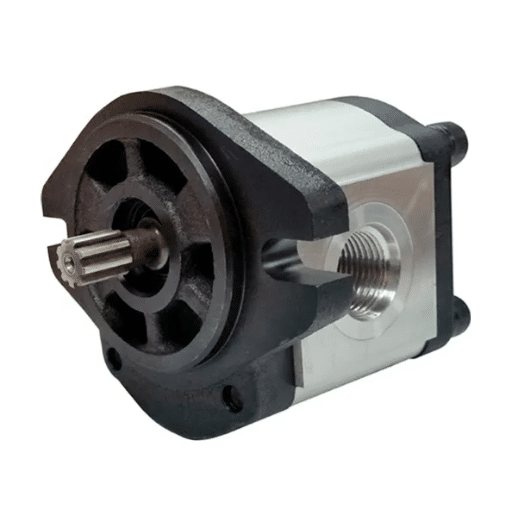
The pump converts mechanical rotation into fluid flow. Gear pumps dominate the dump truck hydraulic power unit market because they deliver consistent flow at moderate pressure with simple, durable construction. According to DataIntelo, gear pumps hold 47.2% of the truck hydraulic pump market. Pump displacement, measured in cubic centimeters per revolution, directly determines flow rate and lift speed.
Reservoir and Tank
The reservoir stores hydraulic fluid, allows air separation, and provides passive cooling. Reservoir capacity should typically be 2.5 to 5.0 times the pump flow rate per minute. A unit pumping 1 GPM, therefore, needs at least 2.5 to 5 gallons of fluid capacity. Steel and polymer tanks are both common; polymer offers corrosion resistance and translucent walls for visual fluid level monitoring.
Integrated Valve Manifold
The valve manifold controls direction, pressure, and load holding. A typical dump truck hydraulic power unit includes a directional control valve, a relief valve set to prevent over-pressurization, and a check valve to maintain lift position. Some units also include solenoid-operated unloading valves for automatic neutral positioning.
Remote Control Systems
Most DC hydraulic power units ship with a wired pendant remote connected by a 15 to 20-foot cord. The remote sends low-current signals to solenoid valves on the manifold. Wireless remotes are increasingly available and reduce cable wear, though they require battery maintenance in the transmitter.
Sizing and Selecting a Hydraulic Power Unit
Selecting the correct dump truck hydraulic power unit requires matching pressure, flow, and power to the mechanical load. Guessing based on trailer size is a common error that leads to slow lift cycles or thermal shutdowns.
Step 1: Calculate Required Lifting Force
Determine the total weight the cylinder must lift. Include the empty dump body weight plus the maximum payload. For a 7×14 dump trailer with a 2,200 lb body and 7,000 lb payload, the total lifting force requirement is approximately 9,200 lb. Apply a safety factor of 1.2 to 1.5 to account for friction and geometry inefficiency.
Step 2: Determine Required Pressure
Pressure depends on cylinder bore size and required force. A 3-inch bore cylinder has a piston area of 7.07 square inches. To lift 9,200 lb, the required pressure is:
Pressure = Force / Area = 9,200 lb / 7.07 in2 = 1,301 PSI
Add 10% for line and valve losses, giving a working pressure of approximately 1,430 PSI. The relief valve should be set 25% to 40% above working pressure, so a 2,000 to 2,500 PSI relief setting is appropriate.
Step 3: Calculate Flow Rate for Target Lift Time
Flow rate determines lift speed. If the cylinder stroke is 60 inches and the target lift time is 20 seconds, the required flow is:
Volume = 7.07 in2 x 60 in / 231 = 1.84 gallons
Flow = 1.84 gal / (20 sec / 60) = 5.5 GPM
A standard 12V dump trailer hydraulic power unit at 1.0 to 1.25 GPM would take roughly 90 seconds to complete this lift. For a 20-second target, a larger displacement pump or higher-speed motor is needed.
A Real Sizing Mistake
Marcus, a hobbyist building a custom dump trailer, selected a 0.75 GPM power unit because it was the cheapest option. His 5-ton load took 45 seconds to lift, and the undersized 4-quart reservoir overheated after two consecutive cycles. After recalculating with the force-pressure-flow formulas, he upgraded to a 1.25 GPM unit with an 8-quart reservoir. Lift time dropped to 18 seconds, and thermal shutdowns disappeared entirely.
Not sure which power unit fits your trailer or truck? Our dump trailer hydraulic pump selection guide includes application-specific sizing charts for common trailer dimensions.
Duty Cycle and Thermal Management

Duty cycle is the most misunderstood specification on a dump truck hydraulic power unit, and it is also the leading cause of motor failure.
Understanding Duty Cycle Ratings
Duty cycle is expressed as the percentage of time a motor can run within a given period. Most DC hydraulic power units carry a 10% duty cycle rating under S1 classification. This means the motor can run continuously for one minute, then must rest for nine minutes to prevent overheating. Some commercial 24V units carry S2 ratings, allowing up to 10 minutes of continuous run time followed by proportional cooling.
Why Duty Cycle Limits Matter
DC motors generate significant heat under load. Without adequate cooling, winding insulation degrades and the motor fails. Operating a 10% duty cycle unit at 30% or 40% duty cycle will not cause immediate failure, but it will cut motor life from years to months. Thermal protection switches can help, but they cannot compensate for fundamentally undersized equipment.
Overheating Prevention Protocols
To prevent thermal overload, size the power unit so that each lift cycle completes within the rated run time. Allow the full cooldown period between cycles. In high-frequency commercial applications, consider upgrading to a 24V system with a larger reservoir, external cooling, or a higher-duty-cycle motor classification.
Installation and Electrical Integration
Proper installation of a DC hydraulic power unit is as important as correct sizing. Electrical failures account for a significant percentage of field service calls.
Wiring Gauge Selection
High current draw demands large conductors. A 12V 1.6 kW motor drawing 133 amps requires 2 AWG wire for runs up to 10 feet, or 1/0 AWG for longer runs, to keep voltage drop below 3%. Many installers use 4 AWG or 6 AWG automotive wire, which creates excessive resistance and heat.
Battery and Alternator Capacity
The vehicle charging system must recover the energy used during lift cycles. A trailer with frequent daily lifts can drain a standard automotive battery. Deep-cycle batteries or dual-battery systems are recommended for high-use applications. Alternator output should exceed average current draw by at least 30%.
Fuse and Circuit Protection
Install a slow-blow fuse or circuit breaker rated at 125% to 150% of maximum motor current. For a 133-amp motor, use a 150 to 175-amp fuse. Fast-blow fuses cause nuisance trips during motor startup inrush current.
Grounding Best Practices
Ground the power unit directly to the vehicle chassis at a clean, paint-free point near the motor. Do not rely on the trailer hitch or frame joints for primary ground return. Poor grounding causes voltage drop, erratic solenoid operation, and reduced motor performance.
Common Power Unit Failures and Troubleshooting
Even a correctly sized dump truck hydraulic power unit can experience problems. Systematic diagnosis saves time and prevents unnecessary parts replacement.
| Symptom | Likely Cause | First Action |
|---|---|---|
| Motor runs hot or burns out | Exceeded duty cycle or undersized wiring | Check run time vs. cooling time; verify wire gauge |
| Pump whines or cavitates | Low fluid level or air in system | Check reservoir level; bleed air from cylinder |
| Slow or weak lifting | Worn pump, low voltage, or clogged filter | Test battery voltage under load; replace filter |
| The bed drifts down when raised | Worn cylinder seals or leaking check valve | Inspect check valve; test cylinder for internal leakage |
| Remote does not respond | Blown fuse or corroded connector | Test fuse; clean and reseat electrical connectors |
| Unit will not run at all | Dead battery, bad ground, or seized motor | Test battery voltage; verify ground; check motor resistance |
If you need detailed repair procedures, our step-by-step pump repair procedures cover seal replacement, coupler repair, and rebuild-versus-replace decisions.
Maintenance Schedule for Long-Term Reliability

Preventive maintenance extends the service life of any dump truck hydraulic power unit and reduces the risk of unplanned downtime.
Hydraulic Fluid Selection
Use anti-wear hydraulic oil with a viscosity grade matched to the operating climate. ISO VG 46 is standard for moderate temperatures. In cold climates below -4 degrees Fahrenheit, switch to ISO VG 32 or a synthetic fluid rated to -40 degrees Fahrenheit. Operating viscosity should remain within 22 to 46 mm²/s under normal conditions per ISO 3448.
Filter and Contamination Control
Contamination is the leading cause of pump wear. Maintain fluid cleanliness at ISO 4406 18/14 or better. Replace the return line filter after the first 100 hours of operation, then at 1,000-hour intervals. Always filter new fluid through a 10 to 30-micron filter before adding it to the reservoir.
Inspection Intervals
Inspect hoses, fittings, and cylinder rods daily for leaks, cracks, or corrosion. Check the reservoir fluid level before each use. Test the relief valve annually to confirm it opens within specification. Pressure-test the complete system every 2,000 operating hours or annually, whichever comes first.
For a complete fleet maintenance schedule, see our dump truck hydraulic system maintenance guide.
OEM Sourcing and Procurement Guidance
For fleet managers and procurement engineers, sourcing a dump truck hydraulic power unit from a reliable manufacturer is as critical as the correct technical specification.
Key Manufacturing Regions
China hosts the majority of DC hydraulic power unit manufacturers. Shandong Province, particularly Qingdao and Rizhao, specializes in dump truck and trailer hydraulics with dedicated factories producing 5,000 or more units per month. Jiangsu Province, centered on Changzhou, supplies complete integrated hydraulic systems. Guangdong manufacturers in Shenzhen and Guangzhou focus on electronic controls and customization.
Certification and Quality Verification
Verify that suppliers hold ISO 9001:2015 certification as a baseline. For export to European markets, CE marking is required. Request material certifications for pump housings and motor windings. Conduct sample orders before committing to bulk procurement, and verify that test reports include pressure hold tests, motor current draw verification, and duty cycle validation.
Warranty Evaluation
Standard warranties from Chinese OEMs range from six months to one year. Evaluate warranty terms on motor burnout, seal failure, and valve leakage. A supplier offering a one-year warranty with documented test procedures signals stronger manufacturing confidence than one offering longer terms with no test data.
A 25-unit construction fleet in Ohio recently replaced mismatched 12V power units from three different suppliers with standardized 24V units from a single OEM. Inventory part numbers dropped from 12 to 4, diagnostic time decreased 30%, and bulk pricing reduced per-unit cost by 18%. Standardization also simplified technician training and reduced warranty claim complexity.
Frequently Asked Questions
What is the difference between a hydraulic power unit and a hydraulic pump?
A hydraulic pump is a single component that generates fluid flow and pressure. A hydraulic power unit is a complete assembly that includes the pump, motor, reservoir, valves, and controls in one package.
How do I know if I need 12V or 24V for my dump trailer?
Choose 12V for light-duty, intermittent use on trailers under 10,000 lb GVWR with standard automotive electrical systems. Choose 24V for heavier loads, frequent cycling, or commercial applications where reduced current draw and extended motor life justify the higher cost.
What size hydraulic power unit do I need for a 7×14 dump trailer?
A 7×14 trailer with a 7,000 lb payload typically needs a 12V 1.6 kW unit with 1.0 to 1.25 GPM flow, an 8-quart reservoir, and a relief valve set to 2,500 to 3,200 PSI. Always confirm by calculating the actual lifting force and required flow for your target cycle time.
Can I run a hydraulic power unit continuously?
No. Most DC hydraulic power units are rated for 10% duty cycle, meaning one minute of run time followed by nine minutes of cooling. Continuous operation causes motor overheating and premature failure.
Why does my 12V hydraulic pump keep burning out?
The most common causes are exceeding the duty cycle, undersized wiring creating a voltage drop, poor grounding, or an overloaded trailer. Check all four before replacing the motor again.
Conclusion
A dump truck hydraulic power unit is an integrated system, not a collection of interchangeable parts. Correct selection depends on understanding voltage requirements, operating mode, duty cycle limits, and electrical integration. The key takeaways from this guide are:
- Match voltage to load and cycle frequency: 12V for light intermittent use, 24V for commercial heavy-duty applications
- Respect the 10% duty cycle: one minute of run time requires nine minutes of cooling for most DC motors
- Size by calculation, not guesswork: force, pressure, flow, and reservoir capacity all interact
- Use adequate wiring: 12V motors draw 130+ amps, and undersized cable is a leading cause of field failure
- Select single-acting for dry free-flowing loads, double-acting for sticky or uneven materials
- Maintain fluid cleanliness at ISO 4406 18/14 and replace filters on schedule
- Source from ISO 9001-certified manufacturers and validate with sample orders before bulk procurement
Whether you are specifying a dump truck hydraulic power unit or a dump trailer hydraulic power unit, the correct selection depends on matching every component to the application. When voltage, duty cycle, and reservoir capacity are aligned with the load, the result is stable lift performance, reduced maintenance, and extended service life. If you need application-specific sizing support or want to review technical specifications for your fleet, contact our engineering team for a customized hydraulic system recommendation.