A maintenance manager in Ohio replaced twelve gear pumps with axial piston pumps across his excavator fleet. Six months later, fuel consumption dropped 18% and hydraulic oil temperatures fell 12 degrees Celsius. The surprise was not the efficiency gain. It was that three of those piston pumps failed catastrophically in the first ninety days because his filtration system was still rated for gear pump tolerances.
The gear pump vs piston pump debate is not about which technology is superior. It is about matching pump architecture to system requirements, maintenance capability, and total cost of ownership. Most online comparisons list features in isolation. They omit the quantitative specifications, contamination thresholds, and application-specific economics that determine whether a piston pump upgrade pays back its premium or becomes an expensive reliability liability.
This guide provides a head-to-head comparison with exact pressure ranges, efficiency percentages, displacement data, and ISO cleanliness requirements. You will learn how each pump works at the component level, when to choose which technology, and how to avoid the specification mismatch that destroys pumps before their first scheduled service interval.
For a complete breakdown of how hydraulic systems transmit power across industrial machinery, see our Dump Truck Hydraulic Pump guide.
What Is a Hydraulic Gear Pump?

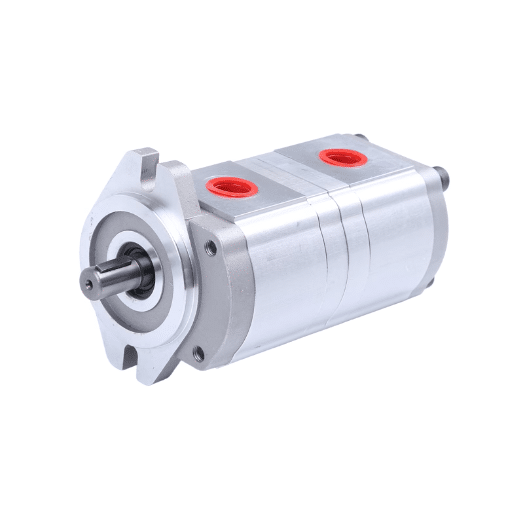
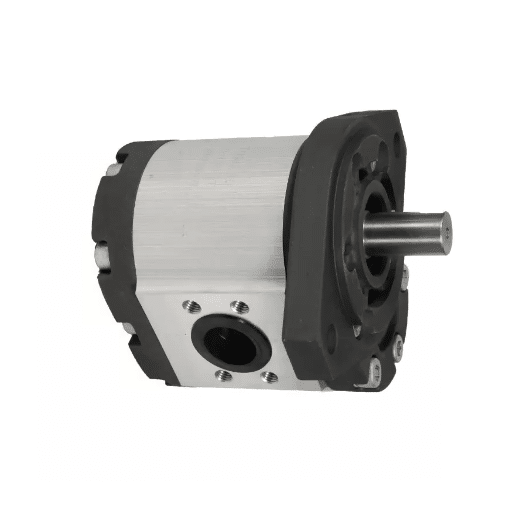
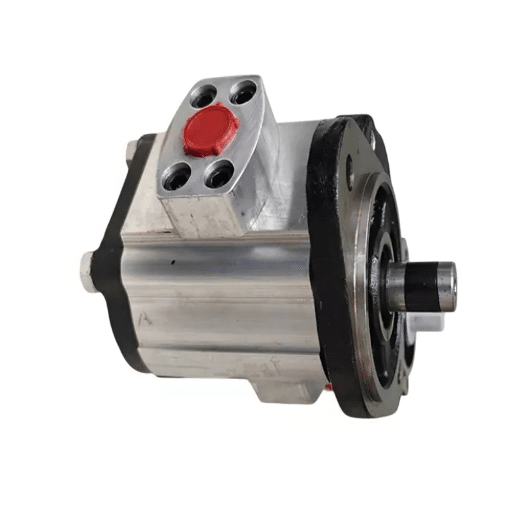
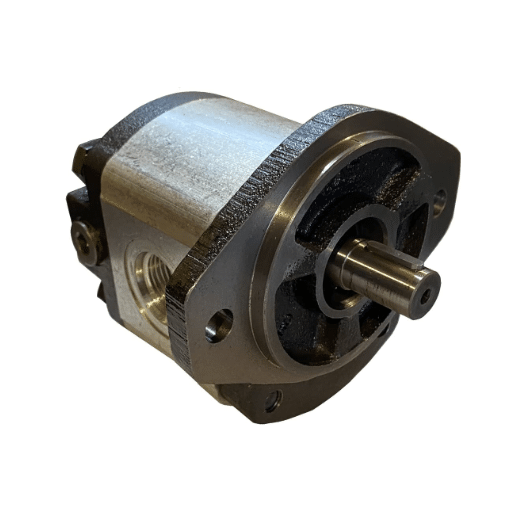
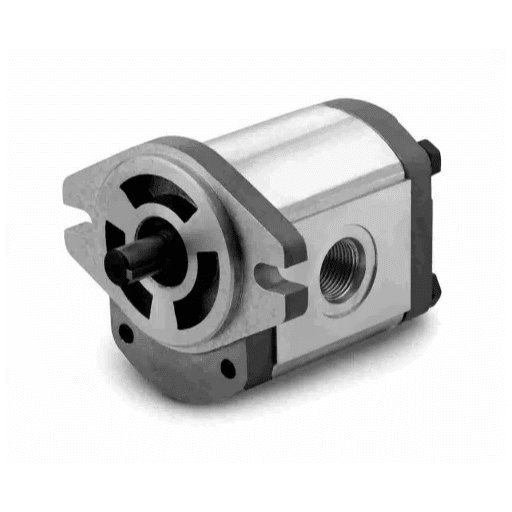
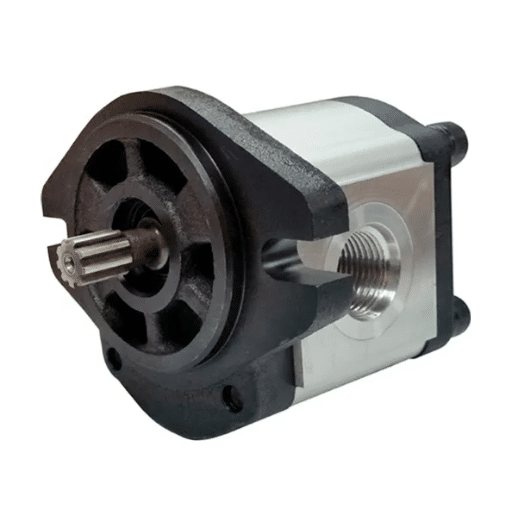
A hydraulic gear pump is a positive displacement pump that uses two meshing gears to trap hydraulic fluid between gear teeth and the pump housing, forcing it from the inlet port to the outlet port as the gears rotate. In any hydraulic gear pump vs piston pump evaluation, the gear pump’s mechanically simple, compact design and inherently fixed displacement stand out as core differentiators. Output flow is directly proportional to input RPM.
External vs Internal Gear Pumps
External gear pumps are the most common type in industrial and mobile hydraulics. Two identical spur or helical gears rotate in opposite directions within a close-tolerance housing. Fluid enters at the suction side, is carried around the periphery in the spaces between teeth, and is expelled at the pressure side where the teeth re-mesh.
Internal gear pumps use a larger internal gear with a smaller external gear rotating eccentrically inside it. A crescent-shaped seal separates the suction and pressure zones. Internal gear pumps run quieter than external designs and tolerate slightly higher viscosities, making them popular in lubrication and fuel transfer applications.
Typical Specifications
| Specification | Range |
|---|---|
| Pressure rating | 140 to 210 bar (2,030 to 3,045 PSI); high-pressure designs up to 250 bar (3,625 PSI) |
| Displacement | 1 to 200 cm³/rev (0.06 to 12.2 in³/rev) |
| Max speed | 1,800 to 3,000 RPM depending on displacement and pressure |
| Volumetric efficiency | 80% to 85% at rated pressure |
| Overall efficiency | 80% to 85% |
| Noise level | 75 to 85 dB(A) |
| Contamination tolerance | ISO 4406 20/18/15 acceptable |
| Starting torque | Low; minimal breakaway resistance |
Gear pumps dominate mobile hydraulics because they tolerate moderate contamination, require no case drain lines, and deliver consistent flow at predictable cost. The global hydraulic pump market reached approximately USD 11.5 to 13.9 billion in 2025, with piston pumps commanding roughly 41% of total market share and gear pumps holding 29% to 36% depending on segmentation methodology. The dedicated hydraulic gear pump market alone reached approximately USD 2.1 billion in 2025.
What Is a Hydraulic Piston Pump?
A hydraulic piston pump uses reciprocating pistons within a cylinder block to generate fluid displacement and pressure. The pistons are driven by a swashplate (axial design) or an eccentric cam (radial design), converting rotary input motion into linear piston strokes that compress and expel hydraulic fluid.
Axial vs Radial Piston Pumps
Axial piston pumps are the dominant configuration in high-performance hydraulics. Multiple pistons are arranged parallel to the drive shaft within a rotating cylinder block. A tilted swashplate pushes the pistons in and out as the block rotates. Changing the swashplate angle varies piston stroke length, enabling variable displacement.
Radial piston pumps arrange pistons perpendicular to the drive shaft around an eccentric cam. They deliver extremely high pressure with excellent efficiency at low speeds but are bulkier and more expensive than axial designs. Radial piston pumps are found in specialized high-pressure testing equipment and some hydrostatic transmissions.
Fixed vs Variable Displacement
Fixed displacement piston pumps maintain a constant swashplate angle. Flow output is proportional to RPM, similar to a gear pump, but with higher pressure capability and efficiency.
Variable displacement piston pumps adjust swashplate angle automatically in response to system demand. When the cylinder does not need flow, the swashplate angles toward zero, reducing output and eliminating the energy losses associated with dumping excess flow across relief valves. Variable displacement is the primary reason piston pumps can improve system efficiency by 25% to 40% compared to fixed-displacement gear pump circuits.
Typical Specifications
| Specification | Range |
|---|---|
| Pressure rating | 250 to 450+ bar (3,625 to 6,525+ PSI) |
| Displacement | 10 to 1,000+ cm³/rev (0.61 to 61.0+ in³/rev) |
| Max speed | 1,500 to 3,000+ RPM depending on architecture |
| Volumetric efficiency | 90% to 95% at rated pressure |
| Overall efficiency | 90% to 93% |
| Noise level | 70 to 80 dB(A) |
| Contamination tolerance | ISO 4406 18/16/13 or better required |
| Case drain | Required; approximately 1% to 3% of rated flow |
Case Drain Requirement
Every axial piston pump leaks a small percentage of high-pressure fluid past the piston slippers and valve plate into the pump case. This case drain fluid must be routed back to the reservoir through a dedicated drain line. If the case drain is blocked or undersized, case pressure rises, destroys shaft seals, and forces lubricating oil out of bearings. Case drain requirements are almost never mentioned in consumer-level pump comparison articles, yet they are a critical system design factor that separates a reliable installation from a premature failure.
For a brand-specific compatibility overview, see our HYVA hydraulic pump for dump trucks guide.
Head-to-Head Comparison: Gear Pump vs Piston Pump
The table below consolidates the quantitative specifications that most comparison articles omit.
| Specification | Gear Pump | Piston Pump |
|---|---|---|
| Max pressure | 140-210 bar (gear pump pressure rating); high-pressure designs to 250 bar | 250-450+ bar (piston pump pressure capacity) |
| Displacement range | 1-200 cm³/rev | 10-1,000+ cm³/rev |
| Volumetric efficiency | 80-85% | 90-95% |
| Overall efficiency | 80-85% | 90-93% |
| Flow control | Fixed displacement only | Fixed or variable displacement |
| Max RPM | 1,800-3,000 | 1,500-3,000+ |
| Noise level | 75-85 dB(A) | 70-80 dB(A) |
| Contamination tolerance | ISO 20/18/15 | ISO 18/16/13 or better |
| Case drain required | No | Yes |
| Starting torque | Low | Moderate to high |
| Weight (same displacement) | Lighter | 30-50% heavier |
| Initial cost | Baseline | 2-3x gear pump cost |
Efficiency Equals Lifecycle Cost
The gear pump vs piston pump efficiency gap is where long-term economics are decided. At first glance, a 10% to 15% efficiency advantage might seem marginal. In continuous-duty industrial systems, it compounds rapidly. Consider a 100 kW hydraulic power unit operating 2,000 hours per year at 200 bar average pressure.
A gear pump at 83% overall efficiency draws 120.5 kW input power to deliver 100 kW hydraulic output. A piston pump at 92% efficiency draws only 108.7 kW. The 11.8 kW difference, at an industrial electricity rate of USD 0.12 per kWh, saves approximately USD 2,832 per year per pump. Over a five-year lifecycle, the energy savings alone can offset the higher purchase price of a piston pump in high-duty applications.
However, this calculation assumes identical maintenance discipline for both pump types. If filtration is inadequate for the piston pump’s tighter tolerances, the savings evaporate into premature rebuild costs.
Pressure, Flow, and Displacement: Engineering Breakdown

Pressure Capability
The gear pump vs piston pump pressure differential is the most decisive selection factor. Gear pumps reach their pressure limit when gear tip clearance, housing elastic deformation, and journal bearing load capacity converge. At pressures above 210 bar, the gear housing expands, increasing tip clearance and causing volumetric efficiency to drop sharply. High-pressure gear pump designs extend this to approximately 250 bar through bearing reinforcement and housing ribbing, but the fundamental architecture remains pressure-limited.
Piston pumps distribute hydraulic load across multiple pistons and a large valve plate contact area. The precision fit between each piston and its cylinder bore creates an effective seal that maintains volumetric efficiency even at 400 bar. Individual pistons experience the same force regardless of system pressure because the load is divided by the number of pistons in the cylinder block.
Flow Control and Displacement Architecture
The fixed displacement vs variable displacement pump distinction defines how each technology responds to changing load. A fixed-displacement gear pump delivers the same volume per revolution regardless of system demand. When the actuator stops, the pump continues producing flow that must be dumped across a relief valve, converting hydraulic energy into heat. This is acceptable for intermittent-duty circuits with short cycle times.
A variable-displacement piston pump senses load pressure and adjusts swashplate angle to match actual flow demand. When the cylinder reaches the end of stroke, the pump destrokes to near-zero output, maintaining pressure without generating significant heat. This load-sensing behavior eliminates the constant energy loss of fixed-displacement systems.
Speed and Cavitation
Gear pumps can operate at higher maximum speeds than piston pumps of equivalent displacement because the gear meshing mechanism does not require the precise timing of a valve plate. However, both pump types are susceptible to cavitation if inlet conditions are poor.
Cavitation occurs when the inlet pressure falls below the fluid’s vapor pressure, causing bubbles to form and collapse inside the pump. Piston pumps are more sensitive to inlet restriction because the pistons create intermittent suction pulses that can depressurize the inlet line. Gear pumps produce more uniform suction but can still cavitate if the inlet line is too long, too small in diameter, or if the fluid viscosity is excessive at cold-start temperatures.
Recommended minimum inlet pressure is 0.8 bar absolute for gear pumps and 1.0 bar absolute for piston pumps. Inlet line velocity should not exceed 1.5 m/s for either type.
Contamination, Filtration, and Maintenance
ISO Cleanliness Codes Explained
ISO 4406 expresses fluid contamination using a three-number code representing particle counts per milliliter at 4, 6, and 14 microns. A code of 20/18/15 means:
- 20: 5,000 to 10,000 particles per mL ≥ 4 microns
- 18: 1,300 to 2,500 particles per mL ≥ 6 microns
- 15: 160 to 320 particles per mL ≥ 14 microns
Gear Pump Filtration
Gear pumps tolerate moderate contamination because the gear teeth do not require the precision sealing of piston-to-cylinder fits. A 10-micron nominal return line filter, maintaining ISO 20/18/15 or better, is generally sufficient for gear pump systems operating under normal conditions. Annual seal replacement and occasional housing inspection are typical maintenance intervals.
Piston Pump Filtration
Piston pumps require significantly cleaner oil. The tight clearances between piston and cylinder bore, typically 5 to 15 microns, mean that particles larger than this range can score surfaces and destroy volumetric efficiency. A 3-micron absolute high-pressure filter on the pressure line and a 10-micron return filter are standard requirements. Target cleanliness is ISO 18/16/13 or better.
Upgrading from a gear pump to a piston pump without upgrading filtration is one of the most common and expensive mistakes in hydraulic system modification.
Failure Mode Comparison
| Failure Mode | Gear Pump | Piston Pump |
|---|---|---|
| Most common cause | Gear tooth scoring from debris; bearing wear | Valve plate scoring; piston shoe galling |
| Early warning sign | Increasing noise; metallic whine | Case drain flow increase; temperature rise |
| Typical rebuild interval | 5,000-8,000 hours | 8,000-15,000 hours (with clean oil) |
| Field repairability | High; can often be swapped on-site | Low; requires clean environment and special tools |
A maintenance supervisor at a mining operation in Queensland learned this lesson firsthand. His fleet of excavators used gear pumps for auxiliary functions and piston pumps for main implement circuits. When a cost-cutting initiative eliminated the separate high-pressure filtration system for the piston pump circuit, three axial piston pumps failed within six months from valve plate scoring. The repair cost exceeded the annual savings from the eliminated filter program by a factor of four.
Noise, Heat, and Operating Environment
Acoustic Comparison
Gear pumps produce a continuous tonal whine at the gear meshing frequency and its harmonics. External gear pumps are typically 5 to 10 dB(A) louder than piston pumps of equivalent displacement. Helical gear designs reduce noise compared to spur gears by distributing the meshing contact across the tooth face. Internal gear pumps are the quietest gear pump variant, often matching piston pump noise levels.
Piston pumps generate less tonal noise but can produce discrete clicking sounds from valve plate transitions, especially at low speeds. When properly maintained, a piston pump at 2,000 RPM is typically 70 to 75 dB(A), compared to 78 to 83 dB(A) for an external gear pump of similar size.
Heat Generation
Heat in a hydraulic system comes from energy losses: volumetric losses from internal leakage, mechanical losses from friction, and hydraulic losses from valve throttling. At equivalent pressure and flow, a gear pump generates approximately 15% to 25% more heat than a piston pump because of higher internal leakage and sliding friction at the gear tooth flanks, as confirmed by comparative testing under ISO 4409 standards.
In closed-center load-sensing systems with variable displacement piston pumps, the heat reduction is even more pronounced. The pump only produces the flow required by the actuator, eliminating the continuous relief valve bypass that characterizes fixed-displacement gear pump circuits. System oil temperature can be 10 to 15 degrees Celsius lower with a well-designed piston pump load-sensing circuit.
Cold-Start Behavior
Gear pumps handle cold, high-viscosity oil better than piston pumps because the gear meshing mechanism is less sensitive to viscous drag. At temperatures below -10 degrees Celsius, a piston pump may require pre-heating or low-viscosity synthetic fluid to achieve breakaway torque without overloading the electric motor or engine starter.
Application Guide: When to Choose Which Pump

Gear Pump Applications vs Piston Pump: When to Choose a Gear Pump
- System operating pressure remains below 200 bar (2,900 PSI)
- The circuit requires fixed, predictable flow with no load-sensing requirement
- Budget constraints prioritize low initial cost over long-term energy savings
- Contamination control is difficult due to operating environment (mining dust, agricultural debris)
- The application is intermittent duty with adequate cooling time between cycles
- Maintenance capability is limited to seal replacement and filter changes
- The pump serves auxiliary functions: pilot control, steering, fan drives, or charge pumps
Choose a Piston Pump When
- System pressure exceeds 250 bar (3,625 PSI) regularly
- Variable flow or load-sensing control is required for energy efficiency
- The machine operates in continuous heavy-duty cycles (excavators, mining shovels, presses)
- Fuel or electricity costs justify the higher initial investment through efficiency savings
- Precise speed control is needed for coordinated multi-actuator movements
- The system architecture includes closed-center or load-sensing valve banks
- Low noise is a critical requirement for operator comfort or regulatory compliance
The Dump Truck Specific Decision
Gear pumps account for 47.2% of the dump truck hydraulic pump market, according to DataIntelo industry data. This dominance is not accidental. Most dump truck hydraulic power units operate at moderate pressure, typically 2,200 to 3,200 PSI (150 to 220 bar), with intermittent duty cycles that rarely exceed 10% run time. A gear pump in this application delivers adequate flow, tolerates the contamination inherent in construction environments, and costs significantly less than a piston pump alternative.
However, commercial dump truck fleets with frequent daily lifts and large-capacity beds can benefit from piston pump upgrades. A 50-unit fleet in Illinois standardized on variable displacement piston pumps for its PTO-driven main hydraulic circuits. Over three years, the 14% reduction in engine load during standby periods translated to measurable fuel savings and extended engine service intervals. The key enabler was a dedicated 3-micron filtration system and technician training on case drain monitoring.
Total Cost of Ownership: The Math Most Articles Skip
The purchase price of a hydraulic pump is a small fraction of its total lifecycle cost. Energy, maintenance, downtime, and filtration infrastructure must all be included in the procurement decision.
Simplified TCO Formula
Five-year TCO = Initial cost + (Energy cost per year x 5) + (Maintenance cost per year x 5) + Filtration infrastructure + Expected downtime cost
Example: Medium-Duty Excavator Main Pump
| Cost Component | Gear Pump | Piston Pump |
|---|---|---|
| Initial pump cost | USD 800 | USD 2,200 |
| Energy cost (5 years) | USD 8,500 | USD 7,200 |
| Maintenance (5 years) | USD 1,200 | USD 900 |
| Filtration upgrade | Baseline | USD 600 |
| Downtime (estimated) | USD 800 | USD 400 |
| Five-year TCO | USD 11,300 | USD 11,300 |
In this scenario, the break-even point occurs at approximately five years. For machines with higher duty cycles or more expensive energy, the piston pump pays back sooner. For intermittent-duty machines or environments where contamination control is difficult, the gear pump maintains its economic advantage.
Procurement Specification Checklist
Use this checklist before ordering either pump type:
| Specification | Verify |
|---|---|
| Maximum operating pressure (continuous and peak) | Exceeds system requirement by 15% |
| Rated displacement at target RPM | Meets flow requirement with 10% margin |
| Input speed range | Within pump’s published min/max limits |
| Fluid viscosity range | Compatible with operating climate |
| ISO cleanliness target | Achievable with existing or planned filtration |
| Noise limit | Meets workplace or regulatory requirement |
| Mounting configuration | SAE flange or ISO 3019-2 dimensions match |
| Control type (for piston pumps) | Load sensing, pressure cut-off, or torque limiter as required |
| Case drain capacity (for piston pumps) | Reservoir sized for continuous drain flow |
| Warranty and rebuild support | Minimum 12 months; spare parts availability confirmed |
Common Misconceptions and Replacement Traps

Myth: Piston Pumps Are Always Better
A piston pump in a simple, low-pressure, fixed-flow circuit is over-engineered and economically wasteful. The variable displacement capability provides no benefit if the circuit has no load-sensing architecture. The higher initial cost, case drain requirement, and filtration demands create unnecessary complexity without improving performance.
Myth: Gear Pumps Are Always Cheaper Long-Term
In continuous-duty, high-pressure applications, the energy losses and heat generation of a gear pump increase operating costs faster than the lower purchase price suggests. A gear pump running at 250 bar near its pressure limit will suffer accelerated wear, shortened seal life, and higher energy consumption that can exceed the piston pump premium within three to five years.
Myth: The Pumps Are Interchangeable
A gear pump cannot replace a variable displacement piston pump in a load-sensing system without a complete circuit redesign. The system architecture, valve types, reservoir sizing, and filtration must all be re-evaluated. Conversely, installing a piston pump in an open-center gear pump circuit without adding case drain lines and pressure compensator controls will cause immediate seal failure and case pressure damage.
Trap: Replacing Without Re-Evaluating Filtration
The most expensive mistake in pump replacement is assuming existing filtration is adequate. A system running ISO 20/18/15 with a gear pump will destroy a piston pump in months. Before any upgrade, sample the fluid, count particles at 4, 6, and 14 microns, and upgrade filters to achieve at least ISO 18/16/13.
Trap: Ignoring Case Drain on Piston Pump Installations
A blocked or missing case drain line on an axial piston pump raises case pressure within seconds of startup. Shaft seals blow out. Bearing lubrication is lost. The pump fails within hours. Every piston pump installation must include a dedicated case drain line sized for 1% to 3% of the rated flow, routed directly to the reservoir below the minimum fluid level.
Frequently Asked Questions
What is the main difference between a gear pump and a piston pump?
A gear pump uses meshing gears to displace fluid and is almost always fixed displacement. A piston pump uses reciprocating pistons driven by a swashplate or cam, is available in fixed or variable displacement, and handles significantly higher pressure with better efficiency.
Which is more efficient: a gear pump or a piston pump?
A piston pump is more efficient. Volumetric efficiency for piston pumps ranges from 90% to 95%, compared to 80% to 85% for gear pumps. Overall efficiency follows the same pattern. The gap widens at higher pressures.
Can I replace a piston pump with a gear pump?
Usually not without redesigning the hydraulic circuit. Fixed and variable displacement pumps are not interchangeable in load-sensing or closed-center systems. Even in simple open-center circuits, the pressure, flow, and mounting requirements must be matched exactly.
Why is my gear pump so loud?
Gear pump noise comes from gear meshing and increases with wear. As gear tooth profiles degrade and bearing clearances increase, the tonal whine becomes more pronounced. Excessive noise often indicates impending bearing failure or gear tooth damage from contamination.
What pressure can a gear pump handle vs a piston pump?
Standard gear pumps handle 140 to 210 bar continuously, with high-pressure designs reaching 250 bar. Piston pumps operate routinely at 250 to 400 bar, with specialized designs exceeding 450 bar. The 100 to 200 bar pressure gap is the primary architectural differentiator.
Conclusion
The gear pump vs piston pump decision is not a popularity contest. It is an engineering match between pump capability and system requirement. Gear pumps deliver simplicity, contamination tolerance, and low initial cost for moderate-pressure, fixed-flow applications. Piston pumps deliver higher pressure, superior efficiency, and intelligent flow control for demanding, continuous-duty systems.
The gear pump vs piston pump decision ultimately comes down to these quantified specifications. A 10% to 15% efficiency advantage, a 100 to 200 bar pressure gap, and a 2 to 3x cost differential are not abstract figures. They determine whether a fleet operates profitably or burns capital on mismatched components.
Match the pump to the circuit architecture, verify that your filtration can support the pump’s tolerance requirements, and calculate the total cost of ownership before making the procurement decision. The right pump is the one that meets your pressure, flow, and duty cycle requirements at the lowest five-year lifecycle cost, not the one with the most impressive catalog specifications.
Ready to specify pumps for your fleet or machinery line? Contact LOYAL INDUSTRIAL PTE. LTD. for a customized hydraulic system recommendation based on your operating pressure, flow requirements, and duty cycle profile.