When Marcus Chen took over fleet maintenance for a 24-truck construction operation in Phoenix last March, the dump truck PTO hydraulic pump failure rate alarmed him. His predecessor had replaced 11 pumps in 18 months at an average cost of $1,200 each. Yet the root cause was not defective pumps. A single PTO ratio miscalculation on every truck caused chronic pump overspeed, and the resulting cavitation destroyed each unit within months.
If you manage a fleet, operate a repair shop, or specify hydraulic components for dump trucks, you have encountered this pattern. Most pump failures are actually system mismatches. Wrong PTO ratios, incompatible mounting standards, skipped support brackets, and misunderstood spline specifications all produce identical failure symptoms. Replace the pump without fixing the system, and you will replace it again.
In this guide, you will learn how a dump truck PTO hydraulic pump works, how to size a dump truck PTO hydraulic pump for your specific transmission and application, how to install it correctly, and how to diagnose the most common failure modes before they cascade into expensive damage. By the end, you will have a complete framework for selecting, installing, and maintaining PTO-driven hydraulic pumps that last.
For the full system architecture that connects PTO pumps to cylinders, valves, and reservoirs, see our dump truck hydraulic pump complete system guide.
What Is a Dump Truck PTO Hydraulic Pump?

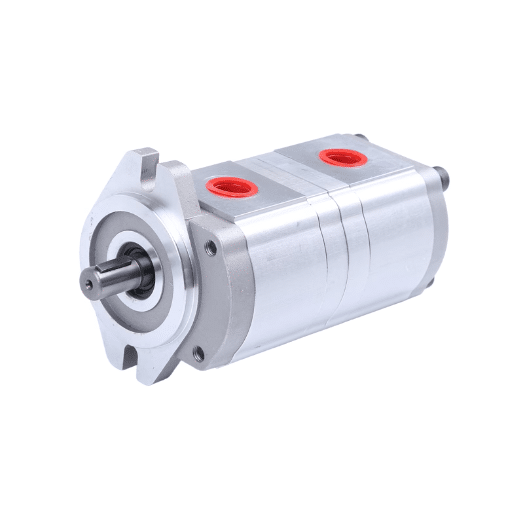
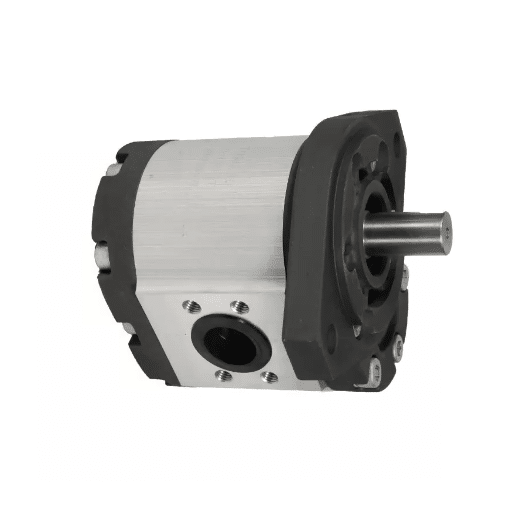
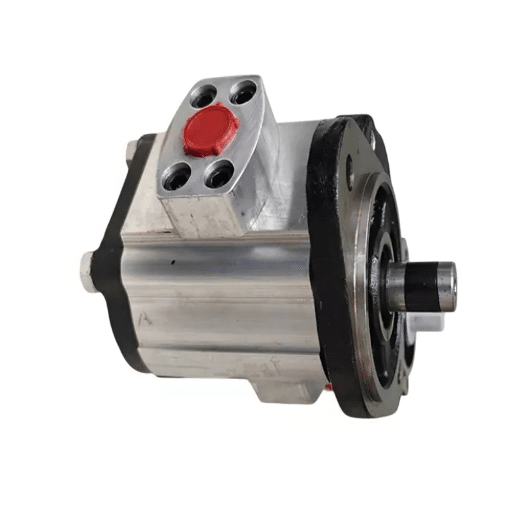
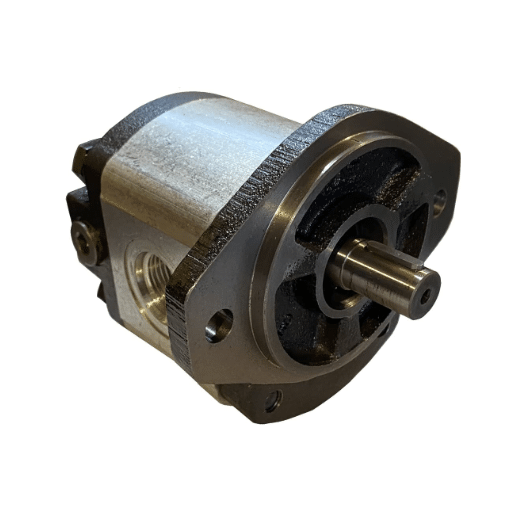
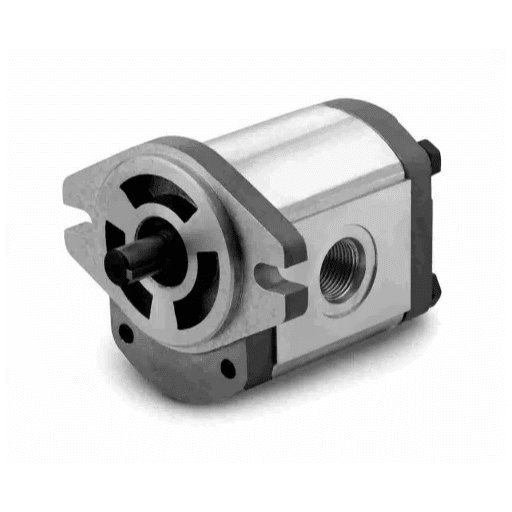
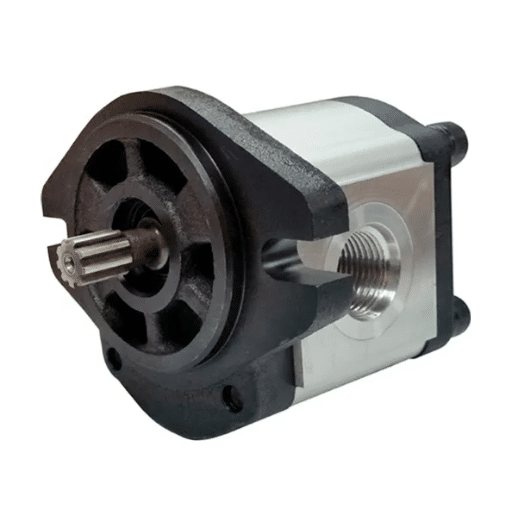
A PTO hydraulic pump for dump truck applications is a transmission-driven pump that converts mechanical engine power into hydraulic pressure to raise and lower the dump body. The power flow follows a clear sequence: the engine drives the transmission, the transmission engages a Power Take-Off (PTO) unit, and the PTO spins the pump shaft to generate pressurized oil flow.
This differs fundamentally from standalone electric pumps or 12V DC power units. A PTO hydraulic pump for dump truck use draws power directly from the drivetrain, producing higher flow rates and greater reliability for commercial fleet applications. Electric pumps serve small dump trailers and light duty use cases where transmission mounting is not practical.
The PTO itself mounts to an opening on the transmission housing and engages with the transmission countershaft gears. When activated, it transfers rotational power to the pump at a fixed ratio determined by internal gearing. That ratio, combined with engine speed, sets the pump’s operating RPM. That single number determines whether the pump runs efficiently, cavitates, or overheats.
When Marcus Chen inspected his fleet, he discovered every truck carried a 1.8:1 PTO ratio driving a pump rated for 1,500 RPM maximum. At the standard 1,200 RPM lift speed, the pumps were spinning at 2,160 RPM, 44% above their design limit. The resulting cavitation eroded internal gears and contaminated the entire hydraulic system. Switching to a 1.3:1 PTO ratio brought operating speed down to 1,560 RPM, well within the safe range. The $200 gear change saved his company $4,800 in avoided pump replacements over the following year.
For a complete breakdown of how a dump truck PTO hydraulic pump integrates into full wet kit assemblies, see our dump truck wet kit guide.
Dump Truck PTO Hydraulic Pump Sizing: Formulas and Selection
Correct dump truck PTO pump sizing prevents the most common cause of premature failure. The process matches four variables: required flow, system pressure, engine speed, and PTO gear ratio.
The Four Selection Parameters
Required flow determines how fast the dump body lifts. Calculate it from cylinder bore, rod diameter, stroke length, and target lift time. Most mid-size dump trucks require 15 to 25 GPM to achieve a 15-second lift cycle.
System working pressure for dump applications typically ranges from 2,000 to 2,500 PSI for standard duty, and up to 3,600 PSI for high-pressure live bottom or combo systems. Check the cylinder rating and relief valve setting before selecting the pump.
Target engine speed during dumping is usually 800 to 1,200 RPM. Lower speeds reduce noise, fuel consumption, and wear while still delivering adequate lift performance.
PTO gear ratio multiplies engine speed to produce pump shaft speed. Common ratios range from 0.73:1 to 1.72:1, depending on transmission model and PTO series.
Sizing Formulas
Use these formulas to calculate the correct pump displacement and verify torque and power requirements:
Pump speed: Np = Ne x Z
- Np = Pump shaft speed (RPM)
- Ne = Engine speed during lift (RPM)
- Z = PTO gear ratio
Pump displacement (imperial): D = (Q x 231) / (Ne x Z)
- D = Pump displacement (cubic inches per revolution)
- Q = Required flow (GPM)
Torque at PTO shaft: M = (D x p) / (63 x n)
- M = Torque (Nm)
- p = Pressure (bar)
- n = Mechanical efficiency (~0.98 for gear pumps)
Power required: HP = (Q x PSI) / (1714 x n)
- HP = Horsepower
- PSI = System pressure
- n = Total efficiency (~0.90 to 0.95)
Worked Example: Medium Duty Dump Truck
Consider a typical 10-yard dump truck with these requirements:
| Parameter | Value |
|---|---|
| Required flow (Q) | 18 GPM |
| System pressure (p) | 2,300 PSI (~158 bar) |
| Engine speed (Ne) | 900 RPM |
| PTO ratio (Z) | 1.30 |
Step 1: Calculate pump speed
Np = 900 x 1.30 = 1,170 RPM
Step 2: Calculate required displacement
D = (18 x 231) / (900 x 1.30) = 4,158 / 1,170 = 3.55 in³/rev (~58 cm³/rev)
Select a standard 60 cm³/rev gear pump, which will deliver approximately 18.6 GPM at 1,170 RPM.
Step 3: Verify torque
M = (58 x 158) / (63 x 0.98) = 9,164 / 61.74 = 148 Nm
This torque must not exceed the PTO’s maximum rated output. A standard Chelsea 489 series PTO rated at 225 Nm handles this load with a comfortable safety margin.
Step 4: Verify power
HP = (18.6 x 2,300) / (1,714 x 0.92) = 42,780 / 1,576.88 = 27.1 HP
At 900 RPM engine speed, most medium-duty diesel engines produce ample reserve power for this hydraulic load.
Quick Reference Table
| Application | Flow (GPM) | Engine RPM | PTO Ratio | Pump Size (cm³/rev) |
|---|---|---|---|---|
| Small trailer / light duty | 10-12 | 700-800 | 1.2-1.4 | 40-55 |
| Mid-size dump truck | 15-22 | 800-950 | 1.3-1.5 | 55-75 |
| Heavy duty / fast cycle | 25-35 | 900-1,100 | 1.5-1.7 | 75-100 |
Transmission Compatibility: Matching PTO to Your Truck

Transmission PTO hydraulic pump selection begins with the transmission. Each manufacturer uses different mounting patterns, spline specifications, and torque ratings. Selecting the wrong combination causes immediate mechanical failure or premature wear.
Eaton Fuller Manual Transmissions
Eaton Fuller transmissions are the most common platform for a dump truck PTO hydraulic pump. They use an 8-bolt SAE mounting pattern on the transmission side cover. Compatible PTO series include the Chelsea 489 and Muncie PE-series units.
Common pump pairings include the C102 Commercial dump pump and the P51 Series roller bearing pump. The C102 integrates a directional control valve directly into the pump body, simplifying hose routing and reducing leak points. The P51 offers higher flow capacity for heavy duty applications.
Typical PTO ratios for Eaton Fuller transmissions range from 0.73:1 to 1.30:1. For dump applications, speed-increasing ratios between 1.20:1 and 1.30:1 allow lower engine RPM during lift while maintaining adequate pump speed.
Cab controls for Eaton Fuller setups commonly use the Buyer’s K90 single lever valve with automatic PTO kick-out. This valve shuts down the PTO when the dump body reaches maximum tilt angle, preventing over-travel and reducing wear.
Allison Automatic Transmissions
Allison 3000 and 4000 series transmissions present unique challenges. Space between the transmission and frame rail is extremely limited, so standard-width pumps often do not fit. Slimline or modular pump designs are frequently required.
Compatible PTOs include the Chelsea 281 series and ProDrive PA-series hot-shift units. These use a 10-bolt mounting pattern instead of the 8-bolt SAE standard. The hot-shift design engages through a clutch pack rather than sliding gears, allowing engagement while the engine is running.
Pump selection for Allison transmissions typically favors the Parker SG102 Slimline or the Permco MVP modular system. The SG102 is a narrower version of the classic C102, designed specifically for tight Allison clearances. The Permco MVP separates the valve from the pump body, allowing the valve to mount remotely where space permits.
Most Allison PTO pumps require clockwise rotation. Torque capacity calculations must account for torque converter multiplication, which can increase effective torque by 20% to 40% above engine output at stall.
Compatibility Summary Table
| Transmission | PTO Series | Mount Pattern | Output Shaft | Common Pump | Ratio Range |
|---|---|---|---|---|---|
| Eaton Fuller (manual) | Chelsea 489, Muncie PE | 8-bolt SAE | 7/8″ 13-spline | C102, P51 | 0.73-1.30 |
| Allison 3000/4000 | Chelsea 281, ProDrive PA | 10-bolt | 7/8″ 13-spline | SG102, Permco MVP | 1.23-1.54 |
| Volvo I-Shift | ProDrive PIM, Interpump P82 | DIN 5462 | 36 mm x 8-spline | Sunfab SAP, + adapter | 1.26-1.43 |
| Mack mDrive | ProDrive PIM, Interpump P82 | DIN 5462 | 36 mm x 8-spline | Sunfab SAP, + adapter | 1.26-1.43 |
| Allison 1000/2000 | ProDrive PA | 6-bolt | 7/8″ 13-spline | SG102, modular | 1.30-1.72 |
How to Install a Dump Truck PTO Hydraulic Pump: Step-by-Step Guide

Knowing how to install a PTO pump on a dump truck correctly determines whether the unit lasts eight years or eight months. Follow this five-phase process to ensure correct mounting, alignment, and hydraulic connection for your dump truck PTO hydraulic pump.
Phase 1: Preparation and Component Verification
Before touching the truck, gather the correct documentation. Confirm the transmission model, serial number, and PTO provision code. Verify the pump’s rotation direction, shaft spline count, and mounting flange pattern. Mismatched splines will strip immediately upon engagement.
Collect the required tools: jack and stands, torque wrench, dial indicator with magnetic base, drain pan, solvent, lint-free rags, new transmission fluid, thread locker, and a pump support bracket if the combined PTO and pump assembly exceeds 12 to 18 inches from the transmission centerline or weighs more than 40 pounds.
Park the truck on level ground, chock the wheels, disconnect the battery, and raise the chassis securely on jack stands.
Phase 2: PTO Installation
Drain the transmission fluid into a clean pan. Remove the PTO access cover from the transmission side to begin dump truck PTO hydraulic pump installation. Clean the mating surface thoroughly with solvent, removing all old gasket material and debris. Inspect for burrs or raised metal around bolt holes.
Align the PTO with the mounting port. It should slide into place without force. Install a new gasket or O-ring. Some Mack transmissions require a silicone sealant bead instead of a gasket. Follow the specific transmission manufacturer’s instructions.
Set backlash using a dial indicator. The PTO input gear must mesh with the transmission countershaft at the correct clearance. Chelsea specifies 0.006 to 0.012 inch backlash. Too tight causes whining and premature wear. Too loose produces clattering and chipped teeth.
Apply thread locker to bolts if specified. Tighten in a star pattern to ensure even gasket compression. Torque to manufacturer specification. Do not guess.
Phase 3: Pump Mounting
For direct mount installations, the pump bolts directly to the PTO output flange. Pack the pump shaft pilot bore with grease before sliding it onto the PTO shaft. This prevents galling and eases future removal.
Install the pump support bracket before filling the system with fluid. Attach the bracket to the pump mounting bolt closest to the pump’s center of gravity. Anchor the bracket solidly to the transmission or frame at two or more points. The bracket must inhibit movement in all directions without pre-loading the PTO or pump mounting.
When Derek Alvarez installed a tandem gear pump on a Freightliner M2 without a support bracket, he believed the PTO flange alone could handle the 48-pound assembly. Within three months, vibration fatigue cracked the PTO output shaft housing. The repair required transmission removal, PTO replacement, and pump rebuild at a total cost of $2,800. The $120 support bracket he skipped would have prevented the failure entirely.
For remote mount installations, connect the pump to the PTO with a balanced tubular driveshaft that includes a slip yoke. Remote mounts are necessary when cab, exhaust, or frame components prevent direct mounting.
Double-check pump rotation before connecting hydraulic lines. Running a pump backwards destroys the shaft seal within seconds.
Phase 4: Hydraulics and Controls
Route hydraulic hoses from the pump to the reservoir, control valve, and cylinder. Verify all hose pressure ratings exceed the system relief valve setting by at least 25%. Keep hoses away from hot exhaust components. Use protective sleeves or heat shields where proximity is unavoidable.
Install the cab control switch and PTO indicator light. Route wiring through grommets, not through raw sheet metal holes. On air-shift PTOs, connect the air supply line and verify that the pressure protection valve receives adequate main tank pressure. Minimum 90 PSI is required for reliable engagement.
Configure safety interlocks. Most modern systems require the transmission to be in neutral and the parking brake engaged before the PTO will activate. These interlocks prevent accidental engagement while the truck is in motion.
Phase 5: Testing and Verification
Refill the transmission with the correct fluid to the proper level. Start the engine with the PTO disengaged and the transmission in neutral. Listen for abnormal gear noise.
Engage the PTO at idle. A whining noise that increases with RPM indicates insufficient backlash. Stop immediately and add a shim. A clattering noise indicates excessive backlash. Remove a shim and recheck.
With the PTO engaged and the engine at 1,000 RPM, operate the dump body through a complete lift and lower cycle. Inspect every fitting for leaks. Verify the relief valve opens at the correct pressure setting. Test the PTO kick-out function if equipped.
After the first heat cycle, shut down and re-torque all mounting bolts, pump fasteners, and hose fittings to specification. Thermal expansion loosens hardware during the initial run.
For all-in-one pump and motor assemblies, see our dump truck hydraulic power unit guide.
Common PTO Pump Problems and Troubleshooting
Most dump truck PTO hydraulic pump failures are misdiagnosed. The symptom points to the pump, but the root cause often lies in the PTO drive, hydraulic fluid condition, or installation error. Use this diagnostic approach to find the real problem.
PTO Engagement Failures
When the control switch activates but the pump does not turn on, check the PTO first. Worn splines on either the PTO output shaft or the pump input shaft allow the PTO to spin without driving the pump. Inspect both shafts for fretting corrosion, rounding, or material loss.
On air-shift PTOs, verify system air pressure. Air-shift mechanisms require at least 90 PSI to engage fully. Low pressure, kinked airlines, or moisture in the lines prevent clutch pack engagement.
On Allison automatic transmissions with hot-shift PTOs, a failed solenoid valve or worn clutch pack blocks power transfer. These faults require transmission-specific diagnostic tools to identify.
Pump Cavitation and Noise
Cavitation sounds like marbles rattling inside the pump. It occurs when the pump inlet cannot supply enough fluid to match the pump’s displacement demand. Common causes include low reservoir fluid level, blocked suction strainer, air leaks on the inlet side, undersized suction hose, or oil viscosity too high for the ambient temperature.
A wrong PTO ratio is another frequent cause of cavitation in a dump truck PTO hydraulic pump. An over-speeding pump draws fluid faster than the reservoir and suction line can deliver it. If the pump noise worsens at higher engine RPM, verify the PTO ratio against the pump’s maximum rated speed.
Symptom-to-Cause Diagnostic Table
| Symptom | First Check | Likely Cause |
|---|---|---|
| Dump body will not raise | PTO engagement indicator | Electrical fault, air pressure low, worn splines |
| Body raises slowly | Pump speed at rated engine RPM | Wrong PTO ratio, worn pump, restricted suction |
| Pump whines or knocks | Reservoir fluid level | Cavitation from low fluid, blocked strainer, air leak |
| Jerky or erratic motion | Fluid clarity and color | Contaminated fluid, air in system, worn valve |
| System overheats | Reservoir temperature | Undersized reservoir, continuous duty, wrong fluid |
| Pump smokes or burns | Fluid presence at inlet | Ran dry, blocked suction, severe cavitation |
| PTO grinds or clatters | Backlash measurement | Improper installation, chipped gear teeth |
| No pressure at outlet | Relief valve setting | Stuck open relief valve, worn pump internals |
When to Rebuild vs Replace
For gear pumps, an OEM seal kit typically costs 80 to 150. Rebuilding makes sense when the pump body, gears, and shaft are in good condition and only seals and bearings need replacement. Rebuild when the pump is less than five years old and has been maintained with clean fluid.
Replace a dump truck PTO hydraulic pump when the gear teeth show pitting, the housing is cracked, or the shaft is worn beyond specification. Also, replace when the cost of rebuilding parts approaches 60% of a new aftermarket unit. For fleet operations, replacement often wins on labor efficiency alone.
For a full diagnostic workflow, see our dump truck hydraulic pump troubleshooting guide.
OEM vs Aftermarket: Cost and Sourcing Guide

Fleet procurement decisions for a dump truck PTO hydraulic pump require accurate cost data. This breakdown covers the major OEM and aftermarket brands used in these applications.
OEM Brand Pricing
Muncie Power Products manufactures the widest range of transmission PTOs for North American trucks. A TG-series PTO for Eaton Fuller transmissions runs 1,500 to 3,500, depending on ratio and shift type. Muncie pumps range from 800 to 1,500. Muncie enforces a genuine parts-only policy, which limits aftermarket seal options but ensures specification compliance.
Parker Chelsea dominates the hydraulic pump side of wet kit assemblies. The classic C102 dump pump sells for 850 to 1,100 aftermarket. Complete Chelsea PTO and pump assemblies start around $2,400. Parker also produces the SG102 Slimline for Allison applications at roughly the same price point.
Bezares specializes in European and Allison-compatible PTOs. Their units typically cost 1,200 to 2,800. Bezares PTOs are common on vocational trucks with non-standard transmission configurations.
Budget Aftermarket Options
Chinese manufacturers produce PTO-connected gear pumps for 58 to 200. These units work for light duty and occasional use, but rarely match OEM pressure ratings or service life. Quality varies significantly between suppliers.
HYVA-style steel gear pumps, common in Asian and Middle Eastern markets, average around $200. They offer better quality control than generic imports but may not meet OEM specification standards for high-cycle fleet use.
Control valves and air-shift kits from aftermarket sources range from 35 to 75. These components experience less wear than pumps and represent a safe area to reduce costs without significant reliability risk.
Procurement Decision Framework
When Elena Vasquez managed a six-truck landscaping fleet in Orlando, she sourced $85 Chinese PTO pumps to stay under budget. Two pumps failed within 18 months, one catastrophically, contaminating the entire hydraulic system. The cleanup and replacement cost $3,400. She then switched to Parker aftermarket pumps at $900 each. The higher upfront cost delivered five-year service life. Over the full lifecycle, the Parker units reduced total cost of ownership by 40% compared to the budget imports.
Use this framework for procurement decisions:
| Factor | OEM (Muncie/Parker) | Aftermarket (Quality) | Budget Import |
|---|---|---|---|
| Unit cost | $800-3,500 | $400-1,200 | $58-200 |
| Expected lifespan | 6-10 years | 4-6 years | 1-3 years |
| Warranty | 2-3 years | 1-2 years | 6-12 months |
| Spec compliance | Full OEM | Meets or exceeds | Variable |
| Parts availability | Excellent | Good | Limited |
| Best for | Fleet / high cycle | Medium fleet / repair | Light duty / backup |
For fleet operators running more than five trucks, OEM or premium aftermarket dump truck PTO hydraulic pump units deliver lower total cost of ownership despite a higher initial cost. For single-truck owner-operators with light duty cycles, quality aftermarket units offer the best balance of cost and reliability.
Frequently Asked Questions
How do I know what PTO ratio I need?
Divide the pump’s rated maximum speed by your target engine speed during lift. For example, if the pump is rated for 1,800 RPM and you lift at 900 RPM engine speed, you need a 2.0:1 ratio. However, always stay within the PTO manufacturer’s recommended ratio range for your transmission. A ratio that works mathematically may overload the PTO mechanically.
Can I install a dump truck PTO hydraulic pump myself?
Yes, if you have mechanical experience, the correct tools, and the manufacturer’s installation instructions. Critical steps include backlash measurement with a dial indicator, proper torque sequencing, and pump support bracket installation. If you lack experience with transmission work, hire a qualified technician. Improper installation voids warranties and creates safety hazards.
Why is my dump truck lifting slowly after PTO pump replacement?
First, verify the new pump has the same displacement as the original. A smaller pump delivers less flow at the same speed. Next, check the PTO ratio. A different ratio changes pump speed and flow output. Also, inspect the suction line for restrictions, verify fluid level, and confirm the relief valve is not stuck partially open.
What PTO spline do I need for my pump?
Match the pump input shaft spline to the PTO output shaft spline of your dump truck PTO hydraulic pump. Common standards include SAE 7/8-inch 13-spline for Eaton Fuller and Allison applications, and DIN 5462 36 mm 8-spline for Volvo and Mack. Count the splines and measure the shaft diameter before ordering. Mismatched splines strip immediately upon engagement.
Conclusion and PTO Pump Specification Checklist
Selecting and installing a PTO hydraulic pump for dump truck fleets is not a guessing exercise. The wrong ratio destroys pumps through cavitation. The wrong mounting standard strips the splines on first engagement. Skipped support brackets crack transmission housings. Most failures trace back to decisions made before the pump ever turns.
The key takeaways from this guide:
- Size the pump using the displacement formula with a 10% to 15% safety margin
- Verify the PTO ratio keeps the pump speed within the manufacturer’s rated maximum
- Match the mounting standard, spline count, and shaft diameter exactly
- Install a pump support bracket on any assembly over 40 pounds or 12 inches from the transmission
- Test with a dial indicator during installation, not by ear
- Diagnose symptoms starting with the PTO drive, not the pump internals
For fleet operators and procurement engineers, the specification checklist below summarizes the critical data points needed for every order.
Need help specifying the right dump truck PTO hydraulic pump for your fleet? Contact LOYAL INDUSTRIAL for technical consultation, compatibility verification, and bulk component sourcing for any dump truck PTO hydraulic pump requirement. Our engineers specialize in dump truck PTO hydraulic pump selection and can provide sizing calculations for any transmission and pump combination. Our engineering team provides sizing calculations and specification cross-referencing for all major transmission and pump combinations.