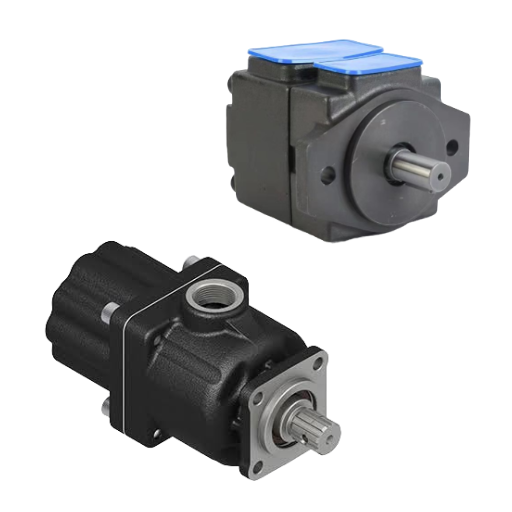
When a maintenance team in Penang replaced a failed pump, they specified it against the machine’s peak shot pressure of about 340 bar. The unit that met that figure had a smaller displacement than the original and could not recharge the accumulator between shots. Six months later, the oil was running at 72°C, and the accumulator was still short when the next shot began. Nothing was underrated; the pump was specified against the wrong number.
That is the most common mistake in die-casting hydraulics: most buyers assume the vane pump for a die-casting machine drives the shot. It does not. On a conventional cold-chamber machine, the pump charges an accumulator, holds the die closed, and supports intensification. The accumulator delivers the fast shot.
This guide explains what a vane pump for a die casting machine has to do, what pressure the system runs at, and how the same pump family behaves on an injection molding machine. For the full family overview, first start with our complete guide to high-pressure vane pumps.
If you are holding a quotation, our engineers can check it against your cycle. Request a specification sheet and application review.
What a Vane Pump for a Die Casting Machine Does
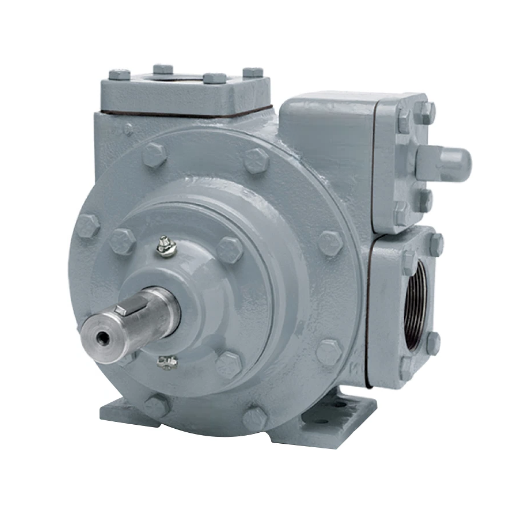
A die-casting machine does not draw on one steady hydraulic demand. It runs a sequence of stages with sharply different needs, and the pump serves only some of them.
A vane pump for a die-casting machine supplies flow for die closing, clamp and locking, slow shot, intensification support, ejection, core pull, and accumulator recharge. The fast shot is supplied by the accumulator, because no pump on the machine can deliver the flow rate cavity filling requires.
That sequence is why die-casting machines carry two or three pumps rather than one large unit. Each stage gets a different combination of flow and pressure.
| Stage | Demand character | Supplied by |
|---|---|---|
| Die close and open | High flow, low pressure | Large pump, often with the small pump |
| Die lock and tie-bar stretch | Low flow, high pressure | Small pump only |
| Slow shot | Moderate flow, moderate pressure | Pump, sometimes with accumulator |
| Fast shot | Peak flow, short duration | Accumulator |
| Intensification | High pressure, low flow | Small pump with intensifier |
| Dwell | Near-zero flow | Pump unloaded |
| Accumulator recharge | Moderate flow, rising pressure | Pump |
| Eject and core pull | Moderate flow | Pump |
The sequence is documented by the North American Die Casting Association in its course material on operating the die casting machine. It describes the die-close cylinder needing a large volume at low pressure to move the platen, then only a small volume at high pressure to stretch the tie bars and lock the die.
That single sentence explains the whole pump arrangement.
Die-Casting Machine Hydraulic System: What the Pressures Really Are
Published figures for a die casting machine hydraulic system cluster between 130 and 165 bar, not at 210 bar. The higher number describes the pump’s rating class, not the machine’s setting.
Here is what five machines specify.
| Machine | Tonnage | System pressure | Intensification | Pumps |
|---|---|---|---|---|
| Toshiba DC2500CST | 2,500 t | 162 / 152 / 78 bar | About 272 bar hydraulic | 3 vane pumps: 56 L/min at 162 bar, 201 L/min at 152 bar, 347 L/min at 78 bar |
| Simhope SC-350 | 350 t | 147 bar | 275 bar maximum | Not stated |
| Idra 560 t | 560 t | 160 bar | 367 bar maximum injection | 37 kW drive |
| HTD DC series | 130 to 880 t | 140 to 160 bar | Not stated | 15 to 45 kW |
| Haichen cold chamber | 30 to 1,600 t | 130 bar, 160 bar on larger models | Not stated | Double vane pump |
Specifications as published by each machine manufacturer.
Three different pressures appear in that table, and buyers routinely blur them.
System pressure is what the pump and main circuit see. It sits around 130 to 165 bar on the machines above.
Intensification pressure is what the shot cylinder produces at the end of the injection stroke. It ranges from roughly 270 to 370 bar. An intensifier multiplies pressure, so the pump does not generate it directly.
Pump rating is what the nameplate says. A 210 bar pump in a 160 bar system has headroom, which is normal and not waste.
A vane pump rated 210 bar is well matched to a machine running at 160 bar. Sizing it against the 367 bar intensification figure is not.
For broader information, our high-pressure vane pump series guide covers the full cross-brand map.
Why the Fast Shot Is Not the Pump’s Job
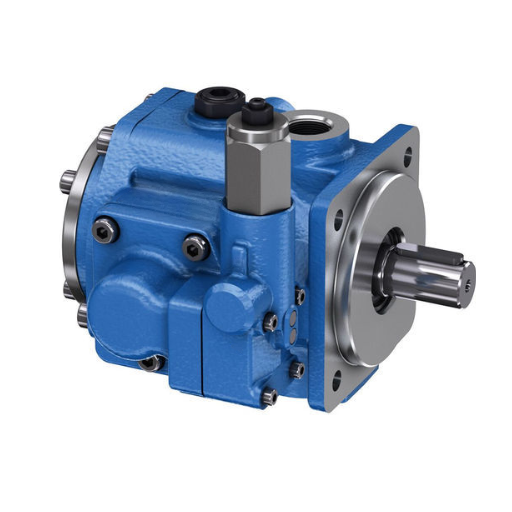
The fast shot fills a die cavity in a fraction of a second, and it needs far more flow than the largest pump on the machine can produce. NADCA states the position plainly: neither of the hydraulic pumps can supply the gallons per second of oil needed for cavity filling.
The accumulator does that work. It stores pressurized oil between shots and releases it through a valve in the shot circuit. Nitrogen-charged piston accumulators are the common type on cold-chamber machines.
This changes what you size the pump for. The pump has to:
- supply enough flow to charge the accumulator before the next shot
- hold clamp pressure through the shot and dwell
- support intensification without a pressure collapse
- cycle the ejector and core pulls
If the accumulator is short of charge when the shot begins, shot velocity falls off during cavity fill. If the pump is oversized against the shot peak, it spends most of the cycle doing little at high pressure, and the excess energy becomes heat in the oil. That is the Penang failure. The pump was healthy; the duty was wrong.
For the circuit-level mechanics of how two pumps stage and unload, our guide to hi-lo hydraulic circuit design covers the unloading valve sequence in detail.
Vane Pump for Injection Molding Machine: A Different Duty Cycle
Injection molding runs the same rotary pump into a different demand pattern, and the difference decides the selection.
A vane pump for an injection molding machine serves the clamp, nozzle approach, injection, packing and hold, screw rotation through a hydraulic motor, ejector, and core pull. The critical phase is hold, which can last from 5 to 30 seconds while the part cools. During hold, the circuit needs pressure and almost no flow.
That is the opposite of die casting. Die casting concentrates its flow demand into a short, accumulator-fed burst. Molding holds pressure for a long, low-flow period.
Typical hydraulic pressure on molding machines runs 160 to 180 bar at the main circuit, with clamp hold commonly between 160 and 200 bar and pilot circuits around 80 to 120 bar. A 160 t machine is commonly specified around 172 bar. A smaller 33 t machine often sits near 179 bar.
The practical consequence: on molding, a fixed pump dumping full flow across a relief valve through every hold phase wastes energy and heats the oil. Variable displacement or a variable-speed drive pays back quickly. Our guide to variable displacement vane pumps covers the compensator behavior.
Where vane is common, and where it is not:
- Common on mid-range hydraulic machines, where one drive serves clamp, injection, and ejector circuits.
- Less common on large precision machines, where variable piston pumps dominate.
- Displaced at small tonnages by all-electric machines. Market tracking shows all-electric growing at 8.4% year on year in 2024 to 2025, two-platen hydraulic at 6.1%, and standard hydraulic contracting at 2.2%, according to Astute Analytica.
Hydraulics still hold large parts, massive molds, and high-force linear motion, as Fluid Power World notes. Vane is the mainstream conventional choice in the middle of the market, not the universal one.
Why Low Pulsation Matters for Casting Quality
Flow ripple does not stay in the pump. It travels to the shot cylinder and shows up in the casting.
A peer-reviewed study of pressure transients in the injection and pressure-boost stage linked them to elastic deformation of the die, which produces dimensional inaccuracy in the finished part (Manas et al., Proceedings of the IMechE Part B, 2001). The die is not perfectly rigid. Pressure spikes flex it, and the cavity changes shape while the metal is still moving.
At a molding shop in Johor, a processor spent three weeks chasing part weight that drifted by 2%. The plasticizing screw, check ring, and heater bands were replaced before anyone measured the hydraulic line. The cause was pressure ripple reaching the injection cylinder, fixed by moving an accumulator closer to the manifold. The pump had not changed.
Vane pumps handle this well by design. A balanced rotor with 10 to 12 vanes delivers overlapping discharge windows, which smooths output. It is why the family was adopted for die casting, and why the high-pressure variants were developed for this application.
Three measures reduce ripple: place the accumulator close to the circuit it serves, avoid long unsupported pipe runs, and use flexible mounts with correct pipe clamping. NADCA recommends reading hydraulic pressure at the die-close and shot cylinders as the repeatability check. A flowmeter will not show you a transient; a pressure trace will.
Single, Double or Triple Cartridge: Matching Machine Tonnage
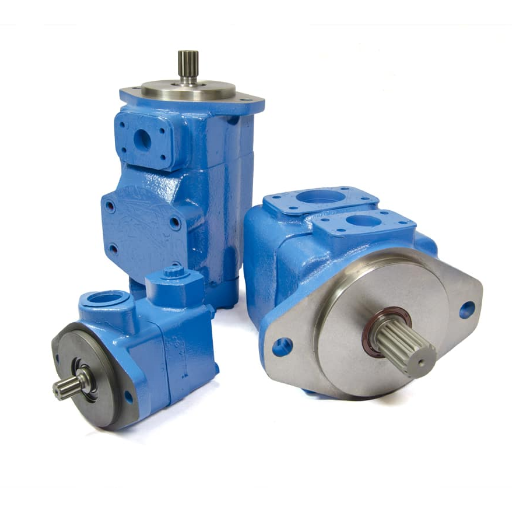
Multi-cartridge vane pumps are standard on die-casting machines because the cycle needs staged flow. A vane pump for die-casting machine service is normally specified as two or three cartridges, not one large unit. A double vane pump puts two rotating groups on one shaft and one drive, with independent outlets.
On a typical Chinese cold-chamber machine, both pumps supply oil together below about 5 MPa. At 5 MPa, the high-flow pump unloads, and only the small-flow pump continues. At the rated 13 MPa, the high-pressure pump unloads too after a preset delay, and the output goes to the cooler.
Toshiba’s 2,500 t specification shows the same logic at a larger scale: 347 L/min at 78 bar, 201 L/min at 152 bar, and 56 L/min at 162 bar. Three cartridges, three jobs, one drive.
The benefits are practical rather than theoretical:
- one motor and one footprint instead of two or three pump sets
- independent pressure and flow for clamp versus injection circuits
- service one cartridge without disturbing the other circuit
- fewer seals, hoses, and mounting points to maintain
For molding machines, the displacement split usually follows tonnage. Suppliers commonly pair a larger clamp circuit with a smaller injection circuit, or combine two cartridges for high-flow clamp phases. Treat any published tonnage table as indicative rather than a specification; the drive power, cycle time, and circuit pressures decide the final arrangement.
Our guide to double and triple vane pump configurations covers how the cartridges stack, how the displacement ratio is chosen, and how combined shaft power is calculated.
Duty Cycle, Heat, Filtration and Noise in the Foundry
A die-casting machine is a punishing host, and the reason is cycle count rather than pressure.
Cycles commonly run 4 to 8 seconds. At a 5-second cycle over two shifts, a machine completes close to 3 million cycles a year. Traditional machines run the pump motor continuously and regulate output through a proportional valve, so the pump turns whether or not the machine is casting.
Three consequences follow.
Select on continuous duty, not peak pressure. The pump has to survive that cycle count at the pressure it holds. The derating guide sets out the correction by speed, displacement, and viscosity.
Manage oil temperature. A pump held at pressure through long unloaded phases puts energy into the oil. As temperature climbs, viscosity falls, internal leakage rises, volumetric efficiency falls, and the pump runs hotter still. Cooling and filtration belong in the same conversation as pump selection; our vane pump maintenance program covers the intervals.
Expect a noisy environment. OSHA citations at die-casting plants record operator exposures of 97.3 dBA at one plant and 97.9 dBA at another, both over an 8-hour shift against a 90 dBA limit. A 2004 occupational study of die-casting industries found ambient levels of 80 to 100 dB(A).
Against that background, a vane pump that suppliers rate at 65 to 70 dB(A) is not the dominant source. It is the component you can specify to make the operator station quieter. One caveat: dB(A) weighting under-reports low-frequency hydraulic thump, so a pump can measure well and still transmit felt vibration through the floor. Isolation mounts address what the meter misses.
When a Vane Pump Is the Wrong Choice
Conventional die-casting machines have run on multi-cartridge vane pumps for decades, and they still do. That is not the same as universal.
Modern servo-driven platforms increasingly use piston or internal-gear pumps, particularly where the machine needs precise shot-velocity profiling, long hold at high pressure, or a tight energy budget. Shibaura reports around 40% power savings from servo delivery against a continuously running fixed pump, with the actual figure depending on cycle and specification.
Move away from vane when the machine needs shot velocity profiled beyond what a fixed pump and accumulator can hold. Long hold times that make a fixed pump’s energy cost matter, or an OEM already standardized on servo piston, also point elsewhere.
Stay with vane when the machine is a conventional cold-chamber unit with staged unloading. Independent clamp and injection circuits suit a double or triple cartridge, and an installed base of vane pumps makes spares commonality a reason to stay.
That last case is where vane has a structural advantage. A rotating-group cartridge can often be replaced without removing the pump from its mounting. For a machine running three shifts, that is downtime measured in hours rather than days.
For the full comparison, our vane pump vs. piston pump comparison covers the crossover decision.
Specifying a Vane Pump for Die Casting Machine Duty
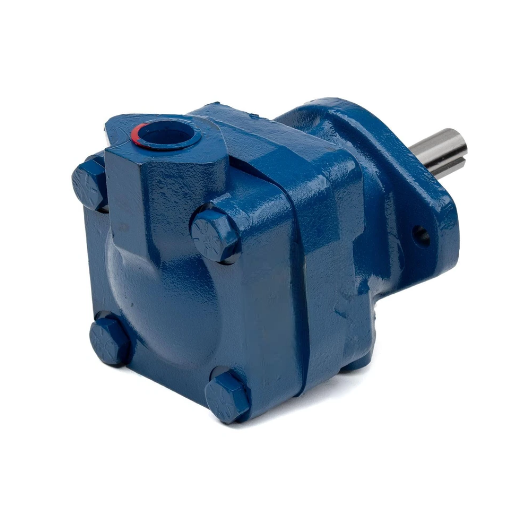
The specification conversation goes wrong when the buyer sends only a pressure figure. Send the operating profile instead.
Pump ratings relevant to this work, from published vendor data: Eaton VMQ up to 293 bar, Eaton VSQ up to 290 bar with a 3,000 rpm maximum, Parker T6CC at 210 bar continuous and 280 bar peak, and Atos PFE-51 at 210 bar. The Vickers HVQ reached 400 bar and was built for high-pressure duty, including die casting, though it is no longer manufactured by the original brand.
The data set that gets a correct quotation the first time:
- Machine make, model, and tonnage
- Circuit pressure and flow for each stage: close, clamp, shot, intensification, ejector
- Accumulator volume, precharge, and recharge window
- Cycle time and shifts per day
- Oil type, viscosity grade, and operating temperature
- Filtration specification and current ISO 4406 code
- Mounting pattern, shaft form, pilot, port positions, and rotation
- Current pump model and nameplate photograph
Then ask the question that separates a real specification from a catalog number: what is the continuous rating at my speed, fluid, and duty? A maximum pressure figure answers a different question.
OEM and private-label programs can adapt displacement, shaft, ports, and rotation to an existing machine, and our vane pump sourcing guide covers how to verify a supplier’s test records and interchange claims. For casting applications specifically, ask for per-unit pressure-hold records rather than a datasheet.
Frequently Asked Questions
What type of pump is used in a die-casting machine?
Conventional cold-chamber machines commonly use two or three vane pumps in a staged arrangement, with a large high-flow pump for die close and a smaller high-pressure pump for clamp and intensification. Servo-driven piston and internal-gear pumps are increasingly used on newer platforms.
Does the hydraulic pump supply the fast shot?
No. The fast shot is supplied by an accumulator. No pump on the machine can deliver the flow rate cavity filling requires, which is why the accumulator is charged between cycles.
What pressure does a die-casting machine hydraulic system run at?
Published specifications for cold-chamber machines cluster between 130 and 165 bar system pressure. Intensification pressure at the shot cylinder reaches roughly 270 to 370 bar. The pump’s own rating, often 210 bar, is a third number again.
Is a vane pump good for injection molding machines?
It is common on mid-range hydraulic machines, where one drive serves clamp, injection, and ejector circuits. Large precision machines often use variable piston pumps, and all-electric machines are taking share at small tonnages.
Can a vane pump run at 200 bar continuously?
Many can. Ratings are frame- and displacement-specific, and a 210 bar pump may be rated lower at high speed or high temperature. Confirm the continuous rating at your conditions, not the headline figure.
Conclusion
A die casting machine hydraulic circuit is a staged system, and the pump is one part of it. Three things follow from that.
- The accumulator makes the shot. Size the pump for recharge, clamp, and intensification support, not for the shot peak.
- System pressure is 130 to 165 bar, not 210. Intensification is a separate, higher number produced downstream of the pump.
- Vane is the mainstream conventional choice, with real advantages in pulsation, multi-circuit configuration, and cartridge serviceability. It is not the only choice, and newer servo platforms increasingly differ.
Get those three right and the specification question becomes straightforward. A vane pump for a die-casting machine needs a continuous rating that matches the application, on a circuit whose accumulator covers the shot.
Send us the machine tonnage, circuit pressures for each stage, accumulator details, and cycle time. Our engineers will map the operating profile against a balanced vane cartridge and return a specification rather than a catalog page. Request a specification sheet and application review.