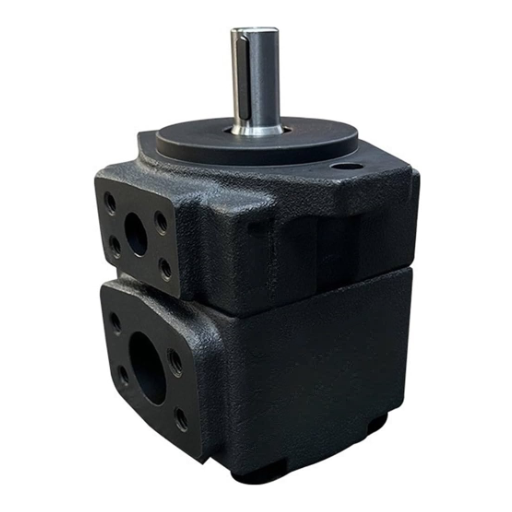
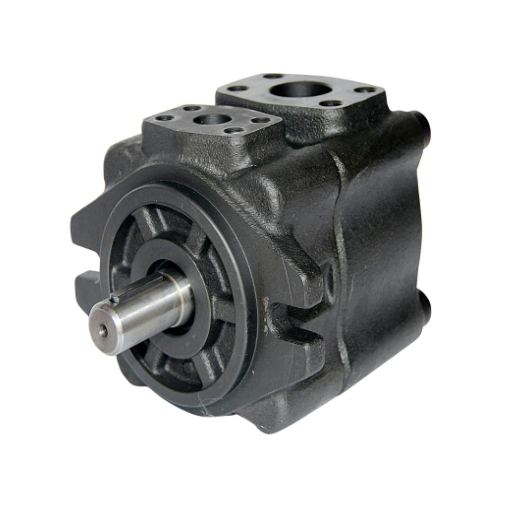
Two quotations arrived at a food-processing plant in Johor Bahru in April 2025. Both described “210 bar high-pressure vane pumps.”
One was a 25VQH. The other was a Yuken PV2R2 running ordinary anti-wear oil, which the catalogue rates at 175 bar on that fluid. The plant bought the cheaper unit and ran it at 195 bar. It failed in eleven months.
The series name did not lie. It simply did not contain the rating. Choosing a high-pressure vane pump series is not a matter of picking the family with the biggest number in its brochure. The number belongs to a frame, a displacement code, a fluid, a speed, and a duty cycle.
Most buyers learn this after the first failure. This guide is built to prevent that. It maps eight series at frame level, explains what each model code encodes, and states which families are still in production.
We supply replacement pumps across the Vickers, Denison, Tokimec, and Yuken families, so this comparison is not tied to one catalogue. For the pressure-band definition and the vane-versus-piston decision, our high-pressure vane pump guide covers the wider picture. For the family fundamentals, start with the complete guide to hydraulic vane pumps.
What a Vane Pump Series Actually Tells You
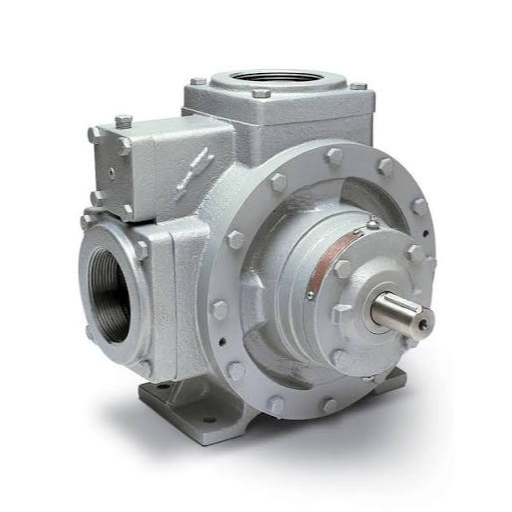
A vane pump series is a design family that shares a cartridge architecture, frame sizes, displacement codes, and mounting options. It isn’t a pressure rating. The rating belongs to one combination of frame, displacement, fluid, speed, and duty.
Four variables move the number, and all four are invisible in the series name.
Frame. Parker uses A to E frames, Vickers uses 20 to 45, Tokimec uses SQP1 to SQP4, and Yuken uses PV2R1 to PV2R4. Pressure and displacement change with every frame.
Displacement code. Within one frame, larger cores often carry a lower rating. Parker’s T6C is 275 bar intermittent and 240 bar continuous on small cores, then 210 and 160 bar on larger cores.
Fluid. The same T7B core is 320 bar intermittent and 290 bar continuous on HF-0 or HF-2. On HF-1, HF-4, or HF-5, it falls to 240 and 210 bar. On HF-3, it falls to 175 and 140 bar.
Speed and duty. A single pump can run to 3,600 rpm on some cores. A multiple pump is capped near 2,200 rpm, and intermittent pressure is defined by a time-weighted average, not a fixed percentage.
The practical rule: a series headline belongs to one frame, one core, one fluid, and one speed. If a quotation doesn’t state all four, it is not a specification.
Already holding a nameplate? Send us the model code and your duty cycle, and we will confirm the frame-level rating before you order.
The Series Map: Eight Families Compared
The table below maps the high-pressure vane pump series landscape; it is not a ranking. Read the status column first, then the pressure column, then the displacement range. A series that can’t be supplied is not a candidate, however good its catalogue number looks.
| Series | OEM | Frames | Displacement (cm³/rev) | Max continuous | Max intermittent | Max speed | Status |
|---|---|---|---|---|---|---|---|
| V | Vickers / Eaton (Danfoss) | 20 / 25 / 35 / 45 | approx. 18 to 193 | approx. 138 to 175 bar | not published | 2,200 to 2,700 rpm | current, widely cloned |
| VQ | Vickers / Eaton (Danfoss) | 20 / 25 / 35 / 45 | up to 193 | 210 bar series max | approx. 240 bar | 2,700 rpm | current |
| VQH | Danfoss | 25 / 35 / 45 | 40.2 to 193.4 | 207 to 241 bar by frame | 262 bar | 2,200 to 2,700 rpm | current |
| HVQ | Vickers / Eaton (Danfoss) | not verified | not verified | 400 bar | not published | not published | discontinued, clone-only |
| T6 / T67 / T7 | Parker / Denison | A / B / C / D / E | 5.8 to 268.7 | 240 to 320 bar by frame and core | up to 320 bar | 2,000 to 3,600 rpm | current |
| SQP | Tokyo Keiki | SQP1 to SQP4 | approx. 7.5 to 237 | 175 bar (17.5 MPa) | not published | 1,800 rpm | current |
| PV2R | Yuken | PV2R1 to PV2R4 | 5.8 to 237 | 206 bar on specified oil, 175 bar anti-wear | not published | 1,800 rpm | current |
| YB-E | Chinese manufacturers | single and double | approx. 10 to 193 | 160 bar (16 MPa) | not published | 1,800 rpm | current, multiple makers |
Three facts stand out. The current-production ceiling for a mainstream series is about 241 bar continuous, and that number belongs to one VQH frame. The 320 bar figure everyone quotes is a Parker intermittent rating on a narrow core range. And YB-E, the series most buyers are actually quoted, is a 160 bar pump by its own standard.
A live catalogue page is not a stock guarantee, and a discontinued series can still be sold from inventory or cloned.
Vickers VQ and VQH: The 210 to 241 Bar Tier
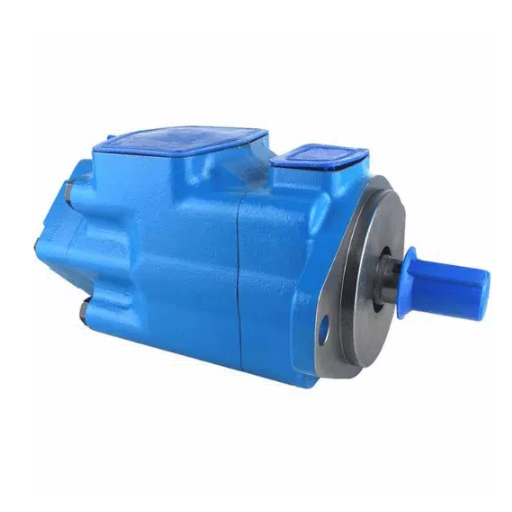
The VQ family covers 20, 25, 35, and 45 frames, displacements up to 193 cm³/r, and a series maximum of 210 bar continuous at up to 2,700 rpm. The housing is gray cast iron and volumetric efficiency is at least 88 percent.
The series maximum is not a frame-by-frame guarantee. The 210 bar figure belongs to the 35 and 45 frames. Distributor data puts the 20VQ at about 175 bar and the 25VQ at about 190 bar continuous. Confirm the frame rating in the Danfoss brochure before you specify one.
The VQH vane pump uses a ductile iron housing and a reinforced rotor, and volumetric efficiency rises to at least 92 percent. There is no 20VQH. The family starts at frame 25, and its cartridge is interchangeable with the VQ while the mounting envelope stays the same.
That interchange is useful, but it has created a myth. Buyers repeat “VQH, 3,500 psi” as if it applies to the whole family. It does not.
| Frame | Displacement (cm³/rev) | Max continuous | Max peak | Max speed |
|---|---|---|---|---|
| 25VQH | 40.2 to 67.5 | 241 bar (3,500 psi) | 262 bar (3,800 psi) | 2,500 to 2,700 rpm |
| 35VQH | 81.6 to 121.6 | 228 bar (3,300 psi) | 248 bar (3,600 psi) | 2,400 to 2,500 rpm |
| 45VQH | 138.7 to 193.4 | 207 to 228 bar (3,000 to 3,300 psi) | 248 bar (3,600 psi) | 2,200 rpm |
Only the 25VQH reaches 241 bar, and only on its smaller cores. The 35 and 45 frames are 228 bar pumps, with the largest 45 core at 207 bar. A quotation that describes a 45VQH as a 3,500 psi pump is wrong by 34 bar.
Mila, a distributor in Rotterdam, learned this in February 2025. She quoted a 45VQH for a 240 bar continuous application because the headline said 3,500 psi. The frame limit was 228 bar. The job was re-specified to a 25VQH, which met the pressure within its speed limit. The frame number, not the series number, set the rating.
VQ and VQH both appear in Danfoss’s current catalogue. Some clone sellers call the VQ discontinued, which the current product pages don’t support. Ask for the discontinuation notice. Cartridge and seal availability is covered in our guide to vane pump cartridge kits.
Parker T6, T67 and T7: The Frame Table Nobody Publishes
Parker’s Denison catalogue is the most detailed public source in this market, and the most misquoted. The T6, T67, and T7 names cover five frames with very different limits: A 300 bar, B 320 bar (300 for multiple pumps), C 275 bar, D 280 bar (250 for multiple), and E 240 bar.
Minimum speed is 600 rpm. Maximum speed reaches 3,600 rpm on smaller cores, falls to 1,800 rpm on HF-3, HF-4, or HF-5, and to about 2,200 rpm on multiple pumps.
The frame maximum is still not the rating. The catalogue publishes per-core figures on HF-0 or HF-2 anti-wear oil, and they move with displacement.
| Model and core range | Intermittent | Continuous | Max speed |
|---|---|---|---|
| T7AS B06 to B22 | 300 bar | 275 bar | 3,600 rpm |
| T7ASW B26 to B32 | 300 bar | 275 bar | 3,600 rpm |
| T7B B02 to B10 | 320 bar | 290 bar | 3,600 rpm |
| T7B B11 to B14 | 300 bar | 275 bar | 3,000 rpm |
| T7B B15 | 280 bar | 240 bar | 3,000 rpm |
| T6C 003 to 012 | 275 bar | 240 bar | 2,800 rpm |
| T6C 025 to 031 | 210 bar | 160 bar | 2,500 rpm |
| T7D B14 to B35 | 300 bar | 250 bar | 3,000 rpm |
| T7D B45 to B50 | 240 to 210 bar | 210 to 160 bar | 2,200 rpm |
| T7E 042 to 072 | 240 bar | 210 bar | 2,200 rpm |
| T7E 085 | 90 bar | 75 bar | 2,000 rpm |
Now the 320 bar question has an answer. It is a T7B rating on cores B02 through B10, single pump, on HF-0 or HF-2, in intermittent duty. The continuous ceiling is 290 bar. Parker’s own footnote says to consult the factory for applications above 300 bar. A buyer who specifies “T7, 320 bar” for a 300 bar continuous duty is outside the published envelope.
Fluid selection moves the same core down two tiers. On HF-1, HF-4, or HF-5, the T7B is 240 bar intermittent and 210 bar continuous. On HF-3 water-in-oil, it is 175 and 140 bar. The pump didn’t change. The fluid did.
Gareth, a press builder in Sheffield, specified a T7B for a 315 bar pressing stroke in September 2024. He had read 320 bar in a distributor table and treated it as continuous. The correct continuous limit for his core was 290 bar. The fix was a 285 bar pressing circuit plus an accumulator for the peak, which kept the pump inside its envelope. The press still met its tonnage.
Multiple pumps derate further. A T7BB or T7BBS retains 320 bar intermittent and 290 bar continuous, but other multiple-pump combinations fall to 300 and 275 bar, or to 240 and 210 bar on HF-1, HF-4, or HF-5. If you run two cartridges together, the single-section rating isn’t your rating. Our guide to double and triple vane pumps covers how the sections combine.
Yuken PV2R, Tokimec SQP and YB-E: The 160 to 206 Bar Tier
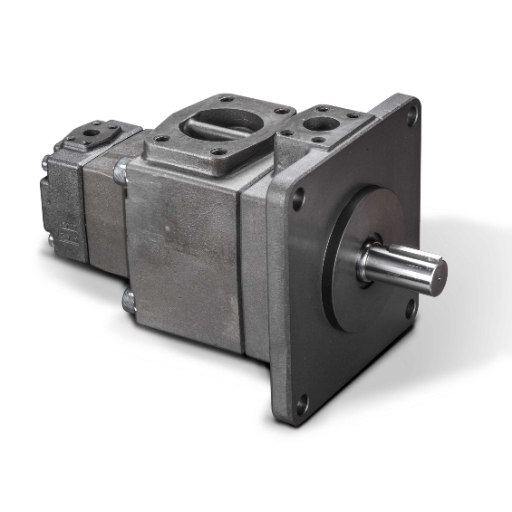
The Japanese and Chinese entries in this high-pressure vane pump series comparison sit in the medium band, and their catalogues are more honest about fluid effects than most marketing pages.
The Yuken PV2R vane pump is rated in kgf/cm², not bar. The headline 210 is 210 kgf/cm², which is about 20.6 MPa or 206 bar. The conversion matters because a buyer who writes “210 bar” is overstating the pump by 4 bar before the fluid is even considered.
The fluid ladder is the real specification.
| Fluid | Max operating pressure |
|---|---|
| Specially specified petroleum oil | 210 kgf/cm² (about 206 bar) |
| Anti-wear petroleum oil | 175 bar |
| R&O petroleum oil | 140 bar |
| Anti-wear water-containing fluid | 160 bar |
| Water glycol | 70 bar |
| Water-in-oil emulsion | 70 bar |
| Phosphate ester | 140 bar, 1,200 rpm max |
Speed runs from 600 to 1,800 rpm, but phosphate ester and water-containing fluids cap it at 1,200 rpm. Displacement ranges from 5.8 to 237 cm³/r across PV2R1 to PV2R4. The larger PV2R3 cores, codes 76, 94, and 116, are rated 160 bar. PV2R4 tops out at 175 bar.
The Tokimec SQP vane pump follows the same pattern. The SQP and SQPS table lists 17.5 MPa (175 bar) at up to 1,800 rpm, with 1,200 rpm on fire-resistant fluids. The catalogue also shows a 12.5 MPa version and a 14 MPa F3 variant, so quote the model row, not the family headline. The intra-vane design explains its low-noise reputation in machine tools and die casting.
The YB-E vane pump series is the one most buyers on this query are actually quoted. It is a Chinese double-vane family with a mother-and-child intra-vane unloading design, built to JB/T7039-93 and JB/T7040-93, with metric flanges and shafts to GB2353.1-80 and ISO3019/2. Manufacturer documentation lists 16 MPa (160 bar) at 600 to 1,800 rpm, with displacements from about 10 to 193 mL/rev.
That is a capable medium-pressure pump. It is not a high-pressure vane pump in the sense the VQH or T7 define. A buyer comparing a YB-E40/25 quote with a T6C quote is comparing a 160 bar pump with a 210 to 275 bar pump. The mounting may be interchangeable. The rating does not.
Vendor tables vary, so confirm the rating basis before treating 16 MPa as continuous. Fluid selection and filtration targets are covered in our guide to vane pump maintenance.
The HVQ Problem: One Name, Three Different Pumps
The HVQ vane pump is the most misunderstood model name in this market. It refers to at least three different pumps, and they are not interchangeable.
| Publisher | What “HVQ” means | Pressure |
|---|---|---|
| Vickers / Eaton / Danfoss | The 1990s ultra-high-pressure lineage, not interchangeable with V or VQ | 400 bar (5,800 psi), discontinued by Danfoss |
| HOF Hydraulic | The mobile variant of its 20HV industrial pump | 206 bar on small codes, 158 bar, 138 bar |
| KCL | An unrelated ultra-high-pressure compact series, equivalent to Yuken PV11R10 | 45 MPa peak (450 bar), 4 to 23 cc/rev |
A maintenance team that orders “an HVQ 20” expecting a 400 bar replacement can receive a 206 bar mobile pump. The name is the same. The product is not.
The Vickers HVQ reached 400 bar by changing materials, balancing geometry, and vane loading, and it doesn’t interchange with the V or VQ series. Danfoss no longer makes it. Clone makers still advertise 5,800 psi, which is a claim to verify, not a specification to accept.
Order by OEM, frame, displacement code, and pressure evidence, never by the three letters alone.
Replacing a discontinued series? Send the nameplate, port-face photographs, and duty cycle, and we will confirm what interchanges and what does not.
How to Compare High-Pressure Vane Pump Series Fairly
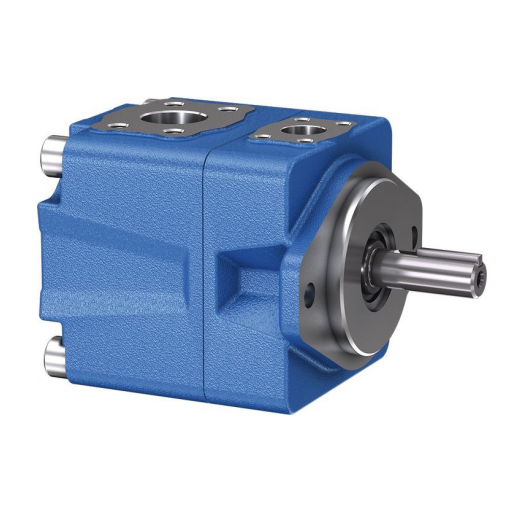
Most comparisons fail before the first number is read. Normalize a high-pressure vane pump series on five columns, and the choice usually makes itself.
- Continuous pressure, not intermittent or peak.
- Fluid, whether HF-0 or HF-2, HF-1 or HF-4 or HF-5, or HF-3.
- Frame and displacement code, not the series name.
- Speed, and whether the pump is single or multiple.
- Status and provenance, current production, discontinued, or clone.
Parker’s intermittent rule shows why the second column matters. Intermittent pressure is allowed only when the time-weighted average is at or below the continuous rating. The catalogue’s own example is 4 minutes at 320 bar, 1 minute at 35 bar, and 5 minutes at 160 bar, which averages 211.5 bar. That is valid against a 290 bar continuous limit. A pump rated 320 bar intermittent is not a 320 bar pump.
Apply the five columns to a 200 bar duty at 1,500 rpm on ISO VG 46 mineral oil. A VQ 35 or 45 frame passes at 210 bar. A 25VQH passes at 241 bar. A T7B passes at 275 to 290 bar. A PV2R2 passes only on Yuken’s specified oil; ordinary anti-wear oil makes it a 175 bar pump. A YB-E fails at 160 bar.
| Required continuous pressure | Shortlist | Caveat |
|---|---|---|
| to 160 bar | YB-E, SQP, PV2R on R&O or anti-wear, VQ 20/25 | widest availability, lowest cost |
| 160 to 175 bar | PV2R2 on anti-wear, SQP, VQ 20/25 | check the fluid row |
| 175 to 210 bar | VQ 35/45, PV2R2 on specified oil, T6C small cores | the most common band |
| 210 to 250 bar | VQH 25, T7B or T7D small cores, T6C | ductile iron or larger frame |
| 250 to 290 bar | T7B or T7D small cores on HF-0 or HF-2, single pump | speed limited to 3,000 or 3,600 rpm |
| 290 to 320 bar | T7B B02 to B10, intermittent only | 290 bar continuous ceiling |
| 320 to 400 bar | HVQ clone only | discontinued, test evidence mandatory |
| above 400 bar | none | move to a piston pump |
This is a comparison, not sizing. Displacement, drive power, and inlet conditions are a separate calculation, covered in our vane pump sizing method. From the perspective of technical principles, please see our article on why vane pumps have a pressure limit.
Reading a Vane Pump Model Code
A vane pump model code is a compressed specification, and each maker compresses it differently.
- Parker:
T7B-B10-1R00-A1-M0gives the series, displacement code, shaft, rotation, port position, mounting, seal, and modification. - Yuken:
PV2R1-6-L-R-A-A-40gives the series, nominal delivery, mounting, rotation, discharge port position, suction port position, and design number. - Vickers:
25VQH17gives the frame, series, and displacement code, followed by suffixes for shaft, mounting, port, and rotation. - YB-E:
YB-E40/25 Rgives the shaft-end displacement, the cover-end displacement, and the rotation direction.
Decoding a code is not the same as confirming interchangeability. Mounting flange, pilot diameter, bolt pattern, shaft form, port position, and rotation all have to match. Those dimensions are covered in our guide to SAE mounting and port standards and in the cross-reference article linked above.
Frequently Asked Questions
Which vane pump series reaches the highest pressure?
No current high-pressure vane pump series reaches 400 bar. The Vickers HVQ did, but Danfoss has discontinued it. Among current production, the highest verified continuous rating is the 25VQH at 241 bar. The Parker T7B reaches 320 bar intermittent and 290 bar continuous on its small cores.
Is VQH the same as HVQ?
No. The VQH is an evolution of the VQ with a ductile iron housing and reinforced rotor, rated 207 to 241 bar by frame. The HVQ is a separate 400 bar design that does not interchange with the V or VQ. The similar names cause real ordering errors.
Can I replace a VQ with a VQH?
The cartridges are interchangeable, and the mounting envelope is the same, so a VQH can often replace a VQ. The pressure rating still depends on the frame, and the shaft, ports, and rotation must match. Confirm the frame rating before assuming the higher series number applies.
What does 320 bar mean on a T7?
It means a T7B core from B02 to B10, single pump, on HF-0 or HF-2 fluid, in intermittent duty. The continuous rating is 290 bar. Parker advises consulting the factory for applications above 300 bar.
Is YB-E a high-pressure vane pump?
By its manufacturer’s documentation, YB-E is rated 16 MPa (160 bar) at 600 to 1,800 rpm. That places it in the medium band, not the high band. It is a capable medium-pressure pump and a common Vickers-compatible choice, but it is not equivalent to a VQH or T7 on pressure.
Conclusion
A vane pump series is a design family, not a pressure rating. The headline number belongs to one frame, one core, one fluid, and one speed. The same series can span 70 to 206 bar depending on the fluid, and the same model name can describe three unrelated pumps.
Four habits prevent expensive mistakes. Read the status column before the pressure column. Ask for the frame and displacement code, not the family name. Normalize every quotation to continuous pressure on a stated fluid. And confirm the model code against the OEM table before you approve the order.
If you are specifying a high-pressure vane pump series at 210 bar or above, send us the duty cycle, fluid, speed, and nameplate. We will confirm the frame-level rating and the available series before you commit. Request a specification-matched quotation, and we will return the pressure evidence with it.