Two quotations land on Daniel’s desk for the same 180 bar blanking press. The vane pump is about $7,000 cheaper. The piston pump is presented as the safer choice because it can handle more pressure. Daniel runs a steady 30 L/min at 4,000 hours a year and asks a simple question: which one actually fits this machine?
That question sits behind most vane pump vs piston pump decisions. The answer is rarely the higher ceiling, but the pump whose pressure, flow, duty, noise, and oil cleanliness match the job.
This guide to the high-pressure vane pump vs piston pump decision separates general vane from the high-pressure tier, explains why published crossover numbers disagree, and quantifies the trade-offs.
For the full family overview, first start with our complete guide to high-pressure vane pumps.
If you’re holding two quotations, our engineers can review both against your duty cycle. Request a specification-matched quotation with your pressures, flow, and annual hours.
Vane Pump vs Piston Pump: The Short Answer
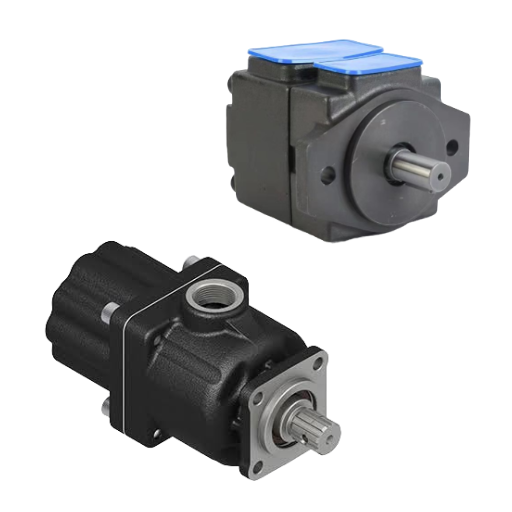
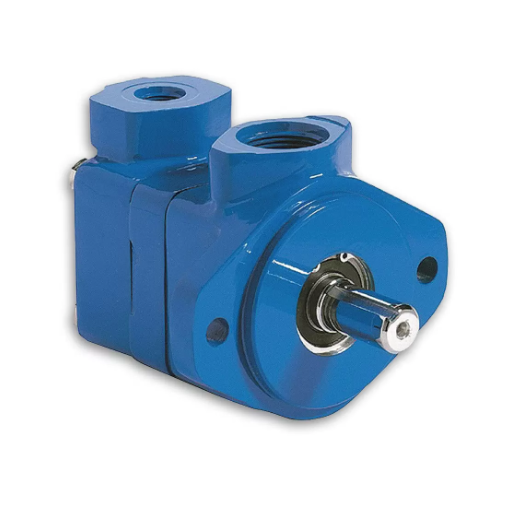
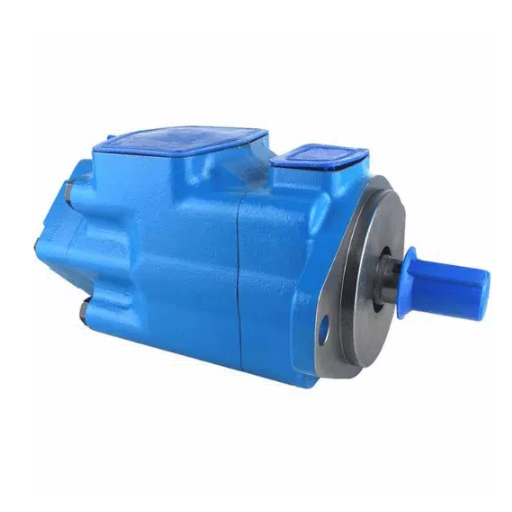
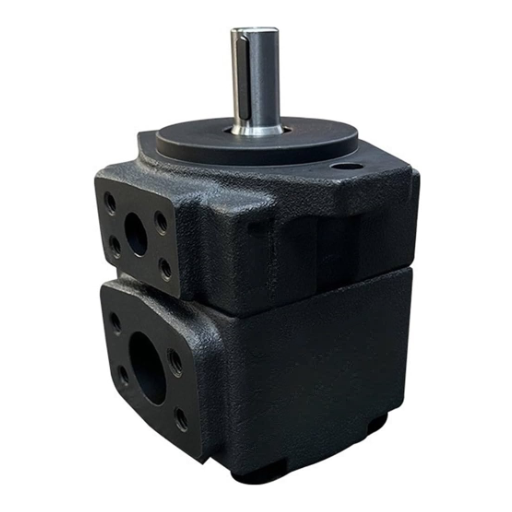
A vane pump moves fluid with sliding vanes held in a rotor inside a cam ring. A piston pump moves fluid with pistons reciprocating in bores, driven by a swashplate or bent axis. Vane pumps are quieter and usually cheaper at moderate pressure. Piston pumps are more efficient and controllable at high pressure.
The practical decision:
- Below about 210 bar continuous, with steady flow and clean fluid, a vane pump usually wins on purchase cost, noise, and serviceability.
- Above about 250 to 310 bar continuous, or with variable flow, a piston pump is the safer default.
- Between 210 and 250 bar, the families overlap. Duty cycle, control, noise, and contamination decide the winner.
| Factor | Vane pump | Piston pump |
|---|---|---|
| Typical continuous pressure | 70–210 bar general; 210–250 bar high-pressure series | 280–450 bar axial; 700+ bar radial |
| Volumetric efficiency | Roughly 85–94% | Roughly 92–98% |
| Noise at 1 m | Roughly 60–72 dB(A) | Roughly 75–85 dB(A) |
| Purchase cost | Moderate | Highest |
| Flow control | Mostly fixed; variable vane is limited at high pressure | Variable displacement, load sensing, pressure compensation |
| Best fit | Quiet, steady, medium-pressure duty | High pressure, variable flow, precise control |
The crossover is a band, not a number. Treat any single figure, including 175, 210, or 250 bar, as a starting point rather than a specification.
Vane Pump vs Piston Pump Pressure: Where the Vane Ceiling Sits
Pressure hides three vane tiers.
General Vane vs High-Pressure Vane
A general-purpose vane pump typically runs 70 to 210 bar continuously. That is the range most comparison articles quote, and why so many conclude vane stops at 210 bar.
High-pressure vane pumps are a separate tier, usually 210 to 250 bar continuous, depending on frame, displacement, speed, and fluid.
Eaton’s VQH series shows how frame-specific that is. The 25VQH is rated 241 bar (3,500 psi) continuous, the 35VQH 228 bar, and the 45VQH 207–228 bar depending on displacement. Peak ratings sit near 248–262 bar.
The Parker Denison T7 family reaches higher in some configurations, with D-grade cartridges commonly quoted around 250 bar continuous and 300 bar intermittent.
Above that sits the HVQ. It reached 400 bar (5,800 psi). According to Fluid Power World, Danfoss no longer manufactures it; clone makers still offer it, and it does not interchange with V or VQ series pumps.
Piston Pressure Capability
Axial piston pumps commonly run 280 to 450 bar continuously. Eaton rates its PVH open-loop pump at 350 bar. Radial piston pumps go higher, above 700 bar. That does not make every piston pump right above 250 bar; it means the family has more headroom.
Why the Published Crossover Numbers Disagree
Search for the crossover, and you will find answers of 175, 200, 210, 250, 300, and 310 bar. They’re not all wrong. They answer different questions.
- 175 bar usually means a general-purpose vane pump.
- 210 bar is a common ceiling for standard industrial vane pumps.
- 250 bar reflects a high-pressure vane pump such as the VQH or T7.
- 300 bar is often an intermittent rating, not a continuous one.
The missing disciplines are continuous, intermittent, and peak pressure. A pump rated 300 bar intermittent isn’t a 300-bar pump. It can touch 300 bar for a defined fraction of its cycle. If your press holds 280 bar most of the shift, that rating is irrelevant.
Use this table as the working boundary:
| Continuous pressure | Steady flow, clean fluid | Variable flow or long duty | Noise-critical |
|---|---|---|---|
| Below 175 bar | Vane | Vane, or variable piston if energy is critical | Vane |
| 175–210 bar | General high-pressure vane | Vane or piston, depending on part-load hours | Vane |
| 210–250 bar | High-pressure vane, verified at your speed and fluid | Piston usually | High-pressure vane, if verified |
| 250–310 bar | Piston | Piston | Piston plus acoustic treatment |
| Above 310 bar | Piston | Piston | Piston plus acoustic treatment |
For the mechanical reason, see why vane pumps have a pressure limit. For series ratings, see the high-pressure vane pump series guide. For the arithmetic, see vane pump derating.
Efficiency and Part-Load Behavior: Where the Money Goes
Most vane pump vs piston pump efficiency data stops at full flow. That is the least interesting part of the decision.
Full-Load Efficiency
Published vane pump efficiency runs at roughly 85–94% volumetric and 75–90% overall. Piston pump efficiency is higher on paper: 92–98% volumetric and 85–95% overall. Treat these as ranges, not guarantees.
At steady full flow, the gap is small. On a 30 L/min, 160 bar system, 88% versus 92% overall is about 0.4 kW, or $240 a year at 4,000 hours and $0.15/kWh. A piston premium will not pay back on efficiency alone.
Part-Load Is the Real Difference
A fixed displacement vane pump delivers the same flow per revolution. When the machine needs less, the excess crosses the relief valve and becomes heat. A variable displacement piston pump reduces displacement to match demand.
Consider Aisha, a process engineer at an injection molding plant. Her 280 bar machine runs 30 L/min at peak, but half of its 4,000 annual hours are at about 30% flow.
The fixed vane would bypass roughly 21 L/min at 280 bar, about 9.8 kW of heat. A variable piston pump draws roughly 4–5 kW. That saves 10–11 kW for 2,000 hours, or 20,000–22,000 kWh a year.
At $0.15/kWh, that’s $3,000–3,300. A $4,000–6,000 piston premium pays back in about 1.5–2 years.
These numbers are modeled. They depend on the relief setting, part-load efficiency, and duty, but the direction is reliable: part-load time is where the piston premium earns its keep.
When the Piston Premium Never Pays Back
Return to Daniel’s press. It runs 30 L/min at 180 bar, 4,000 hours a year, with little variation. The vane at 88% draws about 9.1 kW; the piston at 92% draws about 8.7 kW. The difference is 0.4 kW, roughly $240 a year.
There is no variable-flow problem, so the piston would add cost, complexity, and finer filtration without an energy return. A high-pressure vane pump is better, provided its rating covers 180 bar at the actual speed and fluid.
Buy the piston for controllability and part-load savings, not for a few points of full-flow efficiency. Our axial piston pump guide covers the control options.
Noise, Pulsation, and the Cost of Quiet
In a vane pump vs piston pump noise comparison, the vane pump’s strongest advantage is often undervalued at the quotation stage.
Published vane pump noise figures typically sit around 60–72 dB(A) at 1 m, against 75–85 dB(A) for piston pumps. Eaton’s noise data at 140 bar places several vane models at 72–75 dB(A) and piston models around 82–84 dB(A). Compare like with like.
The decibel scale is logarithmic. A 10 dB difference is roughly a perceived doubling of loudness. A 10–15 dB gap changes whether an operator can hold a conversation beside the unit, and it can decide whether the machine needs an acoustic enclosure.
Vane pumps also produce lower flow pulsation. That reduces piping vibration, accumulator duty, and resonance risk. Piston pumps can be smooth, but pressure ripple tends to rise with load and control action.
Noise matters most in machine tools, injection molding, presses, indoor power units, loader cranes, and municipal equipment. It matters less outdoors or on remote power packs.
The economic test is simple. Price the vane premium against an acoustic enclosure, silencer, and operator protection for the piston option. If the enclosure costs more than the pump difference, vane is cheaper.
Cost, Service Life, and Total Cost of Ownership
Purchase price is the easiest number in a vane pump vs piston pump cost comparison, and the least useful on its own.
Purchase and Repair Cost
The purchase ladder runs from general vane to high-pressure vane to axial piston. Piston pumps cost the most to buy and rebuild; high-pressure vane sits between.
Vane pumps use cartridge assemblies that can often be replaced in the housing. Piston pumps use a rotating group that usually needs specialist tools and a clean bench.
As a planning rule, cartridge repair runs 20–35% of a new pump and piston rebuild 25–40%. Treat those as estimates; the bigger number is usually downtime.
Life and Downtime
Published estimates place vane life at 5,000–10,000 hours and axial piston life at 10,000–20,000 hours, but duty, cleanliness, and maintenance matter more. A clean, correctly sized vane pump can outlast a neglected piston pump.
A cartridge swap can be planned for a shift. A piston rebuild may mean shipping the unit out. If the machine is a bottleneck, serviceability can outweigh a few efficiency points.
Two TCO Scenarios
| Cost element | Scenario A: 160 bar machine tool | Scenario B: 280 bar molding machine |
|---|---|---|
| Flow profile | Steady 30 L/min | 30 L/min peak, 50% of hours at 30% flow |
| Annual hours | 4,000 | 4,000 |
| Vane option | General high-pressure vane, 88% overall | Fixed vane, 88% overall |
| Piston option | Axial piston, 92% overall | Variable piston, 92% overall |
| Annual energy difference | About $240 | About $3,000–3,300 |
| Likely five-year winner | Vane, on purchase and service | Piston, on energy and controllability |
| Deciding risk | Noise and contamination | Filtration and control complexity |
The table is a framework, not a quote. Run it with your electricity price, hours, and flow profile.
Contamination, Control, and Serviceability: The Non-Pressure Deciders
In a vane pump vs. piston pump decision, pressure sets the boundary. These three factors often decide the winner inside it.
Oil Cleanliness
Vane pumps tolerate moderate contamination, but their tips and cam ring are wear surfaces. High-pressure duty usually calls for 10 µm absolute filtration and ISO 4406 18/16/13 or better.
Piston pumps generally need finer filtration, often ISO 18/16/13 minimum and cleaner for servo duty. One contamination event can damage a bore or valve plate.
Consider Tomas, a maintenance manager at a foundry. His 250 bar piston pump failed within months because the oil ran near ISO 20/18/15. A replacement would have failed the same way.
The fix was a filtration upgrade to ISO 16/14/11, then a high-pressure vane pump derated to about 220 bar. The fluid was finally clean enough for either family.
If the system can’t be kept clean, neither family is right. A gear pump or a filtration redesign deserves the conversation.
Control Requirements
Vane pumps are mostly fixed displacement. Variable vane designs exist, but they never gained traction at high pressure. As Fluid Power World contributor Josh Cosford notes, variable-displacement vane designs did not establish themselves in high-pressure duty.
Piston pumps own that territory. They offer pressure compensation, load sensing, horsepower limiting, electro-proportional control, and closed-loop operation. If the machine must match flow to demand across a wide range, control may decide the family before pressure does.
Serviceability
A vane cartridge is field-replaceable. A piston rotating group is not. That affects spare-parts strategy, technician training, and mean time to repair.
If the plant lacks specialist support, the cartridge is a practical advantage. If it has a hydraulic shop, the piston rebuild is manageable.
The Crossover Decision: A Practical Framework
Use this hydraulic pump selection sequence before comparing prices.
- Write down continuous, intermittent, and peak pressure, with the duty fraction for each.
- Map the flow profile. Constant, stepped, or variable with long idle periods.
- Estimate annual hours and energy cost. Include part-load hours, not just peak.
- Set a noise budget at 1 m. Decide whether an enclosure is acceptable.
- State the achievable ISO cleanliness code. Include filtration cost.
- List control requirements. Fixed, pressure-compensated, load-sensing, electro-proportional, or closed-loop.
- Weigh downtime, serviceability, envelope, and weight, then calculate a five-year TCO.
| If the duty looks like this | Start with |
|---|---|
| Under 210 bar continuous, steady flow, clean oil, noise matters | General or high-pressure vane |
| 210–250 bar continuous, steady flow, verified high-pressure vane series | High-pressure vane, with derating checked |
| 210–250 bar continuous, variable flow, long duty, precise control | Piston |
| 250–310 bar continuous | Piston |
| Above 310 bar continuous | Piston; radial piston above 450 bar |
Choose vane when:
- Continuous pressure is under about 250 bar, with the series verified at your speed and fluid.
- Flow is steady, or varies only slightly.
- Noise or pulsation is a real constraint.
- The fluid can be kept clean.
- Cartridge serviceability and lower purchase cost matter.
Choose piston when:
- Continuous pressure is above about 250 to 310 bar.
- Flow must vary widely, or the machine idles for long periods.
- Load sensing, pressure compensation, or closed-loop control is required.
- Duty is severe, and energy savings justify the premium.
- You need the highest power density in a compact envelope.
The contested middle is 210–310 bar. A high-pressure vane pump can be technically correct and commercially wrong, or the reverse. Part-load hours, control complexity, noise budget, and oil cleanliness decide it. A vane pump derated below the duty is not a cheaper piston pump; it is a premature failure.
The 300–400 bar quiet case is the hardest. The HVQ reached 400 bar, but it’s discontinued and does not interchange with V or VQ pumps. You can source a verified clone with pressure-hold test records, or use a piston pump with acoustic treatment.
When converting, check pressure and flow first, then filtration, mounting flange, shaft, port positions, rotation, and control interface. A dimensional match is not a functional match.
Still comparing two quotations? Send the duty cycle to our engineers, and we will check both pumps against continuous pressure, part-load hours, and fluid cleanliness. Get a customized hydraulic system recommendation.
Frequently Asked Questions
What is the difference between a vane pump and a piston pump?
A vane pump uses sliding vanes in a rotor to trap fluid. A piston pump uses reciprocating pistons in bores. Vane pumps are quieter and cheaper at moderate pressure; piston pumps are more efficient and controllable at high pressure.
Which is better, a vane pump or a piston pump?
Neither is universally better. Below about 210–250 bar continuous, with steady flow and clean oil, vane usually wins on cost, noise, and serviceability. Above 250–310 bar, or when flow must vary, piston wins.
At what pressure should I switch from vane to piston?
There is no single number. Start with 210 bar for general vane, 250 bar for high-pressure vane, and 310 bar as the practical upper boundary. Then check the frame rating, speed, fluid, and duty fraction.
Can a vane pump reach 250 bar? 300 bar? 400 bar?
Yes, with caveats. The VQH reaches about 241 bar continuous in the 25 frame. Some T7 cartridges reach about 250 bar continuous and 300 bar intermittent. The HVQ reached 400 bar but is discontinued.
Can a vane pump replace a piston pump?
Sometimes. It can work when pressure is within the vane pump’s verified range, flow is steady, the fluid is clean, and the mounting and control interface match. It is not a drop-in swap at 300 bar or in a variable-flow system.
Are piston pumps more efficient than vane pumps?
At full flow, piston pumps hold a few points more efficiency. The larger advantage appears at part load, where a variable piston pump reduces displacement instead of dumping excess flow across a relief valve.
Why are vane pumps quieter than piston pumps?
Vane pumps produce lower flow pulsation and a smoother pressure profile. Their rotating group also generates less impact noise than reciprocating pistons. The advantage is typically 10–15 dB(A) at 1 m.
Vane pump vs piston pump for a 200, 250, or 300 bar system?
At 200 bar with steady flow, start with a high-pressure vane pump. At 250 bar, flow profile, control, and noise decide. At 300 bar continuous, piston is the safer default unless a vane series is proven for that duty.
Conclusion
The vane pump vs piston pump decision isn’t a pressure contest. It’s a duty-cycle decision.
Five points matter most. Separate general vane from high-pressure vane before comparing ceilings. Read every pressure as continuous, intermittent, or peak.
Calculate part-load hours, because that’s where the piston premium earns or fails to earn its keep. Treat noise and contamination as economic factors, not footnotes. And verify the rating at your speed and fluid before you accept a catalogue number.
Daniel’s 180 bar press did not need a piston pump. Aisha’s 280 bar molding machine did. Tomas’s foundry needed clean oil before it needed a different family. The hardware followed the duty.
If you are specifying a new power unit or replacing a pump, send us the continuous pressure, peak pressure, flow profile, annual hours, and fluid. We supply both families, so the recommendation can follow the application rather than the catalogue. Request a technical specification sheet or ask for a duty-cycle review.