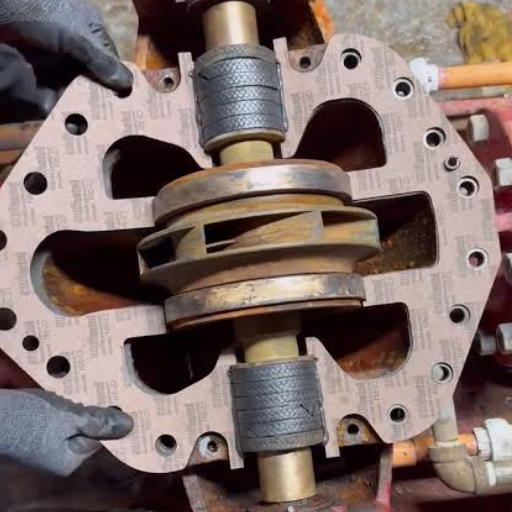
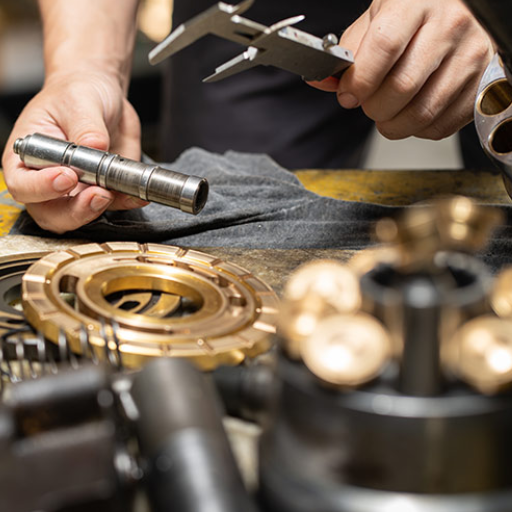
Marisol runs maintenance for a demolition contractor with 22 excavators and loaders. For months, she chased a repeating failure on one machine: the auxiliary circuit that fed a demolition grapple kept losing the main pump, and each replacement cost her a shift plus a premium-priced unit. When her team opened the circuit, they found an axial piston pump doing a job a fixed gear pump should have handled. The grapple ran at a steady load and moderate pressure, so the oversized variable pump spent most of its cycle near idle, ran hot, and failed young. They swapped in a Group 2 external gear pump rated near 210 bar and roughly 20 cc/rev at a fraction of the cost. Two seasons later, that circuit has not failed once.
That pattern repeats across nearly every industry that moves a machine with oil. The gear pump applications that dominate real fleets are not exotic. They are the auxiliary circuits, steering loops, implement systems, and power units where a simple, fixed-displacement pump is the most reliable and economical answer. This guide maps where hydraulic gear pumps are used by industry, with typical designs, pressures, and displacements, and shows you how to tell when a gear pump is the right call and when it is not.
Need to confirm whether a gear pump fits your machine? Start with our types of hydraulic pumps overview, then come back for the application-level detail below.
Where Are Hydraulic Gear Pumps Used?

A hydraulic gear pump is a positive-displacement pump that produces flow with two meshing gears. Because flow is fixed per revolution, it suits circuits that run at a steady speed and load, and it tolerates contamination better than vane or piston designs. Typical gear pump applications include:
- Excavator pilot, auxiliary, and attachment circuits
- Skid steer loader and compact machine implement functions
- Forklift and telehandler mast, tilt, and attachment circuits
- Tractor three-point hitch, steering, and remote valve systems
- Hydraulic power units (HPUs) for machine tools and presses
- Marine steering, winch, and deck machinery
- Lubrication, filter, and transfer circuits in industrial plants
Each of these places a different load on the pump. The sections below break them down by industry with the numbers that matter.
Two Different Jobs: Fluid Power vs Fluid Transfer
Before mapping applications, separate two jobs a gear pump can do. The distinction explains most buying mistakes.
Fluid power. The pump generates flow that moves a cylinder or motor, so the machine does mechanical work. Lifting a loader bucket, steering a tractor, or turning a winch are all fluid power. This is the LOYAL INDUSTRIAL focus and the core of this guide, because these applications set the real pressure, displacement, and duty requirements.
Fluid transfer. The pump moves or doses a liquid, such as lube oil, fuel, or a process fluid, without doing mechanical work. Internal gear pumps shine here because they handle high-viscosity fluids quietly and with steady, near-pulseless flow. These jobs matter for completeness, but they are not the same engineering decision as powering a machine.
Mixing the two is how an engineer ends up with an oversized axial pump on a grapple circuit, or a delicate process pump bolted into a dirty mobile system. Know which job your circuit is doing before you choose a pump family.
Why Gear Pumps Earn Their Place
Four traits explain why fixed-displacement gear pumps stay the most widely used pump family in fluid power.
Cost. A gear pump has few moving parts and simple housings, so it costs less to build, buy, and rebuild than vane or piston pumps of similar size.
Contamination tolerance. Gear pumps survive dirty oil better than close-clearance vane and piston designs. On mobile machines in the field or demolition work, where filtration is imperfect, that robustness prevents the failures that plague precision pumps. Industry experience attributes most hydraulic pump failures to contaminated oil, so a pump that copes with it has real value.
Simplicity and reliability. The drive gear and driven gear are the only main moving parts. Fewer parts mean fewer failure modes, easier service, and predictable long-term operation.
Compact power. For medium-pressure duty, a gear pump delivers good flow per unit of weight and volume. That suits machines with tight engine compartments.
Gear pumps also pair naturally with constant-speed engines, because output rises and falls with RPM. Where a machine runs at a reasonably steady engine speed, the fixed displacement is an advantage, not a limitation. For the full working-principle and specification picture, see our complete guide to hydraulic gear pumps.
Gear Pump Applications by Machine Class
The table maps common machine classes to the typical gear pump role, housing design, and working pressure. Use it as a fast reference before the detailed sections.
| Application | Gear pump role | Typical design | Working pressure | Typical displacement / flow |
|---|---|---|---|---|
| Excavator (auxiliary) | Pilot, attachment, charge | External, aluminum or cast iron | 180 to 250 bar | 5 to 20 cc/rev |
| Skid steer loader | Auxiliary / high-flow circuits | External, cast iron | 200 to 275 bar | 8 to 33 cc/rev |
| Mini-excavator, compact loader | Main or auxiliary implement | External | 180 to 250 bar | 10 to 50 cc/rev |
| Forklift, telehandler | Mast lift and tilt | External, cast iron | 150 to 200 bar | 8 to 33 cc/rev |
| Tractor | Hitch, steering, remotes | External | 180 to 200 bar | 30 to 100 L/min |
| Wheel loader | Steering, fan, auxiliary | External, cast iron | up to 250 bar | Group 3, 19 to 77 cc/rev |
| PTO truck / mixer hydraulics | Implement circuits | External, Group 3 | 250 bar | 19 to 87 cc/rev |
| Machine tool lubrication | Lube and coolant | Internal gear | low, tens of bar | continuous |
| Hydraulic power unit | Power generation | External | 100 to 210 bar | application-specific |
| Marine deck machinery | Steering, winch, aux | Internal or helical | moderate | application-specific |
Pressures are nominal working values and vary by machine size and manufacturer. The pattern matters more than any single row: external gear pumps handle most high-pressure hydraulic duty, while internal gear pumps carry the quiet, low-pressure, high-viscosity jobs.
Hydraulic Gear Pump Applications in Construction and Earthmoving
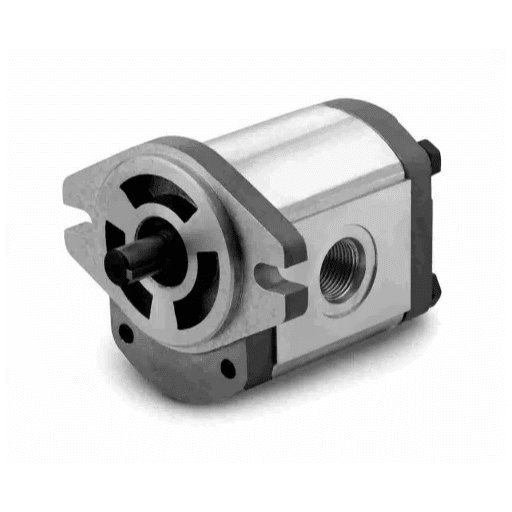
Construction equipment is the largest single home for the hydraulic gear pump. It shows up in three distinct roles, and matching the role matters.
Excavator Pilot, Auxiliary, and Attachment Circuits
A full-size excavator runs its main boom, arm, swing, and travel functions off axial piston pumps, but a small gear pump usually feeds the pilot system that shifts the main control valves, and another gear pump frequently supplies the auxiliary circuit for attachments. A 20-tonne excavator, for example, may run a Group 2 external gear pump around 10 to 20 cc/rev for attachments such as grapples and thumbs, at working pressures of 200 to 250 bar.
Because attachment flow is steady once a grapple or shear is engaged, a fixed-displacement gear pump is a natural fit. It is also far less expensive to replace than a piston pump, which matters when a machine spends its life on a demolition site. For a deeper look at the single-gear-pair design behind these circuits, read our external gear pump guide.
Skid Steer Loaders and Compact Machines
Many skid steer loaders and compact machines rely on cast-iron gear pumps for auxiliary and high-flow circuits, and in some classes for lift and tilt. Typical units sit in the 8 to 33 cc/rev range with working pressures from 200 to 275 bar and peaks near 300 bar. Manufacturers build these pumps specifically for compact equipment, where space is tight, and a housing failure is not an option. Cast-iron construction carries the higher pressure and handles the shock loads of bucket work better than an aluminum body.
Wheel Loaders, Concrete Mixers, and Road Equipment
Larger machines use gear pumps for steering, hydraulic cooling fans, and auxiliary functions, with the main traction and implement flow handled by other pump types. PTO-driven gear pumps are common on concrete mixers and truck-mounted equipment, where an engine power take-off spins a Group 3 external gear pump rated near 250 bar continuous with displacements from roughly 19 to 77 cc/rev, and sometimes larger. Bucher Hydraulics lists construction machinery among the core applications of its cast-iron AP external gear pump series, with continuous ratings that reach up to 300 bar on some models.
Hydraulic Gear Pump Applications in Agriculture
Agricultural machinery is a natural home for gear pumps because farm engines run at fairly constant speed and the cost pressure in farm equipment is severe.
Tractors
A tractor uses a gear pump for its three-point hitch, steering, and remote valve circuits. Working pressures commonly run 180 to 200 bar with flows from 30 to 100 L/min depending on the implement package. The fixed-displacement gear pump matches the steady engine speed well, and it survives the dusty, contaminated environment better than a precision pump. Tractor hydraulic systems have relied on gear pumps for decades, and the design family still dominates this segment across both mature and emerging farm markets.
Harvesters and Self-Propelled Implements
Combines and forage harvesters use gear pumps for auxiliary implement functions, steering, and header control, often alongside axial piston pumps on the highest-flow drives. On smaller self-propelled machines, a single gear pump can handle the whole hydraulic package. The value of contamination tolerance rises here, because crop dust and field debris challenge even well-sealed systems.
Hydraulic Gear Pump Applications in Material Handling and Lift Equipment
Forklifts and telehandlers are among the most gear-pump-intensive machines in any fleet, because their hydraulic duty is steady and cost matters.
Forklifts
An internal-combustion forklift typically uses a gear pump for mast lift, tilt, and attachment functions. Working pressure commonly runs 150 to 200 bar. On heavy-duty classes, manufacturers fit cast-iron gear pumps in the 8 to 33 cc/rev range, sized to sustain frequent lifting without overheating. The pump feeds a lift cylinder that raises and lowers constantly, so reliability and service cost dominate the choice.
Telehandlers and Aerial Platforms
Telehandlers combine lifting with reach, and their hydraulic systems supply boom, carriage, and steering circuits. Gear pumps handle the medium-pressure, steady-flow parts of the job, while load-sensing axial piston pumps appear where the boom needs variable, demand-matched flow. On smaller telehandlers and aerial work platforms, a gear pump is often the sole hydraulic source.
Mobile Off-Highway and Specialty Vehicles

Beyond the big three segments, gear pumps appear across forestry machines, municipal sweepers, garbage trucks, and dump trailers. These machines run in harsh conditions where a cast-iron gear pump rated to about 250 bar continuous, with peaks to 300 bar, gives dependable service at a sensible cost. PTO-driven gear pumps are the standard power source for many truck-mounted and trailer hydraulic systems, where the engine runs the pump only when the operator engages it.
Industrial Machinery and Hydraulic Power Units
Inside factories, gear pumps feed lubrication circuits, hydraulic power units, clamping systems, filter carts, and machine-tool hydraulics.
Lubrication is the classic low-pressure gear pump job. A machine tool needs a steady, continuous supply of oil to bearings and ways, often at only a few tens of bar. Internal gear pumps are favored there because they run quietly and deliver smooth flow for years without fuss. On general industrial HPUs, external gear pumps supply 100 to 210 bar circuits for presses, transfer lines, and clamping systems, where their low cost and ease of replacement keep plants running.
Marine and Offshore Hydraulics
Marine winches, steering gear, hatch covers, and deck machinery rely on gear pumps for auxiliary functions. Helical and internal gear designs are favored where low noise and low pulsation matter for crew comfort and precise control. Corrosion-resistant materials and sealing become important in the salt-air environment, but the operating principle is the same as on land.
Fluid-Transfer and High-Viscosity Duty
For completeness, internal gear pumps also move high-viscosity liquids across oil and gas, chemical, and food processing: lube oil, fuel, asphalt, resins, and syrups. Their wide internal clearances and smooth rotary action handle fluids far thicker than hydraulic oil, with dosing accuracy and near-pulseless flow. These transfer applications share the gear-pump engineering family with hydraulic duty, but they are a separate purchasing decision from powering a machine.
Internal vs External Gear Pumps: Matching Design to Application
Two design families cover nearly all gear pump duty, and the choice follows the application.
External gear pumps use two meshing gears, one driving the other. They are the default for hydraulic fluid power because they reach higher pressures, typically up to 250 to 280 bar and beyond in cast-iron high-pressure classes. If your job is moving a cylinder on a loader, a tractor, or a press, you almost always want an external gear pump.
Internal gear pumps use a larger ring gear driving a smaller internal rotor, with a crescent seal between them. They run quieter with less flow ripple and handle higher-viscosity fluids, but their pressure range is lower. They dominate machine-tool lubrication, engine oil systems, and transfer duty.
A second axis is housing material. Aluminum bodies keep weight and cost down for light mobile duty, while cast-iron bodies carry higher pressure and stand up to shock loads and contamination. A skid steer’s high-flow circuit, for example, earns a cast-iron pump; a weight-sensitive utility application can use aluminum. For the full design comparison, see our guide to the internal gear pump vs external differences.
When a Gear Pump Is the Wrong Choice
A gear pump is not always the answer. Recognize the boundaries so you do not force one into a job it cannot do.
Variable loads. If a circuit needs flow that rises and falls with demand to save fuel and heat, a variable-displacement piston pump matches the load better. A fixed gear pump delivers full flow whenever it turns.
Very high pressure. Sustained duty above roughly 280 to 300 bar pushes most gear pumps past their economical range. Axial piston pumps carry that duty.
Noise-sensitive, high-efficiency indoor systems. Vane pumps offer smoother, quieter operation where operator comfort and efficiency justify the higher cost. For a detailed comparison, see our gear pump vs vane pump guide.
The honest rule: choose a gear pump for steady, medium-pressure, cost-sensitive, or contaminated-duty circuits, and choose a variable pump when the load changes and efficiency pays. The gear pump is a workhorse, not a universal answer.
How to Match a Gear Pump to Your Application

Matching a gear pump to a machine comes down to six checks. Skip one, and you can buy the wrong unit.
- Required flow. Calculate the flow the cylinder or motor needs from its speed and area, then size displacement so that flow at your operating RPM meets it.
- Pressure class. Confirm the maximum pressure the circuit reaches, including spikes, and stay inside the pump rating.
- Housing material. Use cast iron for high pressure, shock loads, and dirty duty; aluminum where weight and cost dominate.
- Design family. Choose external for hydraulic power, internal for quiet or high-viscosity service.
- Mounting, shaft, and ports. Match SAE or ISO mounting, shaft type, and port threads to the existing system or the machine layout. See the SAE mounting and port standards guide for the interface details.
- Viscosity and filtration. Keep oil viscosity in the pump’s window and filtration at the recommended cleanliness level, because contamination is the leading cause of gear pump failure.
For the step-by-step math, including displacement and horsepower formulas with worked examples, read our guide on how to size a hydraulic gear pump.
Ready to source a gear pump for a specific application? Request a technical specification sheet from LOYAL INDUSTRIAL and our engineers will confirm the right displacement, pressure class, and mounting for your machine.
Hydraulic Gear Pump Applications FAQ
What is a gear pump used for?
A gear pump is used to generate steady hydraulic flow for machine functions such as loader buckets, forklift masts, tractor hitches, and steering, and to transfer viscous fluids such as lube oil and fuel.
Where are gear pumps used in industry?
Construction, agriculture, material handling, industrial machine tools, marine systems, and fluid-transfer plants. They are the most widely used pump family in fluid power.
Are gear pumps used in excavators?
Yes. Excavators commonly use a small gear pump for pilot control and another for auxiliary attachment circuits, while the main boom and travel functions run on axial piston pumps.
What is the difference between internal and external gear pumps?
External gear pumps use two meshing gears and reach higher pressures, suiting hydraulic power circuits. Internal gear pumps use a ring and rotor with a crescent and run quieter, with better high-viscosity handling at lower pressure.
What pressure can a gear pump handle?
Aluminum external gear pumps commonly rate near 210 to 250 bar, while cast-iron high-pressure classes reach 250 to 280 bar continuous and up to about 300 bar peak.
Why choose a gear pump over a piston pump?
Choose a gear pump for lower cost, contamination tolerance, and simplicity in steady, medium-pressure circuits. Choose a piston pump when you need variable flow or sustained very high pressure.
Conclusion
Gear pump applications span every corner of industrial fluid power: the excavator attachment circuit on a demolition site, the mast of a warehouse forklift, the three-point hitch of a field tractor, and the lubrication loop of a factory machine tool. In each one, the same logic applies. A fixed-displacement gear pump earns its place wherever the load is steady, the pressure is medium, the budget is real, and the oil is less than perfect.
The reliable result comes from matching the pump to the job. Confirm the flow, stay inside the pressure class, choose external or internal and aluminum or cast iron deliberately, and protect the oil. Do that, and a gear pump will run for years.
LOYAL INDUSTRIAL supplies hydraulic gear pumps for construction, agricultural, material handling, and industrial applications, with engineering support to match the unit to your machine and global export logistics for delivery. If you are specifying a new system or replacing a failed pump, contact us for a specification review to start a conversation about your application.