Both an internal gear pump and an external gear pump move fluid by meshing two gears, yet the two designs serve surprisingly different duties. Choose the wrong one, and you pay for it in noise, wasted energy, or an early failure on a machine that never runs cheaply.
Procurement engineers usually default to the external gear pump because it is everywhere in mobile hydraulics. The internal gear pump quietly wins the applications where noise, pulsation, and efficiency stability decide the specification. Understanding that split before you order is what this guide is for.
You will learn how each pump works, where they genuinely differ on pressure, noise, viscosity, and cost, and how to pick the right one for your circuit. We keep every claim tied to a number, because a pump decision made on data is a decision you will not have to make twice. For the full family overview, first start with our complete guide to hydraulic gear pumps.
What Is an Internal Gear Pump?

An internal gear pump is a rotary, positive displacement pump in which a smaller gear with external teeth rotates eccentrically inside a larger ring gear with internal teeth. A crescent-shaped separator fills the space between the two gears where they do not mesh, dividing the suction and discharge zones. A gerotor variant achieves the same job without a crescent.
Like every gear pump, it is a positive displacement pump with fixed displacement. Each revolution moves a set volume of fluid, so output flow tracks shaft speed, and system resistance creates the pressure. There is no internal adjustment that changes the swept volume.
Two features set the internal design apart from its external cousin. First, the fluid rides between the teeth of both gears, giving a longer sealing path and a smoother, lower-pulsation discharge. Second, the ring gear rotates inside the housing on an oil film, which damps noise and vibration instead of transmitting them.
The internal gear pump is not new technology. It has been a workhorse in lubrication, machine tools, and plastics machinery for decades, and hydraulic series from manufacturers such as Bosch Rexroth and Parker now push it well into high-pressure industrial duty. If you are weighing gear-type pumps against vane or piston units, our guide to the types of hydraulic pumps shows where each family fits.
How an Internal Gear Pump Works
An internal gear pump works by carrying fluid in the spaces between the teeth of two meshing gears as they rotate inside a housing, with a crescent sealing the low-pressure inlet from the high-pressure outlet. Teeth come out of mesh on the inlet side to draw fluid in, and re-enter mesh on the outlet side to push fluid out.
The drive gear is usually the smaller inner gear, and it turns the larger ring gear in the same direction. On the inlet side, the teeth separate, the tooth spaces grow, and the drop in pressure draws fluid in from the reservoir. The crescent sits between the two gears on the opposite side, filling the gap and forcing the fluid to travel through the tooth spaces rather than taking a shortcut across the pump center.
As the gears continue to rotate, the trapped fluid moves around both gears until the teeth begin to mesh again at the discharge side. That re-meshing shrinks the tooth spaces and positively displaces the fluid out under pressure. Because more teeth stay in contact at any instant than in an external gear pump, and because the ring gear floats on a lubricating oil film, the discharge is noticeably smoother.
The practical result is a pump that runs quietly, holds pressure with little internal leakage, and behaves well with higher-viscosity fluids. The trade-offs come later: a higher purchase price and, for standard designs, a speed ceiling below what an external gear pump will accept.
Gerotor vs Crescent: The Two Internal Gear Designs
When engineers talk about an internal gear pump, they usually mean one of two constructions: the crescent design or the gerotor. The difference matters because it decides pressure capability, cost, and the duty each pump can handle.
Crescent internal gear pump. This is the classic internal gear pump described above. The inner gear and outer ring gear differ in tooth count, and the crescent fills the space between them to seal the inlet from the outlet. The added sealing surface lets the crescent design reach higher pressures, which is why hydraulic series such as the Bosch Rexroth IPH hold up to about 315 bar continuously. It also handles higher-viscosity fluid well and produces very smooth flow.
Gerotor pump. A gerotor is an internal gear pump without a crescent. The inner rotor has one fewer tooth than the outer ring, and the two rotors stay in contact throughout rotation, so the teeth themselves form the moving seal. With only two main moving parts and no crescent, a gerotor is compact, inexpensive, and very quiet. Its sealing is weaker at high pressure, so gerotors dominate lower-pressure, clean duties such as engine oil pumps, charge pumps, and power-steering circuits.
| Attribute | Crescent Internal Gear Pump | Gerotor Pump |
|---|---|---|
| Separator | Crescent element seals inlet and outlet | No crescent; teeth stay in contact |
| Pressure range | Medium to high (hydraulic series to ~315 bar) | Low to medium (typically under ~200 bar) |
| Moving parts | Inner gear, ring gear, crescent | Inner rotor, outer rotor |
| Noise | Very low | Very low, compact package |
| Viscosity handling | Excellent, higher-viscosity fluids | Good, clean lower-viscosity oil |
| Cost | Higher | Lower |
| Typical duty | Machine tools, plastics, high-pressure hydraulic | Engine oil, charge, power steering, lube |
Do not assume every internal gear pump handles high pressure. The crescent design is the one with the sealing needed for industrial hydraulics; the gerotor is built for speed and simplicity at low pressure.
Internal Gear Pump vs External Gear Pump: Side-by-Side Comparison

The external gear pump uses two identical gears mounted side by side, their teeth meshing in the center, with fluid carried around the outside of both gears. It is the design behind most mobile and industrial auxiliary circuits. Here is how the two families compare across the attributes that drive a specification.
| Attribute | External Gear Pump | Internal Gear Pump |
|---|---|---|
| Gear arrangement | Two external gears, side by side | Inner gear inside a ring gear |
| Continuous pressure | Up to ~250 bar (peaks ~280-300 bar) | Hydraulic crescent series to ~315 bar; gerotor lower |
| Noise level | Moderate | Lower by roughly 8 to 10 dBA |
| Flow pulsation | Moderate | Low, smooth discharge |
| Viscosity handling | Up to about 300 cSt | Up to about 2,200 cSt in hydraulic series |
| Volumetric efficiency | ~90-95% when new, declines with wear | High and stable over life with gap compensation |
| Best speed range | High speeds | Low to moderate speeds |
| Rotating elements | Two shafts, four journal bushes | Inner gear and ring gear, fewer loaded surfaces |
| Relative cost | Lower, widely interchangeable | Higher, more specialized |
| Typical use | Mobile hydraulics, auxiliary circuits | Noise-sensitive industrial, high-viscosity, precision |
Two numbers capture the personality difference. On noise, an equivalent internal gear pump typically runs 8 to 10 dBA quieter than an external unit, which is roughly a halving of perceived loudness. On viscosity, internal designs handle fluid up to about 2,200 cSt in hydraulic service, while a typical external gear pump suits oil up to about 300 cSt. For a deeper breakdown of the external design, our guide to the external gear pump working principle and design covers its construction, components, and specifications.
Noise, Pulsation, and Efficiency
Noise and pulsation are where the internal gear pump earns its premium. The reasons are mechanical, not marketing. More teeth are in contact at any moment, so each tooth-meshing pulse is smaller. The ring gear also rotates inside the housing on a film of oil, which damps vibration instead of transmitting it to the case.
The difference is measurable. Internal gear pumps commonly run 8 to 10 dBA quieter than an equivalent external gear pump at the same duty point, and manufacturers of low-pulsation internal units claim reductions in delivery-flow ripple of up to 85 percent versus traditional external pumps. That smoothness extends the life of downstream valves, seals, and hoses, which is why internal gear pumps appear in measurement circuits and fine machine tools.
Efficiency tells an even more interesting story. When both pumps are new, volumetric efficiency is similar, often 90 to 95 percent at rated conditions. The difference appears over time.
An external gear pump has fixed clearances and no way to compensate for wear, so as the gears and bushes wear, internal slip rises and efficiency slowly declines. Many internal gear pumps use pressure-loaded or gap-compensated sealing that keeps clearances tight as the pump wears, holding efficiency across the life of the unit.
A university test program illustrates how internal leakage differs. At 200 bar and 40 C, an external pump around 8 cc/rev leaked about 0.98 liters per minute internally, while a comparable internal gear pump leaked about 0.40 liters per minute. In a pressure-hold test, the external unit reached its temperature limit after a few minutes, while the internal unit held pressure with far lower thermal loss. Treat these as indicative single-design results rather than universal ratings, but they show the direction of the difference under load.
Pressure, Viscosity, and Speed
Continuous pressure capability depends less on the gear family than on how each design is built. A standard external gear pump runs to about 250 bar continuous in common sizes, with peaks near 280 to 300 bar, and pressure derates as displacement grows because the pressure difference loads the bearings unevenly.
Internal gear pumps cover a wider spread. High-pressure crescent designs, such as the Bosch Rexroth IPH series, reach about 315 bar continuous, and gap-compensated high-pressure internal units extend toward 300 bar continuous with higher intermittent peaks. Standard internal pumps without compensation stay at lower pressure, and gerotors are lower-pressure machines by design. In short, an internal gear pump can be either a 315 bar hydraulic workhorse or a modest lubrication pump; the construction decides.
Viscosity is where internal gear pumps hold an unambiguous advantage. The longer sealing path and larger clearances let a crescent internal pump move fluid up to roughly 2,200 cSt in hydraulic service, against about 300 cSt for a typical external hydraulic gear pump. This is why internal gear pumps are standard for lubrication circuits, engine oil, and viscous process fluids. When the oil is cold and thick, the internal design keeps its volumetric efficiency at low speed; an external pump at the same speed would leak more and deliver less.
Speed runs in the other direction. External gear pumps accept higher maximum speeds, which suits engine- and PTO-driven mobile circuits where space is tight and speed is fixed. Internal gear pumps are happiest at low to moderate speed, where their efficiency and low pulsation show up best.
If your duty is a 3,600 RPM auxiliary circuit on a loader, external makes sense. If it is a 1,200 RPM precision hydraulic system in a plant, internal may serve better.
Applications: Where Each Gear Pump Belongs
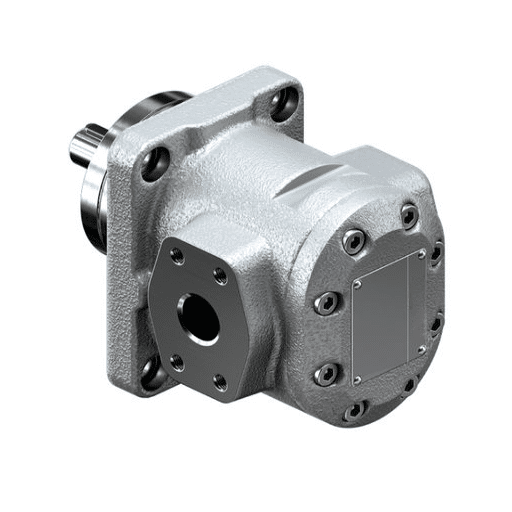
Application is the fastest route to the right decision. External gear pumps dominate where cost, speed, and compactness matter most, while internal gear pumps win where quiet, smooth, efficient operation under viscous or high-pressure industrial conditions justifies the higher price.
| Application | Typical Pump Choice | Why |
|---|---|---|
| Excavator and loader auxiliary circuits | External | Compact, low cost, high speed |
| Tractor implement circuits | External | High PTO speeds, contamination tolerant |
| Hydraulic power units (general) | External | Simple constant-flow supply |
| Machine tool clamping and lube | Internal | Low noise and pulsation near operators |
| Plastics and injection molding | Internal | Quiet, smooth, high-pressure capability |
| Industrial presses | Internal | Low noise, holds pressure with low leakage |
| Engine oil and charge pumps | Gerotor | Compact, quiet, low pressure |
| High-viscosity lubrication and transfer | Internal | Handles thick fluid at low speed |
Indoor plant work is the classic internal gear pump territory. A machine tool builder choosing between the two families will pick an internal unit for a clamping circuit beside an operator, because cutting 8 to 10 dBA avoids soundproofing walls and reduces fatigue on the floor. That same low pulsation protects precision components from pressure ripple.
Decision Matrix: Choosing Between Internal and External Gear Pumps
Use this checklist when a decision is on your desk. Score each factor for your duty, then follow the lean.
| Selection Factor | Choose External | Choose Internal |
|---|---|---|
| Budget-constrained procurement | Yes | Only if noise or efficiency pays back |
| Noise limit near operators | No | Yes |
| High operating speed available | Yes | Only for low-pressure duties |
| High-viscosity or cold-start fluid | No | Yes |
| Need to hold pressure with low leakage | No | Yes |
| Long-term efficiency stability matters | No | Yes |
| Simple replacement with wide interchange | Yes | Check rebuild sources first |
| High continuous pressure in a mobile package | Yes | Only high-pressure crescent series |
A machine designer at a packaging line learned this the hard way. She sized an external gear pump for a new press circuit because it was cheaper and in stock, then spent a week fighting pulsation that shook a precision sensor mount and drew complaints about noise from the production floor. Replacing it with an internal gear pump of the same displacement removed the vibration and cut measured noise by about 9 dBA. The extra purchase cost was recovered in avoided rework and lost production, not in energy savings.
Cost, Maintenance, and Sourcing

Purchase cost still favors the external gear pump, and so does parts availability. External pumps are made in enormous volumes, are simple to rebuild, and interchange across brands using standard SAE and ISO mountings. If uptime is your only priority and the duty is a normal mobile or industrial circuit, external is the pragmatic default.
Internal gear pumps cost more upfront and need more careful sourcing, but they can cost less to own in the right application. Fewer heavily loaded wetted surfaces mean less wear, compensated designs hold efficiency, and the quiet, smooth operation can eliminate soundproofing and reduce strain on the whole circuit. Maintenance is still simple, but you should confirm that seal kits, wear plates, and rebuild parts are available for the specific series before you commit.
Both families are positive displacement gear pumps, so the same operating rules apply. Keep the oil clean, use the correct viscosity, protect the pump with a relief valve, and feed the inlet properly. Contamination remains the leading cause of gear pump failure. High-pressure compensated internal pumps need clean oil, typically to an ISO 4406 cleanliness target, because the gap-compensation surfaces depend on tight clearances.
A maintenance supervisor for a hydraulic press fleet saw this after switching to internal gear pumps: the pumps ran cooler and quieter, but only after he upgraded filtration to keep the fine clearances clean.
Sourcing deserves as much care as the design choice. A cross-reference that matches displacement, mounting, shaft, and rotation will usually bolt in, but documented quality decides how long the pump lasts. Look for a supplier with multi-stage inspection, pressure and leak testing before shipment, and clear specifications rather than vague claims.
Factory-direct sourcing removes distributor markup, and it pays off when the manufacturer backs the order with real test data. LOYAL INDUSTRIAL PTE. LTD. supplies tested internal and external gear pumps and hydraulic components with OEM customization, global export packaging, and technical specification sheets available on request.
Internal Gear Pump vs External Gear Pump FAQ
What is the difference between an internal and external gear pump?
An external gear pump uses two gears side by side that mesh in the center. An internal gear pump has an inner gear rotating inside a larger ring gear, often with a crescent separator. The internal design runs quieter, handles higher-viscosity fluid, and holds pressure with less leakage; the external design is cheaper and more compact.
Which is better, an internal or external gear pump?
Neither is better overall. Choose an external gear pump for low-cost, high-speed, medium-pressure mobile and industrial circuits. Choose an internal gear pump when you need quieter operation, lower pulsation, high-viscosity handling, or efficiency that stays stable over the life of the pump.
Why are internal gear pumps quieter?
More teeth stay in contact at any instant, so each meshing pulse is smaller, and the ring gear rotates on an oil film that damps vibration. Internal gear pumps commonly run 8 to 10 dBA quieter than equivalent external units.
Are internal gear pumps more efficient?
Both reach roughly 90 to 95 percent volumetric efficiency when new. Internal gear pumps with gap compensation hold that efficiency as they wear, while external gear pumps with fixed clearances slowly lose efficiency through increased internal slip.
What is an internal gear pump used for?
Internal gear pumps serve machine tools, plastics and injection molding machinery, industrial presses, lubrication systems, engine oil and charge pumps, and high-viscosity transfer. High-pressure crescent series also handle general industrial hydraulics where low noise matters.
What pressure can an internal gear pump handle?
High-pressure crescent designs reach about 315 bar continuous in hydraulic series, with compensated units going higher intermittently. Standard internal pumps stay at moderate pressure, and gerotors are low-pressure machines by design.
What is the difference between a gerotor and a crescent internal gear pump?
A crescent pump uses a crescent separator to seal the inlet from the outlet, which supports higher pressure. A gerotor has no crescent; the rotors stay in contact and form the seal, making it cheaper and more compact but limited to lower pressure.
Can an internal gear pump handle higher viscosity than an external gear pump?
Yes. Internal gear pumps handle fluid up to about 2,200 cSt in hydraulic service, while a typical external hydraulic gear pump suits oil up to about 300 cSt.
Conclusion
The internal gear pump and the external gear pump are both positive displacement machines, but they are engineered for different jobs. External gear pumps win on price, speed, compactness, and easy interchange, which is why they fill most mobile and cost-sensitive circuits. Internal gear pumps win on noise, pulsation, viscosity handling, and efficiency that holds up over time, which is why they dominate noise-sensitive and high-viscosity industrial applications.
Start your decision with the duty, not the pump. Define the flow, the working pressure, the oil viscosity, the speed, and the noise limit, then match those numbers to the table above. When efficiency, quiet operation, or thick fluid matters more than the upfront price, an internal gear pump is worth the premium. When a simple, rugged, replaceable pump is the safer bet, the external design rarely disappoints.
If you are specifying either family for a machine or replacing a failed unit, request a technical specification sheet from LOYAL INDUSTRIAL PTE. LTD. and let our engineers confirm the right internal or external gear pump for your circuit. Contact us for an industrial solution consultation or a customized hydraulic system recommendation.