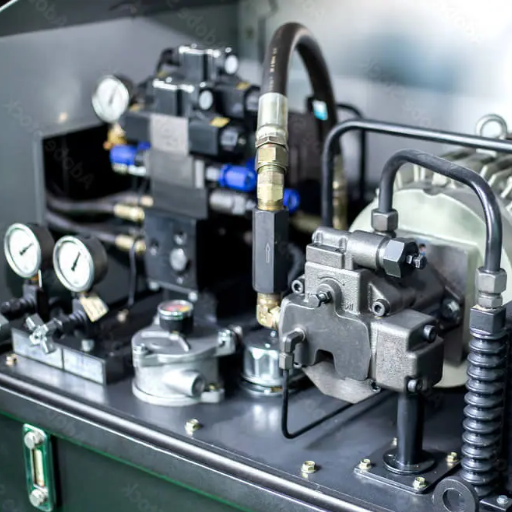
A triple vane pump model code is three pumps’ numbers in one string. It tells you the frame combination, the displacement of each of the three sections, the shaft, the rotation, the port positions, and the seal class, read in a fixed order: shaft end first, then the middle, then the cover end. Each brand spells those fields differently, and each brand counts displacement in its own units, which is why a Denison code 052, a Vickers code 17 and a Tokimec code 60 are not the same kind of number.
A maintenance lead at an injection molding plant learned this the hard way in March. He photographed only the base model, T6EDCoff a failed unit and sent it to three suppliers. Two quotes came back with a D-frame middle section near 158 ml/rev. The pump on the machine needed code014, roughly a third of that. Four production days disappeared while the wrong unit went back.
You will not need four days. This guide gives you a nameplate photo checklist, one worked example each for Denison/Parker, Vickers/Eaton and Tokimec triples, and the unit trap that catches most buyers. For how a triple’s three sections are rated and tested, see the triple vane pump guide.
Key Takeaways
- A triple code carries three displacement fields, always ordered shaft end, middle, cover end.
- The three major brands encode displacement three different ways: Denison and Tokimec use lookup codes that convert to ml/rev through a table, while Vickers capacity codes are nominal US gpm at 1,200 rpm.
- Rotation is meaningless without its viewing reference: Denison reads it from the shaft end, Tokimec from the shaft side, and some Vickers documents from the cover end.
- The base model (
T6EDC,2520VQSV10,SQP432) names three section sizes and nothing else. Two triples can share a base model and share no displacements at all.
What to photograph on the nameplate
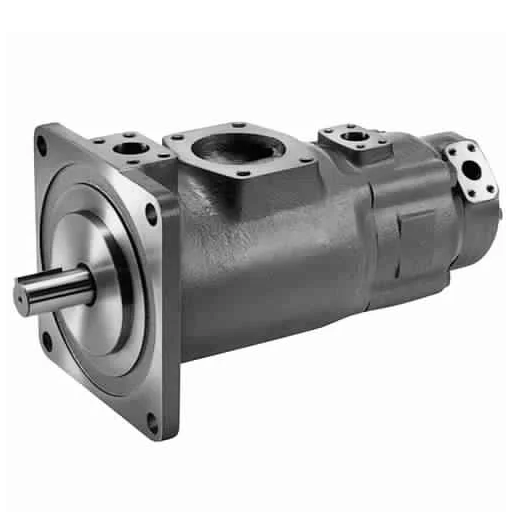
Before you decode a triple vane pump model code, capture the plate properly. A complete photo set is the difference between a quote in one hour and a week of email.
- The full stamped model string, including all three displacement groups. Cropping to the base model is the most common mistake in this article’s comment threads and forums.
- The serial number. It pins the build revision when two vendor tables disagree.
- The shaft type or shaft code. Keyed, splined, and non-SAE shafts are not interchangeable.
- Rotation, with the viewing reference. Note whether the observer stands at the shaft end or the cover end. “CW” alone is ambiguous.
- Port positions for each outlet, and which port is the inlet.
- The mounting flange, so the replacement matches the bolt pattern as well as the hydraulics.
One more field appears on Vickers tags and confuses people: the assembly number, in the form 02-466318-L. That is a part number, not a model code, and it identifies a built unit rather than a configuration. How a vane pump cross-reference verifies fit covers assembly numbers and equivalence checks; this article stays on the stamped configuration string.
Have a code in hand but not sure of the three displacements? Request a triple vane pump configuration recommendation and attach the photo set above. A complete plate removes most of the guesswork.
The common structure of any triple vane pump model code
Every triple string on the market follows the same five-group skeleton, even when the spelling differs:
| Group | What it carries | Example (Denison / Vickers / Tokimec) |
|---|---|---|
| 1. Frame and sections | Series prefix plus three section sizes, shaft end first | T6 + DCC / 3525VQSV10 / SQP432 |
| 2–4. Three displacement codes | One per section, stack order, shaft end first | 038-014-012 / 30-14-5 / 60-35-17 |
| 5. Shared hardware | Shaft, rotation, port positions, design, seal class | 3R04-A101 / 1AA22R / 86CC-RH-18 |
Three rules cover most of what follows:
- The prefix says how many sections there are and what size class each one is. Three letters or three frame digits mean three sections. Two-section units follow the same reading order with two fields; double vane pump codes are the two-field case.
- Displacement fields are always ordered shaft end to cover end, never by size. A larger number does not belong to a different end.
- Everything after the displacement fields is shared hardware, and it is exactly where vendor tables start to disagree. When two tables conflict, the OEM catalog for your exact series wins.
Denison and Parker triples: T6DCC, T6EDC, T67DCB
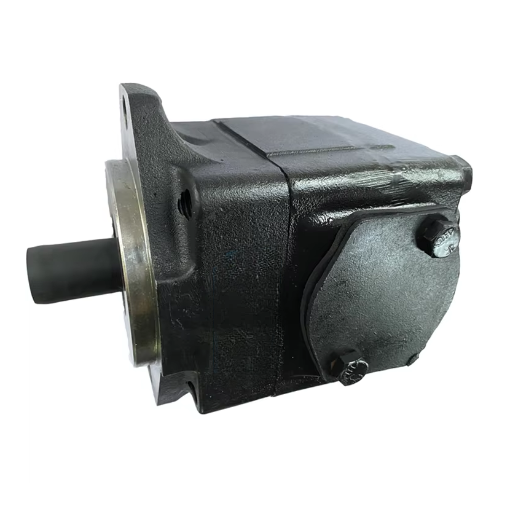
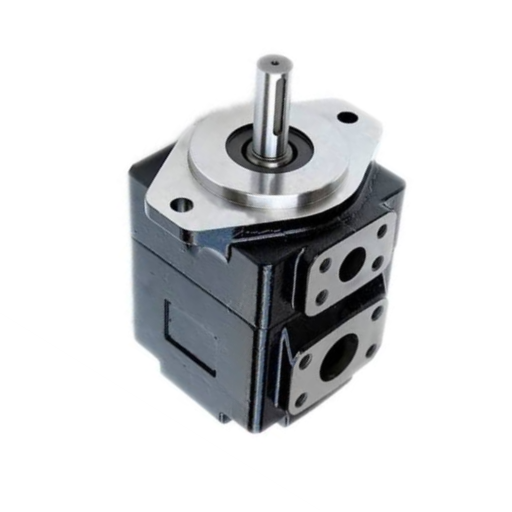
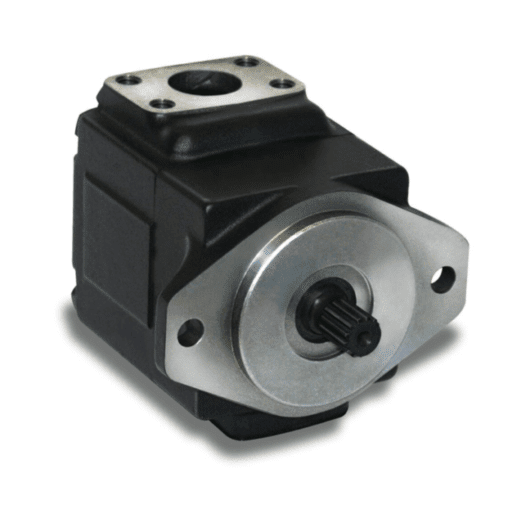
What does T6EDC mean? It is a Denison T6 series triple built from three section size classes: E at the shaft end, D in the middle, and C at the cover end. The letters are cartridge size classes, not quality grades, and they are always read shaft end first.
Take a full string apart, using T6DCC-038-014-012-3R04-A101 as the worked example:
| Field | Value | Meaning |
|---|---|---|
| Frame | T6 |
Denison T6 series. T67 and T7 triples use the same field order |
| Section sizes | D-C-C |
Three size classes, shaft end first |
| Displacement 1 | 038 |
Shaft-end section, lookup code |
| Displacement 2 | 014 |
Middle section, lookup code |
| Displacement 3 | 012 |
Cover-end section, lookup code |
| Shaft | 3 |
Splined shaft, SAE. (1 keyed SAE, 2 keyed non-SAE, 4 splined non-SAE, T splined J718c) |
| Rotation | R |
Viewed from the shaft end |
| Port positions | 04 |
Outlet position group for the stack |
| Trailing group | A101 |
Design, seal class and port size |
The displacement codes are lookup codes, not literal millilitres per revolution. On the E frame, code 052 is 164.8 ml/rev, not 52. The same table runs 042 = 132.3, 045 = 142.4, 050 = 158.5, 057 = 179.8, 062 = 196.7, 066 = 213.3, 072 = 227.1 and 085 = 269.0 ml/rev. Section letters span ranges rather than fixed values: B about 5.8 to 50, C 10.8 to 98.3, D 47.6 to 158.5 and E 132.3 to 269.0 ml/rev across the family.
Two cautions. Vendor tables disagree at the margins: 031 appears as both 98.3 ml/rev and “100 ml/rev”, and seal-class letters are rendered as 1/4/5 in one table and A1/C1 in another. Trailing groups vary too: some strings split A101 differently, and port codes outside the standard 00 to 03 set (opposite inlet, inline, 90° CCW, 90° CW) appear in the wild. Confirm the suffix against Parker’s T6*R catalog (HY29-0027-UK) before you order. Per-port ratings for these frames live in the triple vane pump guide.
Vickers vane pump model codes: 2520VQSV10 triples explained
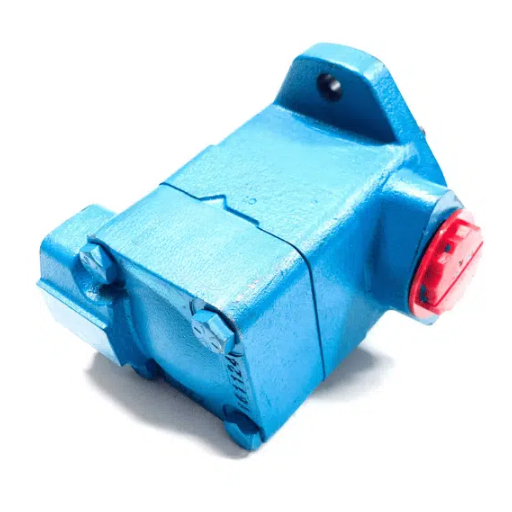
What does 2520VQSV10 mean? It stacks a 25-frame VQ section at the shaft end, a 20-frame VQ section in the middle, and a V10 section at the cover end: three pumps, one string. The frame digits are size classes; the numbers that follow them are capacity codes.
The capacity codes are where Vickers diverges from Denison. They are nominal US gallons per minute at 1,200 rpm, not ml/rev. Danfoss, which now carries the Vickers vane line, publishes the basis directly on its product pages: a 2520VQS17C8 unit carries capacity code 17 on the shaft-end section and 8 on the cover-end section, with the rest of the string giving shaft 297 (13T, 16/32 side fit), rotation L read from the shaft end, outlet position BC read from the cover end, design 20 and SAE flange and port codes.
A triple adds a third capacity code. In 3525VQSV10-30-14-5A-1AA22R:
| Field | Value | Meaning |
|---|---|---|
| Frames | 35-25 + V10 |
35VQ shaft end, 25VQ middle, V10 cover end |
| Capacity 1 | 30 |
Shaft-end section, nominal gpm at 1,200 rpm |
| Capacity 2 | 14 |
Middle section, same basis |
| Capacity 3 | 5 |
Cover-end section, same basis |
| Ports / mount / shaft | A-1-AA |
Port style, mounting flange, shaft type |
| Design / rotation | 22-R |
Design number, rotation |
Two warnings. Vendor pages publish two string shapes for triples: capacity codes embedded in the frame block (2520VQS17C8 style), or set off after a hyphen. Rotation and outlet-position letters are read from the cover end on some documents and the shaft end on others. The current Eaton or Danfoss catalog for your series settles both. Kit numbering runsM-249x-S; the cartridge kit guide covers contents and procedure.
Tokimec SQP triples: SQP321, SQP431, SQP432
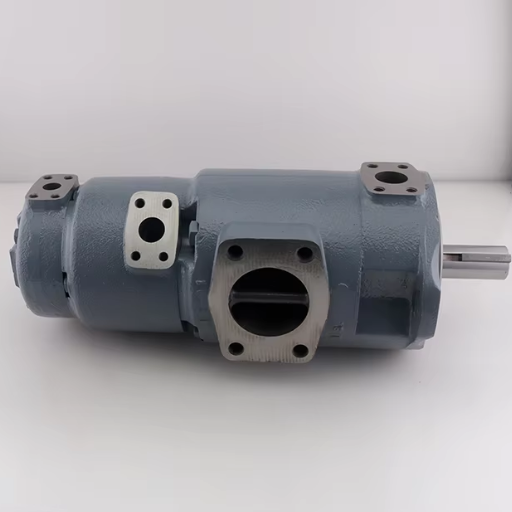
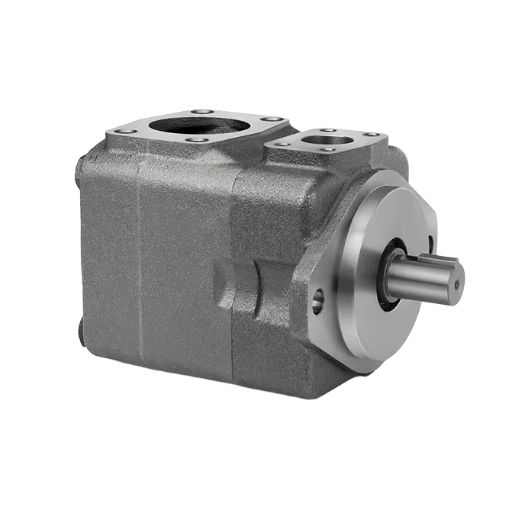
What does SQP432 mean? The middle digits are frame sizes, stacked shaft end first: frame 4 at the shaft end, frame 3 in the middle, frame 2 at the cover end. SQP321, SQP421, SQP431 and SQP211 follow the same logic.
The Tokimec ordering code is the best documented of the three, because the structure is laid out field by field in the Tokimec bladed pump manual (b2022). For a triple:
| Field order | Carries | Values |
|---|---|---|
| Stage 1 capacity (shaft side) | Displacement symbol | SQP4: 30, 35, 38, 42, 50, 60; SQP3: 17 to 38; SQP2: 10 to 21 |
| Stage 2 capacity | Displacement symbol | Same set for the matching frame |
| Stage 3 capacity (cover side) | Displacement symbol | Same set for the matching frame |
| Shaft | Shaft code | 86 = square-key parallel shaft |
| Outlet positions (per stage) | Port letters, read from the cover side | A opposite inlet, B 90° CCW, C inline, D 90° CW |
| Mounting | Flange or foot | Blank = flange, 2 prefix = foot |
| Rotation | Read from the shaft side | Blank = RH (clockwise); vendor strings often write RH/LH explicitly |
A full vendor-style string reads SQP432-60-35-17-86CC-RH-18: frame 4/3/2 stack, capacity symbols 60, 35 and 17 in shaft-end order, shaft 86, outlet positions CC, rotation RH from the shaft side, design 18. The manual’s own worked example SQP432-60-38-14confirms the same three-capacity order and uses it to size drive torque.
Those capacity symbols are lookup codes too: SQP4-60 is 189.0 ml/rev, with 50 at 156.0, 42 at 134.0, 38 at 128.0, 35 at 109.0 and 30 at 96.0 ml/rev; on the SQP2 frame, symbol 10 starts at 32.5 ml/rev and 21 reaches 65.0. Vendor strings publish format variants (C-C-C for CC, (LH)-18 for RH-18) and seal-fluid prefixes (F11- water-glycol, F3- phosphate ester). Check the exact string against b2022 before treating a variant as canonical. Kit numbering starts C-KIT-; the cartridge kit guide covers it.
Four mistakes when reading a triple vane pump model code
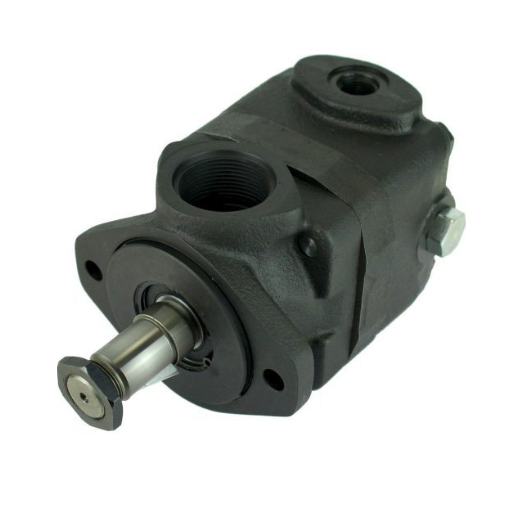
- Reading the displacement fields right to left, or by size. Stack order is shaft end first on all three brands. Sorting the numbers by magnitude tells you nothing about which section they belong to, and the section determines the cartridge, the port, and the circuit.
- Comparing a Vickers gpm code with a Denison or Tokimec ml/rev code as if they were one scale. A Vickers
17is nominal gpm at 1,200 rpm; a Tokimec17is an SQP2 capacity symbol that converts to 52.5 ml/rev; a Denison052on the E frame is 164.8 ml/rev. Three families, three unit systems, zero direct comparison. - Treating section letters as a performance grade.
Eis not better thanC; it is a larger size class with a different displacement range. Specifying “E frame” without the three displacement codes specifies almost nothing. - Ordering from the base model alone.
T6EDC,2520VQSV10andSQP432each describe three section sizes and a frame stack. Two triples that share a base can share no displacements, no shaft, and no rotation. The base model is the start of the string, not the order.
When vendor tables disagree, the OEM catalog decides: Parker’s HY29 for T6/T67/T7, the current Eaton or Danfoss V-series document for Vickers, Tokimec b2022 for SQP. For whether a replacement actually fits, the cross-reference method applies as it does to singles and tandems.
Ready to check a code against a real configuration? Send the full string, the three displacement fields, and the rotation with its viewing reference, and we will map them section by section. Request a triple vane pump configuration recommendation.
Frequently asked questions
What does T6EDC mean on a triple vane pump?
A Denison T6 series triple with three section size classes in stack order: E at the shaft end, D in the middle, C at the cover end. The letters are size classes, and the actual displacements come from the three numeric codes that follow the letters in the full string.
How do I know which displacement code is which section?
Read left to right from the shaft end: first code is the shaft-end section, second is the middle, third is the cover end. All three brands in this article use that order. Rotation, port letters, and kit numbers all depend on getting it right.
Are Vickers and Denison displacement codes the same scale?
No. Vickers capacity codes are nominal US gpm at 1,200 rpm. Denison codes convert to ml/rev through a catalog lookup table, and Tokimec capacity symbols do the same through Tokimec’s own table. Never compare the raw digits across brands.
What is the difference between the model code and the assembly number?
The model code (for example T6DCC-038-014-012-3R04-A101) describes a configuration: frames, displacements, shaft, rotation, ports. An assembly number (for example 02-466318-L) identifies one built unit as a part. Quoting an assembly number can pin down an existing build; quoting a model code lets a supplier build to spec.
What should I send a supplier to get the right triple quoted?
The full stamped string including all three displacement groups, the serial number, shaft type, rotation with viewing reference, port positions, mounting flange, and your duty pressures per port. That set is the photo checklist at the top of this article, plus the pressure figures.
Conclusion
A triple vane pump model code is three displacement fields in stack order, wrapped in a brand-specific spelling of frames, shaft, rotation, ports, and seals. Read it shaft end first, convert the displacement codes through the right brand’s table, and check rotation against its viewing reference. When vendor tables conflict, the OEM catalog decides.
The next step is a photograph: the full stamped string, the serial plate, the shaft, and the ports in one frame. With that set in hand, request a triple vane pump configuration recommendation and include the three displacement codes, the rotation with its viewing reference, and the duty pressure at each outlet. We will confirm the section sizes against the catalog and tell you which configuration the nameplate actually describes.