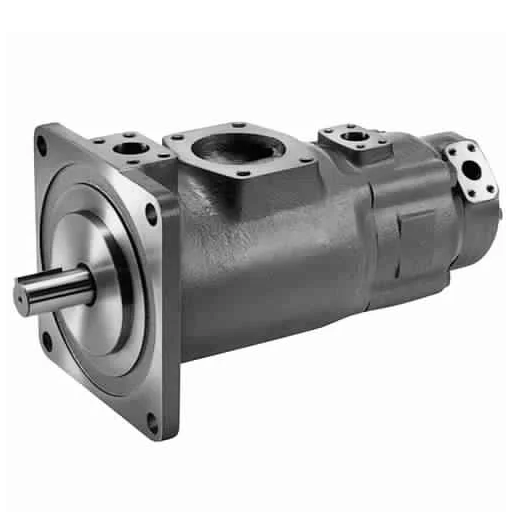
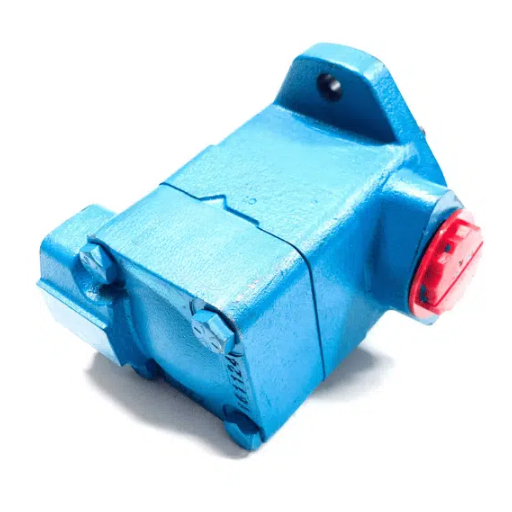
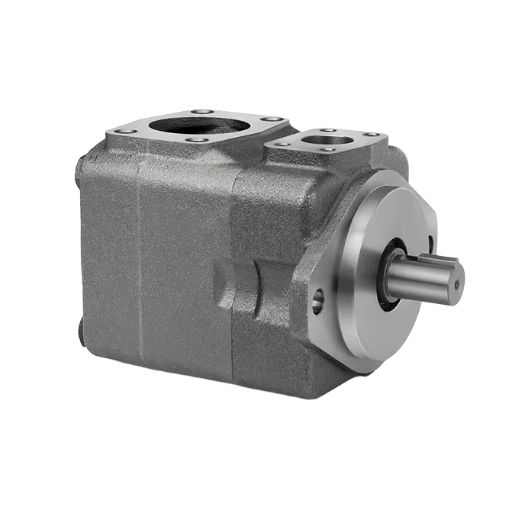
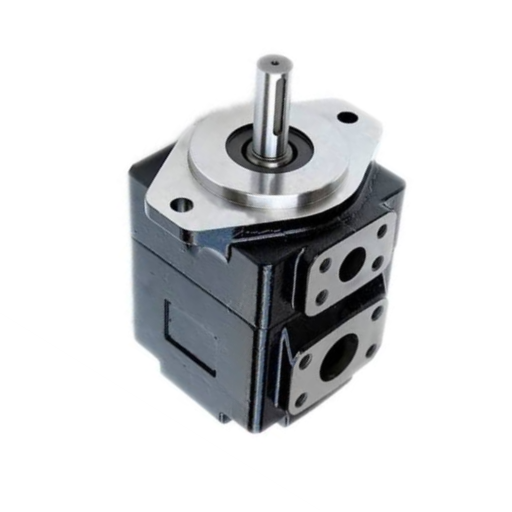
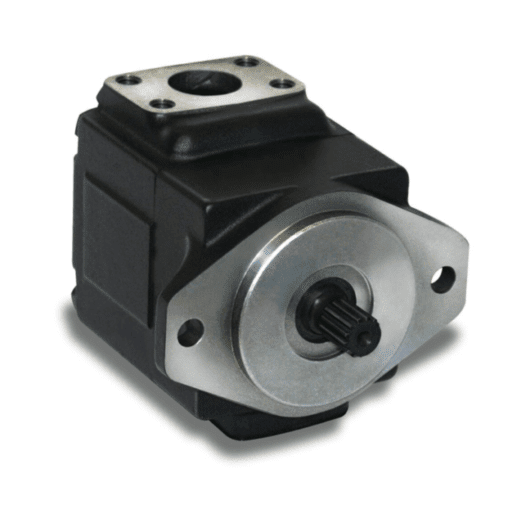
A Vickers triple vane pump built as a VQ + V10 stack is three cartridges on one shaft. In a code such as2520VQSV10, the first pair of digits is the shaft-end section (25VQ), the second pair is the centre section (20VQ), and V10 is the cover-end section. The capacity codes after the base give displacement for each section in that same order.
Why do so many listings call all three circuits 210 bar? Because sellers copy the VQ headline figure across the whole unit. The stack has two pressure classes under one cover, and the section that sets the ceiling is not always the one at the cover end.
If you have a failed unit and a nameplate photo, this guide lets you read the string, find which section limits your pressure, and order the right cartridge or service document. Scope: Vickers/Eaton VQ + V10 triples only, not V20 singles, V2010/V2020 doubles or VMQ3 triples. It isn’t a substitute for the Eaton/Danfoss sheet for your serial number. For the general concept, the triple vane pump guide explains section isolation and derating.
Key Takeaways
- A VQ + V10 triple is a three-cartridge stack: two VQ sections plus one V10 cover-end section on a common shaft.
- The base reads shaft end first:
2520VQSV10is 25VQ + 20VQ + V10, and the capacity codes follow in the same order.- The V10 section is rated 172 bar (codes 1 to 5), 152 bar (code 6) or 138 bar (code 7), below the 210 bar that distributor tables list for the 20VQ, 25VQ and 35VQ sections. A derated 20VQ code can sit lower still.
- The two VQ sections take VQ cartridge kits; the V10 section takes V10 parts. Three cartridges, two kit families.
What is a Vickers triple vane pump?
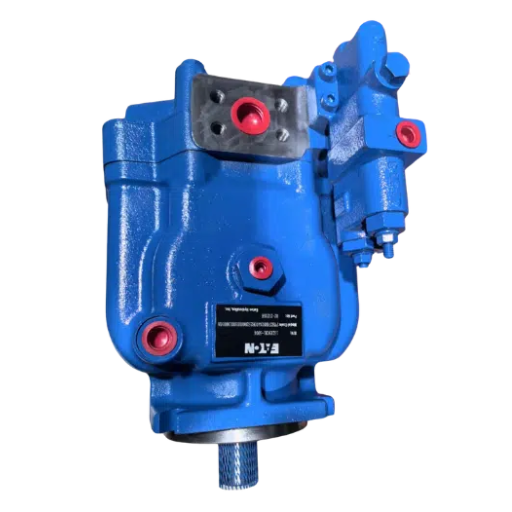
A Vickers VQ + V10 triple is a three-section vane pump with two VQ cartridges and one V10 cartridge mounted on a common shaft. One drive turns three independent pumping sections, and each section has its own outlet and its own pressure limit.
A Vickers triple vane pump is often described as “a VQ double with a V10 added”. That’s true of the hardware and misleading about the build. The sections are assembled as one factory stack in a fixed order, shaft end first and cover end last, with the V10 at the cover end. The shaft passes through all three cartridges.
The build families that appear in OEM and distributor tables are:
- 2520VQSV10
- 3520VQSV10
- 3525VQSV10
- 4520VQSV10
- 4525VQSV10
- 4535VQSV10
That list is what the sources reviewed show, not a guarantee that every family is current. One major distributor lists five of the six and omits the 4520, while a Vickers service document titled for the 4520 exists. Treat the 4520 as real but less common, and read any unlisted family by the same rules.
What is not a triple
The V20 is a single pump, and the V2010 and V2020 are doubles. No V20 triple appears in the OEM catalog or in the distributor and aftermarket sources reviewed; when a listing calls a V20 “triple”, read the whole string. The V series is the industrial 12-vane design, while VQ is the mobile 10-vane design, built for higher speed in a smaller envelope, so a VQSV10 triple carries VQ speed and service-part characteristics in its first two sections.
Vickers is Eaton’s vane pump line, and Danfoss now publishes the Vickers vane pump data. That handover is why both names appear on the sheets cited in this guide.
How to read a VQSV10 model code
The base names the frames. The digits after the base name the capacity of each section. For a Vickers VQSV10 triple such as 2520VQSV10-10-4-2:
| Field | Value | Meaning |
|---|---|---|
| Shaft-end frame | 25 | 25VQ section |
| Centre frame | 20 | 20VQ section |
| Cover-end section | V10 | V10 cartridge |
| Shaft-end capacity code | 10 | 25VQ code 10, nominal 10 gpm, 32.0 cc/rev |
| Centre capacity code | 4 | 20VQ code 4, nominal 4 gpm, 13.1 cc/rev |
| Cover-end capacity code | 2 | V10 code 2, nominal 2 gpm, 6.6 cc/rev |
| Nominal total | 16 gpm | 51.7 cc/rev geometric total |
The arithmetic is simple once the codes are converted: 32.0 + 13.1 + 6.6 = 51.7 cc/rev, which vendor tables round to 52. Call it nominal. Flow is not the sum at every speed, because volumetric efficiency differs by section, so size each circuit on its own curve.
A second example shows a larger stack. 3525VQSV10-30-14-5 is a 35VQ shaft-end section at code 30 (nominal 30 gpm, 97.7 cc/rev), a 25VQ centre section at code 14 (14 gpm, 43.5 cc/rev) and a V10 cover-end section at code 5 (5 gpm, 16.4 cc/rev). Nominal total: 49 gpm, or 157.6 cc/rev.
Two traps sit in the suffix. First, the capacity codes are nominal US gallons per minute at 1,200 rpm, the basis Danfoss publishes on its VQ series product data page, not cc/rev and not litres. Second, the fields after the capacity codes (port, flange, shaft, outlet position, design number, rotation, seal) follow the single-pump convention on some documents and a different order on others; no universal triple suffix order exists across vendor tables. Confirm the order against the Eaton/Danfoss sheet, or use the general method for decoding a triple vane pump model code for the field categories.
Vickers triple vane pump flow bands and speed limits
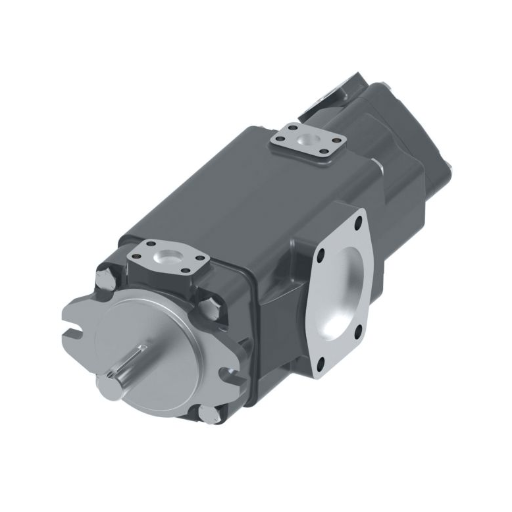
Each VQ frame covers a band of capacity codes. The bands below come from the OEM VQ order tables, which are more complete than some distributor tables.
| Section | Capacity band (nominal gpm at 1,200 rpm) |
|---|---|
| 20VQ | 5 to 14 |
| 25VQ | 10 to 21 |
| 35VQ | 21 to 38 |
| 45VQ | 42 to 60 |
| V10 | 1 to 7 |
Displacement follows the code through the OEM table: 20VQ code 4 is 13.1 cc/rev, 25VQ code 10 is 32.0, 35VQ code 30 is 97.7, and V10 codes 1 to 7 run from 3.3 to 22.8 cc/rev. Vendor tables may round or omit low and high codes; Hydraulics Online and Hydraulex, for example, omit 20VQ code 9 and 25VQ code 10, so use the OEM table for those.
Speed works differently in a triple. The assembly is limited by the slowest section, which in practice is the VQ frame, not the V10. Published frame limits are 2,700 rpm for the 2520 build, 2,500 rpm for the 3525 build, and 2,200 rpm for the 45-frame builds, with 600 rpm the usual minimum.
The V10’s own limit runs from 4,800 rpm at code 1 down to 2,800 rpm at code 7, above the VQ frame ceiling in the sources reviewed. Check both, because a high-code V10 in a 45-frame build narrows the margin.
Suppose a maintenance lead at a quarry plant finds a failed unit stamped 2520VQSV10-10-4-2 and searches that string. The results are dominated by V10 single-pump listings such asV10-1P3P-1C20, because the search engine reads “V10” and ignores the stack. Ordering one of those returns a single pump with one outlet, not a three-section unit. The full string and a nameplate photo are what separate the two.
The pressure hierarchy: which section sets the limit
This is the part most listings get wrong. The three outlets do not share one pressure rating. Each outlet carries the limit of the section behind it.
| VQ section | Maximum pressure listed |
|---|---|
| 20VQ, 25VQ, 35VQ | 210 bar |
| 45VQ | 175 bar |
| 20VQ codes 12 and 14 | 160 bar and 140 bar |
| V10 code | Displacement (cc/rev) | Maximum pressure | Maximum speed (rpm) |
|---|---|---|---|
| 1 | 3.3 | 172 bar | 4,800 |
| 2 | 6.6 | 172 bar | 4,500 |
| 3 | 9.8 | 172 bar | 4,000 |
| 4 | 13.1 | 172 bar | 3,400 |
| 5 | 16.4 | 172 bar | 3,200 |
| 6 | 19.5 | 152 bar | 3,000 |
| 7 | 22.8 | 138 bar | 2,800 |
The V10 figures come from the Eaton V10/V20 catalog. The VQ figures come from distributor tables, which agree with each other but are not the OEM V10/V20 document; confirm them against the Vickers V and VQ catalog for your build. The derate on 20VQ codes 12 and 14 is the detail most often missed: the frame that runs at 210 bar on code 10 is listed at 140 bar on code 14.
The rule for a Vickers triple vane pump follows from that. Each circuit is limited by its own section, not by the highest rating on the unit. A 200 bar third circuit cannot use a V10 section, because no V10 code is rated above 172 bar.
The counter-example matters more than the rule. In 2520VQSV10-10-14-5the 25VQ section at code 10 is listed at 210 bar, and the V10 at code 5 is rated 172 bar. The 20VQ centre section at code 14 is listed at 140 bar, the lowest of the three, so the centre circuit sets the ceiling, not the V10. Anyone who assumes “the V10 is always the weakest section” will set the wrong relief valve on this unit.
Shaft loading and relief protection
Do not assume all three sections can run at rated pressure at once. The shaft, key, and coupling carry the sum of the three torque loads, and the housing carries the resulting side load. A unit rated section by section is not automatically rated for a duty that loads all three outlets together. Eaton’s application guidance, as reproduced by distributors, calls for a shaft-loading check on any triple.
On builds with F-type flow-control covers, the shaft-end and centre sections need separate relief valves. One relief protecting the whole stack leaves a section unprotected. Set each relief against that section’s own rating and capacity code, not the unit’s headline number.
If the third circuit genuinely needs more than 172 bar, this family is the wrong choice. No VQH triple equivalent appears in the sources reviewed; the options are a different configuration or a separate pump for that circuit.
Cartridges, kits and the M-249x-S service documents
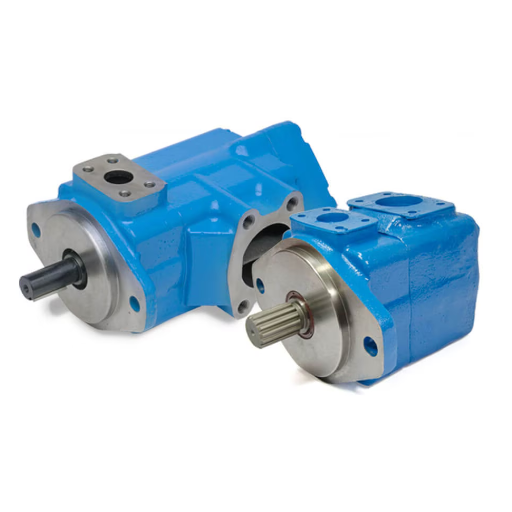
VQ cartridges are independent of the shaft, which makes a triple serviceable: one section can be pulled and rebuilt without disturbing the other two, if you follow the stack sequence on reassembly.
There are three cartridges but only two kit families:
- Shaft-end and centre sections: standard VQ cartridge kits, matched by frame and capacity code. A 20VQ kit fits a 20VQ section whether it sits in a single, a double, or a triple.
- Cover-end section: V10 cartridge parts, meaning rotor, vanes, cam ring, and related components for the V10 series. A VQ kit doesn’t fit the V10 section.
That’s where rebuild budgets go wrong. A purchaser who orders “three VQ kits for a 2520VQSV10” has ordered one kit too many and the wrong parts for the third section.
The vane pump cartridge kit procedure covers removal, inspection, and refitting. For a specific triple’s parts breakdown, Vickers publishes service documents in the M-249x-S range. Three mappings are confirmed in public records:
| Document | Build |
|---|---|
| M-2492-S | 2520VQSV10 |
| M-2495-S | 4520VQSV10 |
| M-2496-S | 4525VQSV10 |
The mappings for M-2493-S, M-2494-S and M-2497-S are not publicly indexed, so this article does not guess at them. Request the sheet for your exact build from Eaton or a Vickers distributor, quoting the full stamped string. The “S” in VQSV10 is not decoded in any source reviewed here either. Treat it as part of the base, not as a field you can interpret.
What to send for a quote:
- The complete stamped model string.
- The serial number.
- All three capacity codes.
- The rotation letter.
- The shaft type.
- The position of each outlet port.
A photo of the nameplate covers all six in one image.
Rotation and reassembly notes
Rotation is read from the shaft end. R is clockwise and L is counter-clockwise as you look at the shaft. A L unit won’t run correctly in place of an R unit, and reversing the motor is not a fix on a fixed-displacement vane pump.
Safety note: isolate the pump from its power source, release stored pressure at every outlet, and lock out the drive before you open any section. A triple has three circuits and can hold pressure in a section you are not working on.
To reverse rotation, two methods are documented. The OEM method swaps the inlet and outlet support plates (port plates). The aftermarket Fluidyne guide also allows rotating the cam ring 180 degrees. Use one method or the other, never both, or the pump will rotate the wrong way again.
The Fluidyne rotation procedure shows the cam-ring method and the vane orientation that goes with it.
On reassembly:
- Confirm the vane leading edge faces the direction of rotation and matches the cam-ring arrow.
- Align all three sections to the cover before tightening any cartridge screw.
- Do not slide the flex plates across the ring and rotor; lift them into place.
- Torque cartridge screws by frame. Service data reproduced in aftermarket guides lists 65 to 75 lb·ft for 20VQ and 25VQ, 140 to 160 lb·ft for 35VQ, and 255 to 275 lb·ft for 45VQ. Confirm the figures in the sheet for your frame before you use them.
When a VQ + V10 triple is the right choice
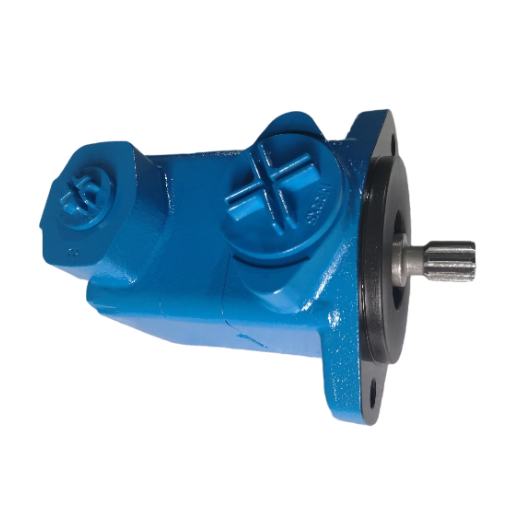
The triple earns its place when a machine needs three independent flows from one drive and one mounting pad. Typical splits are clamp, transfer, and auxiliary on mobile equipment, or clamp, pilot, and cooling on an industrial power unit. One shaft, one bell housing, three circuits, and a smaller envelope than three separate pumps.
It’s the wrong choice in three situations:
- The third circuit needs more than 172 bar. No V10 section reaches it.
- One section needs more flow than its frame band allows. A 45VQ tops out near 60 gpm nominal at 1,200 rpm; beyond that, change the architecture.
- A double plus a small separate pump is lower-cost and easier to service. If the third circuit is low-flow and low-pressure, a separate small pump can cost less than the triple’s third cartridge and the extra service complexity.
If the fit is right, the product page for the V10 triple vane pump series lists the configurations LOYAL INDUSTRIAL supplies. The Vickers hydraulic pumps hub covers the wider Vickers vane pump and piston range. For a configuration review, send the full stamped string and the duty for each circuit.
FAQ
What is a Vickers 2520VQSV10?
It is a three-section VQ + V10 pump: 25VQ at the shaft end, 20VQ in the centre, and V10 at the cover end, all on one shaft. The numbers after the base are the capacity codes in that order; -10-4-2 means 10, 4, and 2 gpm nominal.
Is a Vickers V20 a triple vane pump?
No. The V20 is a single pump, and the V2010 and V2020 are doubles. The third section of a VQSV10 triple is a V10, not a V20, so check the model string before ordering.
What pressure does the Vickers V10 pump section run at?
The Vickers V10 vane pump section is rated in the Eaton V10/V20 catalog at 172 bar for codes 1 to 5, 152 bar for code 6, and 138 bar for code 7. That is below the 210 bar listed for the 20VQ, 25VQ, and 35VQ sections, so the V10 often sets the ceiling, but not always. Check each section’s code.
Can I change the rotation of a VQ triple?
Yes, by swapping the inlet and outlet support plates, or by rotating the cam ring 180 degrees, depending on your unit’s documentation. Do one or the other, never both, and confirm vane orientation before reassembly.
Which cartridge kit fits my Vickers triple?
The two VQ sections take standard VQ cartridge kits matched by frame and capacity code. The V10 cover-end section takes V10 parts, not a VQ kit. For the parts breakdown, request the M-249x-S service sheet for your exact build.
Conclusion
A Vickers triple pump built as a VQ + V10 stack is three cartridges, not a bigger single. The code reads shaft end first, so it 2520VQSV10 is 25VQ plus 20VQ plus V10, and the capacity codes follow in the same order. The pressure ceiling belongs to the weakest section in that specific build, which is sometimes the V10 and sometimes a derated VQ code. The two VQ sections share one kit family; the V10 section does not.
The next step is physical. Photograph the nameplate, write down the full string and the serial number, and note the duty for each of the three circuits.
LOYAL INDUSTRIAL PTE. LTD. supplies Vickers triple vane pump replacements and can review a configuration against those details before you commit to a rebuild or a replacement. Send the string and the duty, and ask for the configuration review.