Most commercial log splitter failures don’t start with the engine or the wedge. They start with a hydraulic pump that was never specified for the job.
If you design, manufacture, or maintain log splitting equipment, you already understand that hydraulic performance defines operational output. A poorly matched pump creates slow cycle times, overheated oil, and premature seal failure. These problems compound in commercial environments where downtime costs more than the component itself.
This guide breaks down exactly how a 2 stage hydraulic pump for log splitter applications works. You will learn the mechanics of Hi-Lo pressure staging, the key specifications that matter for commercial equipment, and how to integrate these pumps into a complete hydraulic system. We also cover what separates industrial-grade units from consumer-grade alternatives, and how to approach procurement with confidence. Need more information about log splitter hydraulic pumps? You can read our complete guide to log splitter hydraulic pumps.
Need the right pump specification for your equipment line? Request a technical specification sheet and our engineering team will match flow, pressure, and mounting to your exact requirements.
Introduction to 2 Stage Hydraulic Pump

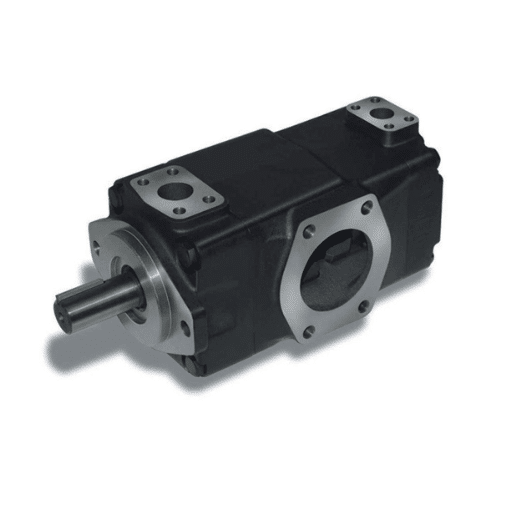
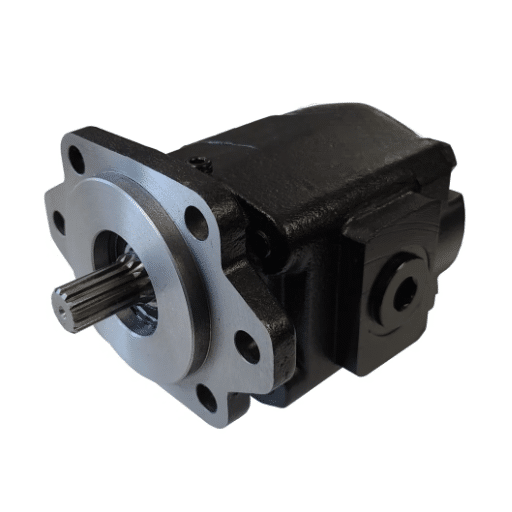
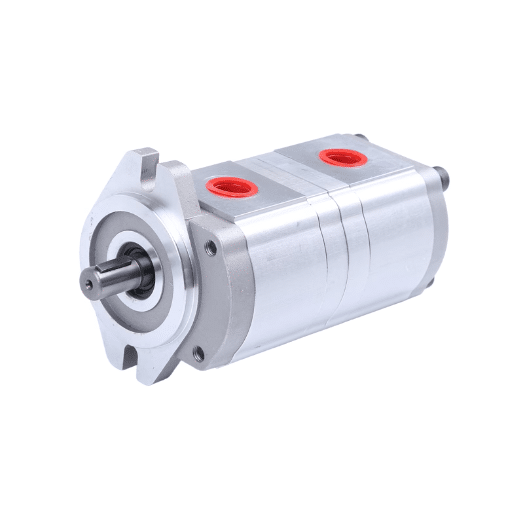
A 2 stage hydraulic pump, also called a hi-lo pump or two stage hydraulic pump, is a dual-displacement device designed to optimize both speed and force in a single hydraulic circuit. It delivers high flow at low pressure during the rapid approach phase, then shifts to low flow at high pressure when the load demands splitting force.
How the Hi-Lo Mechanism Works
The internal architecture contains two distinct pumping sections integrated into one housing. During the initial cylinder extension, both sections operate in parallel. This combined displacement moves a large volume of hydraulic fluid quickly, driving the ram forward at high speed with minimal resistance.
Once the wedge contacts the log and system pressure rises, a pressure-activated bypass valve diverts flow from the high-volume section. Only the smaller displacement section continues to operate. The result is a shift from fast, low-pressure movement to slow, high-pressure force generation. This transition happens automatically without external control input.
The mechanism matters because log splitting is an intermittent, high-force application. A single-stage pump sized for splitting pressure would move the ram painfully slow during the approach stroke. A pump sized for fast approach would require an impractical amount of engine power to generate splitting force. The 2 stage design solves both problems within a compact, mechanically simple package.
Example: When the cylinder on a 25-ton commercial splitter extends unloaded, the pump might deliver 16 GPM at 300 PSI. At contact, output drops to 3 GPM at 2,800 PSI. The same pump does both jobs without changing engine speed.
2 Stage vs. Single Stage Hydraulic Pump for Log Splitters
Equipment manufacturers often face a direct choice between these two pump types. The decision impacts cycle time, fuel consumption, engine sizing, and equipment cost.
Performance Comparison
A single-stage pump maintains constant displacement across its entire operating range. If you specify a 16 GPM single-stage pump, you get 16 GPM regardless of whether the ram is approaching or splitting. That sounds efficient until you calculate the horsepower requirement at 3,000 PSI.
The formula is straightforward: Hydraulic horsepower = (GPM x PSI) / 1714
A 16 GPM pump at 3,000 PSI demands approximately 28 hydraulic horsepower. With mechanical efficiency losses, that translates to a 35+ HP gas engine. Most commercial log splitters run on engines between 5.5 HP and 9 HP. The math simply doesn’t work.
A two stage hydraulic pump solves this by providing high flow only when pressure is low. The same equipment can achieve fast cycle times with a much smaller engine. For commercial manufacturers, this means lower equipment cost, reduced fuel consumption, and simpler engine inventory.
When to Specify a 2 Stage Pump
Commercial and industrial log splitter applications almost always benefit from 2 stage specification. Specifically:
- High-tonnage equipment (20 tons and above)
- Continuous or high-frequency operation environments
- Rental fleet equipment where cycle time affects revenue
- Any system where engine size must be minimized
When a Single Stage May Suffice
Light-duty homeowner-grade equipment represents the primary exception. A 10-ton electric splitter with a small bore cylinder and slow cycle requirements can operate adequately on a single-stage pump. The cost savings matter in consumer markets where purchase price drives decisions.
However, for any equipment intended for commercial firewood operations, landscaping contractors, or municipal maintenance, a 2 stage hydraulic pump for log splitter systems is the engineering standard.
For detailed worked examples, see our guide on what size hydraulic pump for a log splitter.
Key Specifications for Log Splitter Applications

Procurement engineers should evaluate four primary specifications when selecting a log splitter hydraulic pump. Getting any one of these wrong creates performance shortfalls or premature failure.
Flow Rate (GPM)
Commercial log splitter pumps typically range from 11 GPM to 22 GPM for gas-engine-driven systems. Flow rate directly determines how fast the cylinder extends and retracts.
Matching flow to cylinder bore and stroke requires basic calculation. A 4-inch bore cylinder with a 24-inch stroke contains approximately 1.3 gallons of fluid volume. At 16 GPM, the theoretical extension time is under 5 seconds. In practice, system losses and the transition to high-pressure stage extend this slightly.
Specifying too much flow creates problems. Excess flow velocity generates heat, accelerates seal wear, and can cause cavitation at the pump inlet. Specifying too little flow results in sluggish operation that frustrates operators and reduces equipment productivity.
For a dedicated side-by-side comparison, read our article on 11 GPM vs 16 GPM vs 22 GPM log splitter pump.
Pressure Rating (PSI)
The industry standard maximum operating pressure for gas-engine-driven log splitter pumps is 3,000 PSI. Most commercial systems operate in the 2,500 to 2,800 PSI range during the splitting stroke.
Operating pressure and relief valve settings are not the same. The relief valve protects the system from overpressure. It should be set 10-15% above normal operating pressure. For a system designed to split at 2,800 PSI, the relief valve belongs at approximately 3,000 to 3,200 PSI.
Safety margin matters. Continuous operation at pressures approaching the relief valve setting generates excess heat. Industrial-grade pumps maintain stable performance at rated pressure. Consumer-grade units may experience internal bypass and efficiency loss under sustained high load.
Engine Horsepower Requirements
The hydraulic horsepower formula gives you the theoretical minimum. Add 15-20% for mechanical and volumetric efficiency losses in the pump.
A typical commercial configuration might look like this:
- Low-pressure stage: 16 GPM at 300 PSI = 2.8 HP
- High-pressure stage: 3 GPM at 2,800 PSI = 4.9 HP
- Total theoretical: 7.7 HP
- With efficiency losses: 9 to 10 HP gas engine
Undersizing the engine causes the pump to stall before reaching rated pressure. Operators experience incomplete splits and frustration. Oversizing adds unnecessary cost, weight, and fuel consumption.
Port Size and Mounting Configuration
Standard port configurations use SAE or NPT threaded connections. Common inlet sizes are 3/4-inch or 1-inch. Outlet ports typically measure 1/2-inch or 3/8-inch.
Mounting matters for production-line assembly. Most 2 stage pumps for log splitter applications use a direct-drive keyed shaft designed to bolt directly to common gas engine crankshaft PTO configurations. Verify shaft diameter, keyway size, and bolt circle pattern before procurement.
Real-world scenario: A maintenance engineer named David runs a rental equipment depot in Wisconsin. He replaced three single-stage pumps on 22-ton splitters with 2 stage units rated at 16 GPM. Cycle time dropped from 18 seconds to 11 seconds per split. Over a full rental season, that improvement allowed each machine to process 40% more cords. The pumps paid for themselves in reduced customer complaints and higher turnover.
System Integration Considerations
A pump never operates in isolation. The complete hydraulic system determines whether the pump performs to specification or destroys itself prematurely.
Matching the Hydraulic Cylinder
The cylinder bore diameter and stroke length define how much force the splitter generates and how fast it moves. The pump must supply enough flow to fill the cylinder at an acceptable speed, and enough pressure to generate the rated tonnage.
Force calculation follows the formula: Force = Pressure x Piston Area
A 4-inch bore cylinder at 2,800 PSI generates approximately 35,000 pounds of force, or about 17.5 tons. To achieve a 25-ton rating, you need either a larger bore or higher pressure. Most commercial manufacturers optimize around 4.5-inch to 5-inch bore cylinders at standard pressure.
Pump selection and cylinder specification are interdependent decisions. Changing one without re-evaluating the other invites performance mismatches.
Reservoir and Cooling Requirements
Hydraulic fluid does more than transmit power. It lubricates moving parts, seals clearances, and carries heat away from the pump and valves. Reservoir sizing directly affects thermal management.
The fluid power industry rule of thumb states that reservoir capacity should equal 2 to 3 times the pump’s GPM flow rate. For a 16 GPM pump, that means a 32 to 48 gallon tank minimum. In continuous-duty applications such as commercial firewood processing, larger reservoirs improve heat dissipation and extend oil life.
Contamination control is equally important. A suction strainer at the reservoir outlet and a return line filter prevent particulate damage to the pump’s precision internal components. Industrial systems require 10-micron filtration or better.
Valve and Hose Sizing
The directional control valve must handle the system’s rated flow and pressure without generating excessive pressure drop. A valve rated for 20 GPM at 3,000 PSI provides adequate margin for most commercial log splitter configurations.
Hose diameter must match flow velocity limits. For 16 GPM, 3/4-inch hose keeps velocity below the recommended 15 feet per second. Smaller hose creates backpressure, heat, and noise. Pressure rating should exceed the relief valve setting by a safety factor of at least 2:1.
System integration is where specification errors become expensive. A pump rated for 3,000 PSI operating through undersized hoses and a restrictive valve may never reach rated pressure. The operator blames the pump. The real problem is system design.
Industrial-Grade vs. Consumer-Grade Pumps

Not every 2 stage hydraulic pump for log splitter applications meets the same standard. The differences between industrial-grade and consumer-grade units determine reliability, lifespan, and total cost of ownership.
Material and Construction Differences
Industrial-grade pumps typically use cast iron housings with hardened steel gears or pistons. Cast iron provides rigidity under high pressure and resists deformation during thermal cycling. Consumer-grade pumps often use aluminum housings to reduce cost and weight. Aluminum works for light-duty applications but lacks the fatigue resistance needed for continuous commercial operation.
Bearing quality separates the categories. Industrial units use roller or tapered bearings rated for thousands of hours at rated load. Consumer pumps may use sleeve bearings adequate for occasional homeowner use but prone to failure under daily operation.
Shaft and keyway specifications also differ. Industrial pumps use larger diameter shafts with precision-machined keyways that resist shear forces. Consumer units may use smaller shafts that flex or fail when paired with high-torque engines.
Duty Cycle and Reliability Factors
Duty cycle defines what percentage of operating time the pump spends under load. Homeowner equipment might see a 10% duty cycle during a few weekend sessions per year. Commercial rental equipment sees 50-70% duty cycle across hundreds of hours per season.
Industrial-grade pumps are designed for continuous-duty ratings. Seal materials use nitrile or Viton compounds selected for compatibility with standard hydraulic oils and rated for the temperature ranges generated by sustained operation.
Mean time between failures (MTBF) is rarely published for consumer-grade pumps. Industrial suppliers should provide documented durability testing, including pressure cycling data and seal life projections.
Procurement Considerations for Equipment Manufacturers
If you build log splitters for resale or rental, pump consistency matters as much as pump quality. A supplier that delivers identical performance from batch to batch allows you to calibrate equipment once and replicate results across production runs.
Batch variation in displacement, pressure settings, or shaft dimensions creates assembly line delays and field performance complaints. Industrial buyers should demand dimensional reports, pressure test certificates, and material certifications with every shipment.
Common Failure Modes and Maintenance
Even well-specified pumps fail when installation, operation, or maintenance falls short. Understanding common failure modes helps prevent costly downtime.
Pressure Loss Issues
Internal wear is the most common cause of pressure loss in two stage hydraulic pumps. The hi-lo bypass valve relies on precise clearances. As gears, pistons, or vanes wear, internal leakage increases. The pump continues to move fluid but cannot build rated pressure.
Seal degradation manifests as external leaks around the shaft seal or between housing sections. High-pressure cycling accelerates seal fatigue. Once leakage begins, it worsens quickly as hydraulic oil under pressure finds every available escape path.
Valve sticking in one stage creates erratic performance. The pump may remain in low-pressure mode during the splitting stroke, delivering fast but weak output. Alternatively, it may shift to high-pressure mode prematurely, slowing the approach stroke. Both conditions indicate contamination or wear in the bypass valve assembly.
Maintenance Best Practices
Hydraulic oil selection matters more than many operators realize. Standard anti-wear hydraulic oil with ISO VG 32 or VG 46 viscosity suits most climates. In cold environments, lower viscosity oil improves cold-start performance. In hot climates, higher viscosity maintains film strength.
Oil change intervals depend on operating hours and contamination exposure. For commercial equipment operating 500+ hours per season, annual oil changes represent minimum maintenance. Severe-duty applications with dusty environments require more frequent changes and diligent filter replacement.
Filter maintenance is non-negotiable. A clogged suction strainer starves the pump inlet, causing cavitation that destroys internal surfaces within hours. Return line filters protect the reservoir from debris introduced during cylinder seal wear or hose degradation.
Diagnostic Approach
When a pump underperforms, start with pressure testing. Install a calibrated gauge at the cylinder port and measure pressure during the splitting stroke. If pressure stays below specification, test at the pump outlet directly to isolate pump performance from cylinder or valve issues.
Flow testing confirms stage transition. A flow meter on the pump outlet should show high flow during approach and low flow during splitting. Absence of this transition indicates bypass valve malfunction.
Replace the pump when internal wear exceeds economical repair limits. Rebuilding is sometimes viable for large, expensive pumps. For standard log splitter pumps in the commercial category, replacement is usually more cost-effective than rebuilding.
Example: An equipment OEM in Tennessee named Precision Forestry Equipment experienced a 12% field failure rate on their first production run of commercial splitters. Root cause analysis traced failures to a consumer-grade pump paired with a 9 HP engine and 5-inch cylinder. The pumps were operating beyond their continuous-duty rating. Switching to an industrial-grade 2 stage hydraulic pump with cast iron housing and roller bearings dropped the field failure rate below 2%. Warranty costs fell by $47,000 in the first year.
The Sourcing and Procurement Guidance

Selecting the right pump on paper is only half the task. Finding a supplier who can deliver consistent industrial-grade quality at production volumes completes the equation.
Evaluating Hydraulic Pump Suppliers
Technical documentation should include complete specification sheets, dimensional drawings, and performance curves. A supplier who cannot provide these basics is unlikely to meet OEM quality standards.
Sample and prototype testing is essential before committing to volume orders. Test samples under actual operating conditions matching your equipment. Measure flow, pressure, noise, and temperature rise across the full duty cycle. Document results and establish acceptance criteria for production batches.
Quality certification expectations vary by market. ISO 9001 certification indicates a documented quality management system. CE marking may be required for European export. Some buyers require material test reports or pressure test certificates for every unit.
OEM and Bulk Supply Considerations
Customization options for production-line integration include special shaft lengths, modified port orientations, and private labeling. Not all suppliers offer engineering support for these modifications. Clarify capabilities early in the sourcing process.
Packaging and labeling requirements matter for aftermarket distribution. Individual boxes with specification labels simplify inventory management for distributors. Bulk packaging reduces waste for high-volume OEM assembly lines.
Lead time consistency affects manufacturing schedules. A supplier who delivers in 4 weeks today but 12 weeks next quarter creates planning chaos. Evaluate supply stability through reference checks and, where possible, long-term supply agreements.
For equipment manufacturers seeking stable, industrial-grade hydraulic pump supply, LOYAL INDUSTRIAL PTE. LTD. provides tested components with consistent specifications and export-ready documentation. Contact our engineering team for a customized hydraulic system recommendation tailored to your log splitter production requirements.
Conclusion
A 2 stage hydraulic pump for log splitter applications is more than a convenience feature. It is the component that determines whether commercial equipment delivers productive cycle times or frustrates operators with sluggish performance.
The Hi-Lo mechanism provides an elegant solution to a fundamental engineering challenge: delivering speed and force from a compact, cost-effective power unit. Understanding how this mechanism works, which specifications matter, and how the pump integrates with the complete hydraulic system separates informed procurement from guesswork.
Key takeaways:
- Two-stage pumps optimize both approach speed and splitting force without oversized engines
- Flow rate, pressure rating, horsepower requirements, and mounting configuration must all match your specific equipment design
- System integration, cylinder, reservoir, valves, and hoses determine real-world performance
- Industrial-grade construction with cast iron housings and quality bearings outlasts consumer-grade alternatives in commercial duty
- Preventive maintenance, especially oil quality and filtration, extends pump life significantly
When specifying hydraulic pumps for log splitter manufacturing or fleet maintenance, accuracy at the procurement stage prevents expensive problems in the field. Request technical documentation. Test samples under real conditions. Verify that your supplier can maintain consistent quality across production volumes.
Ready to specify the right pump for your equipment? Contact us for industrial solution consultation. Our engineering team supports OEMs, distributors, and maintenance operations with application-matched hydraulic components built for demanding environments.