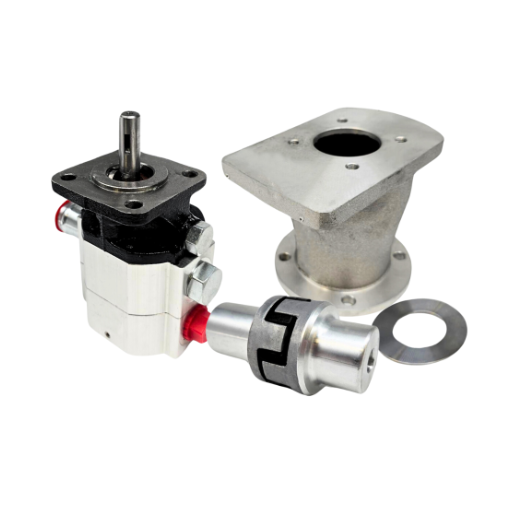
A healthy industrial vane pump noise level is about 55 to 70 dB(A) at 1 m, depending on how the pump is built, how fast it turns, and how hard it is working. Louder than that under the same measured conditions is either a fault or a specification that was never going to be met.
Vane pumps are sold as the quiet option in hydraulics, and at the right conditions they are. A balanced double-acting pump with 12 vanes delivers into its outlet almost continuously, so there is no single pulse per revolution to shake the frame. Put the same pump in a worn machine at 2,100 rpm, or ask 210 bar of a frame rated lower, and it becomes the loudest thing in the plant.
The advice most people get about vane pump noise starts in the wrong place. It jumps to a damper or an enclosure before anyone has established what the sound is, where it sits in frequency, or whether the pump is even the source. This article separates the two problems hiding inside the word “noise”: pulsation, which is periodic and tunable, and everything else, which is not.
It does not cover diagnosis of a failing pump. If the pump is making a sound it did not make last month, the is the right page. For the full family overview, first start with our complete guide to high-pressure vane pumps.
Key Takeaways
- A balanced 12-vane pump measures 62 to 69 dB(A) at 138 bar on published frame data, against 70 to 85 dB(A) for the wider vane family at 1 m.
- Dropping 1,800 to 1,200 rpm on the same frame is worth 2 dB(A), and speed moves the number more than pressure or pump size.
- Twelve vanes at 1,500 rpm gives a 300 Hz pulsation fundamental, so a dampener tuned there cannot touch a cavitation hiss at 3 kHz.
- The loudest faults sit at the inlet and are the cheapest to fix.
- A dB(A) figure without pressure, speed, fluid and test standard is marketing, not a specification.
What a vane pump should sound like
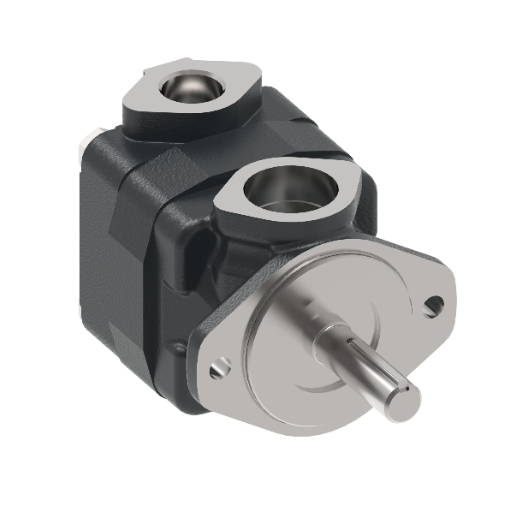
A balanced double-acting pump with 10 to 12 vanes is the quietest common hydraulic pump type. A worn pump, a starved pump, or one held at the top of its pressure band is not, and it will sit well above the band quoted for its family.
One supplier’s published ranges at 1 m put external gear pumps at 80 to 95 dB(A), vane pumps at 70 to 85, and axial piston pumps at 68 to 90. Treat those as family ranges, not test results. They span a 10 cc/rev cartridge and a 200 cc/rev industrial unit, and the condition behind each figure is rarely stated. For a plant with operators nearby, a design target of 70 to 75 dB(A) at 1 m is a reasonable working aim.
Narrower data exists, and it is worth knowing where. Eaton publishes sound levels for the Vickers V series, the 12-vane balanced design most other vane pumps are measured against.
| Frame | 1,200 rpm | 1,800 rpm |
|---|---|---|
| 20V | 62 dB(A) | 64 dB(A) |
| 25V | 63 dB(A) | 65 dB(A) |
| 35V | 64 dB(A) | 66 dB(A) |
| 45V | 67 dB(A) | 69 dB(A) |
| Double pump, both sections loaded | +1 to +3 dB(A) | +1 to +3 dB(A) |
The conditions attached to that table are what make it usable: 138 bar, SAE 10W oil at 26 cSt, 50 °C, measured to NFPA T3.9.70.12. Note the standard, because it is a 1970 method measured at three feet, not the current ISO 4412-1 method at 1 m. A pump quoted to one and compared against a limit set in the other is being compared unfairly, in either direction.
The table also shows the two levers a buyer controls. Go down a frame size, and the number falls by 1 to 2 dB(A). Drop the speed to 600 rpm, and it falls by another 2. Load a second section, and it rises by 1 to 3.
Packaging changes the answer too. Eaton’s own integrated motor pump puts the same 20V cartridge inside a motor bell housing with an acoustic shroud, and measures 58 to 60 dB(A) at 35 bar, 61 to 63 at 140 bar, and 63 to 65 at 210 bar across 1,500 and 1,800 rpm, to a tolerance of plus or minus 2 dB(A). Same rotating group, different number, because the housing, coupling, and motor all contribute. A catalogue headline is not a specification.
Specifying against a noise limit? The covers the frames behind these numbers, and we can quote against a stated limit at a stated duty point rather than a family average.
Video slot: embed a manufacturer or training video showing a vane pump under acoustic measurement, or a cutaway of the cam ring with both delivery arcs visible. Confirm the video is live and shows the actual component before publishing.
Why a vane pump runs quiet, and why that stops
The quietness of a vane pump comes from how its chambers report to the outlet port. Each cell between two vanes sweeps past the outlet window over an arc of cam ring, and the next cell starts delivering before the previous one finishes. Flow into the port is close to continuous. A gear pump dumps each tooth space in a discrete gulp; a piston pump fires each cylinder once per revolution.
Double-acting geometry doubles the effect. A balanced vane pump has two opposed delivery arcs per revolution, so the hydraulic force on the rotor cancels itself. That removes the radial shaft load a carries, and with it the bearing noise and shaft deflection. It is also why the balanced design holds more pressure at the same sound level.
Vane count sets the frequency. More vanes means shorter delivery overlaps repeated more often, which raises pulsation frequency and lowers amplitude. The standard measure is the pulsation coefficient, delta equal to peak flow minus minimum flow divided by peak flow. Commonly quoted figures put a single-acting pump at roughly 5 to 10% ripple and a 12- or 16-vane double-acting pump under about 2%, though those come from vendor comparisons and the test conditions rarely are published.
Now the part that fails. Every clause in that description is conditional. The chambers have to seal, so a worn pump leaks between cells and the overlap stops being smooth. The vanes have to stay against the cam ring, which needs centrifugal force and undervane pressure. The port has to be fed, and the pressure has to be inside the design envelope. The quietness is geometry at a condition, and the condition is the reader’s machine.
From the perspective of technical principles, please see our article on why vane pumps have a pressure limit.
Vane pump pulsation is a different problem from noise
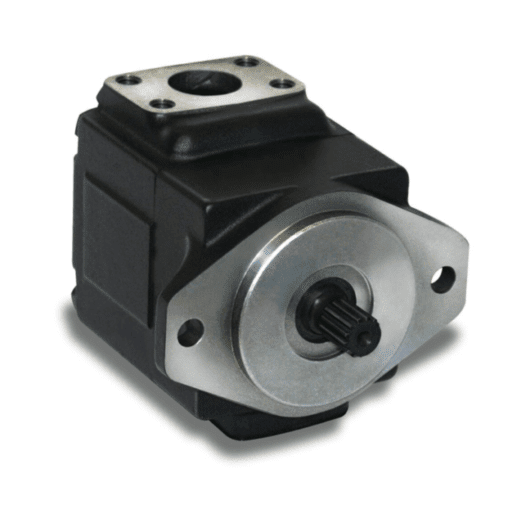
Most pages treat pulsation as a cause of noise and move straight to a damper. That skips a question worth answering first.
| Noise | Pulsation | |
|---|---|---|
| What it is | Airborne sound radiated by the pump, the lines, and the structure | Periodic fluctuation of flow and pressure at the pump outlet |
| Frequency | Wideband: vane pass plus harmonics, cavitation hiss in the kilohertz, structural resonances | Narrowband: vane pass and a few harmonics, sometimes shaft frequency |
| Measured by | dB(A) at a stated distance and condition, per ISO 4412-1 | Source flow ripple and source impedance, per ISO 10767-1 |
| Fixed by | Inlet condition, speed, mounting, isolation, enclosure | Cam and port design inside the pump, then damping on the discharge line |
| What a dampener does | Little, unless the noise is pulsation-driven | Cuts amplitude directly |
Vane pump pulsation is periodic, predictable, and tunable. Noise is the sum of everything the machine radiates, and only part of it starts in the ripple. Separate those two and the fix order becomes obvious. Conflate them, and the first thing you buy is the last thing you needed.
The most useful technical frame for the pulsation half comes from a , which separated pressure pulsation into three tiers. The first is vane-frequency ripple and its harmonics, running up to about the eighth. The second is a low-frequency oscillation at shaft speed, caused by leakage that varies with rotor position. The third is a transient high-frequency spike once per vane period, generated when the oil column in the discharge chamber and port adapter resonates.
That third tier explains something the first cannot. A pump can have low vane-frequency ripple and still produce sharp transients, because the port geometry and the volume downstream of it form a resonator.
Put a number on it. A 12-vane rotor at 1,500 rpm produces a fundamental at 12 multiplied by 1,500 divided by 60: 300 Hz. Harmonics follow at 600, 900 and 1,200 Hz. A suppressor tuned to 300 Hz does nothing for a 3 kHz cavitation hiss, and nothing for a 50 Hz resonance in the mounting.
Hearing is most sensitive between roughly 1,000 and 5,000 Hz, so a small amount of high-frequency energy can be more objectionable than a larger low-frequency component. That is why “add an accumulator” is not a general answer to a noise complaint.
Run the arithmetic before you order hardware. The table below is the fundamental only; harmonics sit at integer multiples of it.
| Shaft speed | 10 vanes | 12 vanes | 14 vanes |
|---|---|---|---|
| 1,200 rpm | 200 Hz | 240 Hz | 280 Hz |
| 1,500 rpm | 250 Hz | 300 Hz | 350 Hz |
| 1,800 rpm | 300 Hz | 360 Hz | 420 Hz |
There is a boundary worth stating plainly. If your pump is making a noise it did not make last month, that is a fault, not a pulsation problem. Start with the diagnostic matrix in our , which walks the sound decoder and the cavitation-versus-aeration split. Come back to this page once you know the pump is healthy and the question is what to change.
What makes a vane pump loud
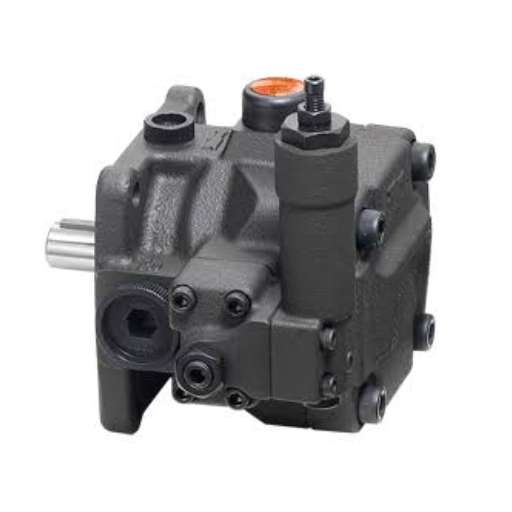
The causes are easier to act on when grouped by the fix rather than alphabetically. That is the order below, and the order of the ladder further down.
Suction starvation and cavitation
When inlet pressure drops below the vapour pressure of the oil, bubbles form and collapse as the oil reaches the higher pressure at the outlet. The collapse is violent and broadband, and it is the loudest thing a hydraulic pump does.
A vane pump adds a mechanical consequence. With a starved inlet, the vanes lose contact with the cam ring on the suction side and are hammered back onto it on discharge, eroding the ring into a washboard pattern. The acoustic damage and the mechanical damage arrive together.
The field signature that settles it: noise that worsens as system pressure rises points to a restricted inlet, because a higher pressure means a larger drop across the restriction and a lower absolute inlet pressure.
The causes are all upstream. An undersized or internally collapsed suction hose, a clogged strainer, a partly closed isolation valve, sludge over the tank outlet, too many elbows, low oil level, a blocked breather. A suction strainer is the one to look at first, since it is the restriction most often added for the wrong reason and then left unmonitored. If a strainer cannot be avoided, use 250 micrometres or coarser with a pressure gauge across it.
Entrained air
Aeration sounds different from cavitation, and the distinction is worth memorising. states it in one line: a high-pitched whine points to cavitation, and a knocking sound like marbles rattling inside the pump points to entrained air.
Air gets in through loose suction fittings, a cracked or porous hose, a worn shaft seal, a return line discharging above the oil level, a vortex at the tank outlet, or poor bleeding after service. One trap catches people repeatedly: a suction leak draws air in without letting oil out, so it leaves no puddle under the machine.
The grease test needs no instrument. Smear grease around each suspect suction joint and around the shaft seal while the pump runs. If the sound changes, air is entering there.
Speed
Speed is the largest single lever on vane pump noise. Roy Wilkes, writing in , put speed as having roughly 300% more influence on noise than pressure or pump size. Three decades have not produced a better field rule.
The frame table shows it arithmetically. A 20V at 1,800 rpm measures 64 dB(A); at 1,200 rpm it measures 62. On a 45V, 69 becomes 67. Two dB(A) from a change that costs nothing once the displacement is right.
That leads to a selection principle worth carrying into the buying decision. For a given flow, a larger frame turning slower is quieter and longer-lived than a smaller frame turning faster. Two dB(A) is small on paper and noticeable beside an operator. Our guide to works through the trade.
Pressure
Vane loading and internal leakage both rise with pressure, and both show up as sound. This is the mechanism behind the complaint that a pump was quiet when new and got louder as the duty changed.
The packaged-unit data makes it concrete. The same 20V cartridge at 1,800 rpm measured 60 dB(A) at 35 bar and 65 dB(A) at 210 bar. Five dB(A) on an unchanged pump, purely from the pressure it was asked to hold.
So choosing a pump at the top of its pressure band is a noise decision as well as a wear decision. If the duty has crept up since the pump was specified, the honest options are or changing the frame, not adding acoustic treatment to a pump being overworked. The covers where that band ends for each series.
Mechanical and structural sources
Some noise never enters the oil. Coupling misalignment and worn bearings produce a high-pitched squeal or a low grinding rumble. Loose mounting feet, unsupported piping, and pipe strain couple pump vibration straight into the machine frame, which radiates it far more efficiently than the pump casing does.
Vanes sticking in their slots, from varnish, burrs, or contamination, give a rhythmic noise that tracks load. On a variable-displacement pump, a stuck compensator spool or a dirty orifice makes the pump load and unload repeatedly, which sounds like cavitation and is not.
For more technical information, please read our article on vane pump derating.
Measuring vane pump noise before you fix it
A dB(A) figure is only meaningful against the standard it was measured to, and three are in common use.
| Standard | Covers | Range and geometry | Notes |
|---|---|---|---|
| ISO 4412-1:1991 | Airborne noise from pumps | A-weighted plus octave bands 125 Hz to 8 kHz, at 1 m radial | International method now in revision |
| NFPA T3.9.70.12 (1970) | Airborne noise from pumps | A-weighted, at three feet, one reflective plane | Still quoted on most catalogue tables |
| ISO 10767-1:2015 | Pressure ripple | Source flow ripple and impedance, 50 to 400 Hz, first 10 harmonics | The ripple counterpart; rare in datasheets |
The distinction matters more than it looks. ISO 4412-1 measures at 1 m in a free field or calibrated chamber, at steady state. NFPA T3.9.70.12 measures at three feet over a single reflective plane, and a large share of catalogue figures, including the Vickers table above, are still quoted to it. That alone explains why two pumps can carry different numbers for the same noise.
In a plant, without a chamber, the method is simpler. Pick a fixed point at a fixed distance, and measure at the same load, speed, and oil temperature every time. A rise of 3 dB(A) is worth acting on, and a trend in the maintenance log beats any single reading.
Characterise before you measure. Locate the peak in frequency with a phone spectrum app or a vibration analyser. Then compare it against the calculated vane-pass frequency. A peak at vane pass is pulsation, a peak at shaft speed is alignment or bearings, and broadband energy up high is cavitation.
That one comparison decides which half of this article applies to the machine in front of you.
For context on where a machine has to sit, OSHA sets a hearing-conservation action level at 85 dBA as an 8-hour time-weighted average and a permissible exposure limit of 90 dBA; EU Directive 2003/10/EC sets lower and upper exposure action values at 80 and 85 dB(A) with an exposure limit value of 87 dB(A). A pump at 68 dB(A) contributes to that total; an enclosure at 95 does more.
Safety note: do not take inlet or case-drain readings on a live circuit without the machine’s lockout and tagout procedure. Suction-side work often means opening a line under vacuum, next to hot oil.
How to reduce vane pump noise: the control order
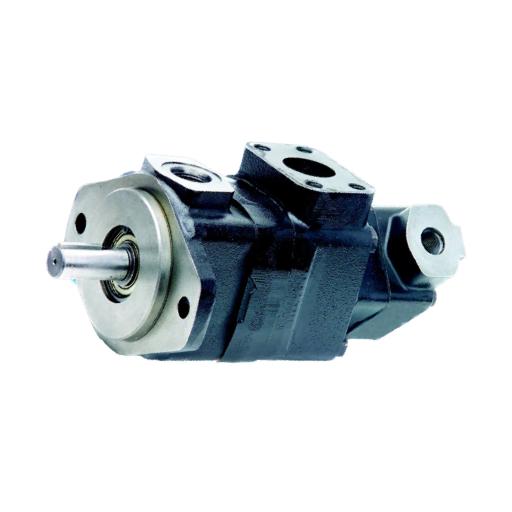
These steps are ordered by effect per unit of effort, not by how often they appear in supplier literature. Steps 1 to 3 usually deliver more than step 6, and cost less.
- Fix the inlet. Restore full-bore suction, remove or coarsen the strainer, keep suction velocity below 1.2 m/s, keep oil about 3 in above the suction inlet, and submerge the return. Cheapest step, largest effect when the pump is cavitating.
- Reduce speed or increase displacement. Take the 2 dB(A) the frame table shows, and the longer service life that comes with it.
- Fix the coupling and the mounting. Align within the manufacturer’s tolerance. Use resilient mounts with a natural frequency no more than half the rotational frequency, so a 1,800 rpm drive at 30 Hz needs mounts tuned to 10 Hz or lower, as . Isolate the pump and motor group from the base rather than the base from the floor.
- Decouple the structure. Put a flexible hose section at the pump outlet and at the tank return, in straight runs. Wilkes measured a 2 to 3 dBA penalty for adding 12 ft of outlet and return line, and an average 5 dB(A) gain from reconfiguring hose routing alone. Use bent metal tubing rather than elbow fittings; both 90- and 180-degree bends raised noise.
- Damp the discharge line. An inline suppressor at the pump outlet beats a tee’d-off accumulator because the flow path is shorter. Charge it to 50 to 60% of system pressure; units of that type absorb above 600 Hz. In Wilkes’ case, sixty double-pump units measured 82 dBA against an 80 dBA limit, and outlet suppressors brought them to 78 dBA. For low frequencies, the alternative is a bladder accumulator sized on an amplitude factor, with a precharge-to-mean-pressure ratio between 0.6 and 0.9 and mounted within about 10 ft of the source. Those amplitude factors are published for piston and plunger pumps, not for vanes, so a vane application needs to be sized from a measured ripple rather than from the table.
- Enclose only as a last step. Insertion loss runs about 5 to 10 dB(A) for basic acoustic panels, 10 to 15 dB for a fully isolated enclosure, and better than 15 dB combined with an already quiet pump. A badly designed enclosure can raise internal noise by 5 to 8 dBA and will overheat the oil if it is not ventilated.
One caveat belongs at the end. The real pulsation levers are inside the pump: cam ring profile, port timing, silencing grooves, pre-compression. A buyer cannot reach any of them. That makes them a selection decision, not a maintenance decision.
Specifying for quiet: what to ask for
Ask for a sound level with four conditions attached: pressure, speed, fluid and viscosity, and the test standard with its distance. A dB(A) figure missing any of those is not a specification, and a supplier who cannot supply them has not measured the pump.
Ask whether the pump is single- or double-acting and how many vanes it carries. Fewer vanes means a lower pulsation frequency and a higher amplitude, which matters more on a metering circuit than on a transfer duty.
Ask for pressure ripple data if the application is ripple-sensitive. Very few suppliers can produce ISO 10767-1 figures, and asking is the quickest way to find out which ones are serious.
For multi-section pumps, budget the published 1 to 3 dB(A) penalty over a single section when both are loaded. That is a real number on a real table, and it disappears from a quotation unless somebody asks.
Above roughly 250 bar continuous, noise is one of several reasons to stop looking at vane pumps at all. The explains where that line sits.
Ready to specify against a number rather than a family average? Send the duty point, the mounting arrangement, and the noise limit, and we will come back with frames that meet all three, with the test conditions stated on the quotation.
Frequently asked questions
Why is my vane pump so noisy?
The likeliest cause is a restricted or leaking inlet, which produces cavitation or entrained air. Check the strainer, suction hose, oil level, and suction fittings before suspecting the pump. If the noise began suddenly, start with the symptom decoder rather than this page.
What is a normal noise level for a vane pump in dB(A)?
A healthy vane pump runs 55 to 70 dB(A) at 1 m, and a balanced 12-vane pump measures 62 to 69 dB(A) at 138 bar on published frame data. Read any figure with pressure, speed, fluid, and test standard attached.
Why does my vane pump get louder as pressure increases?
Vane loading and internal leakage both rise with pressure, so the pump does more work and radiates more sound. Published data shows a 5 dB(A) rise on the same pump from 35 bar to 210 bar. A pump that got louder as its duty crept up is telling you it is overworked.
What is the difference between pump noise and pump pulsation?
Pulsation is a periodic fluctuation of flow and pressure at the outlet, with a frequency you can calculate and damp. Noise is the airborne sound, which may or may not come from that pulsation and often comes from the inlet or the structure instead.
Can an accumulator reduce vane pump noise?
It can, when the noise is driven by pulsation at a frequency the accumulator is tuned for. It does nothing for cavitation hiss in the kilohertz range or a structural resonance in the mounting, which is why the inlet and the mounting come first.
How do I calculate vane pass frequency?
Multiply the shaft speed in rpm by the number of vanes and divide by 60. A 12-vane pump at 1,500 rpm gives 300 Hz, with harmonics at 600, 900, and 1,200 Hz. Compare that against your measured peak to confirm whether the noise is vane-pass driven.
Conclusion
Five points carry the outcome:
- A vane pump is quiet because of its geometry at a condition, not because of its name. Change the condition, and the claim expires.
- Vane pump noise and pulsation are separate problems. Pulsation has a calculable frequency and responds to damping hardware; noise frequently has neither property.
- Speed is the biggest lever, and the cheapest to pull at the specification stage.
- The inlet causes the worst noise and costs the least to fix. Start there, every time.
- A dB(A) figure without pressure, speed, fluid, and standard is a marketing number, whether it comes from a competitor or from us.
The next physical step is a measurement, not a purchase. Take a reading at a fixed point, at a known load, speed, and oil temperature, and write it in the maintenance log. Everything on this page follows from having that number.
If the pump is healthy and the limit is real, send us the duty point and the limit together, and we will quote against both, with the test conditions stated.