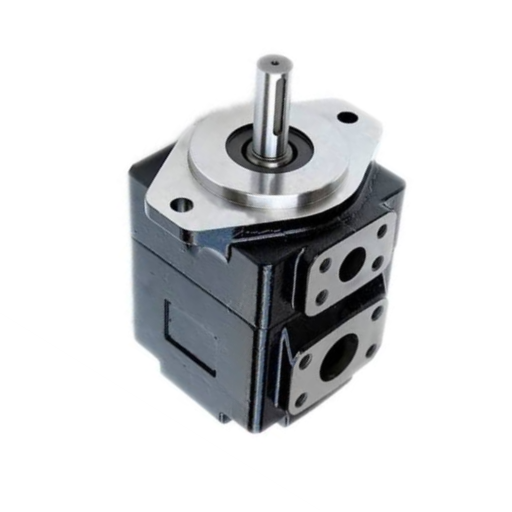
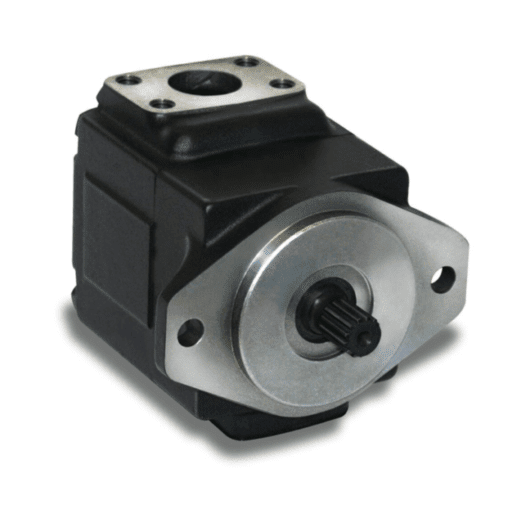
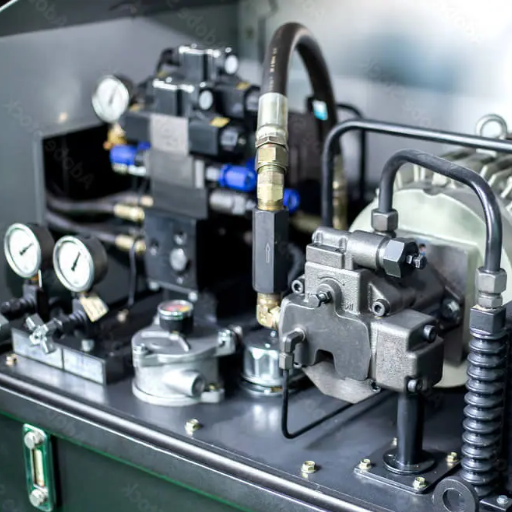
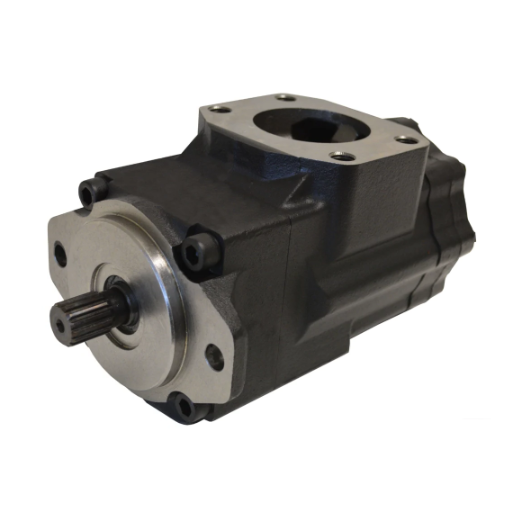
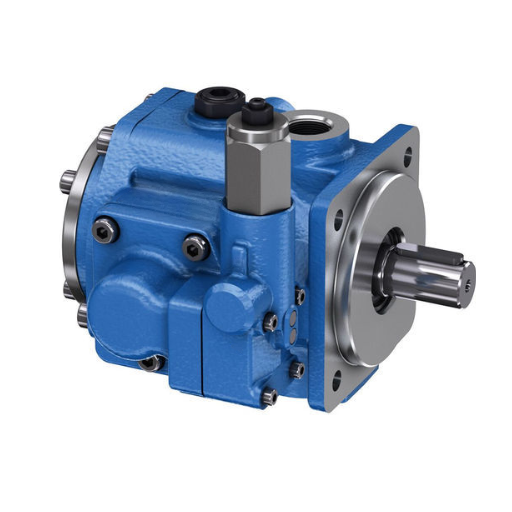
A vane pump cross-reference maps one model or part number to a candidate replacement. It’s a lead, not a guarantee. The number tells you where to look; eight fit points decide whether the pump will work.
Two suppliers can return two different equivalents for the same tag, and both charts can be honest. That happens when each chart stops at the base model, and neither asks for rotation, port position, or shaft type. The disagreement is not the problem. The missing fields are.
This guide covers how to read the four model-code systems that dominate industrial vane pumps, what a cross-reference actually proves, the eight parameters that decide fit, and the red flags that turn a cheap replacement into a second failure.
Scope: industrial hydraulic vane pumps from Vickers, Denison, Tokimec, and Yuken, plus verified aftermarket equivalents. It doesn’t cover vacuum pumps, fluid-transfer pumps, or automotive power-steering pumps, which share the name and little else. For the full family overview, first start with our complete guide to high-pressure vane pumps.
Key Takeaways
- A cross-reference number identifies a candidate, not a fit. The full stamped code, including suffix, is the unit of interchange.
- No OEM-published cross-brand vane pump chart appeared in the public catalogs reviewed for this guide. Every cross-brand table is a supplier claim.
- Displacement is one of eight fit points. Flange, pilot, shaft, ports, rotation, configuration, and control decide the rest.
- A Vickers V and a VQ of the same frame are different duty classes, and a chart that matches only displacement will hide that.
- The Vickers numeric code is nominal flow at 1,200 rpm, not displacement in cc/rev.
What a vane pump cross-reference actually tells you
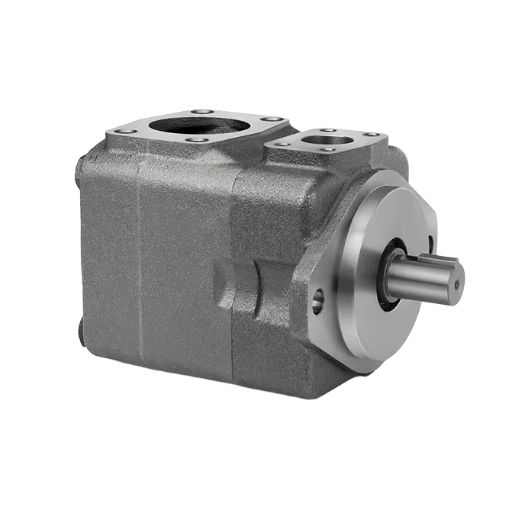
A cross-reference is a lookup from an original number to another number that a supplier says will replace it. The useful question is not whether a chart contains your number. It is what kind of equivalence the chart is claiming.
Four different claims get called “interchangeable,” and they carry different levels of proof.
| Claim | Example | What it proves | What it does not |
|---|---|---|---|
| OEM supersession | Old OEM number replaced by a new OEM number | Same maker, same fit, same support path | Aftermarket availability or price |
| Same-brand revision | 25V17A-1A22R to a later design number | Form and fit within the series | Cross-brand equivalence |
| Aftermarket fit-form-function | Metaris MV/MVQ offered for Vickers V/VQ | The supplier’s dimensional and performance claim | Performance at every duty point |
| Dimensional equivalent | Measured interface match | Physical fit | Pressure class, speed, control, or life |
Only the first is a statement from the original manufacturer. The second is a revision, not a substitute brand. The third and fourth are the ones most buyers need, and the ones that require verification.
Are vane pumps interchangeable? Only when every interface and performance parameter matches: displacement at a stated speed, pressure class, mounting flange and pilot, shaft, ports, rotation, and single or double configuration. A cross-reference number identifies a candidate. It does not prove fit.
Have the tag in hand? Send the full stamped string, including any prefix and the trailing rotation letter, and we will check it against the current catalog before you commit to a number.
Why no single vane pump interchange chart exists
Every major family encodes different information in a different order. Vickers puts frame and nominal flow near the front. Denison uses a frame letter and either a numeric or a B-code displacement. Tokimec treats the whole SQP string as the identity. Yuken uses a short series code plus suffix letters.
There’s no shared cross-brand standard, and no OEM-published chart mapping one maker’s pump to another’s. None appeared in the public catalogs reviewed for this guide. What exists is three separate things: OEM catalogs that define one maker’s ordering code, distributor tables that associate part numbers, and aftermarket cut sheets that claim fit-form-function equivalence for one family.
Each is useful. None is a compatibility guarantee, and the aftermarket category has an extra trap: supplier model names often imitate OEM series. A KCL “VQ35” is a KCL model, not a Vickers VQ35. A Hydrank “H-SQP” is a Hydrank designation, not a Tokimec code.
Brand lineage adds another layer. Vickers became part of Eaton in 1999, and Eaton’s hydraulics business was acquired by Danfoss in 2021, so a Vickers tag may now route through a Danfoss distributor. Parker acquired Denison in 2003. A pump that looks orphaned may still have a live support path through the current owner.
The manufacturer documents are the place to start: the for the current Vickers-line range and ratings, the Eaton master catalog (publication 560) for the full ordering code, and the for Denison.
Decode the nameplate: four model-code families
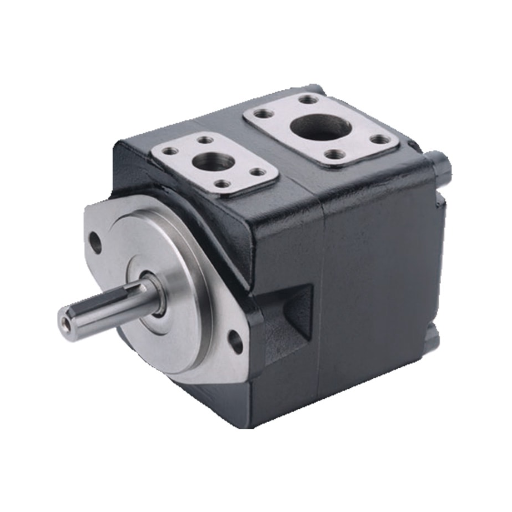
The first rule applies to every family: photograph the entire tag, both faces if there are two, and transcribe every character. The base model is not enough. Prefixes for seal material and suffixes for rotation and design change the part.
If the tag is missing or unreadable, identify the pump from the machine instead. The page covers the physical differences between families, and the machine’s serial number plate is often a better lead than a guess.
Vickers V and VQ
The common Vickers format reads as frame, series, displacement, port, shaft, outlet position, design number, and rotation. A seal prefix or suffix may be added.
| Position | Example | Meaning |
|---|---|---|
| Frame | 25 | 20, 25, 35, or 45 series |
| Series | V or VQ | Industrial V class or higher-speed VQ class |
| Displacement | 17 | Nominal flow code, not cc/rev |
| Port | A | SAE 4-bolt flange; other letters denote straight thread or mixed |
| Shaft | 1 | Straight keyed; other codes cover heavy-duty keyed and splined |
| Outlet position | A | Opposite the inlet; B, C, and D rotate the outlet |
| Design | 22 | Revision level, not a pressure rating |
| Rotation | R | Clockwise viewed from the shaft end; L is counterclockwise |
A worked example: 25V17A-1A22R is a 25 frame, V series, displacement code 17, SAE 4-bolt port, straight keyed shaft, outlet opposite the inlet, design 22, right-hand rotation. That string is what a supplier needs. “25V17” is not.
The displacement code is the part most often misread. On published ratings, 25V17 delivers about 17 gpm at 1,200 rpm, which corresponds to roughly 55 mL/r. The code tracks nominal flow at 1,200 rpm; it is not a displacement figure in cc/rev. Convert it without the catalog, and the arithmetic will be wrong.
Doubles add a second frame and displacement: 3525V38A21-1AA22LV is a 35/25 tandem with a 38 code on the shaft end, a 21 code on the cover end, two outlet positions, and a V seal suffix.
Two details matter at the counter. The F3 prefix denotes Viton seals on many Vickers assembly numbers.
A tag may also carry an assembly number such as 02-137113-1 rather than a model string. Distributor listings associate 02-137113-1 with 25V17A-1A22R, 591010 with 25V17A-1C22R, and 02-137135-2 with F3-35V25A-1B22R. A chart indexed by model code will return nothing for an assembly number until it is decoded.
V and VQ are not interchangeable duty classes. Published catalog summaries put the V class around 175 bar and 1,800 rpm, and the VQ class around 210 bar with higher speed limits. Ratings vary by frame and displacement, so confirm the exact row. A chart that matches frame and displacement but ignores V versus VQ has matched the mounting, not the duty.
Published sources also differ on whether outlet position is read from the cover end or the shaft end. Use the current OEM catalog for the frame, and treat a legacy document as a second opinion. The carries the frame data; the covers the wider range.
Video slot: embed a manufacturer or training video that shows a Vickers nameplate being read field by field, or a teardown that identifies the cartridge and cam ring. Confirm the video is live and shows the actual component before publishing.
Denison and Parker T6, T67, and T7
Denison codes carry a frame letter, a displacement code, and a run of suffix groups. Parker’s catalog defines the groups, and the group counts change with the options fitted.
| Group | Values | Meaning |
|---|---|---|
| Frame | T6C, T6D, T6E | Small, mid, and large frame |
| Displacement | 014 or B22 | Numeric code or B-code; both appear in documentation |
| Shaft | 1, 2, 3, 4, T | 1 keyed SAE, 2 keyed non-SAE, 3 splined SAE, 4 splined non-SAE, T splined J718c |
| Rotation | R or L | Clockwise or counterclockwise, viewed from the shaft end |
| Port position | 00, 01, 02, 03 | Opposite inlet, inline, 90 degrees CCW, 90 degrees CW |
| Design | A1, A0 | Current and earlier revisions |
| Seal class | 1, 4, 5 | S1 mineral oil and NBR, S4 resistant fluid, S5 mineral plus fire-resistant |
The B-code causes the most errors. Parker defines it as flow in litres per minute at 1,500 rpm and 0 bar, not as displacement. A numeric code such as 014 and a B-code such as B22 are two systems that coexist in T6 documentation. Mixing them produces a pump that is the wrong size and looks right on paper.
Parker’s service information also states that 7B, 6C, and 6CM cartridges share external dimensions and interchange in the same housing position, and that 7D with 6D and 7E with 6E do the same. The has the frame specifications.
Tokimec SQP
The SQP string is the identity. Published decodings read it as series, shaft-end flow code, port connection, cover-end flow code on doubles, shaft type, outlet position, design number, and rotation. Singles and doubles do not carry the same number of groups, so match the whole string.
Shaft codes commonly seen are 1 for straight keyed, 86 for heavy-duty keyed, and 11 for splined. Design number 20 appears in current strings, and rotation sits at the end. A triple might read SQP321-30-21-12-86CCC-18; a single will be shorter.
Aftermarket listings put the SQP1 to SQP4 classes at roughly 7.5 to 45, 32.5 to 67, 67 to 142, and 138 to 237 mL/r, with a maximum around 207 bar and 1,800 rpm. Treat those as class ranges from supplier literature, not a rating for every displacement. The lists the models we supply.
Yuken PV2R
Yuken’s code is shorter and more regular. PV2R1 through PV2R4 identify the frame, and suffix letters define the mount, shaft, rotation, and port position.
| Suffix | Meaning |
|---|---|
| F | Flange mount |
| 1 or 2 | Main or minor shaft |
| R or L | Right or left rotation, viewed from the shaft end |
| E, F, G, H | Outlet position |
| A or B | Inlet at top (standard) or bottom |
Cartridge kits use a separate prefix: PC for a single-pump kit and PCT for the cover end of a double. Catalog ranges run from about 6.1 to 30.6 mL/r for PV2R1, 25.4 to 74.5 for PV2R2, 51.5 to 152.8 for PV2R3, and 136 to 237 for PV2R4, with the largest frame in a lower pressure class.
For broader information, our high-pressure vane pump series guide covers the full cross-brand map.
The eight fit points
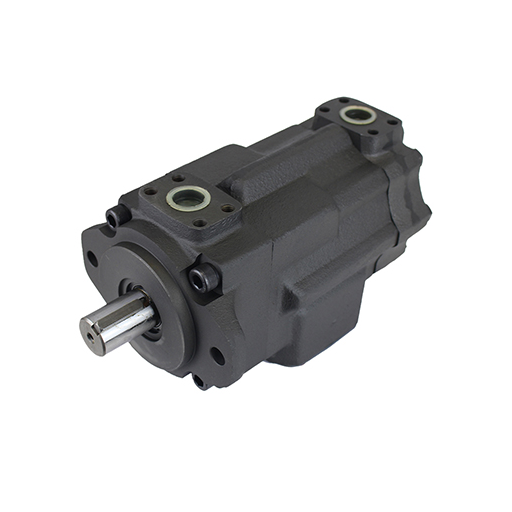
A cross-reference can pass on displacement and still fail at the flange. Record these before you accept any equivalent.
| # | Parameter | Record | Confirm by | Common mismatch |
|---|---|---|---|---|
| 1 | Displacement and flow | cc/rev, plus gpm at a stated speed | Nameplate code and OEM table | Chart quotes flow at a different rpm |
| 2 | Pressure class | Continuous, intermittent, or peak | OEM row for that frame | V and VQ classes confused |
| 3 | Flange and pilot | SAE A, B, or C; 2- or 4-bolt; pilot diameter; bolt circle | Calipers on the flange | “2-bolt” assumed; pilot differs |
| 4 | Shaft | Keyed or splined, diameter, length, key, spline count | Calipers and OEM drawing | Spline count or length differs |
| 5 | Ports | Type, thread or flange, size, position | Thread gauge and centerlines | Inlet and outlet reversed or moved |
| 6 | Rotation | CW or CCW viewed from the shaft end | Tag and catalog | Chart ignores the L suffix |
| 7 | Configuration | Single, double, or triple, with section displacements | Tag and outlet count | Tandem section sizes unmatched |
| 8 | Control and seals | Fixed or variable, compensator type, seal material | Tag suffix and duty | Wrong seal compound or missing control |
Rotation is the point most often omitted from a chart and the one that ruins a startup. Seal material is the one most often assumed, and it is the one that fails first on fire-resistant fluid or a hot duty. Where the frame has a case drain, confirm its position and size as well: a pump can fit the flange, match the shaft, and still be undrainable in the installed orientation.
Field note: Relieve system pressure and isolate stored accumulator energy before loosening any fitting. Hydraulic oil at system pressure can penetrate skin and cause a serious injection injury. Wear eye protection, and never use a hand to search for a leak.
Run the cross-reference in six steps
- Photograph and transcribe the full tag. Include both faces, any prefix such as F3, any assembly number, and the trailing rotation letter.
- Decode every field against the OEM catalog for that family, and write the meaning next to each character.
- Record the eight fit points on one sheet, adding the case drain where it applies.
- Generate candidates at series and class level. A chart is good for this step and no further.
- Demand dimensional verification against the OEM drawing, plus written confirmation of rotation, seal material, and the revision being replaced.
- Confirm the terms: test record, lead time, warranty, and whether anything on the machine must change.
Step 4 is where a series map helps. The table below collects class-level equivalence claims that aftermarket suppliers publish. Every row is a claim by the named publisher, not an OEM statement, and none is a part-number match.
| OEM family and series | Commonly claimed equivalent | Published by |
|---|---|---|
| Vickers V, 20V to 45V | Metaris MV; Fluidyne V-series; Bezares VV for part of the range | Metaris/Hydraulex; Northern Hydraulics; Bezares |
| Vickers VQ | Metaris MVQ | Metaris/Hydraulex |
| Vickers V10 and V20 | Fluidyne V10 and V20 | Northern Hydraulics |
| Vickers 2520V to 4535V tandems | Metaris tandem equivalents | Metaris/Hydraulex |
| Denison T6C, T6D, T6E | Veljan T6; KCL KT6C, KT6D, KT6E | KCL and distributor listings |
| Denison T67 | KCL KT67 | KCL |
| Denison T7B and T7BS | KCL KT7B and KT7BS | KCL |
| Tokimec SQP1 to SQP4 | Hydrank H-SQP; KCL DVQ20, 25, 35, 45 at class level | Hydrank; KCL |
| Yuken PV2R1 to PV2R4 | KCL VQ15, DVQ25, VQ35, DVQ45 at class level | KCL |
| Cross-family example | KCL VQ35 to Yuken PV2R3, Vickers 35V, or SQP3 | KCL |
A row in that table is a reason to request a quote, not a reason to place an order. The KCL cross-family row makes the point: one supplier model is claimed against three OEM families, which can only be true at the level of frame and approximate displacement. Shaft, port, and rotation still have to be matched one at a time.
Red flags, and what to do with an obsolete pump
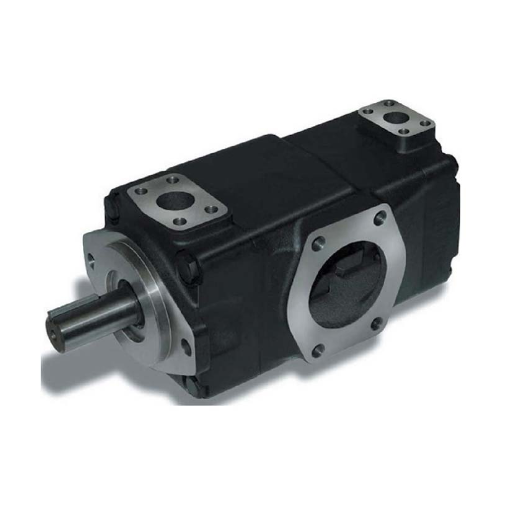
Most bad cross-references are recognisable before the order is placed. The failure is usually visible in the chart.
Red flags in an interchange claim
- “100% interchangeable” with no dimensional statement. A percentage isn’t a specification.
- A base code with no suffix. “25V17A” doesn’t define rotation, shaft, port, or seal.
- One pressure and one speed for every displacement in a frame. Real ratings change with size and speed.
- A Parker or Denison row mapped to a Vickers row without a code translation. The systems don’t align field for field.
- Rotation treated as a detail. It is the first thing to confirm, and the first thing a chart omits.
- An aftermarket name that imitates an OEM series. KCL VQ35 is not Vickers VQ35; Hydrank H-SQP is not Tokimec SQP.
- A price-only reply to an identification question, or a source that contradicts itself. If a page calls an 11-character code 13 positions long, stop reading.
When the pump is obsolete or renumbered
A discontinued plate does not always mean a discontinued pump. Trace the brand first, then the number. An assembly number such as 02-137124-4 can often be resolved to a model string, and a model string to a current series.
Eaton service literature, as cited by distributors, notes that complete cartridges are interchangeable with the previous design even when individual cartridge parts are not. That’s useful when the housing is sound, and only the rotating group is worn. It isn’t a licence to fit a new cartridge into a worn bore.
There are four honest options: new old stock if the exact number exists and the seals have not aged out; remanufactured if the rebuilder can show wear measurements and a test result; a verified aftermarket equivalent with dimensional and rotation confirmation; or a deliberate change of pump family and mount, which is the right answer when the duty has outgrown the old frame.
The machine serial number decides more of these cases than the pump tag does. Equipment makers changed pumps mid-production, and the same model year can carry two different flanges.
Sourcing a cross-referenced vane pump
The first quote is only as good as the information sent. A supplier who receives “25V17” will guess, and a supplier who receives the full string has no reason to.
Send the nameplate photo, the complete stamped code, any assembly number, the eight fit points, the machine make, model, and serial number, the fluid, and the duty cycle. Add photos of the shaft, the flange face, and the ports. That set answers most of the questions a good supplier would otherwise ask over three emails.
A competent reply contains the cross-reference number, a dimensional verification statement, written confirmation of rotation and seal material, the revision it replaces, a test record, a lead time, and warranty terms. If any of those is missing, ask before the order, not after the failure.
Genuine and aftermarket both have a place. Genuine carries the OEM warranty and an assured fit. A verified aftermarket unit from a supplier that can show dimensional verification and a test record can deliver the same function at a lower price. The deciding factor is evidence.
For a full guide on vetting suppliers, read our high-pressure vane pumps supplier verification guide.
Request a cross-reference check. Send the full tag and the eight fit points, and we will confirm the number, the rotation, and the seal before quoting. If the honest answer is that the pump is obsolete or the duty has outgrown the frame, we will say so.
Frequently asked questions
What does cross-reference mean for a vane pump?
It means matching an original model or part number to a candidate replacement. The match can be an OEM supersession, a same-brand revision, an aftermarket fit-form-function claim, or a measured dimensional equivalent. Only the first is an OEM statement, and none replaces the eight-point check.
Are Vickers and Denison vane pumps interchangeable?
Not as brands. Individual models can sometimes be matched on frame, displacement, flange, shaft, ports, and rotation, but the coding systems differ, and no OEM cross-brand chart exists. Treat any such row as a supplier claim to verify dimensionally.
How do I read a Vickers vane pump model number?
Read it as frame, V or VQ, displacement code, port, shaft, outlet position, design number, and rotation. In 25V17A-1A22R, the 25 is the frame, 17 is the nominal flow code, and the final R is right-hand rotation.
Can I replace a Vickers V pump with a VQ pump?
Only if the higher speed and pressure class are acceptable and every interface matches. V and VQ are different duty classes, so the swap can fit physically and still be wrong for the machine.
What does the 02 number on a Vickers pump mean?
It is an assembly or catalog number, not a model code. Distributor listings associate numbers such as 02-137113-1 with model strings such as 25V17A-1A22R. Decode the model string first, then use the assembly number to confirm the build.
How do I find a replacement for a discontinued vane pump?
Trace the brand’s current owner, resolve the assembly number to a model string, and record the eight fit points. Then choose between new old stock, remanufactured, a verified aftermarket equivalent, or a deliberate change of pump family.
Is a cross-reference number guaranteed to fit?
No. It identifies a candidate. Fit depends on the full interface and duty match, and the only reliable confirmation is a dimensional check plus written rotation and seal confirmation.
Conclusion
Five points carry the decision:
- A vane pump cross-reference is a lead, not a guarantee. The full stamped code is the unit of interchange.
- No OEM publishes a public cross-brand vane pump chart. Every cross-brand table is a supplier claim with a supplier’s naming.
- Displacement is one of eight fit points. Rotation and seal material are the two most often missed and the two that fail first.
- The Vickers numeric code is nominal flow at 1,200 rpm, and the Denison B-code is flow at 1,500 rpm. Neither is cc/rev.
- A discontinued brand plate is not the same as a discontinued support part.
The next step is a photograph and a measurement, not a purchase. Write down the full tag, measure the flange, pilot, shaft, and ports, and put the eight points on one sheet. Every supplier conversation gets shorter after that.
If the tag is worn or the chart disagrees with itself, send us what you have. We will decode it against the current catalog and tell you what matches, what does not, and what to measure next.