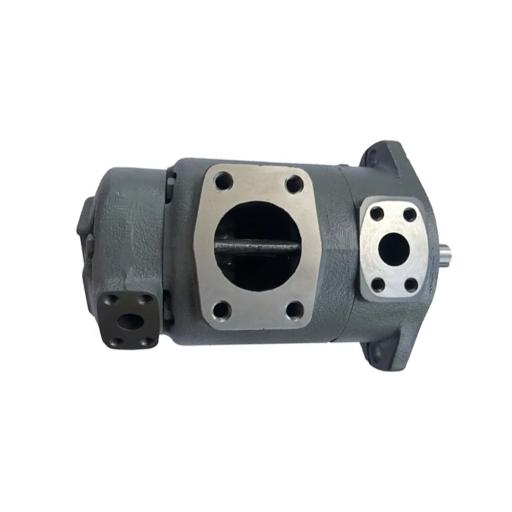
In a Daikin RP model code, RP15A1-22-30 means an RP15 frame (14.8 cm³/rev) with A pressure-compensator control, pressure code 1 (an adjustable range of 1.5 to 7 MPa), a 2.2 kW motor, and design number 30. The 22 is motor output, not 22 MPa.
That single correction prevents most of the wrong orders this series attracts. A buyer reads -22- as a pressure, orders expecting a 22 MPa build, and receives a 7 MPa machine with a 2.2 kW motor bolted to it. The pressure is the digit before the first dash. The two digits after it are the motor in kilowatts times ten.
A Daikin RP series model code packs thirteen positions into one line: frame, control method, pressure range, motor, voltage, design number, remote control, and mounting. This guide decodes each position from the RP catalogue, shows which combinations the catalogue actually permits, and ends with the string to put in a quote request.
It covers the hydraulic RP rotor pump only. Daikin also uses RP in air-conditioning model numbers, and a search for an RP code will surface those first. If you need the pump construction rather than the code, start with what a hydraulic rotor pump is.
Key Takeaways
- A Daikin RP code has 13 positions;
RP15A1-22-30decodes as RP15 frame, A control, pressure code 1, 2.2 kW motor, design 30, foot mounted, no remote control.- The digits after the dash are motor output in kW times ten.
-22-is 2.2 kW, and it’s never 22 MPa.- The pressure digit sets an adjustable range, not a set pressure. Code 1 is 1.5 to 7 MPa, and the pressure screw sets the cut-off inside that band.
- Not every combination exists: code 3 (21 MPa) is offered only on RP15 at 2.2 kW, RP23 at 3.7 kW and RP38 at 5.5 kW, and no RP08 build reaches 21 MPa.
- Remote control is not a free suffix. With RC the adjustable floor rises to 2.0 MPa and the legal motor can change, so confirm the whole string before ordering.
What a Daikin RP series model code can and cannot tell you
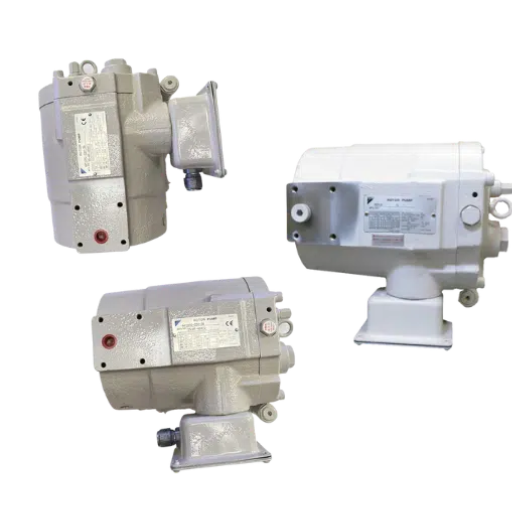
The code describes how the pump is built. It answers the first question a quote desk asks: which frame, which control, which pressure range, which motor, and which supply.
What it doesn’t describe is the duty. The code gives the adjustable range of the pressure compensator, not the pressure at which the pump is currently set. Nor does it state the discharge-rate setting, the oil grade, the filtration, the port and flange arrangement, the relief valve, or the drain piping. Those are set with screws on the pump or specified separately on the datasheet and handling pages.
| The code tells you | The code doesn’t tell you |
|---|---|
| Frame and displacement | Actual cut-off pressure setting |
| Control method (A or C) | Discharge-rate setting within the range |
| Adjustable pressure range | Oil grade, viscosity, and cleanliness |
| Motor output and supply voltage | Ports, flanges, and relief valve |
| Remote control and mounting | Drain arrangement and electrical protection |
Two limits follow from that. The code belongs to the hydraulic RP rotor pump, so it shouldn’t be cross-read with Daikin’s air-conditioning codes or with the V and VZ piston pump ranges, which use their own ordering logic. And a string copied from a listing without its pressure digit isn’t an ordering code at all, because the digit is what selects the build.
The 13 positions of a Daikin RP series model code
A Daikin RP series model code is a 13-position ordering string naming the frame, the control method, the pressure adjustment code, the motor output, the supply voltage, the design number, the remote-control option and the mounting. Take RP15A1-22-30 as the working example.
| Pos. | Element | Example | Meaning |
|---|---|---|---|
| 1 | Model | RP | RP series rotor pump |
| 2 | Capacity | 15 | 08 = 8.0, 15 = 14.8, 23 = 24.4, 38 = 37.7 cm³/rev |
| 3 | Control method I | A | A = pressure compensator; C = combination control |
| 4 | Pressure range (A) | 1 | Code 1, 2 or 3 from the pressure range table |
| 5 | Low range (C) | Not used | Low-pressure code, 1 or 2 only |
| 6 | High range (C) | Not used | High-pressure code, 1, 2 or 3 |
| 7 | Control method II (C) | Not used | H = pressure feedback; J = solenoid operated |
| 8 | Solenoid voltage (CJ) | Not used | A = AC 100/110 V; B = AC 200/220 V; P = DC 24 V |
| 9 | Motor output | 22 | 07 = 0.75, 15 = 1.5, 22 = 2.2, 37 = 3.7, 55 = 5.5 kW |
| 10 | Voltage | (blank) | Blank = AC 200/220 V; X = AC 230 V; Y = AC 380 to 460 V |
| 11 | Design number | 30 | Current design number; subject to change |
| 12 | Control method III | (blank) | Blank = without remote control; RC = with remote control |
| 13 | Installation | (blank) | Blank = foot support; T = vertical, RP08 and RP15 only |
The positions don’t all run in a straight line. An A-control string puts the pressure digit before the first dash and the voltage letter after the motor code. A C-control string puts two pressure digits side by side before H or J, low range first. That’s why RP23C22H-22-30 has four digits in a row before the dash and still decodes cleanly once you know the order.
Decode RP15A1-22-30 position by position
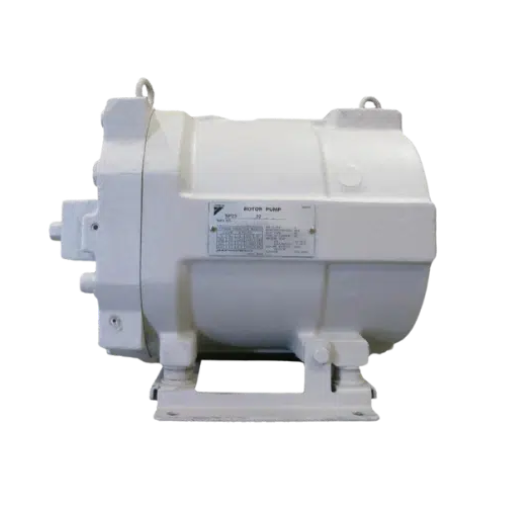
Read the string from left to right, and the arithmetic is simple.
- RP is the series.
- 15 is the frame, at 14.8 cm³/rev with a 60 Hz flow range of 12.0 to 25.0 L/min.
- A is pressure-compensator control, the single-pressure control that holds a set pressure by adjusting displacement.
- 1 is the pressure code, an adjustable range of 1.5 to 7 MPa.
- 22 is a 2.2 kW, 4-pole motor with Type B insulation, the larger of the two offered on this frame.
- 30 is the design number.
- Nothing follows, so the motor is the standard AC 200/220 V version; there’s no remote control, and the pump is foot-mounted.
The mass for this build is about 45 kg, and the flow range is a discharge-rate adjustment range, not a measured flow at any duty pressure.
The number that trips people up is the pressure code. RP15A1-22-30 isn’t a pump “set to 7 MPa”. It’s a pump whose compensator adjusts anywhere from 1.5 to 7 MPa, with the pressure adjusting screw setting the cut-off inside that band. Turn the screw clockwise, and the setting rises.
The same frame and motor with code 2 gives 1.5 to 14 MPa, and with code 3 gives 3.5 to 21 MPa.
| String | Pressure code | Adjustable range | Motor | Same frame? |
|---|---|---|---|---|
| RP15A1-22-30 | 1 | 1.5 to 7 MPa | 2.2 kW | Yes |
| RP15A2-22-30 | 2 | 1.5 to 14 MPa | 2.2 kW | Yes |
| RP15A3-22-30 | 3 | 3.5 to 21 MPa | 2.2 kW | Yes |
One catalogue inconsistency is worth knowing before you quote a range. The nomenclature page prints the A-control summary as 2.5 to 7 MPa for code 1 and 2.5 to 14 MPa for code 2. The pressure range table that the same page points to gives 1.5 to 7 and 1.5 to 14 without a remote valve.
The table is the operative document, and this guide follows it. If a seller quotes 2.5 MPa, ask which page they took it from.
Pressure codes and motor codes that go together
Pressure code and motor aren’t independent choices. The catalogue lists the legal frame, code, and motor combinations, and a string that breaks the table isn’t a build you can order.
| Code | Range, no remote | Range, with RC | Legal frames and motors, no RC |
|---|---|---|---|
| 1 | 1.5 to 7 MPa | 2.0 to 7 MPa | RP08, RP15, RP23, RP38 at any listed motor |
| 2 | 1.5 to 14 MPa | 2.0 to 14 MPa | RP08, RP15, RP23, RP38 at any listed motor |
| 3 | 3.5 to 21 MPa | 2.0 to 21 MPa | RP15 at 2.2 kW; RP23 at 3.7 kW; RP38 at 5.5 kW |
Three rules fall out of that table.
First, code 3 always uses the larger motor of its frame. The 21 MPa build exists on RP15 at 2.2 kW, RP23 at 3.7 kW, and RP38 at 5.5 kW, and nowhere else. A string such as RP23A3-22-30, which asks for 21 MPa on the 2.2 kW RP23, isn’t a catalogue build even though every individual position looks plausible.
Second, no RP08 build reaches 21 MPa. The smallest frame tops out at code 2, and the catalogue adds a restriction on RP08 in the 7 to 14 MPa band, so a 14 MPa RP08 order deserves a second look at the duty.
Third, remote control isn’t a free suffix. With RC fitted, code 1 exists only on RP08 at 0.75 kW. Code 2 on RP15 is limited to 1.5 kW and on RP23 to 2.2 kW. The RC version of code 3 keeps the same three large-motor pairings and drops its adjustable floor from 3.5 to 2.0 MPa.
Motors come in five outputs, all 4-pole with Type B insulation.
| Motor code | Output | Frames it’s offered on |
|---|---|---|
| 07 | 0.75 kW | RP08 |
| 15 | 1.5 kW | RP15 |
| 22 | 2.2 kW | RP15, RP23 |
| 37 | 3.7 kW | RP23, RP38 |
| 55 | 5.5 kW | RP38 |
The frame table adds displacement, flow, and mass, which is what a buyer needs to check the machine envelope.
| Frame and motor | Displacement (cm³/rev) | Flow range, 60 Hz (L/min) | Mass (kg) |
|---|---|---|---|
| RP08A-07 | 8.0 | 4.8 to 14.0 | 30 |
| RP15A-15 / -22 | 14.8 | 12.0 to 25.0 | 45 |
| RP23A-22 | 24.4 | 20.0 to 42.0 | 67 |
| RP23A-37 | 24.4 | 20.0 to 42.0 | 73 |
| RP38A-37 | 37.7 | 20.0 to 64.0 | 73 |
| RP38A-55 | 37.7 | 20.0 to 64.0 | 87 |
The frame column above uses the catalogue’s wildcard form, where the pressure digit is replaced by a marker. That form suits a family table and fails as an order. A string without the pressure digit doesn’t specify a build, which is why listings that print RP15A-22-30 leave the most important decision open.
If the frame is still undecided, the RP selection guide works through flow, pressure and duty cycle in order. This page assumes the frame is chosen and the code is the question.
Voltage, remote control, vertical mounting, and the design number
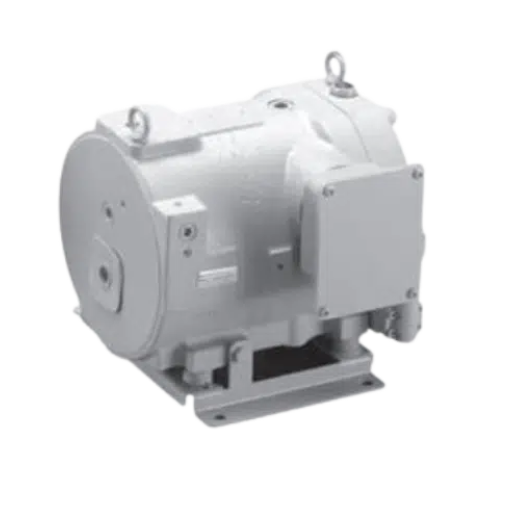
The last four positions are the ones most often dropped from a short-form Daikin RP series model code, and each changes what ships.
Supply voltage. A blank in position 10 means AC 200 V at 50 or 60 Hz, or AC 220 V at 60 Hz. X means AC 230 V at 50 Hz. Y covers the 380 to 460 V band: 380 V at 50 Hz, 400 V at 50 or 60 Hz, 415 V at 50 Hz, 440 V at 60 Hz and 460 V at 60 Hz. A 400 V plant in Europe or Asia carries a Y in the string.
Remote control. RC follows the design number, as in RP15A1-22-30RC. It adds a remote pressure-compensator valve so the cut-off can be set away from the pump. As the previous section showed, it also changes the adjustable floor and, on some frames, the legal motor. It appears only in the A-control template, and the catalogue doesn’t show it on a C model.
Mounting. T means vertical installation and applies to RP08 and RP15 only, written after RC with a dash, as in RP15A1-22Y-30RC-T. The catalogue adds a condition: vertical mounting needs a rigid base, because the vibration-absorbing rubber pad under the foot does nothing in that orientation. T doesn’t appear on C models either.
Design number. The 30 before any suffix is a design number, and the catalogue states it’s subject to change. It isn’t a pressure, a revision letter, or a serial. If a nameplate shows a different value, quote what the nameplate says instead of correcting it to 30.
Suffixes beyond that are a separate matter. Strings in the market carry forms such as -001, -002, -150 and a J- prefix, for example RP15A3-22Y-30-150 or J-RP15A2-22Y-30. None appears in the 13-position nomenclature, so none can be decoded from it. Treat the part before the suffix as the pump and ask the supplier to confirm the rest, rather than guessing a seal, a paint, or a special motor.
Reading a C-control model code
In a Daikin RP series model code, C control is the two-pressure version, built for a cycle that approaches at low pressure and holds at high pressure. The string differs from an A code because it carries two pressure digits and a switch type.
The layout is RP + capacity + C + low digit + high digit + H or J + solenoid voltage letter (J only) + - + motor + voltage + -30. So RP23C22H-22-30 is an RP23 frame, combination control, low code 2, high code 2, pressure feedback, 2.2 kW motor, design 30. The methods themselves are described on the catalogue’s control method pages.
| Code | Low range | High range | Available on |
|---|---|---|---|
| 1 | 2.5 to 7 MPa | 2.5 to 7 MPa | RP15, RP23, RP38 |
| 2 | 2.5 to 14 MPa | 2.5 to 14 MPa | RP15, RP23, RP38 |
| 3 | not offered | 3.5 to 21 MPa | RP15, RP23, RP38 |
Four limits come with this family. There’s no C model on RP08. The low digit stops at 2, so only the high digit can be 3. Every C row is listed at a 21 MPa maximum, but the high digit sets the actual ceiling, so a code 1 C pump is a 7 MPa pump.
The high range can also be restricted by the low setting, which the catalogue notes and illustrates with adjustment graphs. A wide gap between the two settings is worth checking before the order.
H and J are the two methods. H uses pressure feedback, switching the high-pressure side with a pilot signal from the low-pressure side. J uses a solenoid, which adds a solenoid voltage code: A for AC 100 or 110 V, B for AC 200 or 220 V, P for DC 24 V. Both are ordering decisions rather than accessories, and the mass differs between them on the larger frames.
Worked examples of the Daikin RP series model code
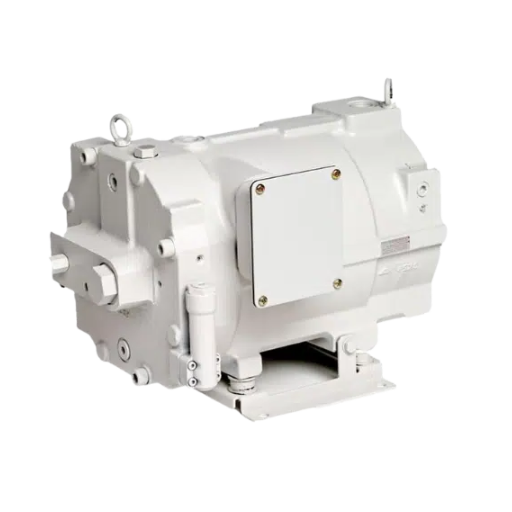
Four strings cover most of what a buyer is likely to hold, and each one is a complete Daikin RP series model code.
| String | Frame and displacement | Code | Motor | Note |
|---|---|---|---|---|
| RP08A1-07-30 | RP08, 8.0 cm³/rev | 1 (1.5 to 7 MPa) | 0.75 kW | 30 kg, 4.8 to 14.0 L/min |
| RP15A2-22Y-30 | RP15, 14.8 cm³/rev | 2 (1.5 to 14 MPa) | 2.2 kW | Y voltage, 380 to 460 V supply |
| RP23A2-37-30 | RP23, 24.4 cm³/rev | 2 (1.5 to 14 MPa) | 3.7 kW | 20.0 to 42.0 L/min, about 73 kg |
| RP38A2-55-30 | RP38, 37.7 cm³/rev | 2 (1.5 to 14 MPa) | 5.5 kW | Legal on the code table; confirm the build |
Two of these need a comment. The RP08 string is legal at code 1, and the same pump appears as RP08A2-07-30RC when it carries code 2 and remote control, which the catalogue lists. The RP38 string is legal on the pressure code table, but the frame table prints the 5.5 kW RP38 at its 21 MPa build with a 20.0 to 64.0 L/min range, so a 14 MPa version of that row should be confirmed with the supplier before it’s quoted as a catalogue item.
Before a quote request goes out, six checks close the gaps.
- Copy the string from the nameplate exactly, including the design number and every suffix.
- Confirm the pressure digit, and read it as a range rather than a rating.
- Check the motor output against the frame: the digits after the dash, times 100 W.
- Check that the frame, code, and motor combination appears in the pressure range table.
- Add the voltage letter, RC, and T if the machine needs them, and check that both are available on that frame.
- State the flow and pressure the machine actually needs, so the supplier can confirm the setting rather than just the build.
If you have the string and want to see how it maps to the range the site stocks, the Daikin RP series specifications page lists the frames and control options, and the Daikin rotor pump range covers the wider family. The same position-by-position method is worked through for another family in the triple vane pump model codes guide.
Frequently asked questions
What does RP15A1-22-30 mean?
It’s an RP15 frame at 14.8 cm³/rev with A pressure-compensator control, pressure code 1 (1.5 to 7 MPa adjustable), a 2.2 kW motor, design number 30, and foot mounting. The 22 is motor output in kW times ten.
What does the 22 mean in a Daikin RP series model code?
It’s 2.2 kW of motor output. The position is the motor code, not a pressure, and reading it as 22 MPa is the most common decoding error in this series.
What is the difference between RP15A1-22-30 and RP15A3-22-30?
Only the pressure code changes. Code 1 gives 1.5 to 7 MPa and code 3 gives 3.5 to 21 MPa, while the frame and the 2.2 kW motor stay the same. Code 3 on RP15 is legal only at 2.2 kW, which is why this pair works.
What do A and C mean in a Daikin RP model?
A is a pressure compensator with one adjustable range. C is combination control with a low and a high range, switched by pressure feedback (H) or a solenoid (J), for a cycle that needs two holding pressures.
What does the -30 at the end of an RP code mean?
It’s a design number. The catalogue states it’s subject to change, so quote the number on the nameplate rather than assuming 30 applies to every unit in service.
Why do some RP codes end in -001 or -150?
Those suffixes sit outside the 13-position nomenclature in the catalogue, so their meaning can’t be decoded from it. Confirm them with the supplier and keep them on the order line.
Conclusion
A Daikin RP series model code reads left to right, and the two positions that decide whether an order is right are the pressure digit and the motor digits.
- RP plus a capacity code sets the frame: 08, 15, 23, or 38.
- A and C are different templates, not two versions of one code. C carries a low digit, a high digit, and H or J.
- The digit before the dash is the pressure range code. Code 3 is restricted to three frame and motor pairings.
- The digits after the dash are motor output in kW times ten, never pressure.
- RC and T change more than the suffix suggests, and
-30is a design number that can change.
The next step is physical. Photograph the nameplate, copy the string character for character, and note the flow and pressure the machine needs at the working point. Send both to a supplier. The string fixes the build, and the duty point confirms the setting. That pair of facts is what turns a code into the right pump. Daikin’s official RP rotor pump page is the manufacturer’s own reference if you want to check the family definition first.