In March, a site manager named Dario pulled a 20-tonne excavator off a road job after its main pump began to whine under load. The unit had just 2,300 hours on it, barely a third of its expected life. The teardown found scored pistons and a pitted valve plate. The pump had not worn out from work. It had been destroyed by oil that had not been changed or tested in over a year.
That failure is the rule, not the exception. Industry data consistently ties 70 to 80 percent of hydraulic pump failures to fluid contamination and skipped service, not mechanical fatigue. An axial piston pump is a precision device with clearances measured in microns, so it punishes neglect faster than almost any other component in the system. Good axial piston pump maintenance is not complicated, but it must be scheduled, measured, and performed on time. It is also the highest-value discipline in any broader hydraulic pump maintenance program because the pump is both the most expensive and the most contamination-sensitive component in the system.
This guide gives you a complete preventive program: a service schedule by duty cycle, the oil and cleanliness specifications that actually extend life, a case drain check that predicts wear before failure, and a clear framework for deciding between rebuild and replacement.
Maintaining a fleet or planning a replacement? Contact us for a service interval review or a specification sheet matched to your pump and duty cycle.
How Often Should You Service an Axial Piston Pump?

Most axial piston pumps need an oil and filter change every 1,000 operating hours or once a year, whichever comes first. Severe duty cycles, contaminated environments, and breather-style reservoirs call for shorter intervals, often every 500 hours. The first change after a new or rebuilt pump is the most important one you will ever make.
The break-in change removes metallic particles generated as internal surfaces seat during the first hours of operation. Skip it, and those particles circulate through the valve plate and piston bores for the rest of the pump’s life.
| Service Point | Interval | Key Actions |
|---|---|---|
| Break-in change | First 50–100 hours | Change oil and filters; remove seating debris |
| Daily | Every shift | Check oil level, leaks, noise, temperature |
| Weekly / 50 hours | Weekly | Clean suction/return filters; check mounts and hoses |
| Monthly / 250–500 hours | Monthly | Oil change on severe duty; sample oil for analysis |
| Quarterly / 1,000 hours | Standard interval | Change oil and all filter elements; inspect seals |
| Annual / 2,000–5,000 hours | Yearly | Flush system; inspect bearings, valve plate, pistons |
Adjust for conditions. A pump on a clean, climate-controlled industrial press can stretch toward the top of the range. The same pump on a dusty quarry loader should be serviced at half the standard interval. Want to learn more about the axial piston hydraulic pump? Please check out our axial piston hydraulic pump complete guide.
Hydraulic Oil and Cleanliness: The #1 Life Factor
If you only manage one variable, manage the oil. Contamination is the leading cause of axial piston pump failure, which makes hydraulic oil cleanliness the highest-leverage part of any maintenance program.
Use the Right Oil
Most manufacturers specify an anti-wear hydraulic oil in the ISO VG 32 to 68 range, with an operating viscosity between 12 and 60 cSt. Running oil that is too thin starves the lubricating film between piston and bore. Running oil that is too thick causes cavitation and sluggish control response. Never mix different oil brands or types in the same system.
Hit the Cleanliness Target
Oil cleanliness is classified by ISO 4406 codes, a three-number rating of particle counts per milliliter at 4, 6, and 14 microns. The scale is logarithmic, so each single-step increase roughly doubles the particle count.
For axial piston pumps, target a cleanliness code of 16/14/11 to 19/17/14, and never run dirtier than the 19/17/14 minimum. Falling below that threshold accelerates wear and can void the manufacturer’s warranty. Systems operating above 172 bar should hold the tighter 17/15/12 code.
Filter and Sample Correctly
Use 10-micron absolute filtration with a beta ratio of β10 ≥ 200 on pressure and return lines. Change filter elements at every oil change or whenever the clogging indicator trips. Take an oil sample every 250 to 500 hours and test for viscosity, water content, particle count, and total acid number. Trending these values tells you whether the oil is aging, the system is ingesting contamination, or a component is beginning to wear.
For a closer look at the axial piston pump internal components, see our guide to axial piston pump parts.
Case Drain Flow: Your Best Wear Indicator
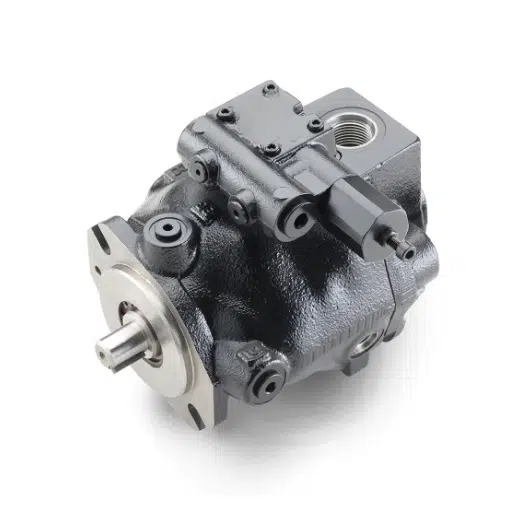
Every axial piston pump leaks a small, controlled amount of oil from its internal clearances into the housing. That leakage exits through the case drain line. Because the flow rises as internal surfaces wear, case drain flow is the single best predictor of remaining pump life, yet most maintenance programs never measure it.
Establish a baseline when the pump is new or freshly rebuilt. As a rule of thumb, case drain flow should stay below about 10 percent of the pump’s rated flow at a given pressure and speed. A rising trend, even before any external symptom appears, means internal leakage is growing and the pump is approaching the end of its service life.
A maintenance lead named Priya put this to work on a fleet of forestry forwarders. During a routine check, one machine’s case drain flow had climbed from 3 to 8 liters per minute over two months with no other symptom. She scheduled a planned rebuild for 2,100 during a scheduled service window. Three months later, an identical machine on the same site, never monitored, failed catastrophically in the field. That repair cost 6,800 plus two days of downtime.
On closed-circuit propel pumps, always drain from the topmost case port to keep the housing full of oil, and route the flow through a heat exchanger. The Danfoss Series 40 service manual identifies contaminated fluid as the main cause of unit failure and ties case drain management directly to service life. If you see a sudden spike in case drain flow combined with noise or heat, move to troubleshooting noise, heat, and pressure loss rather than routine maintenance.
Inspection Checklist by Component
A scheduled inspection catches wear that fluid checks alone miss. Work through the pump systematically, and match the method to the pump design.
Daily and weekly checks:
- Inspect for external leaks at the shaft seal, ports, and housing
- Verify reservoir oil level and look for milky or foamy oil, which signals water or air
- Listen for new noise and feel for abnormal housing temperature or vibration
- Check that mounting bolts, couplings, and hose connections are tight
Monthly and quarterly checks:
- Inspect the shaft seal for weepage and replace it at the first sign of a steady drip
- Check bearing play; most pump bearings have a design life near 10,000 hours
- Test pressure compensator and control settings against specification
- Sample oil and record particle count and water content
Annual and overhaul checks:
- Inspect the valve plate, pistons and shoes, and cylinder block for scoring or wear
- On swashplate designs, check the swashplate surface and slipper contact for uneven wear
- On bent-axis designs, inspect the drive shaft bearings and the pistons for side-load marks
- Verify charge pump output on closed-circuit systems
The design matters during inspection. A swashplate pump concentrates wear on the swashplate face and slipper pads, while a bent-axis pump loads its shaft bearings and pistons differently. Open-circuit pumps demand close attention to suction line condition because a starved inlet causes cavitation. Closed-circuit pumps depend on charge pressure and case drain health instead.
How Long Do Axial Piston Pumps Last?

A well-maintained axial piston pump typically lasts 10,000 to 20,000 operating hours in clean industrial service and 6,000 to 8,000 hours in mobile equipment. Harsh conditions or poor fluid control can cut that to 2,000 hours or less. The answer to how long axial piston pumps last depends far more on maintenance than on the pump itself.
| Application | Typical Service Life | Main Life Limiter |
|---|---|---|
| Industrial / stationary | 10,000–20,000 hours | Oil age, bearing wear |
| Mobile (excavators, loaders) | 6,000–8,000 hours | Shock load, thermal cycling, contamination |
| Forestry / mining | 4,000–6,000 hours | Extreme contamination, vibration |
| Poor maintenance | 2,000–5,000 hours | Fluid neglect, missed intervals |
The pattern is consistent. Clean oil, correct filtration, on-time oil changes, and case drain monitoring push a pump toward the top of its range. Skipped break-in changes, dirty oil, and clogged filters drag it toward the bottom.
Rebuild vs Replace: Cost and Decision Framework
When a pump reaches the end of its service life, the decision is usually economic. A common rule of thumb is the 65 percent threshold: if the axial piston pump rebuild cost exceeds 65 percent of a new unit’s price, replacement is the smarter choice. Rebuilds make sense when the cylinder block and swashplate are salvageable. Damage to the housing usually means replacement.
| Pump Model | Rebuild Cost | New Price |
|---|---|---|
| Rexroth A10VSO45 (45 cc) | 1,200–1,800 | 2,800–3,500 |
| Rexroth A10VSO100 (100 cc) | 2,500–3,500 | 5,500–7,000 |
| Parker PV046 | 1,000–1,600 | 2,400–3,200 |
| Kawasaki K3V112 | 2,000–3,000 | 4,500–6,000 |
| Kawasaki K3V180 | 3,500–5,000 | 7,500–9,500 |
Core exchange programs can credit 200 to 2,000 for your failed unit, and a quality rebuild typically carries a one-year warranty. Filtration practices from the Parker F1 and VP1 pump manual, which specifies ISO 4406 code 20/18/13 and 10-micron absolute filtration, apply just as much after a rebuild to protect your investment.
Common Maintenance Mistakes That Kill Pumps

Most premature failures trace back to a short list of avoidable errors:
- Skipping the break-in oil change, which leaves seating debris circulating for the pump’s entire life
- Using the wrong oil viscosity, starving the lubricating film, or causing cavitation
- Ignoring case drain flow, missing the earliest warning of internal wear
- Over-running filters past their change point, letting contaminants bypass
- Mixing different oil brands or types, which can break down additive packages
- Never sampling oil, so contamination and aging go undetected until failure
Avoid these six, and you remove the causes behind the large majority of early axial piston pump failures. For diagnostic tables and repair guidance, see our axial piston pump troubleshooting article.
Frequently Asked Questions
How often should you change axial piston pump oil?
An axial piston pump oil change is the highest-value task on the schedule. Change the oil every 1,000 hours or annually under standard duty, every 500 hours under severe duty, and after the first 50 to 100 hours on a new or rebuilt pump.
What oil do you use in an axial piston pump?
Use an anti-wear hydraulic oil in the ISO VG 32 to 68 range, keeping operating viscosity between 12 and 60 cSt. Follow the pump manufacturer’s specifications and never mix oil types.
What is the case drain flow on a piston pump?
Case drain flow is the small amount of oil that leaks from internal clearances into the pump housing and exits through the drain line. It rises as the pump wears, so it is a reliable indicator of remaining life.
How much does it cost to rebuild an axial piston pump?
Rebuild costs typically range from 1,000 to 5,000, depending on the model, versus 2,400 to 9,500 or more for a new unit. Replace rather than rebuild if the cost exceeds 65 percent of a new pump.
What ISO cleanliness code does a piston pump need?
Target ISO 4406 code 16/14/11 to 19/17/14, and never run dirtier than 19/17/14. High-pressure systems above 172 bar should hold 17/15/12.
Conclusion
Effective axial piston pump maintenance comes down to a disciplined routine: change the oil on schedule, hold the ISO 4406 cleanliness target, watch case drain flow, and inspect components by design type. Do that, and a pump that might otherwise fail at 2,000 hours can run for 10,000 hours.
Start by setting a break-in change for any new or rebuilt pump, then build the standard 1,000-hour interval into your service calendar. Track case drain flow as your early-warning signal, and use the 65 percent rule to make confident rebuild-versus-replace decisions.
When a pump does reach the end of its life, we can help you source the right replacement. Request a specification review with your model number and duty cycle, and our team will match a pump to your machine, circuit, and pressure requirements.