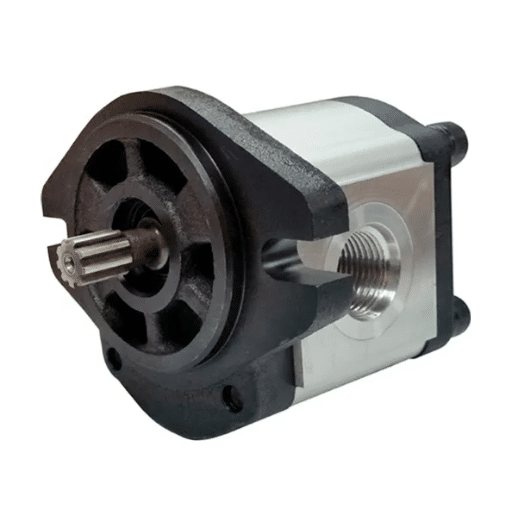
When a test bench at a hydraulic components lab in Ohio kept eating through pumps every few months, the engineer in charge, Daniel, blamed the oil. He changed the filtration, flushed the reservoir, and shortened the oil-change interval. The pumps still failed.
The real problem was the architecture. The bench ran at 700 bar continuous, and Daniel had specified a compact axial piston pump rated for 350 bar nominal. The pump was never wrong. The selection was.
That mistake is common because both machines are positive-displacement piston pumps, and the names sound interchangeable. In an axial piston pump vs radial piston pump decision, piston orientation changes pressure capability, noise, efficiency, footprint, and service life. Pick the wrong one, and you pay for it in energy, downtime, or premature failure.
This guide compares the two architectures with real numbers, a scored decision matrix, and a total cost of ownership view. You will learn where each pump belongs, when the extra pressure of a radial design actually matters, and how to avoid the most common specification errors.
Need help matching a pump to your circuit? Contact us to request a specification review or a full data sheet for your replacement axial piston pump.
What Is the Difference Between Axial and Radial Piston Pumps?

An axial piston pump arranges its pistons parallel to the drive shaft, and a tilted swashplate or bent-axis cylinder block makes them reciprocate as the shaft turns. A radial piston pump arranges its pistons like spokes around a central cam or eccentric ring. That single difference, axial versus radial piston orientation, drives almost every other performance gap between the two.
Both deliver fixed or variable displacement by changing piston stroke. Both reach high volumetric efficiency. Both also sit at the high-pressure end of the types of piston pumps used in industrial hydraulics. But they get there through different mechanics, and those mechanics favor different jobs. Want to learn more about the axial piston hydraulic pump? Please check out our axial piston hydraulic pump complete guide.
How an Axial Piston Pump Works
In an axial design, the cylinder block rotates with the drive shaft. The pistons ride against a tilted swashplate. As the block spins, the swashplate angle forces each piston to extend and retract, drawing fluid in on one side and pushing it out through the valve plate on the other.
Stroke, and therefore flow, depends on the swashplate angle. A larger angle gives a longer stroke and more flow. A smaller angle reduces flow. This geometry makes the axial pump a natural variable displacement piston pump. A control system can change the angle on the fly, which is why axial designs dominate mobile and demand-driven circuits. For the control options themselves, see our guide to variable displacement axial piston pump controls.
Two mechanical variants exist. Swashplate designs are compact, fast to respond, and easy to make variable. Bent-axis designs angle the cylinder block itself, which reduces side loads on the pistons and holds efficiency better at high pressure and high speed. Both keep the rotating group aligned with the shaft, so the package stays short and light. For a deeper mechanical breakdown, read our axial piston pump working principle and types article.
How a Radial Piston Pump Works
The radial piston pump working principle is fundamentally different. The pistons sit in cylinders arranged radially around a central drive shaft, like the spokes of a wheel. An eccentric cam or cam ring on the shaft pushes each piston inward and outward as it rotates.
On the outward stroke, the piston draws fluid into the cylinder. On the inward stroke, the cam forces the piston back, pushing pressurized fluid out through the valve plate. Because several pistons fire in sequence each revolution, the output is a smooth, low-pulsation flow with very small dead volume.
Two design details give radial pumps their reputation. First, the forces are balanced around the shaft, so there is no axial thrust on the drive bearings. Second, the pistons can be hydrostatically balanced, which lets the pump carry high load even at very low speed. The trade-off is a larger radial envelope and, in variable versions, a more complex valve and cam arrangement.
Axial vs Radial Piston Pump: Side-by-Side Comparison
| Feature | Axial Piston Pump | Radial Piston Pump |
|---|---|---|
| Piston motion | Parallel to drive shaft | Radial, outward from center |
| Actuating element | Swashplate or bent axis | Cam ring or eccentric |
| Typical pressure | 280 to 420 bar | 500 to 700 bar |
| Peak pressure | up to about 450 bar | up to about 1,000 bar |
| Displacement control | Commonly variable | Usually fixed, some variable |
| Overall efficiency | 90% to 95%, up to 98% at high speed | High overall, weaker at low speed |
| Speed range | Wide, strong at high rpm | Best at low to mid rpm |
| Noise | High-frequency pulsation, about 70 to 95 dB | Low pulsation, some models below 70 dB |
| Size and weight | Compact, lighter | Larger radial envelope, shorter axial length |
| Fluid compatibility | Primarily mineral oil | Broad, including water-glycol and HFC/HFD |
| Upfront cost | High | High to very high |
| Typical service interval | up to about 10,000 h | about 500 to 1,000 h on older designs |
| Best duty | Mobile, variable flow, dynamic | Static, extreme pressure, continuous |
This table is the core of any axial vs radial piston pump comparison. Neither row is universally better. Each column describes a different duty.
Pressure and Flow Capability

Pressure is where the two architectures separate most clearly. A typical axial piston pump runs in the 280 to 420 bar range. Real models confirm this. The Bosch Rexroth A10VSO Series 32 is rated at 280 bar nominal and 350 bar maximum. The A11VO reaches 350 bar nominal and 400 bar maximum. Closed-loop designs like the A4VG push to 400 bar nominal and 450 bar peak. Kawasaki’s K3V, K5V, and K7V series carry continuous ratings up to about 350 bar.
A high pressure piston pump in the radial family operates in a different class. Radial designs routinely handle 500 to 700 bar, and specialized models reach about 1,000 bar, roughly 14,500 psi. The balanced piston layout and short, stiff load paths let the cam drive each piston against extreme pressure without the side-loading that limits a swashplate.
The question is whether the extra pressure matters for your circuit. A 250 bar clamping or lifting system gains nothing from a 700 bar pump. You would pay more, carry more weight, and add service work for capacity you never use. Reserve radial pressure for forging presses, deep-hole drilling, test rigs, and overload protection where the circuit genuinely runs above 400 bar.
Sizing an axial pump for a high-pressure circuit? Our axial piston pump specifications and sizing guide walks through pressure, flow, and displacement selection step by step.
Efficiency, Noise, and Contamination
Efficiency depends on operating point, not architecture alone. Axial pumps reach 90% to 95% overall efficiency, and well-designed bent-axis units approach 98% at high speed. Their volumetric efficiency is sensitive to oil viscosity, so they hold peak numbers in a roughly 30 to 60 degree Celsius window. Radial pumps post high overall efficiency but lose ground at very low speed, where internal leakage and valve timing matter more.
Noise is where radial designs earn their premium in stationary systems. Axial pumps produce a high-frequency pulsation that typically measures about 70 to 95 dB, and that whine is hard to enclose. Radial pumps run with low flow and pressure ripple. Some models stay below 70 dB, which is why they show up in indoor test benches and machine tools where noise limits apply.
Contamination tolerance favors neither side outright, but the failure modes differ. Axial pumps are sensitive to the slipper, swashplate, and valve-plate interfaces, so they need clean oil, usually ISO 4406 18/16/13 or better. Radial pumps tolerate a wider range of fluids, including mineral oil, biodegradable oil, water-glycol, and HFA, HFC, and HFD fluids. That fluid flexibility is a real advantage in steel mills, marine systems, and any circuit that cannot run straight mineral oil.
Applications: Where Each Pump Belongs
The application split follows the physics. Axial pumps go where compact packaging, variable flow, and high-speed efficiency matter. Radial pumps go where extreme pressure, low noise, and continuous heavy load matter.
Axial piston pumps fit excavators, wheel loaders, mobile cranes, forklifts, agricultural drives, aircraft hydraulics, and injection-molding machines. These machines throttle flow constantly, so a variable displacement axial pump saves fuel and heat.
Radial piston pumps fit hydraulic and forging presses, mining and rock-drilling systems, marine steering and propulsion, power-plant auxiliaries, machine tools, test benches, and wind-energy pitch systems. These are mostly stationary, run long hours, and either need extreme pressure or cannot tolerate pulsation and noise.
A midwestern injection-molding shop learned this the hard way. The plant engineer, Priya, replaced a failed axial pump on a quiet clamping line with another axial unit because the footprint matched. The new pump met the pressure requirement, but the high-frequency whine pushed the cell past the facility’s 85 dB exposure limit. A radial replacement cost more upfront but brought the line under the noise threshold and cut the maintenance team’s hearing-protection complaints to zero.
Decision Matrix: Choosing the Right Piston Pump

Score your circuit 1 to 5 on each criterion, where 5 means the factor is critical. Then read the column that totals higher for the weighting that matches your priorities.
| Criterion | Favors Axial | Favors Radial |
|---|---|---|
| Pressure above 400 bar | Low | High |
| Variable flow on demand | High | Low |
| Low noise requirement | Low | High |
| Tight packaging | High | Low |
| High-speed efficiency | High | Moderate |
| Low-speed load capacity | Moderate | High |
| Non-mineral fluid | Low | High |
| Lowest upfront cost | Moderate | Low |
| Long service interval | High | Moderate |
A short if-then guide covers most cases:
- If the machine moves and throttles flow, choose an axial piston pump.
- If the circuit runs above 400 bar continuously, choose a radial piston pump.
- If the installation is indoors and noise-limited, lean radial.
- If the fluid is water-glycol or biodegradable, lean radial.
- If fuel or energy cost dominates the budget, lean axial with load sensing.
Total Cost of Ownership and Maintenance
Upfront price is only part of the cost. An axial pump usually costs less to buy than a radial of similar frame size, and a variable-displacement axial pump saves energy every hour the circuit throttles below full flow. Over five years on a variable-load mobile machine, that energy saving can exceed the pump’s purchase price.
A radial pump costs more upfront and, on older designs, requires service roughly every 500 to 1,000 hours. Seals, valves, and the cam ring wear under extreme pressure and need inspection. Newer hydrostatically balanced radial pumps extend those intervals significantly, but the parts and the skilled labor still cost more than an axial overhaul.
The axial counterargument is service interval, not service simplicity. A quality axial pump can run up to about 10,000 hours between major services when the oil stays clean. When it does need work, the rotating group and control module are complex, but the interval is long. Match the budget to the duty: frequent, cheap energy on variable load favors axial, and long continuous high-pressure duty can justify radial.
Common Selection Mistakes of Pumps

Even experienced buyers repeat these errors in an axial piston pump vs radial piston pump decision.
- Over-specifying radial pressure. Paying for a 700 bar on a 250 bar system adds cost, weight, and service with no performance gain.
- Putting an axial pump on extreme-pressure static duty. A 350 bar axial pump run at 700 bar continuously will fail early, exactly as Daniel’s test bench did.
- Ignoring indoor noise limits. An axial pump that meets the pressure spec can still violate an 85 dB exposure limit, as Priya’s clamping line showed.
- Overlooking fluid compatibility. A water-glycol or biodegradable fluid may force a radial choice regardless of pressure.
- Forgetting displacement control needs. If the circuit throttles flow through directional valves, a fixed radial pump wastes the energy a variable axial pump would save.
- Assuming footprint interchangeability. Radial pumps are larger radially but shorter axially. A drop-in swap rarely works without checking both dimensions.
Axial vs Radial Piston Pump FAQ
What is the difference between an axial and a radial piston pump?
An axial piston pump arranges pistons parallel to the drive shaft and uses a swashplate or bent axis to stroke them. A radial piston pump arranges pistons like spokes around a central cam or eccentric. That orientation difference drives the gaps in pressure, noise, footprint, and cost.
Which is better, an axial or radial piston pump?
Neither is universally better. Axial pumps suit compact, variable-flow, mobile duty up to about 420 bar. Radial pumps suit extreme-pressure, low-noise, continuous static duty up to about 1,000 bar. The right choice depends on the circuit.
Why are radial piston pumps used for high pressure?
The pistons are arranged radially around a stiff cam, with short load paths and balanced forces and no axial thrust on the shaft bearings. That layout lets the pump drive each piston against extreme pressure without the side-loading that limits a swashplate.
Is a radial piston pump variable displacement?
Most radial piston pumps are fixed displacement, though variable designs exist. Axial pumps are far more common as variable displacement units, which is one reason they dominate mobile and demand-driven circuits.
Which is more efficient, an axial or a radial piston pump?
Axial pumps reach 90% to 95% overall efficiency and up to about 98% at high speed. Radial pumps are highly efficient overall but lose ground at very low speeds. The answer depends on the operating point.
Why are axial piston pumps noisy?
Axial pumps generate high-frequency flow and pressure pulsation as the pistons pass over the valve-plate ports. That pulsation typically measures about 70 to 95 dB and produces the characteristic high-pitched whine.
What are radial piston pumps used for?
Radial piston pumps are used in hydraulic and forging presses, mining and rock-drilling systems, marine steering and propulsion, power plants, machine tools, test benches, and wind-energy systems where extreme pressure or low noise is required.
Can a radial piston pump replace an axial piston pump?
Only if the circuit pressure, flow control, noise, fluid, and mounting all suit the radial design. The footprint and the control logic rarely match, so treat it as a re-specification rather than a direct swap.
Conclusion
The axial piston pump vs radial piston pump decision comes down to duty. Choose an axial piston pump when you need compact packaging, on-demand variable flow, and high efficiency across varying speeds, at pressures up to about 420 bar. Choose a radial piston pump when you need extreme pressure, low pulsation, low noise, and long continuous duty, up to about 1,000 bar.
Score the circuit honestly. Pressure, flow control, noise, footprint, fluid, and energy cost each push the decision in a clear direction. Match the architecture to the work, and the pump will run within its rating, stay quiet enough for the environment, and last through its service life.
If you’re specifying a new system or replacing a failed unit, LOYAL INDUSTRIAL PTE. LTD. can help you confirm whether an axial design fits your circuit. Review our axial piston pumps or contact us for a specification review, and we will match the pressure rating, displacement, and control option to your machine.