Marcus pressed the remote pendant on his new 10,000-pound dump trailer. The 12V motor whined. The pump cycled. The bed stayed flat. He checked the battery. It read 12.4 volts. He checked the reservoir. The fluid was at the full mark. The problem was not broken parts. It was a specification mismatch between the pump and the cylinder that never got caught at the buying stage. A 6-quart reservoir on a 3-inch bore cylinder leaves no margin for thermal expansion or return flow. By the second loaded lift, the pump was pulling air. By the third, the housing cracked from cavitation heat.
Most buyers treat a hydraulic pump for a dump trailer selection as a simple part swap. They match voltage and bolt pattern and hope the rest works out. That approach fails because dump trailer hydraulics involve four interdependent systems: pump flow, cylinder displacement, reservoir volume, and electrical capacity. Get one wrong and the others follow.
This guide gives you the complete specification framework for selecting, sizing, and installing a dump trailer hydraulic pump. You will get the flow formula that tells you exactly what GPM you need, the electrical requirements that prevent melted wiring, the single vs double acting decision matrix by hoist type, an OEM replacement compatibility table, and a troubleshooting quick reference you can use in the field.
Need help matching a replacement pump to your trailer specs? Contact our engineering team for a direct-fit compatibility check and specification sheet.
What Is a Hydraulic Pump for Dump Trailer Systems
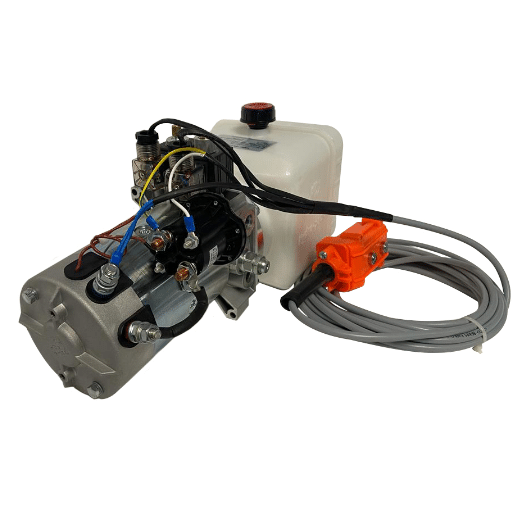
A hydraulic pump for dump trailer use is a self-contained 12V DC power unit that combines an electric motor, positive displacement pump, fluid reservoir, and directional control valve. It converts electrical energy from the trailer battery into hydraulic pressure that extends the lift cylinder and raises the trailer bed. These units are commonly called hydraulic power packs because they integrate every element needed for the lift cycle into one assembly.
How Hydraulic Pumps Work in Dump Trailer Systems
The Power Unit as a Complete Subsystem
A single dump trailer hydraulic power unit, at its core, is comprised of an electrical DC motor, a positive displacement pump, a hydraulic fluid tank, and a hydraulic flow control valve. Often, these components are named hydraulic power packs because they bring together every part necessary for the lifting system in one device. The motor operates the pump at a speed somewhere in the range of 2500 to 2850 RPM.
Fluid is drawn from the tank by the pump and then forced by the pump through the valve into the cylinder. Once the operator lets go of the remote control button, a positional lock valve stops the flow of fluid and the cylinder remains stationary. In the case of a gravity-down lift, a return path is opened by a different solenoid. In the case of a power-down lift, a mechanism in the valve is turned in order to redirect the liquid flow.
Most of the hydraulic and pneumatic components involved in the design normally come in matched sets. For instance, one could not just as well substitute a higher capacity pump into a small tanked unit without starving the inlet. Additionally, a high-pressure pump would not in any way fit into a system having a high-flow motor without stalling the windings. In other words, the power unit has to be taken as a whole and not just individual parts.
12V DC Electric vs PTO-Driven vs Gas Engine
Most dump trailers under 14,000 pounds GVWR use 12V DC electric power units. They draw power from the trailer battery or the tow vehicle charging circuit. No PTO shaft is required. No separate engine is needed. The trade-off is a limited duty cycle and flow rate. A 12V 1.6 kW motor cannot match the output of a PTO-driven gear pump on a commercial dump truck.
PTO-driven pumps attach to the transmission of the tow vehicle. They deliver higher flow and continuous duty. They are common on commercial hook-lift trucks and heavy equipment trailers. Gas engine power units are standalone units with a small gasoline engine driving the pump. They appear on remote job sites where no vehicle electrical system is available.
For standard single-axle and tandem-axle dump trailers used in landscaping, construction, and agriculture, the 12V DC power unit is the practical standard. The rest of this guide focuses on that configuration.
Single-Acting vs Double-Acting: Which Does Your Trailer Need
The first specification decision is the action type. Get this wrong and the trailer either will not lower properly or you will pay for complexity you do not need.
Single-Acting (Power Up / Gravity Down)
A single-acting hydraulic pump for dump trailer use delivers pressurized fluid to lift the bed. Lowering is controlled by gravity. The operator opens a solenoid valve and the weight of the bed plus payload pushes the oil back to the reservoir.
Single-acting systems are simpler, less expensive, and easier to maintain. They have fewer hoses, fewer seals, and one less solenoid. They are the correct choice for standard front-mount telescopic cylinders where the geometry of the trailer frame ensures the bed can descend freely.
The limitation is control. Gravity descent is slower in cold weather when oil viscosity rises. It is less predictable with sticky loads such as wet clay or hot asphalt. And it offers no powered retraction for horizontal or side-mounted cylinders.
Double-Acting (Power Up / Power Down)
A double-acting pump delivers pressurized fluid to both sides of the cylinder. It powers the lift and it powers the descent. This gives faster, more controlled lowering. It handles sticky loads without hesitation. And it is required for scissor hoists and side-dump configurations where gravity alone cannot retract the cylinder.
The disadvantage would be the additional costs and the sizes of the products involved. The units that are double-acting require two native lines, two solenoid valves, and increased wiring. These units also have slightly greater battery capacity per cycle. To a trailer or truck manufacturer who decided to purchase twenty such devices, the difference in price might be of significance.
Mini-story: In March 2025, a fleet manager named Jennifer issued an RFQ for twenty utility trailers with scissor hoists. She specified “12V hydraulic pump” without naming the action type. The supplier delivered single-acting units. The scissor hoist geometry required powered retraction to fold flat. Every trailer had to be rewired and re-plumbed for double-acting at 180 per unit. The specification omission cost 3,600 plus a two-week production delay.
Decision Framework by Hoist Type
Use this framework to select the correct action type for your trailer geometry.
| Hoist Type | Recommended Action | Reason |
|---|---|---|
| Front-mount telescopic cylinder | Single-acting | Gravity provides adequate down force; simple and reliable |
| Scissor hoist | Double-acting | Powered retraction required to fold the scissor mechanism flat |
| Side-dump or tilt-deck | Double-acting | Cylinder orientation prevents gravity-only retraction |
| Custom horizontal mount | Double-acting | Gravity cannot assist retraction in horizontal plane |
Can You Mix a Double-Acting Pump with a Single-Acting Cylinder?
Technically speaking, this procedure can be carried out intentionally, although it is deemed to be a wasteful application. A double-acting pump may feed a single-acting cylinder by stopping (or looping) the second pressure outlet. However, what you are actually doing is essentially pouring money into something that is beyond your reach.
The best practice is to match the pump action to the cylinder action at the stage of factory recommendation. If you are changing a pump that has failed and you are left with a double-acting only, it can be utilized. For new houses at a later stage or in large quantities, where a number of pumps might be required if desired, the correct use needs to be demanded at the outset.
How to Size a Hydraulic Pump for Your Dump Trailer

In many of the cases, the lack of proper sizing is the leading reason for field failures. The case in point goes to the end use, the buyer matches voltage and bolt pattern, and builds on new pumps, and pumps without actually evaluating the hydraulic system. In it, three elements that may worry are fluid flow rate, fluid pressure, and the vessel capacity.
The Flow Formula
Flow rate determines how fast the bed lifts. The standard formula is:
GPM = (Bore Area in² × Stroke in × 60) / (231 × Lift Time in seconds)
If the area of the bore is equal to (pi)r², where r is the radius, the area of a bore of 3 inches will have an area of 7.07 in². The expected flow rate is: In order to accomplish this, we must use an 18-inch stroke cylinder and in addition, try to perform the stroke in 20 seconds. The required flow is:
GPM = (7.07 × 18 × 60) / (231 × 20) = 1.65 GPM
Most 12-volt DC units are designed for dump trailers, and most will turn out from 1.25 to 2.0 gallons per minute. If coming up with the given number demands a significantly larger number, you should rather go for a DC pump unit with higher capacity or resign and take the longer elevation one.
Pushing a small pump beyond its rated flow causes overheating and premature seal failure. For a full walkthrough of power unit flow and pressure relationships, our 20 GPM hydraulic power unit guide covers sizing logic that scales across all voltage classes.
Want to learn more about the 20 GPM Hydraulic Pump? Please check out our guide about the 20 GPM Hydraulic Pump.
Pressure Requirements
Pressure is a deciding factor for lift capacity due to physics. A 3-inch cylinder with a bore diameter of 2,500 PSI can generate about 17,671 pounds of force. More than enough to lift a 10,000-pound trailer, that is properly balanced across the cylinder’s dimensions.
Standard relief valve settings for 12V dump trailer pumps are:
- Single-acting units: 2,100 to 2,500 PSI operating pressure, with a 2,500 PSI relief
- Double-acting units: 3,200 PSI on the A-port (lift side), 1,500 PSI on the B-port (lower side)
The valve acts as a safety precaution and not a throttle. For instance, if a load-in-place current of 2800 PSI is required, and your pump fails at 2500 PSI, do not expect the deck to respond. Adjust the pressure range by adding 10%-15% of the maximum required value.
Reservoir Sizing
In line with this, the reservoir must be well-sized so as to contain all the fluid required to fill the cylinder to the end stroke and allow for thermal expansion as well as aeration of return flow. This would generally be in the range of roughly 1.5 to 2 times the displacement of the cylinder.
Given a 3-inch bore by 18-inch stroke hydraulic cylinder producing a displacement of 0.55 gallons or 2.2 quarts, the minimum reservoir that needs to be accommodated is 3.3 to 4.4 quarts. The practice of an 8-quart reservoir is more common in general because volume in the form of hose length, cooler ability and collapsing foam is allowed for. Camera’s Flash
Mini-story: In the month of August in the year 2024, the guy by the name Derek, a contractor, would purchase an electrically powered hydraulic pump, the cites being a single-acting hydraulic pump used as an auxiliary in the the hydraulic dump trailer system on such a hefty apparatus of his that weighs 10000 lbs. He had a piston, 3 inch in bore and 20 inch in stroke. The optimum size was arrived at and it was 6.5 quarts at the very least. On a 95-degree day in Texas, the oil expanded and aerated during the second lift. The pump cavitated. The aluminum housing overheated and cracked. He replaced the entire power unit mid-job at double the cost of buying the correct 10-quart unit initially.
Sizing Table by Trailer Capacity
Use this table as your quick reference during specification.
| Trailer Capacity | Typical Cylinder | Cylinder Displacement | Min Reservoir | Recommended Flow |
|---|---|---|---|---|
| 5,000 lb | 2″ bore × 12″ stroke | ~0.16 gal (0.65 qt) | 4 qt | 1.0–1.3 GPM |
| 7,000 lb | 2.5″ bore × 16″ stroke | ~0.34 gal (1.4 qt) | 6 qt | 1.3–1.6 GPM |
| 10,000 lb | 3″ bore × 18″ stroke | ~0.55 gal (2.2 qt) | 8 qt | 1.6–2.0 GPM |
| 12,000+ lb | 3.5″ bore × 20″ stroke | ~0.83 gal (3.3 qt) | 10–12 qt | 2.0+ GPM |
Duty Cycle: What Intermittent Rating Means
Most 12V units carry an intermittent duty rating. The common specification is 3 minutes on followed by 5 minutes off. This also implies that the motor can be on all the time, only for 3 minutes. There is a time winner, however, and this is 5 minutes. Also, the motor requires 5 minutes of cooling down before the next sequence of functioning.
For a typical dump trailer lift, the loaded cycle time takes 15 to 30 seconds. The 3-minute rating allows six to twelve consecutive lifts before a cooling period is required. If your application requires more frequent cycling, such as a material sorting operation with twenty lifts per hour, specify a continuous-duty unit with a higher kW motor and larger cooling capacity.
12V Electrical Requirements and Wiring

The electrical side of dump trailer hydraulics causes more field failures than the hydraulic side. A 12 volt hydraulic pump for dump trailer use with a 1.6 kW motor draws approximately 133 amps at full load. Most buyers underestimate this by a factor of three.
Motor Amp Draw and Battery Requirements
A 1.6 kW 12V DC motor, the shaft of which has to withstand between 130 and 150 A, goes way beyond its rated current when starting for the very first time, and the battery that is almost discharged might not be able to provide support. It is not fit because at such a low voltage as 10.5 V, the motor is not rendering humbles and drops current at the fault. There is also a slowing of the pump down when the motor parameters worsen and the relief valve support begins to increase, causing rattling—it is the turn of the system to overheat.
The minimum battery specification for reliable operation is 600 cold cranking amps or higher. For a deeper understanding of how motor power translates to electrical demand, our hydraulic pump horsepower calculator helps you size the battery and charging system together.
Deep-cycle marine batteries are preferred over standard automotive batteries because they tolerate repeated deep discharge. In the case where the trailer battery is also meant to provide power for winches, lights, and brakes, it becomes convenient to install a separate battery that will only be dedicated to the hydraulic system, being fitted with an isolation relay from the charging circuit of the towing vehicle.
Wire Gauge and Relay Sizing
The pump of a dump trailer should never be switched on or off from a distance using an ordinary dashboard switch or the functioning light standard toggle. This is because the current flow through the pump will heat and melt 16-gauge or 14-gauge wires within as little as a few seconds.
Use a dedicated heavy-duty relay rated for 150 amps continuous. The relay coil is controlled by the low-current remote pendant. The relay contacts carry the high-current path directly from the battery to the motor.
Conforming to the ampacity table, the wire gauge is determined. Whenever there is a 150-amp load and the cable sections don’t exceed 10 feet in length, 4 AWG copper wiring stands as the least acceptable option for the provided scenario. If the distances are between 10 and 20 feet, the wire should be 2 AWG. Where distances are over 20 feet, the wire ought to be 1/0 AWG. Reduced wire is known to be the reason for voltage drop, high resistance, accompanied by heat buildup and fire.
Mini-story: In June 2025, Raj, a novice utility trailer manufacturer, led his initial 1.6 kW dump hydraulic pump installation through 14 gauge wire within a 20 A switch. Trying to justify the reason was the motor load only driving by a switch and not the motor said. On the first attempted dump, the wire caused a melt of the insulation at the fire wall and caused the interruption. The fault breaker snapped into existence immediately and cut off the current as much that every time it clicked, the wire fused more. This unit also cost a further 45 whereas 45 minutes were invested in customizing a 150-amp relay to involve the connection of the 4-gauge wiring.
Fuse Protection and Ground Integrity
Ensure the installation of a 150-ampere fuse or circuit breaker at less than 12 inches from the positive terminal of the battery. It is necessary to consider the standard 1.6 kW-sized to determine the size. It makes the wiring from the battery to the relay a fail-safe.
Ground integrity is equally critical. The motor ground must return to the battery negative terminal or a verified chassis ground point with equal gauge wire. A corroded or loose ground connection is the single most common cause of slow or intermittent pump operation.
Remote Pendant Wiring and Solenoid Control
Most aftermarket power units include a 15-foot wired pendant with up and down buttons. The pendant and its wire harness carry low-current control signals to the relay and solenoid coils. Standard solenoid coils draw 1 to 3 amps. They can be wired through lighter gauge cable, typically 16 to 18 AWG.
Check if the receiver module is compatible with the voltage, and if the inductive solenoid current can be handled. Usually catered to the high voltage of dump trailers, most of the solenoids are usually rated for continuous service operations without allowing those parts to overheat even though they are 12V solenoids.
OEM Replacement Compatibility Guide
The most typical explanation a person of a hydraulic pump for dump trailer tries to buy a new one is when an old pump on the trailer fails. This is because the existing trailer failure is the reason for looking for a new hydraulic pump for a dump trailer, and how smoothly or easily can one replace the new hydraulic pump with the old piping and mounting configuration.
Common OEM Pump Specs by Trailer Brand
The major trailer manufacturers do not build their own power units. They source from hydraulic suppliers and brand them. Most use common specifications that allow direct aftermarket replacement.
| Trailer Brand | Common OEM Spec | Direct Replacement Notes |
|---|---|---|
| Big Tex | 12V, 1.6 kW, single-acting, 6–8 qt, 2,500 PSI | SAE #6 ports; standard horizontal mount |
| PJ Trailers | 12V, 1.6 kW, single or double-acting, 6–8 qt | Verify action type by hoist; remote plug may differ |
| Load Trail | 12V, 1.6 kW, single-acting, 6 qt | Early models use proprietary valve body; check port spacing |
| Lamar | 12V, 1.6 kW, single-acting, 6 qt | Direct SAE fit; standard wiring harness |
| MAXX-D | 12V, 1.6 kW, single-acting, 6–8 qt | Some models use KTI-branded units with matching bolt pattern |
| Diamond C | 12V, 1.6–2.0 kW, single or double-acting, 8 qt | Higher flow spec’d on some models; verify GPM |
| Belmont | 12V, 1.6 kW, single-acting, 6 qt | Standard horizontal mount; common aftermarket fit |
Mounting Pattern and Port Thread Matching
The industry standard for dump trailer power units is a horizontal mounting bracket with four bolt holes on the reservoir base. Pump heads use SAE #6 O-ring boss ports, which means 9/16-inch-18 UNF threads with a chamfered O-ring seat. This is the same thread used on most hydraulic cylinders in the 2-inch to 3.5-inch bore range. For a complete reference on port and flange standards, see our guide to SAE mounting port standards.
Before ordering anything else, remember to check the following three things. Firstly, check the port size with a thread gauge, or try the known fitting of a 9/16 inch O-ring. Next, determine the center-to-center distance of the bolts in the base of the reservoir. Third, ascertain the action by aiding hydraulic lines: One line is single-acting, whereas two lines would be double-acting.
When Aftermarket Replacement Works
Aftermarket power units from established hydraulic suppliers offer direct replacement fit at 40 to 60 percent below OEM pricing. The pumps use the same SAE port standards, the same 12V DC motors, and the same horizontal mounting patterns. The primary differences are branding and warranty terms.
An alternative unit comes in handy when the original one was an off-the-shelf model utilizing standard SAE ports, a simple mounting bracket and a standardized 1.6 kW motor. However, in applications where the original unit had provided proprietary valve blocks, non-standard port threads, or custom-designed mounting ears, the replacement may demand re-engineering of the piping. If the arrangement is not clear, take the placard and the location of the ports on the elevation and share it with the supplier for further clarification and guide the client accordingly as to what kind of replacement would do.
Key Specifications to Check Before Buying

Before placing an order, verify each of these parameters against your trailer requirements.
Voltage
12V DC is standard for light to medium duty. 24V DC is seen in larger dual-axle trailers and some European imports. Make sure its pump shaft is compatible with the crankshaft on the engine. It is not advisable to connect a 24V pump to a 12V battery; the working of the pump will be slower, and it will also overheat. Never connect a lubrication pump that comes with a 12V DC motor to a 24V DC system. The motor will burn the windings of the pump in a matter of seconds
Flow Rate at Operating Pressure
When the content is tables or charts, at times, maximum flow at 0 pressure is commonly listed on these tables. This value is absolutely of no use. Instead, it is the flow rate at rated pressure demanded, i.e., usually a dump trailer pressurized at about 2,000 to 2,500 PSI. A pump presuming for example it has a property of 2.0 GPM may actually provide 1.3 GPM at 2,500 PSI. Call your supplier and inquire about the ‘pressure compensated flow curve’.
Max Relief Pressure and A-Port / B-Port Settings
However, ensure that for all single acting units, the relief valve setting matches or exceeds the cylinder rating. As concerns double-acting units, the system requires that the A port and B port pressures be confirmed separately. The A port must be equivalent to the lift height. The B port should be equal to the height rate of descent.
Reservoir Material and Capacity
Steel reservoirs withstand vibration and impact better than plastic. They are standard on heavy-duty and commercial units. Plastic reservoirs are lighter and corrosion-proof. They are common on light-duty units. For a full comparison of housing materials and when each is appropriate, see our article on aluminum vs steel hydraulic pumps. Regardless of material, capacity must follow the 1.5× to 2× rule relative to cylinder displacement.
Port Type and Thread
SAE #6 O-ring boss is the industry standard. Verify before ordering. Some imported units use BSPP or metric threads that require adapter fittings.
Weather Sealing
For trailers that are exposed to the elements such as outdoors, there are various effects that come with it such as their exposure to rain as well as road salt. In addition, there are some that are often cleaned using a high-pressure system, they actually serve their purpose, but what do you find? Look at the motor casing and check if it has a minimum IP54 rating. Under such conditions, an encapsulated solenoid coil seems more preferable to an open-frame coil.
Installation Best Practices
Correct installation prevents the majority of field failures. Follow this sequence for first-time installs and replacements.
Mounting Location and Vibration Isolation
Mount the power unit on a flat surface with adequate airflow around the motor. Avoid locations directly above the axle or suspension where road shock is greatest. Use rubber isolation mounts between the reservoir base and the trailer frame. Vibration transferred into the pump head can loosen port fittings over time.
Hose Routing and Strain Relief
Avoid pulling the hydraulic hose against the hoses, other components, or a sharp bulkhead. Use an Adel clamp or P-clamp at 18-inch intervals to keep the hoses in place. Add slack for possible frame twisting, without squeezing hoses over solid and moving objects. Add a strain relief at the cylinder port to keep the hose from pulling its own weight on the fitting.
Bleeding Air from the System
Air in the hydraulic lines presents various operational constraints such as soft operation, noise, and damage due to cavitation. Fill the reservoir and move the cylinder under pressure three to four times, non-loaded. Hold the cylinder at full extension and full retraction for ten seconds each to allow the air to escape through the reservoir vent before returning to the pump and the bores. Fill the fluid to the top of the reservoir after each and every movement. This swell and retract action will displace the air and in effect, reduce the fluid’s level in return.
Initial Fluid Fill and Level Check
Troubleshooting Common Dump Trailer Pump Problems

Motor Runs but the bed will not lift
Before conducting any more tests, the battery under load test has always been the very first step. A rest voltage of a 12.4V battery might drop to 9.5V when subjected to the load of the motor. This is not acceptable. Attempt charging or replacement of the battery. Secondly, check the functioning of the solenoid. A solid, distinct click should be expected upon pushing the arrow up; if no click, then a wire or solenoid fault. Finally, perform the relief valve test. Provided it is stuck open or set up less than required by the load. In that case, the pump flow goes back into the tank unutilized.
Slow or Weak Lifting
Weak lifting is generally electricity-based, instead of hydraulic. Carry out the testing on the battery, cable connections and earth path. where the voltage drop between the motor terminal and the battery is greater than 0.5V, there is a wiring fault. For an ok voltage, ask if there is any air in the system, if the fluid is below the desired level or if the suction strainer is clogged. Additionally, excessive wear on the pump prevents leakage but seldom occurs if the device is below 5 years old.
Pump Overheating
There are three most common factors for hydraulic systems to overheat. Once the thermal limits are exceeded, there may be severe signs of malfunction. This is in case of high-duty usage. For example, making six loaded positions under ten minutes will cause an intermittent- duty machine to overheat. Delay five minutes in the cases of such machines before making another lift.
Second, the oil level is low. Due to a lack of oil, the cooling system works more than requiring it this makes the pump circulate hot oil. Third, the jammed ready-to-go relief valve. Many worn-out pumps keep circulating fluid because the return line is obstructed. In such Instances, all the energy that was put into the pump work gets converted to heat energy.
Noisy Operation or Cavitation
When the pump is producing cavitation, it sounds like noise caused by air bubbles bursting and rolling along inside the pump, it sounds like marbles. That happens when air gets into the suction line, when the inlet filter is clogged and if the tank is too small, in some cases may cause the same noise. Examine the suction tube for any damage as well as the pipe clamp for any looseness. Also, inspect the strainer. Verify the reservoir capacity against the cylinder displacement rule.
Troubleshooting Quick-Reference Table
| Symptom | Likely Cause | First Check |
|---|---|---|
| Motor runs, no lift | Low voltage, stuck relief valve, failed solenoid | Battery voltage under load |
| Slow lifting | Weak battery, air in lines, blocked strainer | Voltage at motor terminals |
| Pump overheats | Excessive duty cycle, low fluid, relief valve bypass | Fluid level and duty cycle log |
| Noisy / rattling | Cavitation from air ingress or inlet restriction | Suction hose and strainer |
| Bed drifts down | Leaking cylinder seal or faulty lower valve | Cylinder rod seal inspection |
| Intermittent operation | Loose ground, corroded terminals, failing relay | All electrical connections |
FAQ
What size hydraulic pump do I need for my dump trailer?
Pump flow should be calculated taking into account the characteristics of the cylinder, i.e., the cylinder bore, stroke, and the time taken to lift the load. In general, a 10,000 lbs trailer with a 3-inch bore by 18-inch stroke cylinder would require approximately 1.6 or 2.0 GPM and an 8-quart reservoir. If in doubt refer to the sizing chart, optionally provided in the equipment manufacturer’s dos and don’ts document.
How many quarts of hydraulic oil does a dump trailer pump need?
The recommended amount of fluid to be stored in the reservoir should be 1.5-2 times the volume occupied by the cylinder. Since displacement gets quite large, a 3-inch cylinder with an 18-inch stroke will occupy nearly 2.2 quarts and so the smallest tenable volume of reservoir shall be 4-5 quarts. A more universally accepted practice would be to use an 8-quart reservoir in this application as that is the nominal capacity that is currently in use and is deemed to be the common standard specification.
Why does my dump trailer hydraulic pump run but not lift?
Test the battery and observe the voltage under load because this is one of the major causes of failure. There should not be any drop while pressing the remote, and voltage should not be below 10.5 volts. In the case of the battery failing to hold the necessary voltage to charge, either charge the battery or get a new one. The relief valve could be blocked, which is a very common fault or the forward solenoid needs to be changed.
How do I wire a 12V hydraulic pump on a dump trailer?
Disconnect the battery from the motor and install a standalone 150 amp relay with an operating current to the remote being used. Use 4 AWG wire from battery to the motor for runs less than 10ft. There should be a 150-amp fuse as part of the battery positive lead, short of 12 inches from the battery terminal.
Conclusion
Selecting the right hydraulic pump for dump trailer use is not a matter of matching voltage and bolt pattern. It requires sizing the flow rate to the cylinder displacement, sizing the reservoir to the flow volume, sizing the electrical system to the motor amp draw, and matching the action type to the hoist geometry. Each of these parameters connects to the others. A mismatch in any one creates failure in the rest.
Three principles should guide your next specification or replacement.
First, size the reservoir with a margin. A reservoir that barely holds the cylinder displacement leaves no room for thermal expansion, foam settling, or hose volume. The 1.5× to 2× rule exists because trailers operate in real conditions, not laboratory conditions.
Second, it is indeed the case that the electrical system is as vital as the hydraulic pressure system. Motor operates at 1.6 KW with 12V and it pulls 130 to 150 amperes of current. It is unwise to construct drawings and use wiring, switches, etc. of a standard automotive level. Instead, for such a load, use a 150-ampere-capacity relay, not less than 4 AWG size wire and ensure a proper earth connection is achieved.
Third, specify the action type explicitly. Single-acting and double-acting are not interchangeable without adaptation. For scissor hoists and side-dump trailers, double-acting is not optional. It is a structural requirement.
Lowering the size, the production standards, and the request form compliance proportion of the customers that this instruction is designed for no longer permits most of the dump trailer pump failures in the field. Sharing this list with procurement agents and trailer builders design removes the confusion and saves time for the production builder.
Need a direct-fit replacement pump or a custom specification for your trailer build? Contact our engineering team for compatibility verification, flow calculations, and factory-direct sourcing.