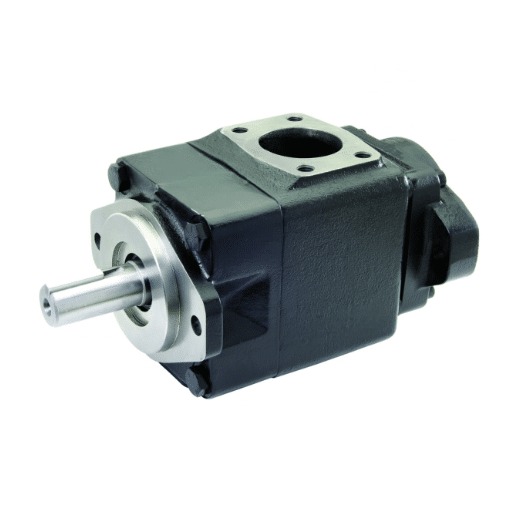
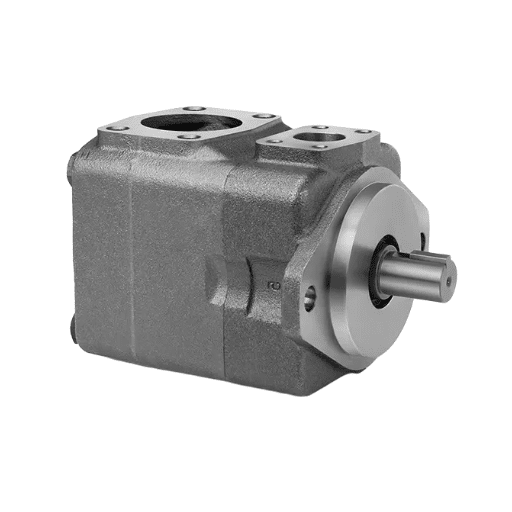
Most “2 stage hydraulic pump diagram” results online show a generic gear-pump outline with no component labels, no arrows, and no explanation of what actually happens inside the housing. That is a problem when you are trying to troubleshoot a log splitter that will not build pressure or spec a replacement pump for a mobile power unit.
This article walks through a proper 2 stage hydraulic pump diagram component by component. You will see what each part does, how oil moves during the low-pressure and high-pressure stages, and how to read the schematic symbols used in service manuals. We will also include real manufacturer specifications from the Concentric/Haldex GC and D series, so the diagram connects to a physical pump you can source.
If you are new to two-stage pumps, start with our deep dive on how a 2 stage hydraulic pump works and come back here for the visual reference.
What a 2 Stage Hydraulic Pump Diagram Actually Shows

A 2 stage hydraulic pump diagram is a cutaway or schematic view of a single housing that contains two gear pumps of different displacements plus a set of internal valves. The drawing shows the flow path from inlet to outlet and identifies the parts that switch the pump between its two operating modes.
Two-stage pumps are also called HI/LO pumps, two-speed pumps, or high/low pumps. On a 2 stage hydraulic pump diagram you will usually see:
- A large-displacement gear set labeled “Stage 1” or “LO” (low pressure, high flow)
- A small-displacement gear set labeled “Stage 2” or “HI” (high pressure, low flow)
- An unloader valve that senses pressure and redirects the large stage
- A check valve that isolates the two stages at high pressure
- A relief valve that limits maximum system pressure
- Inlet and outlet ports, shaft, seals, and bearings
Understanding the diagram matters because the same physical parts produce two very different performance curves. If you misread the unloader valve location or ignore the check valve, you can misdiagnose a pump that seems to run fine but never transitions to high pressure.
Need more information about 2 Stage Hydraulic Pump? You can read our 2 Stage Hydraulic Pump Complete Guide.
Complete 2 Stage Hydraulic Pump Component Breakdown
The best way to read a two stage hydraulic pump diagram is to identify each component first, then trace the oil path. Below is a labeled breakdown of the 2 stage hydraulic pump parts you will find on most manufacturer cutaways.
Pump Housing / Body
On a 2 stage hydraulic pump diagram, the housing is shown as a single cast body that holds both gear sets and the valve cavities. It has one inlet port and one outlet port. Because both stages share the same inlet, the suction line must be sized for the combined flow of both gear sets, not just the high-pressure stage.
Drive Shaft
The drive shaft turns both gear sets at the same speed. Rotation is fixed: clockwise (CW) or counter-clockwise (CCW) as viewed from the shaft end. Running the pump backward will destroy the shaft seal and starve the inlet.
Stage 1 Gear Set (Large Displacement, Low Pressure)
This is the “LO” stage. On a 2 stage hydraulic pump diagram, it is the larger gear set. It has a larger displacement, so it moves more oil per revolution. During the fast part of the cylinder cycle, this stage delivers the majority of the flow. It is only rated for low pressure; if it were forced to stay online at 3,000 PSI, it would overload the engine.
Stage 2 Gear Set (Small Displacement, High Pressure)
This is the “HI” stage. Its smaller displacement produces less flow but can operate at the pump’s maximum working pressure. When the load rises, the unloader valve removes Stage 1 from the circuit and only Stage 2 continues to pressurize the system.
Inlet Port (Suction)
Oil enters from the reservoir through a single inlet. The inlet must be large enough and the suction line short enough to prevent cavitation, especially at the combined flow rate of both stages.
Outlet Port (Discharge)
The outlet is the single point where oil leaves the pump and goes to the directional valve, cylinder, or motor. During Stage 1, the outlet receives combined flow from both gear sets. During Stage 2, it receives only the small-stage flow.
Unloader Valve (Transition Valve)
The unloader valve is the pressure-sensitive switch that makes the two-stage design work, and it is the most critical label to find on any 2 stage hydraulic pump diagram. When system pressure reaches the preset transition point, the valve opens and routes Stage 1 flow back to the inlet or tank. Typical factory setting is around 650 PSI, with an adjustable range of 400-900 PSI on many Concentric/Haldex models.
Check Valve (Combiner / Isolation Valve)
The check valve sits between the Stage 1 and Stage 2 outlets. At low pressure, it stays open, so both stages combine flow. At high pressure, it closes, preventing pressurized oil from Stage 2 from back-driving Stage 1 while the unloader valve unloads Stage 1.
Relief Valve (Pressure Limiting)
The relief valve protects the system by opening at the maximum working pressure, typically 3,000 PSI on GC series pumps. It is not the same as the unloader valve; the relief valve only opens during overload, while the unloader valve opens and closes during normal operation.
Shaft Seal and Bearings
The shaft seal keeps hydraulic fluid inside and air outside. Bearings support the gear shafts against radial loads. Contaminated fluid or misaligned couplings are the most common causes of seal and bearing failure.
How Oil Flows Through a 2 Stage Hydraulic Pump: Step-by-Step

A hydraulic pump flow path diagram for a two-stage pump has two distinct states. Here is how the oil moves in each state.
Stage 1 Flow Path: Low Pressure, High Flow
When the cylinder or motor is under light load, system pressure is below the unloader setting.
- Oil enters the inlet from the reservoir.
- Both gear sets draw oil and push it toward the outlet.
- The check valve remains open, so Stage 1 and Stage 2 flow combine.
- Combined oil leaves through the outlet port and moves the actuator quickly.
During this phase, total flow is the sum of both displacements. For example, an 11 GPM pump may deliver roughly 8 GPM from Stage 1 and 3 GPM from Stage 2.
Transition: When the Unloader Valve Opens (~650 PSI)
When the actuator meets resistance, pressure at the outlet rises. Once it reaches the unloader setting, usually around 650 PSI, the unloader valve shifts.
- The higher-pressure oil from Stage 2 acts on the unloader piston.
- The unloader valve opens a path from Stage 1 back to the inlet/tank.
- Stage 1 flow no longer reaches the outlet.
This transition is automatic and repeats every cycle. It is what gives a log splitter its fast return stroke and its powerful splitting stroke.
Stage 2 Flow Path: High Pressure, Low Flow
With Stage 1 unloaded:
- Only the small Stage 2 gear set continues to pressurize the outlet.
- The check valve closes, isolating the unloaded Stage 1 from the high-pressure circuit.
- The pump now operates at maximum pressure but lower flow.
- The engine load drops because it only drives the small stage against high pressure.
This two-stage behavior keeps horsepower demand lower than a single large pump would require at 3,000 PSI.
What Happens When Load Drops
When the cylinder finishes its work and the directional valve opens to retract, system pressure falls. The unloader valve spring closes the valve, the check valve reopens, and both stages combine again for the fast return stroke. The cycle repeats as long as the pump runs.
Reading a 2 Stage Hydraulic Pump Diagram Schematic
A 2 stage hydraulic pump diagram schematic explained in plain terms uses standard ISO symbols. Once you can read the diagram, you can trace the circuit without opening the pump.
| Symbol | Component | What to Look For |
|---|---|---|
| Circle with black triangle | Hydraulic pump | The triangle points in the direction of flow |
| Circle with two overlapping pump symbols | Two-stage pump | Often shown as two pumps side by side |
| Ball on a seat with arrow | Check valve | Arrow shows allowed flow direction |
| Spring-loaded valve with dashed pilot line | Unloader valve | Usually has a pressure-adjustment spring symbol |
| Spring-loaded valve with dashed line to tank | Relief valve | Limits maximum pressure |
| Line with open triangle | Reservoir / tank | Indicates return to tank |
A simplified schematic would look like this in text form:
Reservoir ──→ Inlet ──→ [ Stage 1 (large gears) ] ──┬── Check Valve ──┬── Outlet → System
                                                     │                 │
                                              Unloader Valve      [ Stage 2 (small gears) ]
                                                     │                 │
                                                   Tank ←──────────────┘
When pressure is low, both stages pump through the check valve. When pressure reaches the unloader setting, Stage 1 is diverted to tank and only Stage 2 feeds the outlet.
Concentric/Haldex Two-Stage Pump Spec Reference
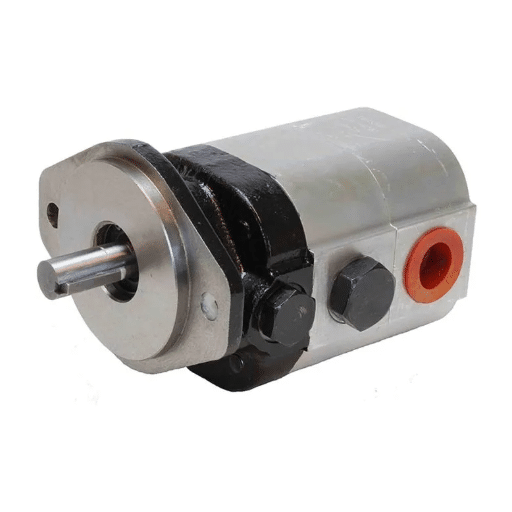
A 2 stage hydraulic pump diagram becomes truly useful when you can match the labels to a part number. The table below uses data from the Concentric AB high/low pump catalog.
| Nominal Flow | Part Number Example | High-Pressure Displacement | Low-Pressure Displacement | Max Pressure | Unloader Setting | Shaft | Inlet | Outlet |
|---|---|---|---|---|---|---|---|---|
| 5 GPM | 1300483 | 0.065 in³/rev | 0.258 in³/rev | 3,000 PSI | 650 PSI (factory) | 1/2″ keyed | 1/2″ NPTF | 1/2″ NPTF |
| 7 GPM | 1300484 | 0.065 in³/rev | 0.388 in³/rev | 3,000 PSI | 650 PSI (factory) | 1/2″ keyed | 1/2″ NPTF | 1/2″ NPTF |
| 9 GPM | 1300485 | 0.194 in³/rev | 0.388 in³/rev | 3,000 PSI | 650 PSI (factory) | 1/2″ keyed | 1/2″ NPTF | 1/2″ NPTF |
| 11 GPM | 1300356 / 1300357 | 0.194 in³/rev | 0.517 in³/rev | 3,000 PSI | 650 PSI (factory) | 1/2″ keyed | 1/2″ NPTF | 1/2″ NPTF |
| 16 GPM | 1300487 | 0.258 in³/rev | 0.776 in³/rev | 3,000 PSI | 650 PSI (factory) | 1/2″ keyed | 1″ tube | 1/2″ NPTF |
| 22 GPM (D series) | 1300488 | 0.465 in³/rev | 0.930 in³/rev | 3,000 PSI | 650 PSI (factory) | 5/8″ keyed | 1″ NPTF | 3/4″ NPTF |
| 28 GPM (D series) | 1300489 | 0.465 in³/rev | 1.395 in³/rev | 3,000 PSI | 650 PSI (factory) | 5/8″ keyed | 1″ NPTF | 3/4″ NPTF |
All GC series pumps in this table have a 500-4,000 RPM speed range and an adjustable unloader range of 400-900 PSI. The displacement split is what changes the nominal flow: the low-pressure stage is roughly 2.5 to 3 times larger than the high-pressure stage.
Common Mistakes When Reading a 2 Stage Pump Diagram
Even experienced builders misread diagrams. Here are the most common errors.
Confusing the Unloader Valve with the Relief Valve
The unloader valve opens at ~650 PSI during normal operation. The relief valve opens at 3,000 PSI only to protect the system. If you adjust the relief valve hoping to change the transition pressure, you will overheat the pump.
Thinking Both Stages Run at Full Pressure Simultaneously
They do not. At high pressure, Stage 1 is unloaded into the tank. The diagram shows both gear sets turning, but only Stage 2 is delivering useful flow above the transition pressure.
Missing the Check Valve Function
On a 2 stage hydraulic pump diagram, the check valve may look like a minor detail. Without it, high-pressure oil from Stage 2 would backflow into the unloaded Stage 1. The pump would never build full pressure. If you are troubleshooting low pressure, inspect the check valve for debris or scoring.
Assuming Any Rotation Direction Works
Two-stage pumps are built for a fixed rotation. The diagram usually marks CW or CCW as viewed from the shaft end. Running the pump backward will damage the shaft seal and may cause immediate leakage.
Field Example: Why the Diagram Matters

Miguel, a maintenance technician at a Midwest equipment rental shop, had a log splitter that extended fast but bogged down the engine as soon as it touched the wood. The owner assumed the engine was too small. Miguel pulled the pump catalog and traced the 2 stage hydraulic pump diagram.
The unloader valve was stuck partially open because contaminated oil had scored the piston. Stage 1 never fully unloaded, so the engine was trying to drive both gear sets against high pressure. Miguel cleaned the valve, replaced the filter, and set the unloader back to 650 PSI. The splitter returned to normal operation without replacing the engine or the pump.
That is the practical value of a labeled diagram: it turns a guessing game into a targeted inspection.
FAQ
What does a 2 stage hydraulic pump diagram show?
A 2 stage hydraulic pump diagram shows the internal layout of a pump that contains two gear sets of different sizes, plus an unloader valve, check valve, and relief valve. It traces how oil flows at low pressure/high flow and at high pressure/low flow.
Where is the unloader valve on a 2 stage pump?
On most Concentric/Haldex and similar two-stage pumps, the unloader valve is located under a cap on the inlet side of the pump body. It is usually adjusted with a slotted screw or Allen key.
What is the transition pressure on a two-stage pump?
Factory transition pressure is commonly 650 PSI on GC series pumps, with an adjustable range of 400-900 PSI. The exact setting depends on the manufacturer and application.
Can a two-stage pump run as a hydraulic motor?
Generally no. Two-stage pumps are designed to pump in one direction with internal valving that does not work correctly when oil is driven backward through the unit. Using one as a motor can damage the check valve and unloader assembly.
Why does the diagram show two gear sets?
The two gear sets give the pump two performance curves. The large set provides speed when the load is light. The small set provides pressure when the load is heavy. The valves switch between them automatically.
What is the difference between a two-stage pump and a single-stage pump?
A single-stage pump has one gear set and delivers one flow/pressure curve. A two-stage pump switches between a large gear set for speed and a small gear set for pressure. For a detailed comparison, read our article on two stage hydraulic pump vs single stage.
Conclusion
A clear 2 stage hydraulic pump diagram is more than a technical illustration. It is a troubleshooting map. By identifying the housing, shaft, two gear sets, inlet/outlet ports, unloader valve, check valve, relief valve, and seals, you can trace exactly how the pump delivers fast approach speed and high-pressure power in the same compact unit.
Knowing how to read a 2 stage hydraulic pump diagram lets you diagnose problems faster and select the right replacement with confidence. The key transitions happen automatically around 650 PSI: the unloader valve opens, the check valve closes, and the pump shifts from combined flow to high-pressure-only flow. Match those components to the specifications in your service manual, and you can diagnose transition problems, select the right replacement, and build more reliable hydraulic systems.
Need help sourcing a two-stage pump or interpreting a 2 stage hydraulic pump diagram for your next build? Contact LOYAL INDUSTRIAL PTE. LTD. for technical specifications, OEM options, or a complete log splitter pump kit quote. For application-specific sizing, see our log splitter hydraulic pump selection guide.